fbpx
Home Blog Page 735

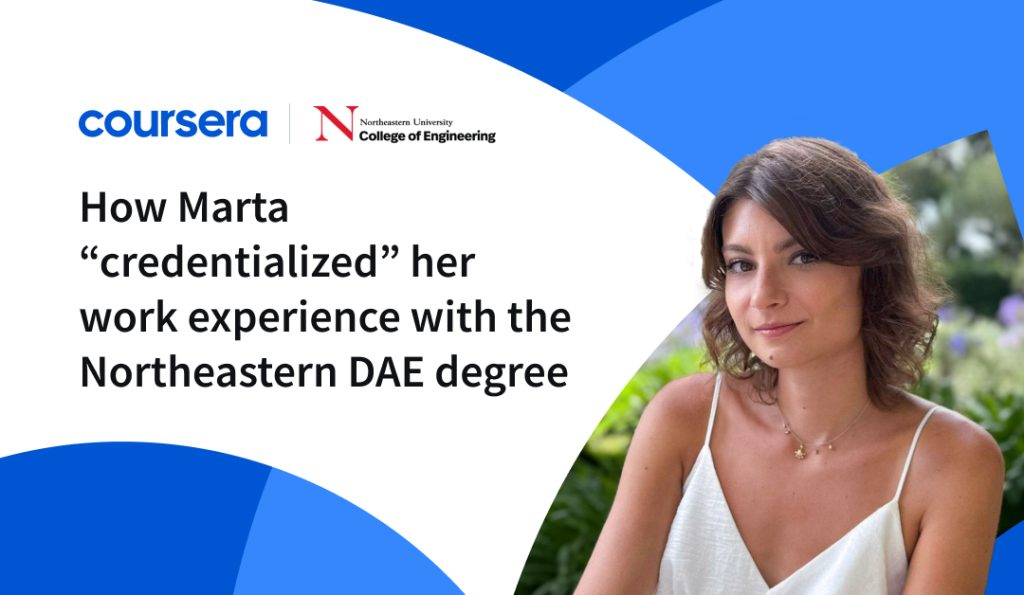
How Marta “credentialized” her work experience with the Northeastern DAE degree

0
How Marta “credentialized” her work experience with the Northeastern DAE degree

Learning the theory behind the application with the MS in Data Analytics Engineering

As a working analytics engineer with a bachelor of arts in behavioral psychology from the University of Maine, Marta found herself craving further education that would be relevant to her career path. After considering degree options like an MBA, she recognized the value of filling in the gaps in her theoretical knowledge with a more technical degree. Marta refers to this as “credentializing” what she already knew. 

A technical program with easy admissions and flexible learning

Having had prior success with free courses on Coursera, Marta looked into potential opportunities to earn her degree online. While her initial search was for business-focused degrees on the platform, she quickly took an interest in the Northeastern Master of Science in Data Analytics Engineering (DAE), given it’s more of a technical degree. She recalls, “The admissions process was super easy. It’s nice that you could pay as you go, too.” As a learner with a full-time job, Marta also recounts, “The flexibility that was presented was really enticing to start the program. Just the fact that there’s so many start times was really beneficial.”  Having vetted the degree, spoken with enrollment counselors, and noted friends and mentors who were proud Northeastern graduates, Marta ultimately made the decision to enroll.

Taking advantage of performance-based admissions as a lifelong learner

Enrolling in the DAE program was easy for Marta largely due to performance-based admissions. For learners with a STEM background, like Marta, this means skipping the formal application and jumping right into two introductory courses from the program. Upon receiving a B or better in both courses and providing proof of a bachelor’s degree, learners earn admission to the full DAE program. Initially a bit intimidated by this process, Marta advises other lifelong learners like herself, “Just try it! Worst case, if you don’t get into the program, I think it’s nice that you’re still learning something.” 

Self-paced technical learning and advice for non-technical students

Now one semester into the program with three to go, Marta is taking courses like Python and Data Visualization. The first coding assignment was an eye-opener, in which she could test her skills and receive immediate feedback from TAs. She found the flexible, self-paced learning environment immensely helpful and appreciated the consistent feedback throughout the semester, especially due to the rigorous coursework. Marta notes spending 25–30 hours per week when taking two courses at a time. Even non-technical learners can confidently jump in, make mistakes, and learn as they go. Like Marta says,  “Don’t worry about messing up your computer—everything is saved somewhere.” She also encourages non-technical learners to complete the weekly readings, dive into office hours, and lean into help that can be gained from fellow students. She believes these resources are a goldmine for gathering insights and building confidence.

Looking toward the future as a DAE graduate

Marta’s journey speaks to the power of pursuing a formal education to enrich self-taught skills and open new professional avenues. Her desire to take her prior knowledge and “credentialize it” is already growing her confidence, capabilities at work, and future career potential. For those contemplating a similar path, her story serves as an inspiring blueprint.

Conversations With Journalists: A Media Literacy Activity for Teens

0

This fall we’re choosing some teen-friendly Times articles and inviting students to talk to the people who made them. Post your thoughts, ask questions or suggest ideas, and the reporters will reply!

Forum 2 | How Often Do You Have Meaningful Conversations With People Who Don’t Share Your Views?

0

More and more of us are living in bubbles with like-minded individuals. What have your experiences in having conversations across divides been?

Smiley Faces

0

What do you think this image is communicating?

Word of the Day: consternation

0

This word has appeared in 149 articles on NYTimes.com in the past year. Can you use it in a sentence?

What Is Your Reaction to the First Harris-Trump Debate?

0

On Tuesday night, the candidates met for their only scheduled debate. Did you watch?

Sleep Routine

0

What do you do to get ready for a good night’s rest?

Word of the Day: volatile

0

This word has appeared in 684 articles on NYTimes.com in the past year. Can you use it in a sentence?

The 2024 Presidential Debate: A Place for Student Reactions

0

On Tuesday night, the candidates will meet for their only scheduled debate. Will you be watching?

Ready for a tech career? How to choose between IT and cloud support

0
Ready for a tech career? How to choose between IT and cloud support

You may have seen the news that Microsoft launched three new Professional Certificates on Coursera, with a fourth that’s also open for pre-enrollment.

Let’s take a closer look at the relationship between IT support and cloud support.

As noted, these two roles are closely related, and if you’re interested in a technical career, you may engage with both of these roles at some point throughout your career journey.

IT support is the broader starting point. IT support specialists maintain and improve the computer systems that organizations rely on for everyday business operations. They also help users securely install software and troubleshoot technical issues. People who start their careers as IT specialists may end up advancing into cybersecurity, network administration, system administration, software development, software engineering, web development, or even cloud computing roles.

Cloud support is a more niche, rapidly evolving industry. Cloud computing allows organizations to store data and access computational resources via the internet rather than local hardware or installed software. Since this architecture doesn’t require organizations to maintain their own servers or data centers, it can cut costs and increase efficiency. Starting out as a cloud support associate is one way to guide toward roles like cloud architect, cloud developer, or cloud engineer.

Choosing between IT support and cloud support

Knowing where you should get started often comes down to knowing where you want to end up.

If you have no experience working in a technical field and aren’t quite sure where you’d like to end up, IT support is a great first step. Working in IT will introduce you to a range of career paths, which you can choose to pursue when you’re ready to advance. Cloud support primarily differs from IT support because it focuses on troubleshooting, maintaining, and optimizing cloud services. In a cloud support role, you’ll likely specialize in vendor-specific platforms such as Microsoft Azure or Amazon Web Services (AWS).

If you know you eventually want to advance into a cloud computing role, cloud support may be a better choice for you. Entry-level cloud computing jobs tend to require background knowledge and hands-on experience working in IT or a similar field, so starting out as a cloud support associate can be a productive entry-point into those more advanced specialties.

Where to begin

Essentially, if you have any uncertainty regarding where you’d like to end up, start with the Microsoft IT Support Specialist Professional Certificate. Later, if you decide to enroll in the Microsoft Cloud Support Associate Professional Certificate, the aligned IT Support Specialist courses you already completed will count toward your progress—or perhaps you’ll decide to take a different route, like cybersecurity, data science, or data engineering.

No matter which you choose, you can feel confident that you’re working toward an in-demand career. According to the US Bureau of Labor Statistics, computer and information technology occupations in general are expected to grow much faster than the average for all occupations from 2022 through 2032, and as of May 2023, the median annual wage for these roles was $104,420—much higher than the median across all occupations, $48,060.

Learn more about IT career paths and cloud computing, and feel free to drop any lingering questions in the comments below!