fbpx
Home Blog Page 893

How I Went from Quality Assurance Intern to DEI Program Manager

0
How I Went from Quality Assurance Intern to DEI Program Manager

Learning to code so that you can land a job in tech can feel daunting. That’s why we’re sharing inspiring stories from Codecademy’s community — to show how people like you (yes, you!) can embark on a learning journey and end up with a totally new career. We hope these stories serve as a reminder that there’s no single path to a more fulfilling work life.

Today’s story is from Neiko Lampkin, a 28-year-old DEI Program Manager at the cybersecurity company Expel, living in Alexandria, Virginia. Read more stories from Codecademy learners here — and be sure to share your story here.

Why I chose to learn to code

“Back in January of 2018 I enrolled in a year-long workforce development program called Year Up. The way that the program works, you study for the first six months and then the six months following they partner you with one of their corporate sponsors for a six-month internship. Prior to Year Up, I had done a lot of retail and food service jobs.

I had never heard of the company Expel before, but I was brought on to be a Quality Assurance Intern, so I was testing our workbench platform and building out an automated test suite. I got there on the first day and I realized, I’m not exactly sure how to do my job here. Over the course of a month, I started to understand how the business operates, but still didn’t have those technical skills needed to effectively perform my position at that time.

Learn something new for free

With full transparency, I went to my manager and shared with her that I was experiencing a little bit of impostor syndrome and that I felt like the skills gap between what I needed to effectively perform my job and what I brought to the internship just wasn’t there. She encouraged me to look into coding boot camps and online platforms that offered coding skills workshops. I came across Codecademy, and I started taking some of the courses. That was really the first time that programming began to stick with me.”

How I made time to learn

“They allotted me time during the internship to study Codecademy and go through the courses. I also spent a little bit of time outside of the internship working on it because I was eager to learn. Because the internship was only six months, I wanted to learn it as soon as I could, that way I could transition from being an intern who’s still learning the skills to being an intern performing the skills.”

How I saved up money to switch careers

“My manager saw the progress I made over a few weeks, and shortly after, I shared that I was interested in the Codecademy Pro paths, which are more costly. I told her, ‘I’m committed to being here, I want to convert this internship into a full-time position. If there’s a way that we can deduct the cost of the intensive* from the stipend that I was being paid through the workforce development program, I’d be willing to do that.’ We were able to work out a plan to make that happen.”

Did you know you can ask your company to pay for you to take our courses?

Here’s how to approach your employer about paying for professional development. Be sure to browse all of our plans to find one that fits your goals.

How long it took me to land a job

“Six months later, once that internship was over, they decided to bring me on full time as a Software Engineer in Test.”

How I got in the door

“Codecademy was really one of the first programs that helped me retain the concepts that I struggled with learning. It was also one of the tools that was instrumental in me being able to convert that internship into a full-time position.”

I wish I knew that I didn’t have to compare myself to anyone else and that everyone’s journey is different.

Neiko Lampkin

DEI Program Manager at Expel

How I nailed the interview

“I think there were just certain intangibles that they saw in me and appreciated. One was having that learner spirit, constantly wanting to learn, investing in learning, and really being committed to understanding how to do the role. If I’m being completely honest, they probably could have hired someone with more technical skills than I had at that time. A lot of the soft skills that I brought to the job were some of the things that made them feel very confident in my ability to continue to learn, perform, and grow within the role. I also had a desire to build relationships with a lot of people there and make the company better.”

How I evaluated the offer

“What really made me not even have to second guess the offer was just their culture and commitment to taking care of their customers and their employees. It’s something that I think is shown through the way leadership handles running our organization; they’re very transparent.

[Expel] has been instrumental in helping me develop psychological safety, because I was entirely new to this space. When I got to Expel, it seemed like everyone knew way more than I did. Being able to admit mistakes or failures and learn from those things has created a culture where, if I do fail, I can feel comfortable having a conversation about it.”

How I switched from engineering to DEI work

“There were a few experiences that solidified the way I want to grow my career. Going through Year Up, I was able to develop strong connections and relationships with people who came from many different backgrounds and lived experiences who faced so many challenges in obtaining career opportunities. That was something that I wanted to change.

Another experience was when I attended the conference AfroTech back in 2019, the first year that I was working at Expel. I remember being in the expo room where they had all of these companies who were recruiting at AfroTech, and they had their Black ERGs present and all of these things. It was a very welcoming experience for me, and it was the first time I felt sense of belonging in this space. Leaving the conference, it was clear to me that this was something that I wanted to cultivate moving forward.

I did software engineering for about a year and a half, and I really enjoyed the challenges that came with being a software tester. It enabled me to collaborate with multiple teams and really get to know the product. I realized after doing some reflecting that I was just a lot more passionate about solving people problems, specifically focused on diversity, equity, and inclusion work.

My manager was fully supportive of me shifting careers, so she went to the leadership team to figure out how they could build out a role or support that interest in any way possible. Now I’m the Equity, Inclusion, and Diversity Program Manager at Expel. While I’m no longer doing programming, it was a doorway into limitless opportunities.”

What I wish I knew before I started learning

“I wish I knew it was okay to not know everything. I put a lot of internal pressure on myself to know everything and I created unnecessary anxiety for myself. I felt like even though I was an intern, I had to compete with some of the Junior Engineers that I worked with who went the traditional four-year degree route. I wish I knew that I didn’t have to compare myself to anyone else and that everyone’s journey is different. Just take it a day at a time and focus on learning and getting better.”

Not sure where to start? Check out our personality quiz! We’ll help you find the best programming language to learn based on your strengths and interests.

Want to share your Codecademy learner story? Drop us a line here. And don’t forget to join the discussions in our community.

You applied and you’re waiting to hear back. What now?

0
You applied and you’re waiting to hear back. What now?

After finishing up our resume series and before we dive into our next, let’s take a pause and talk about one of the more difficult periods of the job search: the in-between.

The in-between is the collection of passive moments after you’ve done what you can do and the only thing left is to wait and maintain faith that eventually someone will see the potential in you that you know is there. There’s only so much you can control; the in-between is not one of them.

The in-between can be a space of discomfort. The longer it lasts, the more feelings of defeat may start creeping in. You’re never alone here. And you may even see updates from others in your network, sharing their own experience of the too-long search, along with a collection of supportive and empathetic comments from digital passersby.

But while it’s nice to feel less alone, it’s never really enough, is it?

During these times of transition, when uncertainty begins to settle in, there are ways to reignite your drive. Here are some ideas for empowering yourself when you’re feeling stuck in the in-between.

Make something fun.

Eventually, you are going to get a job. But right now, in the in-between, you have this unexpected open space to use your skills in whatever way you want to use them. So choose fun! Remind yourself why you pursued these skills in the first place, and how good it can feel to use them when the stakes are low.

Here are some examples:

  • Interested in social media marketing? Share your gardening hobby with the world on TikTok.
  • Aspiring data analyst? Create a spreadsheet to track your TV habit.
  • Going into web development? Build a website dedicated to the joys of the color yellow.

To come up with your own idea, all you need to do is combine your skill with something else you like. It doesn’t have to be profound; it just has to feel good.

Plus, if you like the thing you make for fun, you can incorporate it into your resume or portfolio. This can be a nice way to demonstrate workplace skills like creativity and innovation alongside your sought-after technical skills.

Learn something completely different.

Once you have a solid resume and adaptable cover letter template, the job application process can feel tedious. Pull yourself out of the monotony by activating a different part of your brain. Learn something new.

There are chemical benefits to learning—if you haven’t taken Learning How to Learn yet, this is a good course to start understanding what’s happening in your brain when you learn. (And it’s free.) But more importantly, those brain benefits can activate mood benefits.

Learning feels good. It’s a confidence builder and it’s a way to gain a new perspective on the world around you. When you learn something new in one subject, you’ll likely start making new connections in completely different areas.

Restore your brain with a wildcard course. There are plenty of hidden gems on Coursera. Here are some recommendations:

Set boundaries.

Looking for a new job can feel like a full-time job in itself. The difference is, when you’re job searching, there aren’t always clear milestones suggesting that you take a step back and focus on something else. There are always more job sites to check out, more applications to send, and more people to network with. There’s also more life to live outside of your job search.

The tenets of maintaining a healthful work-life balance hold true even when your work is to find work, and setting boundaries to guide your job search is one way you can invite more balance into your daily routine.

Your boundaries can be anything that feel right for you. Perhaps you want to send a certain number of job applications per day, schedule one networking meeting every week, or stop checking your email after 7 p.m. every day. You may experience some trial and error as you figure out your boundaries, but it tends to be worth the effort.

This feels like a good time to mention The Science of Well-Being from Yale University. Another popular free course, this one explores happiness and how to achieve it from a psychological standpoint.

That’s all for this week. If you’re struggling with the in-between, we’re rooting for you. If you have tips for staying positive, please share them in the comments. Next week, we’re going to start our series on high-income skills and explore how you can incorporate them into your professional toolkit. See you then.

Free October 2023 Wallpaper & Instagram quote

0
Free October 2023 Wallpaper & Instagram quote

Free October 2023 Wallpaper & Instagram quote

Free October 2023 wallpaper is here!

With October here, it’s the perfect time to add some spookiness to your screen. So for this month’s free wallpaper, I’ve got just the thing for you – a navy mystical theme that’s perfect for the season. It’s not too over the top with skulls, pumpkins, and bats, so it’s a great choice if you want something a bit more subtle.

Each wallpaper download from October 2023 includes the following:

  • Desktop wallpaper x3 (plain, with the calendar, and with a quote)
  • Phone wallpaper x3 (plain, with the calendar and with a quote)
  • Tablet wallpaper
  • Instagram ready quote

October's wallpaper phone preview

Quote for October 2023

Going after what you want and achieving your dreams is an important part of finding happiness and success. It means taking risks, staying determined, and never giving up on what you’re passionate about. Yes, overcoming obstacles that come your way can be hard, but the payoff is priceless. Remember that your dreams are totally within your grasp, and with some hard work and perseverance, you can make them come true. So don’t wait any longer – go out there and chase your dreams until you catch them!

Follow Your Dreams and Make it Happen - October's Quote

Follow Your Dreams and Make it Happen

P.S the square image is also included as a larger file in the download package below! Feel free to post it on your Instagram.


October Wallpaper preview on various devices

Looking for more? Check our previous wallpapers!

You can get three different desktop options with the free download – one that has a calendar, one without the calendar, and another with a quote. Additionally, there’s a wallpaper available for tablets, and three phone options too. You’ll also find an Instagram-ready square that features the weekly quote.

Free October 2023 Wallpaper & Instagram quote in mystical navy-gold theme

FOR PERSONAL USE ONLY.

NOTE: This wallpaper is available as a free download through October 31, 2023 only. After that, a $5 download fee applies.


Looking for more?

Browse all wallpapers from this series.


How about a new design?

Since you just got a new wallpaper, consider updating your blog’s appearance with a fresh and modern look too! There are many different blog templates available that can make your page more enjoyable to read and navigate. Take some time to browse through them and see what catches your eye.

Blogger templates

WordPress Themes


Your voice matters!

If you have your favorite quotes and would like them to appear on the next free wallpaper, make sure to post them in the comments below or send us your ideas via email.

Enjoy!

What Misconceptions Do People Have About Where You Live?

0
What Misconceptions Do People Have About Where You Live?

When you tell people where you’re from, how do they react? Do you think their view of the place is accurate? Or do they have it all wrong?

In “‘Are You OK?’ San Francisco Residents Say They Most Certainly Are.” Heather Knight writes about the California city’s foundering public image, and what the people who live there say it’s really like:

Soon after Karan Mathur arrived in Brooklyn for a new job last year, New Yorkers couldn’t wait to congratulate him for fleeing San Francisco.

He heard over and over about the abandoned downtown in his former city. The shuttered Nordstrom store that once anchored the retail core, but now symbolizes its decay. The people who stumble along the city’s sidewalks in a drug-fueled haze. The rampant car break-ins leaving puddles of shattered glass.

But that’s only part of San Francisco’s story, Mr. Mathur has been quick to respond. While the city faces disarray in parts of its grim core, he said he’s tried to offer a more complete picture beyond the crime footage that has gone viral on social media and the despair that has been highlighted in regular news reports.

“It’s like going to New York and spending your entire time in Times Square, and your takeaway is, every New Yorker is dressed like Cookie Monster,” Mr. Mathur said. He tells his neighbors that San Francisco as a whole remains stunning and its amenities world-class.

The article continues:

Like any city, San Francisco is a complicated place with many story lines. It has a property-crime epidemic, but low rates of violent crime. It has a homelessness crisis and is pleading with a federal court for more leeway to clear tent encampments, but according to the most recent homeless count, there was a 15 percent drop in the homeless population living on its sidewalks between 2019 and 2022. Its downtown recovery has been glacial, but its unemployment rate is low at 3.6 percent.

The city has a record-high 31 percent office vacancy rate, and some prominent retail departures have drawn attention. But optimists say they hope these trends will open up space in the city for artists, nonprofit groups and possibly colleges.

There is no way to positively spin the drug crisis; 84 people died of overdoses in August, putting the city on track to tally 845 drug deaths this year, the most on record.

But there are hopeful signs. Several new parks have opened in the city in recent years, including Tunnel Tops, where families flock on sunny weekends to picnic, stroll and take in views of the bay. The city has closed a couple of scenic thoroughfares to cars, most notably John F. Kennedy Drive in Golden Gate Park, where people can now bike, roller skate or play a weathered grand piano.

While downtown struggles, previously sleepy neighborhoods are thriving. Thousands of people packed Irving Street in the Sunset District this month for the inaugural Sunset Night Market, eating Asian delicacies and watching ballerinas dance in the road.

Students, read the entire article and then tell us:

  • How would you characterize the reputation of the place where you live? In other words, what do outsiders think it is like? How much of that perception is accurate, in your opinion?

  • What are some of the misconceptions people have about your town or city? If they were to share those with you, what would you say to correct them?

  • The article’s reporter writes, “Like any city, San Francisco is a complicated place with many story lines.” What are some of the “many story lines,” the good and the bad, of the place where you live?

  • The article includes an anecdote about a resident of one of San Francisco’s hardest-hit neighborhoods giving a walking tour aimed at providing a more “nuanced picture” of the place. Where would you take visitors to help them see what your hometown is really like, beyond the stereotype they may know, and why?

  • Do you like where you live? What are your favorite things about it? What ideas do you have for improving it?


Students 13 and older in the United States and Britain, and 16 and older elsewhere, are invited to comment. All comments are moderated by the Learning Network staff, but please keep in mind that once your comment is accepted, it will be made public and may appear in print.

Find more Student Opinion questions here. Teachers, check out this guide to learn how you can incorporate these prompts into your classroom.

Police Robot

0
Police Robot

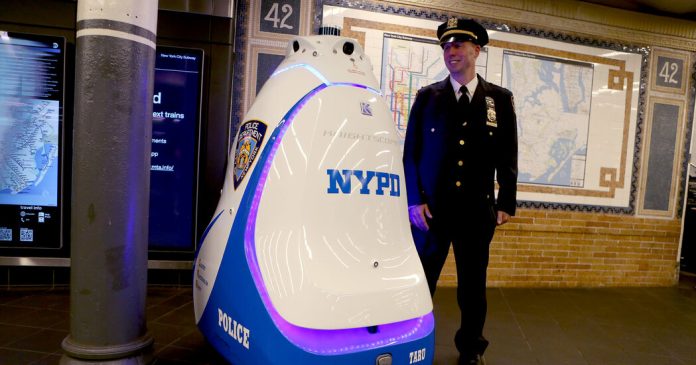
It’s a bird. It’s a plane. No, it’s a crime-fighting robot!

The “fully autonomous” security robot, weighing almost 400 pounds and standing roughly 5-foot-3, is part of a push by the mayor of New York City for more law-enforcement technology.

The Times reported on Sept. 22:

Its official name is K5, and its California-based maker, Knightscope, describes it as a “fully autonomous outdoor security robot.” It is currently used in hospitals, malls, airports, warehouses and casinos, and will soon be deployed in the Times Square subway station, the city’s busiest underground transit hub.

The robot, armed with four cameras, will record video but not audio. It will not employ facial recognition and — at a moment when the mayor is calling for vital city agencies to slash 5 percent of their budgets — the cost of leasing it averages out to about $9 per hour.

Some have taken a dismissive view, describing the new crime-fighting robot as a “trash can on wheels.” Others have likened it to an oversized version of R2-D2, the droid from the “Star Wars” films. And privacy rights advocates are skeptical, fearing that the latest in surveillance technology will lead to civil rights violations.

What do you think? Would you like a police robot like K5 where you live? Why or why not? Do you think it would improve public safety? Or, present more problems than it might solve?

Tell us in the comments, then read the related article to learn more about K5 and what it means for the future of crime fighting.


Students 13 and older in the United States and Britain, and 16 and older elsewhere, are invited to comment. All comments are moderated by the Learning Network staff, but please keep in mind that once your comment is accepted, it will be made public and may appear in print.

Find more Picture Prompts here.

Word of the Day: curt

0
Word of the Day: curt

The word curt has appeared in 53 articles on NYTimes.com in the past year, including on Sept. 19 in “Brooke Shields Dishes Trump and Madonna in a New Cabaret Show” by Jacob Bernstein:

“Most of the time, I’m halfway content.”

Those words are Bob Dylan’s, and they were delivered one night last week by Brooke Shields during her sold-out debut show at the Café Carlyle, the intimate Manhattan supper club where Bobby Short, Elaine Stritch and Debbie Harry have performed.

… She also recounted being mean girl-ed by some of the world’s best-known women. When she met Bette Davis at the Oscars, she said, “Hi, I’m Brooke Shields,” to which the star replied, “Yes, you are.” A similar encounter occurred when Ben Stiller brought her to Madonna’s house, Ms. Shields said. The greeting she received from Madonna was curt: “Oh, you.”

Can you correctly use the word curt in a sentence?

Based on the definition and example provided, write a sentence using today’s Word of the Day and share it as a comment on this article. It is most important that your sentence makes sense and demonstrates that you understand the word’s definition, but we also encourage you to be creative and have fun.

Then, read some of the other sentences students have submitted and use the “Recommend” button to vote for two original sentences that stand out to you.

If you want a better idea of how curt can be used in a sentence, read these usage examples on Vocabulary.com.


Students ages 13 and older in the United States and the United Kingdom, and 16 and older elsewhere, can comment. All comments are moderated by the Learning Network staff.

The Word of the Day is provided by Vocabulary.com. Learn more and see usage examples across a range of subjects in the Vocabulary.com Dictionary. See every Word of the Day in this column.

Use These AWS-related Interview Questions (& Answers) to Prep for Your Technical Interview 

0
Use These AWS-related Interview Questions (& Answers) to Prep for Your Technical Interview 

Amazon Web Services (AWS) is gaining traction as one of the first complete cloud-based computing platforms on the market today. As it becomes more popular, the need for AWS Developers will also increase.  

If you’re in the running for one of these positions, you can expect to be asked several AWS-focused questions during your interview. Practicing ahead of time with some common questions can help boost your confidence so you can put your best foot forward.  

You can also set up a mock interview to help you practice. Rehearsing with other people can help you identify any areas you might need to work on before your interview. (You can also do your mock interview on Zoom if you’ll be interviewing virtually.) If you’d rather practice on your own, you can use Zoom to record yourself and then play the recording back to see how you did. 

To help you start preparing, here are 15 AWS-related interview questions, plus tips on how to answer them.

l

1. Why should an organization migrate to the AWS Cloud? 

The time and effort it takes to migrate to the cloud can be significant, but hosting an application in the AWS cloud can help the whole workforce become more productive. Before migrating, the organization needs to assess the security of their current data storage solution and whether virtualizing information is the best solution to meet its specific needs. For most organizations, moving data to a secure cloud computing platform reduces expenses and keeps data secure from cyber attacks. 

2. What are the key components of AWS? 

Some of the critical components that make up AWS include: 

  • Route53: a DNS and networking service. 
  • Simple Email Service (SES): a hosted email service 
  • Identity and Access Management (IAM): security management 
  • Simple Storage Service (S3): storage management 
  • Elastic Compute Cloud (EC2): computing resources 
  • Elastic Block Store (EBS): persistent storage 
  • CloudWatch: security and monitoring 

3. What’s an AMI, and what does it do? 

An Amazon Machine Image (AMI) is a template that consists of the information needed to launch an instance, which includes an application server, applications, and the operating system used. With this information, a copy of the AMI is created within the cloud’s virtual server. 

4. Which AWS services are available in any region? 

Amazon launches different AWS services to each region separately. There are some features that users in certain regions cannot access, but the services available regardless of region include Identity and Access Management (IAM), Route 53, Web Application Firewall, and CloudFront. 

Note: Amazon may release new services to all regions at any time, so be sure to check for any updates to the list before your interview. 

5. What are the search features in the Amazon cloud called? 

Amazon CloudSearch provides cloud-based search features. Several types of searches are offered, including Boolean-based searches, pre-fix, and full-text searches. Amazon CloudSearch also includes autocompleting for searches to help the user quickly find the information they need. 

6. What is Snowball, and how does it work? 

AWS Snowball allows for easy movement of data to the edge of the computing cloud and beyond. Snowball transfers large volumes of data to the cloud at once, minimizing networking expenses and the time and effort needed to transfer data packets. 

Using Snowball, a terabyte of data can move to the cloud in as little as a week. This makes it ideal for organizations with a high volume of data to move, such as healthcare providers and medical insurers. 

7. What load balancers exist in AWS? 

AWS has three built-in load balancers — classic, network, and application. 

  • Classic works on applications built on the Elastic Compute Cloud (EC2) network. 
  • The network load balancer offers a static IP and powers extreme performance. 
  • Application is used to balance newly designed applications through flexible management. 

8. What services does Amazon CloudWatch monitor? 

CloudWatch allows you to monitor key data points from the performance stack, including logs, metrics, application performance, and events. These points are displayed on an easy-to-read dashboard to make it easy to detect issues with website performance. 

9. What’s AWS Lambda, and what does it do? 

AWS Lambda allows code to run without the need to provision or manage the server. Lambda not only runs code for applications or back-end services, but it also manages computing resources like the operating system and servers. 

10. What options exist for virtualization in the AWS cloud? 

AWS users have three options for virtualization through the platform: 

11. How can you use AWS to prevent DDoS attacks? 

AWS includes multiple built-in tools to prevent DDoS attacks, including: 

  • Shield 
  • Cloudfront 
  • Route 53 

12. What are the advantages of auto-scaling? 

Auto-scaling helps allocate resources properly by automatically provisioning and launching new instances as needed without any human intervention. This typically leads to a reduction in expenses for the business. 

13. What are users, user groups, and roles in AWS? 

Users refer to the root user and IAM user accounts that govern who can access which information, with the root user having the most authority. User groups refer to several IAM users that are given specific permissions. This is great for organizations with large personnel. 

Roles are given specific permissions as well, but they aren’t tied to a person. A user can switch to a role for access rights to a service if needed. 

14. How many buckets can each AWS account accommodate? 

Amazon S3 stores data in buckets, and each account in AWS can create 100 buckets before reaching its default limit. 

Get more interview prep 

These questions give you a great starting point as you prepare for your AWS-related job interview. But if you’re looking for more ways to prep, check out our complete guide to acing the technical interview, tips for answering behavioral interview questions, and our advice for the whiteboard interview. We also have a guide for interviewing on Zoom if you’re doing a virtual interview. 

For more, check out our Career Center, which features more resources for your interview, along with resume, cover letter, networking, and portfolio advice. 

If you’re looking for a class or skill path to sign up for, you can check out our catalog.

The TCP Three-Way Handshake Explained  

0

The Transmission Control Protocol/Internet Protocol (TCP/IP) is the most widely used internet connectivity protocol for enabling communication of data between computers across a computer network.  

TCP/IP, paired with Hypertext Transfer Protocol (HTTP), has revolutionized the way we do everyday things, allowing for information to be passed nearly instantaneously around the world. The internet as we know it (mostly in web browsers) is possible via the network connection created by something called the TCP three-way handshake. We go over how it all works in-depth in our free course Introduction to IT, but here’s an overview of the basics (which you’ll need to know if you want to get into web development).

Learn something new for free

Layers of TCP/IP 

The TCP/IP model is a four-layer protocol stack supporting computer networking and connections. It is an internet protocol that standardizes how data is processed, transmitted, and received.  
 
The model is divided into the following layers, each performing specific duties: 

  • Application layer: Interacts with software applications, allocates resources, and synchronizes communication.   
  • Transport layer: Transports data from the source to the receiver (and back, if necessary) and ensures the correct sequence of transmissions. 
  • Internet layer: Routes data packets between the different addresses on a computer network. 
  • Network Access layer: Explains how data should be transmitted throughout the network. 

The Transport layer is an interface for network applications that allows for error checking, flow control, and verification of communications. Data from an application program interface (at the Application layer) passes to the Transport layer and then to the Transmission Control Protocol (TCP). The protocol creates the connection between a client and server via the three-way handshake. 

  • A client is a computer requesting services from another computer on a network.  
  • A server is a computer offering services to other computers on a network. 

TCP Segments 

The Transmission Control Protocol (TCP) is a reliable connection-oriented protocol. A connection-oriented protocol begins, maintains/monitors, and ends a connection between two computers. 

TCP processes data via Stream-oriented Processing, which means that it accepts a byte of data at a time and formats it into segments. A segment is a data package encapsulating the entire Application layer message. If the data message arrives out of order, TCP can resequence the data to restore to the original order. 

A TCP connection is full-duplex, meaning data can flow independently in each direction (from client to server). The sending machine records status information to ensure delivery. Every data package sent across the network receives an acknowledgment from the receiving computer. A data segment is formatted into 13 distinct parts, as illustrated below.  
 

Source Port (16-bit) Port number of the application on the sending machine 
Destination Port (16-bit) Port number of the application on the receiving machine 
Sequence Number (32-bit) The byte number of the first byte of data in the TCP packet sent 
Acknowledgment Number (32-bit)  Acknowledges a received segment – the value +1 of the number the receiving computer expects to receive.  
Data Offset (4-bit) Tells receiving machine where the data begins 
Reserved (6-bit) Reserved for future development  
Control flags (1-bit each)  URG Urgent pointer field  ACK Acknowledgment  PSH Push all data to the receiving application  RST Reset connection  SYN Synchronization request (used to open a connection) FIN A sending computer has no more data to transmit (used to close connection)  
Window (16-bit)  The range of sequence numbers beyond the last acknowledged sequence number that the sending machine can transmit without further acknowledgment. (control flow) 
Checksum (16-bit) Checks for corruption in the datagram 
Urgent Pointer (16-bit) Urgent information point in sequence number  
Options Optional settings  
Padding Ensures 32-bit boundary 
Data Additional data being transmitted with the segment 

What is a TCP three-way handshake?  

A TCP connection is a graceful connection-oriented protocol to establish, maintain/monitor, and terminate network connections reliably between two computers. It’s accomplished by a sequence/acknowledgment system where the client and server synchronize their sequence numbers. A network connection is made between client and server in three steps (a.k.a. handshakes).  

Establishing a connection  

Step 1 

The client sends a segment to the server that includes: 

  • A SYN number to open the connection. 
  • An ACK number with information acknowledging a connection. 
  • The client’s ISN (initial sequence number).  

The SYN is a synchronization request, and the ACK states the current value of the acknowledgment sequence. If a connection is being made for the first time, then ACK starts at 0.  

Step 2  

The server receives the client’s segment. In response, the server acknowledges the client’s ISN by sending back an ACK with 1 added to its value. Additionally, a SYN request is sent from the server, along with its own ISN, back to the client. 

Step 3 

The client receives the server’s request for synchronization and responds with a segment that contains an ACK to acknowledge receipt of the server’s ISN, and the connection is established.  

Connection 

Once the TCP three-way handshake is made, the data segment is then passed to the Internet layer. At this layer, IP provides logical-addressing info, encloses data into a datagram, and provides routing to support delivery across the interconnected network. Finally, at the Network Access layer, which provides an interface, a datagram is received and formatted into a frame. The frame is then converted into a bitstream that is transmitted over the network.    

Terminating a connection 

Step 1 

The client sends a segment containing a FIN value set to 1. The client application then enters fin-wait state, which allows it to continue to receive and process segments in the queue. However, no additional data is transmitted.  

Step 2 

Then, the server sends ACK back to the client, which acknowledges receipt of the FIN, and sends any remaining segments.  

Step 3 

The server notifies the local application that a FIN segment has been received and then transmits FIN to the client, signaling the connection’s close. 

Step 4 

Once received, the client sends ACK to the server, acknowledging receipt of FIN, and gracefully closing the connection. 

In the context of the Web, the “clients” are web browsers that connect to web servers and present data in a predetermined format. The web server communicates using HTTP. After a TCP connection is made, the browser uses HTTP commands to request a web page URL, which ultimately results in what we see on the screen made with HTML/CSS and JavaScript.  

Want to learn more about how the web works? Check out our web development and IT courses for more info.

Word of the Day: a cappella

0
Word of the Day: a cappella

The term a cappella has appeared in 56 articles on NYTimes.com in the past year, including on March 30 in “The Indie-Rock Trio boygenius Returns, Confident and Connected” by Jon Pareles:

The new album is (to borrow the title of a Paul Simon compilation) a collection of negotiations and love songs. Its 12 tracks cherish relationships but constantly interrogate them: romances, friendships, family ties and musical bonds. Baker, Bridgers and Dacus take turns singing lead vocals and join in harmonies, savoring and then subsuming their differences.

“The Record” begins the way the “boygenius” EP ended: a cappella, just three voices sharing major chords like a family singing a hymn. The song, “Without You Without Them,” is a request coupled with a promise, and it could describe their musical alliance as well as a prospective liaison: “Give me everything you’ve got/I’ll take what I can get.”

Can you correctly use the word a cappella in a sentence?

Based on the definition and example provided, write a sentence using today’s Word of the Day and share it as a comment on this article. It is most important that your sentence makes sense and demonstrates that you understand the word’s definition, but we also encourage you to be creative and have fun.

Then, read some of the other sentences students have submitted and use the “Recommend” button to vote for two original sentences that stand out to you.

If you want a better idea of how a cappella can be used in a sentence, read these usage examples on Vocabulary.com.


Students ages 13 and older in the United States and the United Kingdom, and 16 and older elsewhere, can comment. All comments are moderated by the Learning Network staff.

The Word of the Day is provided by Vocabulary.com. Learn more and see usage examples across a range of subjects in the Vocabulary.com Dictionary. See every Word of the Day in this column.

What’s Going On in This Picture? | Oct. 2, 2023

0
What’s Going On in This Picture? | Oct. 2, 2023

1. After looking closely at the image above (or at the full-size image), think about these three questions:

2. Next, join the conversation by clicking on the comment button and posting in the box that opens on the right. (Students 13 and older are invited to comment, although teachers of younger students are welcome to post what their students have to say.)

3. After you have posted, try reading back to see what others have said, then respond to someone else by posting another comment. Use the “Reply” button or the @ symbol to address that student directly.

Each Monday, our collaborator, Visual Thinking Strategies, will facilitate a discussion from 9 a.m. to 2 p.m. Eastern time by paraphrasing comments and linking to responses to help students’ understanding go deeper. You might use their responses as models for your own.

4. On Thursday afternoons, we will reveal at the bottom of this post more information about the photo. How does reading the caption and learning its back story help you see the image differently?

We’ll post more information here on Thursday afternoon. Stay tuned!


More?

• See all images in this series or slide shows of 40 of our favorite images — or 40 more.

• Learn more about this feature in this video, and discover how and why other teachers are using it in their classrooms in our on-demand webinar.

• Find out how teachers can be trained in the Visual Thinking Strategies facilitation method.

Students 13 and older in the United States and the Britain, and 16 and older elsewhere, are invited to comment. All comments are moderated by the Learning Network staff, but please keep in mind that once your comment is accepted, it will be made public.