Atlantic International University (AIU) proudly announces the integration of Dall-E as its latest addition to the university’s virtual campus. This integration marks an important milestone in AIU’s commitment to harnessing Artificial Intelligence (AI) to empower students to tailor their academic programs through the innovative “Curriculum Builder” tool.
Building upon the success of the initial integration of ChatGPT, AIU continues to spearhead the transformation of education by incorporating cutting-edge AI technologies into its virtual campus. Dall-E, one of the world’s leading AI tools developed by OpenAI, brings the unprecedented potential to highlight the latest innovations and trends, enabling students to shape their educational journeys with the utmost precision.
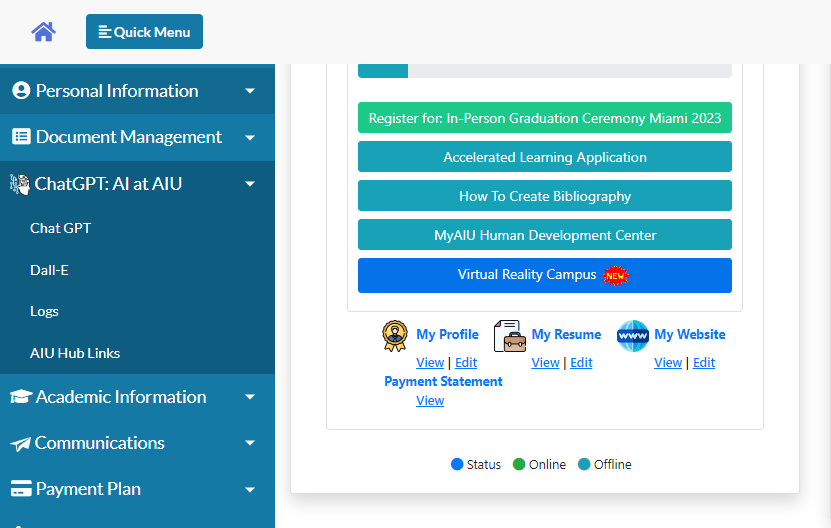
Students can find the AI tools integrated into the student section
Artificial Intelligence has emerged as a transformative force, reshaping various industries, and education is no exception. AIU recognizes the importance of embracing these advancements to enhance the learning experience and equip students with the skills needed to excel in the evolving landscape of work. As ChatGPT and Dall-E seamlessly integrate into the Virtual Campus and the Curriculum Builder tool, AIU remains at the forefront of educational institutions embracing AI’s potential to revolutionize learning.
The integration of Dall-E within the Curriculum Builder tool empowers students to tailor their academic programs to match the dynamic demands of the future. By leveraging Dall-E’s image generation capabilities, students can explore and incorporate the latest innovations and trends into their curriculum design, ensuring their programs remain relevant and cutting-edge.
Jose Mercado Atri, Chairman of the Board affirmed “At AIU we firmly believe that the integration of AI technologies like ChatGPT and Dall-E within our virtual campus and curriculum design is a pivotal step in shaping the future of education. We’re dedicated to providing our students with the tools and resources they need to thrive in an ever-changing world. With Dall-E, students can now curate their academic paths with a deep understanding of current and emerging trends, ultimately preparing them for the opportunities and challenges of tomorrow”.
The integration of AI tools not only enhances the academic experience but also allows students to develop critical skills necessary for success in the AI-driven era. By engaging with AI-powered technologies, students gain proficiency in utilizing AI as a tool for creativity, problem-solving, and data-driven decision-making—essential skills in a rapidly evolving job market.
With the integration of Dall-E and ChatGPT, AIU continues to solidify its position as a trailblazer in AI-driven education. Through these strategic integrations, AIU empowers its students to unlock their full potential, equipping them with the knowledge and expertise needed to thrive in a world shaped by AI.
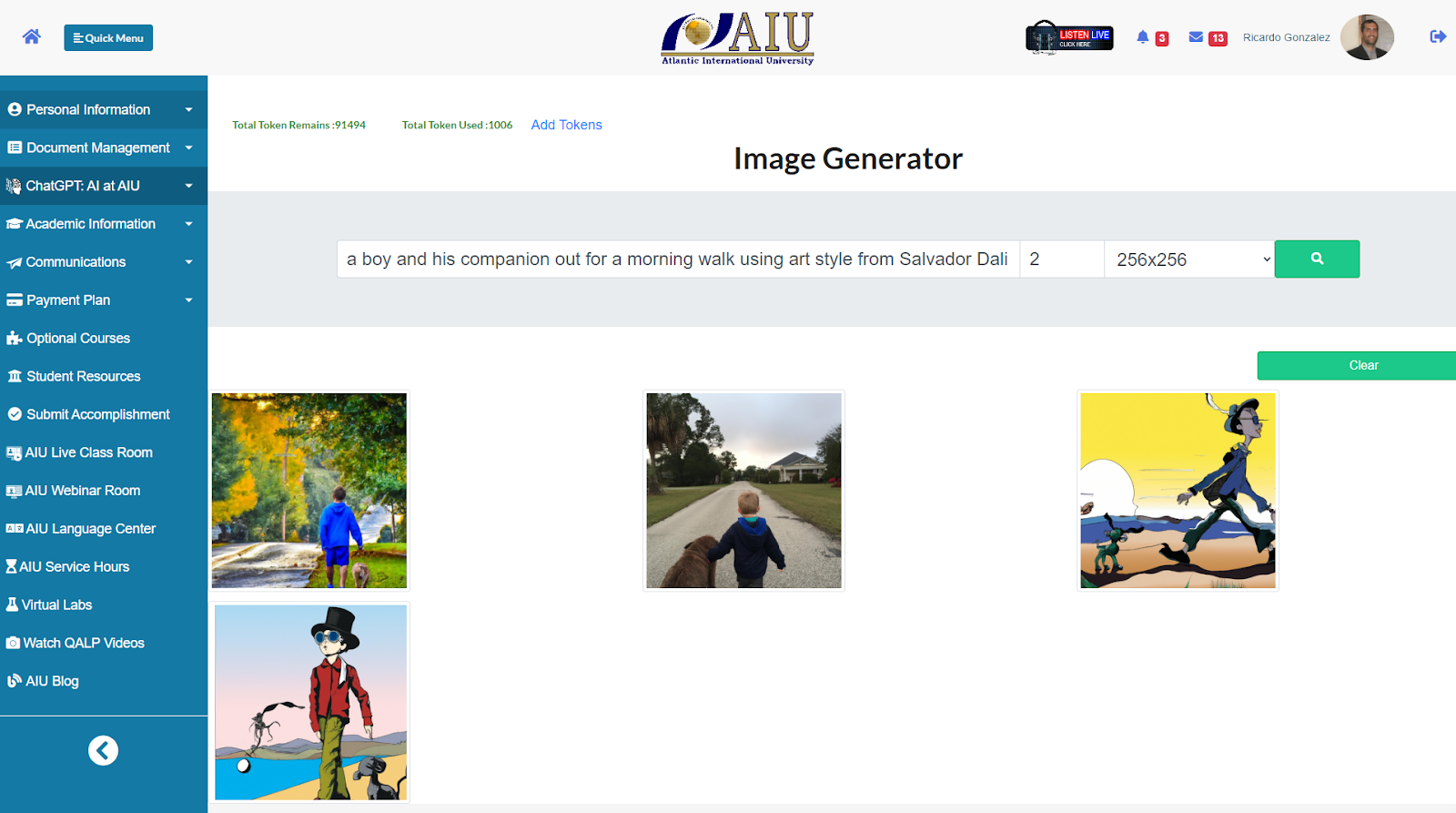
In order to illustrate how Dall-E works. The possibilities are infinite!
Example of Text to image:
Prompt 1: A boy and his companion are out for a morning walk.
As a result, see the first 2 images/photos of the boy and his dog.
Now we added a specific artist style:
Prompt 2: A boy and his companion out for a morning walk using the art style of Salvador Dalí.
The result, see 3rd and 4th images integrating Salvador Dalí artistic style
Please share with us, your creations and how they can make your work/life easier.
Author : Vanessa D”angelo Degree : Major : Marketing Country : Spain Language : English
Mr. Lineker will return to hosting the BBC’s flagship soccer program, “Match of the Day,” on Saturday, having been taken off for a Twitter post in which he likened the British government’s language on immigration policy to that used by 1930s Germany. His suspension caused a staff mutiny that plunged the BBC into chaos and Britons’ televisions into eerie silence as the broadcaster aired his show without commentary.
… The BBC could find itself in another hot seat the next time one of its stars posts something that raises hackles — and Mr. Lineker is not the only opinionated figure on the BBC. Alan Sugar, a British businessman who hosts a BBC version of the American reality TV show “The Apprentice,” has tweeted against a former Labour leader, Jeremy Corbyn, whom Mr. Lineker has also criticized.
Daily Word Challenge
Can you correctly use the word hackles in a sentence?
Based on the definition and example provided, write a sentence using today’s Word of the Day and share it as a comment on this article. It is most important that your sentence makes sense and demonstrates that you understand the word’s definition, but we also encourage you to be creative and have fun.
Then, read some of the other sentences students have submitted and use the “Recommend” button to vote for two original sentences that stand out to you.
If you want a better idea of how hackles can be used in a sentence, read these usage examples on Vocabulary.com.
Students ages 13 and older in the United States and the United Kingdom, and 16 and older elsewhere, can comment. All comments are moderated by the Learning Network staff.
Whether you’re packing for an epic vacation or prepping for your first engineering sprint, nothing sparks motivation like a solid plan. Having a concrete path toward a clear end goal helps you maintain a sense of momentum and achievement, and it can help make loftier goals feel easier to accomplish.
This is true for your coding goals, too. Stephanie Chiu, a Senior Software Engineer at Paypal and founder of Road to Tech, has helped tons of new and self-taught developers break into the field. For many people, especially career switchers or folks from nontraditional educational backgrounds, the hardest part is figuring out what to do next. “I find that many people just need a little guidance or advice,” she says. “They know they want to become a software engineer, they might take a couple of courses, but they don’t know how to actually get there.”
Big goals can be daunting, and not having a plan can leave you feeling paralyzed. But breaking larger milestones into smaller objectives can help you feel more capable and motivated, which usually leads to quicker progress, Stephanie says.
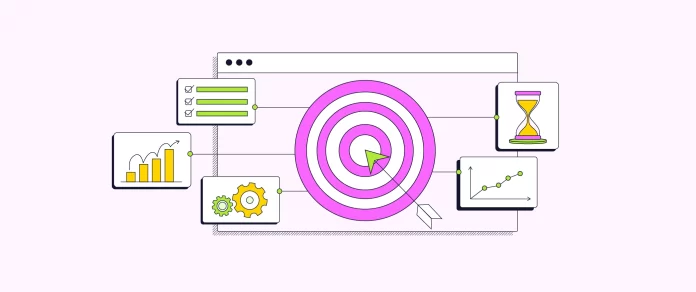
One tried-and-true method you should consider when it comes to your own coding goals is the SMART goals framework — a planning method that helps clarify the path to your end goal, minimize indecisiveness, and keep you on track. “SMART” in SMART goals stands for Specific, Measurable, Achievable, Relevant, and Time-Bound. The words that make up that acronym provide a framework to keep in mind as you flesh out the plan toward your end goal.
We recently refreshed our catalog of programming courses, so they’re broken up into shorter, more specific modules. There are hundreds of free courses that will help you focus on exactly what you want to learn and achieve your SMART goals in a shorter amount of time. Ahead, we’ll go over how you can use the SMART goals framework to plan out your next steps and some common goals for new programmers.
Learn something new for free
What is a SMART goal?
Here’s what makes SMART goals so, well, smart.
Specific: Clearly define your goal so that it’s focused and detailed, rather than broad and vague.
What exactly are you looking to achieve? Is there a specific skill you want to learn, or are you looking for a particular job in web development or data science?
Measurable: Make sure there’s a metric or quantifiable criteria you can use to measure success towards your goal.
How will you track your weekly learning target? Which languages will you learn? What projects will you include in your portfolio to find a job?
Achievable: It’s awesome to challenge yourself, but you’ve got to make sure that your goal is realistic given your abilities or bandwidth.
What can you accomplish with your current capabilities and resources? What skills and resources do you need to get to where you want to be? Which do you have now, and how easily can you attain the rest?
Relevant: Goals should be meaningful and ladder up to larger objectives.
How does this tie into your other goals? What will your end goal allow you to do?
Time-Bound: Give yourself a deadline or timeframe when you want to achieve your goal to keep yourself accountable and focused.
How long will this take to complete? What can you do if you don’t meet your deadline?
How to set SMART goals
The first thing Stephanie does when taking on a new mentee is have them break down their goals using the guidelines above. “We break down the whole process into small bits, and from there, even smaller bits,” she says. “At the end, they know what to focus on for every day, week, and month.” And once your plan is set, all you need is a little discipline.
Your SMART goals should clearly align with your desired end goal. For example, say you wanted to get a job as a professional software developer by next year. That’s a big goal, but it’s definitely realistic — tons of learners land tech jobs in just a matter of months.
So where should you start? You might already have a few courses under your belt, or some experience contributing to open-source projects on GitHub. But let’s use the SMART framework to come up with an actionable plan.
SMART goals examples
Here’s what a SMART goals might look like for someone who wants to start applying to tech jobs (BTW, feel free to follow this plan yourself):
Specific: I will create a list of companies I want to work for and browse their job postings to get a sense of which tools and skills I should reflect in my application. I will use these skills to create several projects that I can include in my technical portfolio and resume.
Measurable & Achievable: I will complete two of Codecademy’s guided coding projects every month, and use code challenges to prepare for the technical interview process. I will also reach out to professional developers in Codecademy’s chapters or Discord for tips on how to further prepare and stand out as a great candidate.
Relevant: I need a technical resume and portfolio to get my foot in the door, and I want to do well on the technical interview to actually land a job. Talking to other developers will help me learn more about what to expect and might also lead to professional opportunities.
Time-Bound: I will complete four portfolio projects within two months and create my portfolio and resume by the third month. I will start applying to jobs by the fourth month, and I’ll concurrently take code challenges to prepare for the interview process.
Your goals will also likely evolve as you progress on your path. The cool thing about the SMART goals framework is that you can scale it to fit areas of your life — whether you’re trying to break into tech, build your own application, or develop skills that make you more productive at work.
Setting SMART goals is a great way to keep yourself focused and on task. And if things don’t go as planned or it takes longer than you wanted to achieve a goal, try to stay positive and take it in stride. “It’s natural to feel a little down, especially when you’re looking for a job and possibly dealing with rejections,” Stephanie says. “But I find that having a positive mindset and outlook on things and learning to work smarter, not just harder, is the key to achieving your goals.”
As mentioned, the authors used a mixed-method approach. One the one hand, they asked students during the pre- and post-assessment to indicate how many minutes they had spent using successive relearning or other learning strategies, when they had started studying for the exam, their confidence in recalling specific content from the course, etc. On the other hand, they had a few open questions allowing to better understand students’ motivation for using or not using taught learning strategies:
Pre-assessment: “Imagine that your course instructor knows about an extremely effective study strategy that dramatically boosts long-term retention and learning of the course material. What would your course instructor need to do to convince you to stop using your existing study strategies and instead use this new study strategy?”
Post-assessment: “If you used successive relearning to study for the last exam, please explain why you chose to do so; if this is the first time you have used it to study for an exam, please explain what convinced you to try it.”
Post-assessment: “If you did not use successive relearning to study for the last exam, please explain why you chose not to do so and what the instructor could have done to convince you to try it.”
As part of the in-class intervention, students learned about the research behind successive relearning and how the demonstration they worked on in the previous sessions was linked to that strategy. They were also told how they could apply the strategy (e.g., using flashcards, making study schedules) and were shown research on other – less effective – strategies.
This essay, by Megan Luong, age 17, from Notre Dame High School in San Jose, Calif., is one of the Top 11 winners of The Learning Network’s 10th Annual Student Editorial Contest, for which we received 12,592 entries.
We are publishing the work of all the winners and runners-up over the next week, and you can find them here as they post.
Expectations of “Perfect” English Are Elitist and Unrealistic
The aroma of my mother’s homemade phở fills the air. I eagerly greet my mom and welcome mealtime in a melodic blend of Vietnamese and English, “Ăn cơm yet?” This linguistic mélange feels like home, and in my immigrant-filled neighborhood, it’s just one of the many unique flavors that English adopts. From Chicano to Tagalog English styles, each storefront and bus stop resonates with symphonic variations in slang, cadences, and intonations.
In broader society, the notion of “perfect” standard English is placed on a pedestal and worshiped as the only acceptable form of English. This elitist expectation hides behind arbitrary grammar and pronunciation rules while demeaning language that does not conform — upholding white privilege and stifling minority communities from classrooms to courtrooms.
Research by an HR consultancy reveals that nonnative accents are perceived as less competent, less intelligent and less trustworthy in professional settings. My mother, despite years of experience in her job, has been denied equal respect and opportunities solely because of her accent. One time, a superior even blatantly called her English “uneducated.”
This bias extends to African American English and Chicano English dialects, which actually have nuanced and accurate tense systems beyond standard English’s three tenses. Double negatives (such as “ain’t got no money”) and omitted copulas (like “he smart”) are commonly denounced despite being grammatical structures found in languages worldwide.
Conforming to a speaking style can be a constant struggle for those with complex linguistic backgrounds. Linguistic assimilation alone cannot heal the pervasive problem of cultural subjugation that has fueled colonization and ethnic cleansing for centuries. Eighty percent of English is derived from 300-plus other languages, ranging from African American English slang to Sanskrit-originating “guru” and “yoga.” The “pure” English concept actively erases cultural contributions and reflects the colonizer mentality. It’s time for society to move beyond these narrow preconceptions.
Language is not static, but a living entity, evolving with the ebbs and flows of humanity. Linguist John McWhorter notes in The New York Times, “There are things that strike people as mistakes, where a linguist just sees the language moving along.” Linguists widely agree that prescriptive grammar rules do not define linguistic competence; one’s ability to effectively convey meaning does. And while writing errors and slips of the tongue occur, if a linguistic community understands the message, it serves its purpose as language.
In our increasingly interconnected world, diversity is more important than ever. Labeling someone’s English “imperfect” is elitist and unrealistic, undermining the value of linguistic diversity. Before judging others based on their English, or any language, pause and reflect: Is it unacceptable or just unfamiliar? Acknowledging systemic bias and embracing language’s natural diversity is the first step to an inclusive society where everyone’s voice is valued, regardless of how it differs from our own.
Online learning, e-learning, and virtual learning. Whatever you call it, there are modern approaches to learning that you can use to enhance your skill set in any area. In this article, we will delve into the principles of Agile learning, its benefits, and how it can be applied in various educational settings.
What is agile learning?
Agile learning is a modern educational approach that draws inspiration from the Agile software development methodology. It emphasizes flexibility, collaboration, and adaptability in the learning process.
Why is agile learning important?
Agile learning holds significant importance in the modern educational landscape due to the following reasons:
Adaptability: Agile learning equips learners with the skills to adapt and thrive in rapidly evolving environments, fostering resilience and preparedness for future challenges.
Lifelong learning: Agile learning promotes a culture of continuous learning, enabling individuals to stay curious, seek knowledge, and keep up with emerging trends and advancements.
Real-world relevance: Agile learning emphasizes the application of knowledge in practical contexts, bridging the gap between theory and practice.
Engagement: Agile learning promotes active engagement, motivation, and a sense of achievement through manageable tasks and incremental progress.
Customised learning paths: Agile learning allows learners to personalise their educational journey, focusing on areas of interest and progressing at their own pace.
Critical thinking: Agile learning nurtures critical thinking skills, stimulating creativity and the ability to propose innovative solutions.
Agile learning empowers learners to adapt, engage, collaborate, and think critically, preparing them for lifelong learning and success in a dynamic world.
What is the difference between agile learning and learning agility?
While both agile learning and learning agility involve adaptability and flexibility in the learning process, they have different meanings and applications. Here’s an overview of the key distinctions between agile learning and learning agility:
Agile Learning:Agile learning refers to an educational approach that draws inspiration from the Agile software development methodology. It emphasizes iterative and incremental learning, collaboration, flexibility, and continuous improvement. Agile learning is typically applied within specific learning environments, such as classrooms, online courses, or project-based learning settings. It focuses on breaking down learning goals into smaller, manageable tasks, fostering collaboration among learners, and adapting learning strategies based on feedback and reflection.
Learning Agility: Learning agility refers to an individual’s ability to quickly learn, adapt, and apply new knowledge and skills in different situations or contexts. It is a personal attribute or competency that encompasses cognitive, behavioural, and emotional aspects. Learning agility extends to various life experiences and work environments. Individuals with high learning agility are open to new ideas, embrace change, seek diverse learning opportunities, and readily adjust their approaches to tackle unfamiliar challenges.
Who is responsible for implementing agile learning in a business?
In a business setting, the successful implementation of agile learning requires collaboration among:
Leadership:set the vision and create a supportive environment that embraces agile learning principles. They can allocate resources, provide support, and encourage a culture of continuous learning.
Human Resources (HR):facilitate the implementation by aligning learning and development initiatives with agile methodologies and promoting the adoption of agile learning practices.
Learning and development teams: design and deliver agile learning programs, curate relevant resources, and provide training and guidance to employees.
Together, they create an environment that fosters continuous learning and empowers employees to embrace agile practices.
What do you need to start agile learning?
To start implementing agile learning, you need a few key elements.
Firstly, a clear understanding of agile learning principles and methodologies is essential. This includes knowledge of iterative and incremental learning, flexibility, collaboration, and continuous improvement.
You need a supportive learning environment that encourages active engagement, collaboration, and experimentation. This may involve creating spaces for teamwork, providing access to relevant resources and technology, and fostering a culture of open communication and feedback.
A willingness to embrace change and adapt your learning approaches based on feedback and reflection.
By combining these elements, you can begin implementing agile learning and reap its benefits in your educational journey.
What are the topics covered by the Agile learning process?
The Agile learning process covers various important topics that contribute to effective and dynamic learning. These topics include iterative and incremental learning, where concepts and skills are broken down into manageable chunks for focused development.
Collaboration and teamwork are emphasized, promoting effective communication, cooperation, and knowledge sharing among learners.
Adaptability and flexibility are central to agile learning, encouraging learners to embrace change, explore alternative approaches, and adjust strategies accordingly.
Reflective practices and continuous improvement are also integral, fostering self-awareness, goal setting, and the ability to learn from both successes and failures.
How to harness the power of agile learning effectively?
To harness the power of agile learning effectively, there are a few key strategies to consider.
Establish clear learning goals and break them down into smaller, achievable tasks or increments.
Foster a collaborative and supportive learning environment where learners can engage in discussions, share knowledge, and provide feedback to one another.
Embrace flexibility and adaptability by encouraging learners to explore different approaches, experiment with new ideas, and adjust strategies based on feedback and reflection.
Promote continuous improvement through regular self-assessment, goal setting, and reflection on learning outcomes.
Leverage technology and online resources to facilitate access to learning materials, promote interaction, and enable self-paced learning.
By employing these strategies, you can effectively harness the power of agile learning in your educational endeavours.
What are the benefits of LMS for agile learning?
Learning Management Systems (LMS) offer several benefits for implementing agile learning. Some key advantages are:
Flexible content delivery: LMS platforms enable the delivery of diverse learning content, including text, multimedia, interactive modules, and assessments. This flexibility allows for a variety of learning experiences and accommodates different learning styles.
Progress tracking: LMS platforms offer features for tracking learner progress, including completion tracking, grading, and assessment feedback. This enables timely feedback on learning activities, ensuring learners stay on track and providing opportunities for iterative improvement.
Personalised learning paths: An LMS can support personalised learning paths by allowing learners to set goals, track their progress, and access content tailored to their individual needs.
Data analytics: LMS platforms often provide analytics and reporting features that offer insights into learner performance, engagement, and progress. These help instructors and learners make informed decisions, identify areas for improvement, and optimise the agile learning process.
Centralised learning environment: An LMS provides a centralised platform where learners can access learning materials, assignments, and resources. This streamlines the learning process and ensures the easy availability of content for agile learning.
Accessibility and flexibility: LMS platforms can support anytime, anywhere access to learning materials, enabling learners to engage in agile learning at their convenience. This flexibility accommodates different schedules and learning preferences.
Agile learning offers a dynamic and adaptable approach to education, empowering learners to actively participate in their own learning process. By embracing collaboration, flexibility, and continuous improvement, learners can develop the skills necessary to thrive in a rapidly changing world.
In “Where We Belong,” which opened at the Public Theater on Wednesday, the writer and performer Madeline Sayet tells the audience that she is named for Jeets Bodernasha (or Flying Bird), the last fluent speaker of Mohegan, a language once widely spoken by Indigenous people in the Northeast. Sayet considers the legacy of her name an immense responsibility: one that moves her to grapple not only with how words can be used to preserve her ancestry, but how they might also help others imagine a world where Indigenous people — who’ve been systemically displaced for centuries — actually belong.
… “I fly. I land,” Sayet repeats, an avian logic animating her transitions from one beat to the next. Under the direction of Mei Ann Teo, Sayet traverses a mini mountain range beneath a storm cloud of light, bare bulbs descending from a lucent swirl, in production design by Hao Bai that reflects the show’s resistance to linear momentum.
Daily Word Challenge
Can you correctly use the word lucent in a sentence?
Based on the definition and example provided, write a sentence using today’s Word of the Day and share it as a comment on this article. It is most important that your sentence makes sense and demonstrates that you understand the word’s definition, but we also encourage you to be creative and have fun.
Then, read some of the other sentences students have submitted and use the “Recommend” button to vote for two original sentences that stand out to you.
If you want a better idea of how lucent can be used in a sentence, read these usage examples on Vocabulary.com.
Students ages 13 and older in the United States and the United Kingdom, and 16 and older elsewhere, can comment. All comments are moderated by the Learning Network staff.
Everywhere I turn, trans rights are being restricted. I see further pushes against lifesaving care for me and thousands of others. I see constant demonization and ridicule. I see authors whom I admired and grew up on claiming that I am a predator, comparing me to Death Eaters to be locked up. To J.K. Rowling, I am part of a “powerful, insidious, misogynistic movement” because I identify as something other than what I was assigned at birth.
Because of people like her and politicians who hold immense power in U.S. legislatures, I am scared for my right to exist. When I add colleges to my list to apply to, I have to check whether the state that they are in allows for my existence. I would love to go to Rice or U.T., but I am scared that if I stay in Texas I will be denied the health care that I need because of people like Governor Greg Abbott.
According to the Equality Federation, in just the last year, more than 350 anti-trans bills have been introduced in state legislatures, 50 in Texas alone. The primary takeaway is that being trans is getting harder. When I was growing up, I hoped that transitioning would become easier. But instead, proposed bills would take us back to the early 2000s.
Historic activists who defied the traditional boundaries of gender, like Stormé DeLarverie and Marsha P. Johnson, did not fight, live and die so afraid yet so defiant for me, for us, to still live in fear, for our existences to be re-criminalized. They would want us to fight for our right to exist. We cannot sit here and let anti-trans bills become law across the country. A New York Times write-up discusses Nebraska Senator Megan Hunt, who “has been filibustering for weeks, trying to block a bill that would ban transition-related medical treatment for young people.” Like Hunt, we must take action to stop legislative proceedings that decimate trans rights and health care.
We cannot let ourselves and future generations of trans and gender nonconforming individuals continue to live in fear. We must resist and we must disrupt because being trans is not a choice; submitting to transphobia is.
This essay, by Kelley Kwok, age 16, from Staten Island Technical High School in New York, N.Y., is one of the Top 11 winners of The Learning Network’s 10th Annual Student Editorial Contest, for which we received 12,592 entries.
We are publishing the work of all the winners and runners-up over the next week, and you can find them here as they post.
“Not Real Chinese”: Why American Chinese Food Deserves Our Respect
I sit down, surrounded by gossiping aunties and cranky uncles, meeting the warm scent of the dishes on the glass turntable. My stomach growls, preparing itself to be filled. Yet I am left with a lingering guilt for eating this kind of food. American Chinese food. “Fake” Chinese food.
Dishes including chop suey, beef with broccoli, and General Tso’s chicken are considered American Chinese food, foreign to the traditional cooks in China. For this reason, many have been calling it “fake” or “inauthentic,” spreading attitudes of distaste and refusing to eat an Americanized version of their favorite cuisine.
But should this really be the case? The humble origins and admirable impacts of American Chinese food prove otherwise.
In the 19th century, the majority of the first wave of Chinese immigrants in America became laborers. Due to the discrimination that forced them out of their jobs, some turned to opening their own restaurants to make money and bypass immigration law restrictions.
Chinese immigrants were forced to adapt to their new environment, using only the limited and unfamiliar ingredients available to them. Dishes like chop suey were rumored to be first put together with leftovers. Beef, traditionally eaten in a dish with string beans, was cooked with broccoli instead. Through the cuisine, Chinese immigrants fed and comforted one another, giving each other a taste of the land they left. As the popularity of Chinese food spread, Chinese cooks found their niche in America and adapted their food to both Chinese and American tastes.
Despite the heat of anti-Chinese sentiment during the Cold War, American Chinese food quickly became a trend — and a key factor in changing discriminatory attitudes toward the Chinese. The cuisine provided Chinese American restaurant owners enough money to support themselves through an era of oppression, allowing them to send their children to college and benefit the future generation.
Today, there are more Chinese restaurants in the United States than McDonald’s, KFCs, Pizza Huts, Taco Bells, and Wendy’s combined. Many Chinese Americans, including myself, grew up with the food and consider it an integral part of their childhood.
That being said, it’s strange that the cuisine continues to be judged by its authenticity instead of its actual taste or legendary impacts. Can we devalue a cuisine just because it deviates from tradition? American Chinese food is still food created by Chinese people; at first for other Chinese immigrants, and then for everyone in America, to enjoy.
Because of its rich history and taste, American Chinese food deserves respect in our modern society. Instead of calling it “fake” or “not real Chinese food,” we can simply make the distinction between American Chinese and traditional Chinese. Both should be respected, none less valid than the other.
It took me, an absolute beginner programmer, just under 15 minutes to code my first program in Go completely from scratch, no AI involved. Impressed? I am! While it might not be the most sophisticated program, watching the code I typed into the terminal actually do something was (no exaggeration) extremely rewarding.
Some context: As Codecademy’s Content Marketing Manager, I often get to talk to people in our community who launched careers in tech after learning to code. It’s easy to get inspired listening to the stories about people who’ve gone from a total beginner to a pro in a matter of months — it’s harder to actually take initiative and get started.
I have rudimentary HTML/CSS experience (thanks, MySpace) and know a teeny bit of JavaScript, but like lots of people, I’m a busy person and I struggle to learn consistently. Making time to learn to code is tough, whether you’re at the start of your coding journey or trying to upskill in your current role. And with AI tools like ChatGPT making it easier than ever to quickly generate working code, now newbies can bypass the tedious parts of writing code syntax.
Learn something new for free
Plenty of people who work with code are already finding ways to incorporate generative AI and ChatGPT into their workflow. In the 2023 Stack Overflow Developer Survey, 82% of respondents who are learning to code said they’re using or planning to use AI in their development process. So we wanted to see for ourselves: Can a human with beginner coding knowledge quickly build a coding concept from scratch better than the large language model ChatGPT? Here’s what happened.
Selecting a course
We recently updated our course catalog, slicing long courses into shorter bite-sized chunks. Now, you can choose from hundreds of smaller free courses, making it easy to learn a language concept quickly. For someone like me, who’s easily intimidated by how long it takes to learn how to code, but is eager to explore coding further, these courses are a Goldilocks solution.
I decided to take the free beginner course Learn Go: Fundamentals. A learner recently told me that his favorite language is Go because it’s simple and concise, so it felt like a good option for me. Go was created by Google for in-house development, and the language is now used for everything from cybersecurity to web development. A delightful bonus: The project at the end of this course involves printing ASCII art of a gopher (Go’s mascot), which felt like a supercute way to combine my creative sensibilities with code.
The first few modules covered the basics of how to compile and run programs in Go, then it was time to complete the first project. The Gopher It project incorporates the use of fmt to make ASCII art.
Completing the project on my own
I set a timer on my watch and began working on the project. It took me a total of 14 minutes and 48 seconds to code the gopher, in part because I’m impatient. I wanted to skip over steps to get to the fun part faster, but in the process I missed important information that I eventually had to go back to.
It helped to use the hints within the tasks to remember specific syntax. When it came time to compile the program, I typed the command into the terminal, but it didn’t work. I got an error response: main.go:3:11: expected 'STRING', found newline. I went and watched the YouTube video walkthrough of this project and noticed where I went wrong; I forgot to put “” around fmt. When I added those and my gopher appeared, I was so excited that I fist pumped the air.
Prompting ChatGPT to do the project
Feeling like a genius, now it was time to see what ChatGPT could come up with given the same instructions. The prompt that I gave ChatGPT was: “Can you please incorporate the use of fmt in the programming language Go to make ASCII art in the shape of a gopher?” Here’s what the AI chatbot delivered in just seconds:
The gopher is very minimalist and takes a lot of artistic liberties. It looks more like a heart or a pear than a gopher, even when I printed it in the terminal. Though, in ChatGPT’s defense, the chatbot’s response included this note: “The ASCII art provided above is just a simple example. You can find more elaborate and detailed gopher ASCII art online or create your own.” Writing a clear and specific prompt is part of getting a relevant response from a chatbot. (You can learn how to write prompts in our free course Intro to ChatGPT.) Maybe the prompt needs more information to get it closer to what we want?
I changed the prompt, this time requesting, “Make the ASCII art of a gopher look more detailed, and use the programming language Go and incorporate fmt.” Here’s the code that ChatGPT generated the second time around:
And here’s what the ASCII image looks like when you run the program. The ASCII art is more detailed, certainly, but not at all gopher-like. Makes you wonder if ChatGPT knows what a gopher is and looks like?
Comparing my project and ChatGPT’s
Art is subjective, even ASCII art. When determining which ASCII gopher is “better,” there are the visual parameters to consider (does it look like a gopher?) as well as the syntax (is the code written in a way that the program will run?). While the code that ChatGPT created was syntactically correct and runs, the ASCII interpretation of the gopher is highly abstract.
An ASCII art gopher as coded by a human (left). ChatGPT’s interpretation of an ASCII gopher (right).
I could see using ChatGPT if I needed to quickly generate syntax for something, but as a learning tool or an artistic gizmo, it leaves a lot to be desired. This project has pretty low stakes, but imagine if you were tasked to write a program with real-life implications? Relying on ChatGPT to write your code opens the door for errors that can have serious impact. Without making mistakes in my code and figuring out how to correct them, I wouldn’t have picked up important coding habits (like double-checking that I included quotation marks) that I’ll need going forward. More importantly, realizing that I actually can write code has given me the motivation to keep learning Go.
In the past few months that ChatGPT has taken off, there’s been plenty of discourse about what this technology means for the future of coding and developers. The way folks write coding syntax might change and likely become more efficient. But at its core, programming is all about issuing commands in a way a computer can understand — and that’s a skill that’s going to remain relevant as AI takes off.
Developers today need to learn coding fundamentals and understand how and when to utilize these AI tools. (That’s one reason why we launched the free course Intro to ChatGPT, so learners like you can dive into the advanced AI chatbot.) This goofy little gopher project is proof that there’s more to coding than just copying and pasting syntax. In order to really think like a programmer, you might be better off typing your code one letter at a time. But if that still sounds intimidating or tedious, I’d encourage you to just gopher it.
Want to check out all of our free courses? Explore the recently-overhauled catalog to discover short, free, beginner-friendly courses like this.