fbpx
Home Blog Page 939

Should Teachers Provide Trigger Warnings for ‘Traumatic Content’?

0
Should Teachers Provide Trigger Warnings for ‘Traumatic Content’?

Last month, a Cornell University sophomore, Claire Ting, was studying with friends when one of them became visibly upset and was unable to continue her work.

For a Korean American literature class, the woman was reading “The Surrendered,” a novel by Chang-rae Lee about a Korean girl orphaned by the Korean War that includes a graphic rape scene. Ms. Ting’s friend had recently testified at a campus hearing against a student who she said sexually assaulted her, the woman said in an interview. Reading the passage so soon afterward left her feeling unmoored.

Ms. Ting, a member of Cornell’s undergraduate student assembly, believed her friend deserved a heads-up about the upsetting material. That day, she drafted a resolution urging instructors to provide warnings on the syllabus about “traumatic content” that might be discussed in class, including sexual assault, self-harm and transphobic violence.

The resolution was unanimously approved by the assembly late last month. Less than a week after it was submitted to the administration for approval, Martha E. Pollack, the university president, vetoed it.

“We cannot accept this resolution as the actions it recommends would infringe on our core commitment to academic freedom and freedom of inquiry, and are at odds with the goals of a Cornell education,” Ms. Pollack wrote in a letter with the university provost, Michael I. Kotlikoff.

To some, the conflict illustrates a stark divide in how different generations define free speech and how much value they place on its absolute protection, especially at a time of increased sensitivity toward mental health concerns.

  • Do trigger warnings have a place in schools? Should teachers and professors alert students to “traumatic content,” such as sexual assault, domestic violence, self-harm, suicide, child abuse, and racial hate crime? Why, or why not?

  • Have any of your teachers provided trigger warnings in advance of presenting sensitive material to you in class? If so, do you think it was beneficial or detrimental to students’ learning? If not, do you wish you had received such a warning?

  • Connor Strobel, a professor of social sciences at the University of Chicago, says, “When used correctly, trigger warnings can open up a conversation.” Have you found that to be true in your own experience? Are trigger warnings helpful in protecting the mental health and well-being of students? Which arguments in favor of trigger warnings discussed in the article do you find most persuasive?

  • However, Amna Khalid, a professor of history at Carleton College in Northfield, Minn., counters: “Life happens to you while you are driving, while you are walking, while you are in the supermarket. The most challenging moments in life rarely come with warning.” Do you agree? Do trigger warnings “infantilize” students and stifle free inquiry? Which arguments against trigger warnings did you find most convincing?

  • What is your reaction to the dispute at Cornell over a resolution to require faculty to alert students to upsetting educational materials? Do you agree with the administration’s decision to veto the proposal?

  • What do you think about the use of trigger or content warnings outside of school settings — such as for films or television shows like the Netflix series “13 Reasons Why”? When, if ever, do you think such warnings are appropriate?

  • Clichés

    0
    Clichés

    A cliché is a saying or expression that has been so overused that it has become boring and unoriginal. For example, “tip of the iceberg,” “have your cake and eat it too,” or “straw that broke the camel’s back.”

    Alone, or with a partner or small group, set a timer for five minutes, and challenge yourself to come up with as many clichés as you possibly can.

    Post them in the comments section, and then read a related Opinion piece to see how many of the ones you listed also appear on the author’s list.

    Finally, challenge yourself: Take one cliché that you personally overuse, and come up with an original way to say the same thing.


    Students 13 and older in the United States and Britain, and 16 and older elsewhere, are invited to comment. All comments are moderated by the Learning Network staff, but please keep in mind that once your comment is accepted, it will be made public and may appear in print.

    Find more Picture Prompts here.

    Word of the Day: filament

    0
    Word of the Day: filament

    The word filament has appeared in 11 articles on NYTimes.com in the past year, including on March 10 in “What is an atmospheric river?” by Raymond Zhong:

    Atmospheric river storms get their name from their long, narrow shape and the prodigious amount of water they carry.

    They form when winds over the Pacific draw a filament of moisture from the band of warm, moist air over the tropics and channel it toward the West Coast. When this ribbon of moisture hits the Sierra Nevada and other mountains, it is forced upward, cooling it and turning its water into immense quantities of rain and snow.

    Can you correctly use the word filament in a sentence?

    Based on the definition and example provided, write a sentence using today’s Word of the Day and share it as a comment on this article. It is most important that your sentence makes sense and demonstrates that you understand the word’s definition, but we also encourage you to be creative and have fun.

    Then, read some of the other sentences students have submitted and use the “Recommend” button to vote for two original sentences that stand out to you.

    If you want a better idea of how filament can be used in a sentence, read these usage examples on Vocabulary.com.


    Students ages 13 and older in the United States and the United Kingdom, and 16 and older elsewhere, can comment. All comments are moderated by the Learning Network staff.

    The Word of the Day is provided by Vocabulary.com. Learn more and see usage examples across a range of subjects in the Vocabulary.com Dictionary. See every Word of the Day in this column.

    Cool Job: I’m a Software Engineer at LinkedIn & Orchestral Cellist

    0
    Cool Job: I’m a Software Engineer at LinkedIn & Orchestral Cellist

    In many ways, a technical interview for a programming job can feel like an audition — your performance is being evaluated on the spot, it’s nerve-wracking, and there’s a potential job on the line. Though if you ask Zach Mansell, who was an orchestral cellist for a decade before learning to code, software interviews tend to be “much more forgiving,” he says. 

    There are lots of parallels between mastering a musical instrument and programming: both require discipline and mastery, for example. “In the software world, nothing is perfect,” Zach says. “But in music, it’s so competitive and the standard is so high that you have to be shooting for perfection.” 

    After a successful career as a professional musician, Zach was eager to test his talents in tech.  He eventually landed a job as a Software Engineer at LinkedIn, where he’s the front-end tech lead for an internal big-data processing team. Going from endless auditions to a stable software job was a welcome change, but not without its challenges. “Software engineering and tech in general can be very intimidating,” he says. “I have not gotten over impostor syndrome.”

    Nowadays, Zach has found new ways to incorporate music into his life as a programmer. “I listen to classical music all the time, and it’s a real pleasure to listen to great recordings,” he says. If you want to learn more about how Zach changed careers from cello to coding, we’re hosting a community event with Zach on May 24, where you’ll be able to ask him questions. Register for the virtual event here, and read on to learn more about Zach’s career path and what it’s like to work at LinkedIn. 

    What got me interested in the job

    “I’ve always been a technical person. As a kid, I remember begging my parents to help me buy a super old used HP laptop so that I could play video games on it. I was obsessed with solving problems on computers, but at the same time, I was really into playing cello. I started playing cello when I was 5, and was a full-time classical musician until I was in my 30s. 

    I worked professionally as an orchestral cellist for over 10 years. To be successful as a professional classical musician is extremely competitive. I’ve won major auditions and did well in the industry. While I love music, at one point, I realized that I needed to make a change for myself. 

    I was taking an audition for another symphony orchestra, and I was staying with a friend of mine who is an engineer. My friend asked, ‘If you win this audition, what’s the salary of the orchestra?’ I told him, and he said, ‘If you lived here and had a job as a software engineer, you would be making double that.’ The math just didn’t make sense to me, and I was fed up. That’s when I decided to really concentrate on software.” 

    How I got in the door

    “I didn’t think that I had a shot with computers and technology, because I didn’t go to school for it. I went to a boot camp and I worked as a Software Engineer and Instructor for active duty military service members who were learning to code. 

    Something that was extremely helpful for me getting this job at LinkedIn was going outside of my comfort zone and networking. To me, networking just means reaching out to someone, talking to them, setting up a call, and just getting to know them. If you can demonstrate that you’re serious about what you’re doing, and you ask good questions, you’ll eventually meet people who will be willing to give you an interview referral to their company. 

    I hunkered down for 6 months applying for jobs, practicing so-called ‘toy problems’ for technical interviews, and networking while working full time. I reached out to 50 people a day on LinkedIn and asked them: Where do you work? How much do you make? Do you like it? What do you recommend for someone in my position? I had calls all the time with people and was getting a ton of advice. By the end of the process, I had competing offers from LinkedIn, Google, and Square — all just by knowing someone.” 

    What I actually do every day

    “I work on internal tooling and offline data processing at LinkedIn. My particular team is flexible and lets me decide when to go into the office. I’m the tech lead on the project that I’m working on, so I have to figure out all the steps of our project, what needs to happen, and how long it’s going to take. One of the hardest parts about this job is the non-technical project management part. 

    My main language is JavaScript. I’m a full-stack engineer with a specialty in UI — so I do JavaScript/TypeScript on the front-end, but our back-ends are in Java. I also work on the API layer and have to debug API code.”

    Here’s what you need to get started

    If networking feels out of your comfort zone, Zach’s advice is to find someone whose career you admire or who has a similar background to yours, and ask them for a 15-minute phone call. Most of the time people will be more than happy to speak to you. “Talk to people, get their advice, get to know their story, and then you have all these data points and can form a plan for yourself,” he says. 

    Also, no matter what level you’re at, don’t be afraid to ask questions. “I try to ask clarifying questions, that way ​​you’re getting this information on the table for everybody else,” Zach says. “There’s so many things to keep track of in this field, and it’s so important to just always be on the same page.”

    Got questions for Zach about how he made this career switch? Be sure to attend our live Q&A community event on May 24. You can RSVP for the free event now — see you there!

    Coursera’s 2023 Learner Outcomes Report highlights the real-world impact of online learning 

    0
    Coursera’s 2023 Learner Outcomes Report highlights the real-world impact of online learning 

    By Marni Baker Stein, Chief Content Officer, Coursera 

    Coursera’s mission is rooted in serving the world through learning so everyone – regardless of location, socioeconomic status, or personal circumstance – has the power to unleash their full potential. This impact is most profound when learning on Coursera unlocks new job opportunities and career advancement. 

    To help measure the progress we’re making toward this goal, I’m pleased to introduce our most extensive Learner Outcomes Report ever, created in collaboration with Huron Consulting Group. The report gathers insights from more than 55,000 learners across over 190 countries to understand how Coursera helps learners reach their career and personal goals. The results highlight the transformative impact of online learning: 

    • 77% of learners (and 91% in developing economies) report career benefits, such as getting a new job, earning a promotion, gaining applicable career skills, and more. 
    • 95% of learners (and 99% in developing economies) report personal benefits, such as gaining more confidence, feeling more accomplished, and more. 
    • 30% of unemployed learners were employed after completing their most recent course or program on Coursera.
    • 1 in 4 Entry-Level Professional Certificate completers got a new job.

    In addition to results for learners worldwide, the report delves into the benefits of online education for learners in developing economies and specific countries with a high concentration of Coursera learners – such as India, the U.K., Mexico, and more. It also highlights the impact on low-income learners and first-generation college students in the U.S., uncovering the critical role high-quality online education plays in helping those who need it most.  

    As technology advancements like generative AI and demand for remote roles reshape the job market, online learning can empower learners with the skills needed to thrive in this rapidly changing environment. We’re encouraged by the stories of our learners and how our partners’ content is helping individuals around the world advance their careers and enrich their lives. But our work is far from over. Together with our world-class university and industry partners, we will work tirelessly to help anyone, anywhere create a brighter future for themselves and their communities.

    How to duplicate and edit WordPress blocks

    0
    How to duplicate and edit WordPress blocks

    The WordPress blocks feature has completely changed how I create website content. I love the flexibility it provides and how it allows me to add different types of content in a visually appealing way. Whether I’m adding images, videos, or text, the block feature makes it simple to create a layout that looks professional and engaging, and I no longer need to use code to style everything. In this post, I will show you some tips & tricks on how to duplicate and edit WordPress blocks to create amazing content.

    How to add WordPress Block

    There are various types of blocks, each offering different customizations option. Moreover, you extend your blocks library using plugins to get even more options and styles. In this post, I will focus only on default WordPress blocks, but if you want a more advanced guide with plugin recommendations, let me know in the comments.

    If you want basic information on adding blocks visit our guide on creating WordPress posts and pages.

    How to edit and customize WordPress Blocks

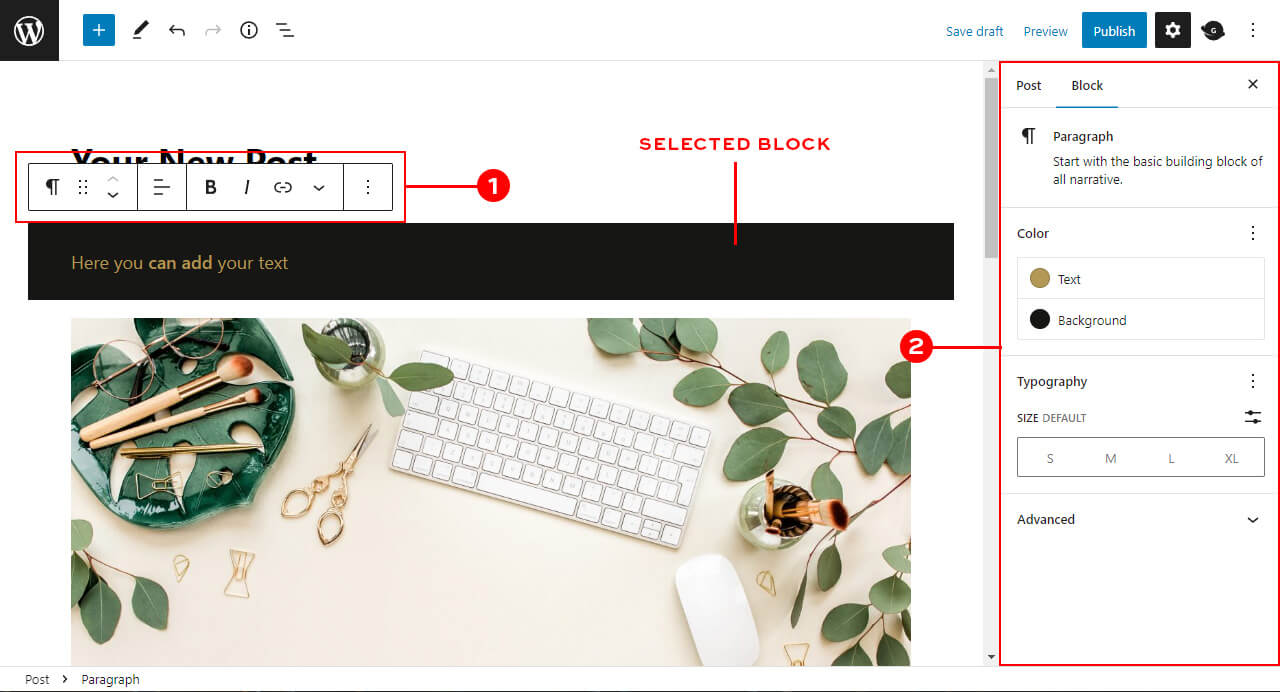
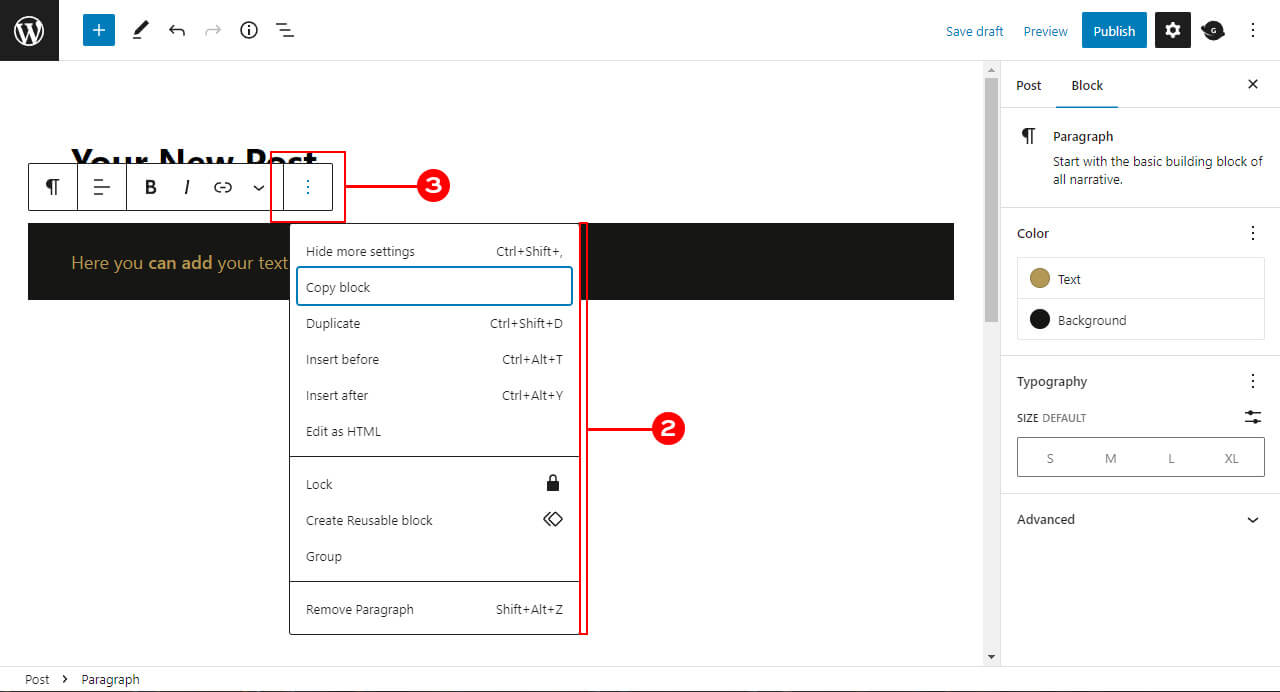
    Editing your blocks is actually very simple! Once you start creating your post or page, you can click on the block of your choice. I’m selecting a basic paragraph block with a black background on the screen below to show you all the space it covers. You can click anywhere on the black area to select such block.

    Immediately after selection, you will see a small option panel above the block (#1) and a larger, more advanced don’t on the right (#2). All customizable options for the selected block will be in one of those two panels.

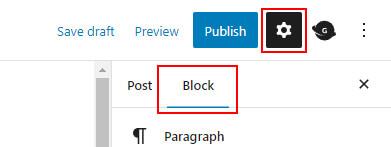
    If you don’t see the panel on the right, make sure it is turned on! The cogwheel icon in the top right corner must be selected. It is also worth checking if the right panel is switched to block view instead of post view.

    The common elements for all block types are an icon at the left of the panel above the block (#1), which shows the selected block type and movement icons. Those are represented by six dots and the top/bottom arrow.

    Important: Movement icons are visible only if you have more than 1 block!

    Use the six dots icon to drag and drop your block in to desired location or use the arrows to position it above or below other blocks.

    Additional options

    Don’t forget to click the three dots button on the very left end of the top edition panel. It includes very useful functions like adding a new block above or below the selected one!

    You can also use this panel to copy your block and paste it into a different post or page.

    How to duplicate WordPress Blocks

    The option to duplicate your blocks is very useful, especially if your design has a homepage with multiple post categories or if you are using a recipe index. It allows you to add a copy of an existing section and keep your design’s settings and styling.

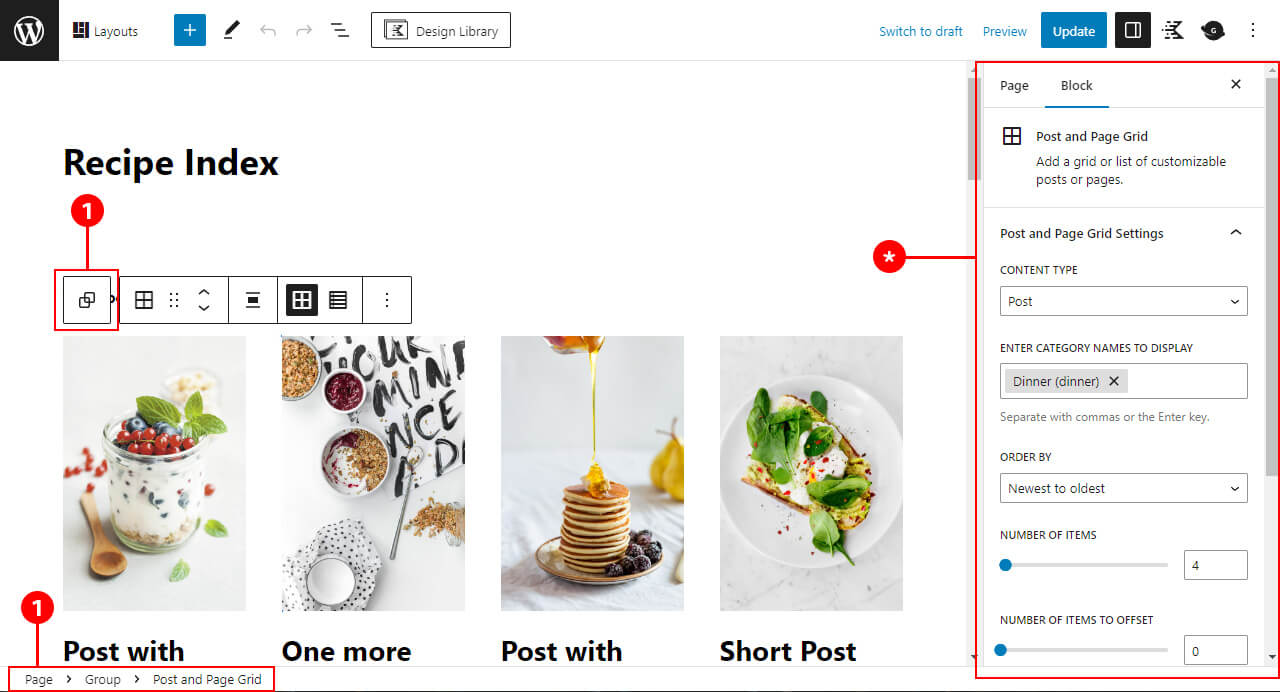
    As an example, I will be using Recipe Index from Daphne Theme.

    Before you start duplicating your block (in this case, the recipe row from the recipe index), make sure you are selecting the correct thing. In more advanced designs, blocks may be grouped to make it easier to duplicate them. In this example, Post Grid (row with 4 posts) is grouped with a title above it and a button below it. So if you want to copy it, the best option will be duplicating the whole group. You can access it by clicking the group icon on the very left of the small panel above block (#1) or by looking at the bottom of your browser (#1), where you will find a path to your current selection. Click on the word Group there and you will select the whole Group.

    It is worth mentioning that after selecting a Group, you will also see a change in the right panel. Previously it was showing Block settings where you could pick which category of posts is displayed. After selecting Group, there will be fewer options on the right.

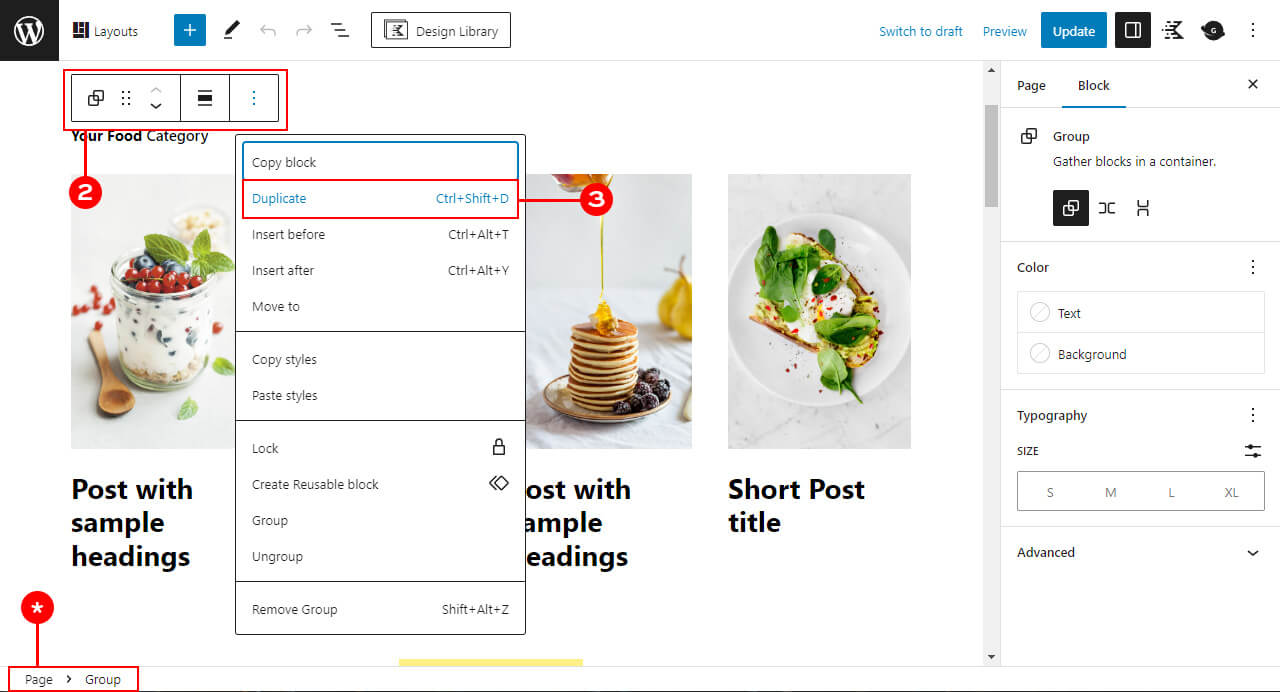
    With the group selected, navigate to the top block panel (#2) and click the tree dots button on the right to access more options. You will find there a Duplicate button. Click it, and the whole group will be duplicated.

    All you need to do now is play with the settings and content of your duplicated blocks to change text, links, and post categories (if you are editing the recipe index).

    With the ability to customize each block, you can truly make your content stand out. I highly recommend giving it a try if you’re looking to take your website to the next level. With an option to duplicate WordPress blocks, you can easily create pages with multiple post areas or galleries while keeping the same style for all of them.

    We use blocks for our WordPress themes to allow you to easily edit your homepage and move things around without needing to touch the design code.

    Browse our latest premade WordPress Themes.

    Still not sure how to work with blocks?

    Let us customize them for you. Contact us, and we will do our best to help!

    Has Forgiving Someone Ever Made You Feel Better?

    0
    Has Forgiving Someone Ever Made You Feel Better?

    Think back to a time when you felt wronged by someone. Did you forgive that person? Or are you still holding a grudge? Do you think you would feel better if you were able to let go of what happened? Why or why not?

    For someone who’s led a charmed life, my 8-year-old can hold a serious grudge. Out of the blue, he recently brought up “that bad pencil thing that happened.” It took me a while to divine that he was talking about the classmate who nabbed one of his writing utensils … nearly two years ago.

    I thought about my son’s inability to let go of The Great Pencil Incident of First Grade when I learned recently about new research that suggests forgiveness improves mental well-being — and offers a road map for getting there.

    In the study, which was presented last week at an interdisciplinary conference on forgiveness at Harvard and is currently under review for publication, researchers randomly assigned 4,598 participants from five countries into groups. One set received a forgiveness workbook with exercises they completed on their own. (An example: Write the story of a specific hurt you want to forgive. Then write it again as more of an observer, without emphasizing how bad the wrongdoer was or how you felt victimized. Look for at least three differences between the two versions.) Those in the control group waited for two weeks before receiving the workbook.

    When the two weeks were up, researchers found that those participants who’d completed the workbook felt more forgiving than those in the control group — and had reduced symptoms of anxiety and depression. These findings jibe with other studies on forgiveness, which have found it can be a boon to mental health, helping to do things like lower stress and improve sleep.

    “What forgiveness does is sort of free the victim from the offender,” said Tyler VanderWeele, the director of the Human Flourishing Program at Harvard and one of the co-authors of the study. “I would never say ‘Once you’ve forgiven, everything’s fine.’” But it is a better alternative to rumination or suppression, he said. And that is likely why it can improve overall mental well-being.

    As my son shows, it can be hard to forgive even minor transgressions — and I’m not dunking on him here. I could easily prattle off a list of perceived offenses I’ve been holding onto for years. But Dr. VanderWeele believes forgiveness is a skill that can be practiced.

  • Are you someone who tends to hold grudges? Or do you forgive easily? Why do you think you react how you do? Does the article convince you to give forgiveness a try — if for no reason other than improving your own mental well-being?

  • Has forgiving someone ever made you feel better, as the research here suggests? If so, tell us a story about a time when you forgave someone and the effect it had on you.

  • Tyler VanderWeele defines forgiveness as replacing “ill will toward the offender with good will.” But, he said, “Forgiveness is not forgetting the action or pretending it didn’t happen; it’s not excusing or condoning the action, and it’s not the same as reconciling or forgoing justice.” What do you think of this definition? What does true forgiveness look like to you?

  • Dr. VanderWeele shares several strategies for practicing forgiveness. Which, if any, would you try? How do you think those tips could help you?

  • “In a society like the one we’re living in, with increasing polarization and animosity, that disposition to forgive is potentially very much needed,” Dr. VanderWeele said. Do you agree? Do you think our society could use more people who are willing to forgive? What do you imagine our world might look like if that were the case?

  • Best Ways to Upskill on a Budget

    0
    Best Ways to Upskill on a Budget

    The constant thing about life is that it’s constantly changing. Jobs and the career landscape are no exception. Reskilling and upskilling is a necessary activity that helps individuals and organisations remain relevant in today’s competitive marketplace. This article will show you the best ways to upskill on a budget. Learning and developing new skills can propel career advancements and improve your performance. Upskilling is a worthwhile investment but not everyone knows what skills they need to develop, where to go to upskill, or the best ways to do so. 

    What is meant by upskilling?

    Upskilling is best described as the process of taking additional education and training to build on and grow your current skill set. It’s a growing trend in organisations and among individuals to go through training, and development opportunities to expand an employee’s workplace skills and help minimise skill shortages. A few examples of training can include attending workshops, and seminars, taking courses, or learning new skills for a different role.

    Why upskilling is important

    It’s no secret that the workplace is constantly changing. New technological advancements mean industries are developing at a rapid pace. These new developments also create skills gaps in the workforce if continuous learning is not prioritised.

    Hiring managers face increasing pressure to meet the demands of the changing trends by providing organisations with candidates that are skilled and up to the task to meet the demands. However, a 2020 report by the US Chamber Foundation found that 74% of hiring managers said that there is a lack of skilled employees entering the workforce in the last few years. Additionally, competencies are gaining traction in the preferred skills recruiters look for as opposed to degrees.

    Benefits of upskilling

    There are many advantages to upskilling and we’ll discuss a few of these below.

    •       Salary increases

    Upskilling puts you in a position to request a raise from your employer. you can showcase your newly developed and crafted skills to your employer and demonstrate the benefit these will bring to the company. Added to this, the new skills will allow you to take on more roles and duties and a salary increase will reflect your growth.

    After reskilling and upskilling, you can make a dream career change, apply for, and land a promotion, or change companies if necessary. You set yourself up for new opportunities and provide you leverage to your resume to take your career to the next level.

    •       Enhanced job satisfaction

    Oftentimes after years in one role doing the same thing, you can get bored and lose your passion and motivation. Acquiring new skills is a challenge, a learning opportunity, and it reignites your love for your job. When you learn new skills, you feel more productive, and satisfied, bolster your workplace morale, and inject some life into the monotony that can come with an 8-4.

    Best ways to upskill on a budget

    1.     Repurpose existing training programmes

    Companies can take advantage of existing training programmes they have used and repurpose them with updated content and answer some of the common questions or mistakes they see in the workplace. This can look like breaking down longer training into shorter weekly courses, converting material into infographics, and hosting webinars. lunch and learns for your team, or schedule podcast listening sessions.

    1.     Guided learning

    Training and upskilling employees cost money. But in some cases, the staff don’t know how to implement their learnings into their day-to-day activities. Companies can pair employees with supervisors who can answer questions, review what they’ve learned, and help them connect it to their role.

    1.     Job shadowing or mentoring

    Another way to upskill on a budget is to utilise in-house resources. As an employer, you can use the expertise and knowledge that senior employees have to assist in providing learning and development to junior staff. Those who have decades of experience and have undergone their own training can be tasked with sharing their knowledge either by job shadowing or being mentors to new recruits. Furthermore, mentoring is an interactive training method, and this allows young professionals to see the skills in action in a structured way and later pass on what they have learned to others joining the business.

    1.     Broaden your perspectives about learning and development

    Learning and development are not limited to a classroom. Instead, it can incorporate many things like TED Talks, listening to podcasts, attending conferences, inviting speakers to the workplace to give special talks to the team, short masterclasses, and other options that don’t cost a lot of money or take up a lot of time. The option you choose will depend on the scope of the learning required and your various business needs.

    Added to these options, you can explore government-funded training programmes to see which ones you qualify for. Or join small business organisations that provide skills training and development to companies of a certain size.

    1.   Online learning

    There is a growing number of eLearning platforms that offer a variety of courses to help individuals and corporations build skills in a manner that they find suitable. If you are a  business owner you will need to identify what your goals and requirements are, where the skills gap is, and then create a plan to bridge that gap.

    You can sign up with a learning partner, utilising a learning management system (LMS) where you have the option to curate your own individualised learning paths for your staff based on the needs of your organisation. Alison’s powerful library of 4,000 plus online courses encourages proactive life-long continuous upskilling and learning with certificates and badges.

    Alison’s Free LMS is quick and easy to set up, you can monitor your staff’s progress and the learning paths are flexible and self-paced, ideal for different learning styles.

    To future-proof your business and ensure you remain competitive, you should take note of the predicted skills that will be in high demand in the next decade and work on introducing these into your workplace skills development programme.


    5 Questions U must Ask Every Vendor with Gen-AI

    0
    5 Questions U must Ask Every Vendor with Gen-AI

    Vendors are a clever bunch of folks. Whether they are selling learning technology, content/courses, or even learning systems. I saw this firsthand at LTUK. Those who have Gen-AI in their system, platform content/courses, and technology are noted very visibly. Some who didn’t even have it pitched it at those vendor sessions on the floor. Lots of attendees listened intently. Their eyeballs fully focused on the information at hand, as though Svengali was in front.

    While observing one session, it was clear the person just scraped the internet for their presentation. Still, eyes were on them. After all, generative AI, aka Gen-AI, is all the rage, and darn it, if anyone is going to add it, it’s us in the L&D and Training communities. First, though, we must ask the right questions. Which for many isn’t so much a question, as a “wow, eyes are glazed off,” listening intently and seeing Gen-AI in action.

    I get it. It’s new. If done right can be spun into a magic elixir that who knows could be the alchemist’s dream of turning anything into gold. And there lies the problem. Although Newton actually thought he could turn X into Gold. Good thing he had that Gravity validation as a backup.

    Filtered was one of those vendors promoting Gen-AI in their system. This, of course, made me want to know more. I zoomed over there, as fast as my feet could go, and asked to learn more about Gen-AI in their system. I believe it is ChatGPT. One of the “new components was curation plus, the other – okay, can’t recall, but it had a “plus” too.

    It sounded great. I can use Gen-AI in this system to generate a learning pathway and curate content. Oh, boy! Then I saw it, and started to ask questions.

    • How do you count for hallunication? Do you tell people they might get hallucination with their outcomes? (The answer BTW, was no.)
    • It looks like a search engine function – (this was with one of the plus things) – why not just have a search bar? (They noted that there were vendors coming by who were impressed by said search function and wanted to add it to their systems.)
    • This is a chatbot and the assets are the ones I pay for correct? (Answer is yes)
    • With the AI pathway, while it generates each header, the assets underneath are the ones I pay for or must own correct? (Answer is yes)
    • Getting back to the hallucinations what can I do on the back end to make sure the content they see is accurate – this was under the assumption that the content they pull down from the net (which is free content), is well from the net. (Answer – We have identified several sources that are vetted by us, that you can access. If the client wants to add additional sources we can add them.) In other words, Filtered’s Gen-AI doesn’t scrape the entire internet – rather selected sites that Filtered has “vetted”, whatever that entailed that the Gen-AI will go to. You still access free content, just selected “free content.”

    Now you may ask yourself why would a vendor limit such options, or tweak it in such a way, as above. It has to do with something called Tokens. ChatGPT uses them. GPT4 uses them. In fact, every open-source Gen-AI solution out there uses them. It’s how those vendors, make money. OpenAI is the people behind the ChatGPT, GPT4, and several others they have – it’s their method of revenue. Any open-source LLM you select can be modified, tweaked, and so forth. Then it is added to your system, learning technology, authoring tool, and content (as it relates to our industry). I won’t get into the technical of “how to” but I will say that it isn’t a free deal for any vendor out there. If you, Company X want to add Gen-AI to whatever you are doing, then an Open Source LLM is the route to go (some are 100% fee, others are fee-based). And they can get very expensive, which is why – as it relates to our industry – vendors will try to reduce the cost in any way possible.

    The Five Questions will come, but first, you need to understand at a high level about Tokens, because it is part of one of those questions you will ask any vendor who has Gen-AI.

    Tokens

    To go further down into Tokens, I recommend just doing a search around Gen-AI and Tokens. For the basics, it works like this – anytime the AI processes text it becomes a token. “Tokens can be words or chunks of characters,” noted Azure OpenAI.

    Another way to think of tokens is pieces of words.

    Multiple sites use the example of “hamburger.” It looks like one word, but with Tokens, it counts as three words. “Ham,” “bur,” “ger.” And you charged for each token.

    If the language is non-English, the token numbers increase. “‘Cómo estás’ (‘How are you’ in Spanish) contains 5 tokens (for 10 chars). The higher token-to-char ratio can make it more expensive to implement the API for languages other than English.” (OpenAI)

    OpenAI provides a Tokenizer, which allows you to see the number of tokens based on the text. Please note that with tokens, the way it works is with a white space prior to the word itself. Example: ” Bye”

    I tried it out, with the phrase – “Vendors who use proprietary models without stating whether it is built on an open-source model, is a concern.” The number of tokens – 22.

    Okay, I added some words/characters but what is the basis, or method for processing and fees?

    I did a deep dive around the net seeking to find a simple explanation for explaining this and choose Azure OpenAI. “The total number of tokens processed in a given request depends on the length of your input, output, and request parameters. The quantity of tokens being processed will also affect your response latency and throughput for the models.” (Azure OpenAI).

    In other words, the moment the end user types in a word, phrase, or whatever, and hits the button for a response, the cost for tokens begins. When the end user follows up, more token costs. As you can see, the numbers will rapidly increase. For example, OpenAI’s ChatGPT is free. The cost to do this is reportedly, 700K a day. That is 700 hundred thousand dollars a day.

    Pricing for tokens varies. That is to say, if a vendor uses any of OpenAI’s LLMs the cost per token isn’t the same. Nor is the price for Stability.ai the same as OpenAI, which most folks will recognize with ChatGPT and their latest version, GPT-4.

    Finding the pricing is another challenge for those of curious nature. Here is OpenAI’s pricing. I should note they offer two price models, but vendors would use the token more than say the subscription, which is what I use. The interesting piece around some of OpenAI’s models is that training your data is fee-based, even before actual usage.

    Other LLM Models

    There are a lot out there and they continue to be added at a faster rate than most anticipated.

    There are open-source AI that is 100% free, but these are based on other Gen-AI models, thus while free, it isn’t say, a foundational LLM fee-based one. Thus, you might find vendors who went 100% free open source using any one of these (a way to avoid paying token fees). This is just a shortlist.

    • Vicuna
    • Stability.ai (They offer 100% freebies, and DreamStudio which is fee-based. Even if you only want to use the API) Their newest one is StableLM.
    • GPT4All
    • LAION
    • Dolly-2
    • Alpaca (According to the site, you can reproduce it for less than $600) – But I slide it into free here.
    • Koala (Built on LLaMA 13B)
    • Github (A repository of a lot of 100% free open-source models) – This link goes to the Gen-AI ones.

    Most people will recognize OpenAI – but are likely unaware that they offer multiple models including Dall-E2 (which creates and edits images (Bing Create uses this) and Whisper which is a “speech recognition model that transcribes, identifies and translates into multiple languages.” (OpenAI)

    Google is expected to announce the next version of PaLM-2 for Bard with other LLM models to follow. It is their own model and not available elsewhere. To learn about what PaLM was trained on (for those curious, read here)

    A Short List – These are all “open source” LLM (Fee-Based)

    • LLaMA (from Meta) – From LLaMA, there are numerous offshoots – view
    • Azure OpenAI (Microsoft) – For those using Azure
    • Amazon Titan (Amazon) – Available only to those who use AWS – They also offer Bedrock, which allows you to build from other LLM (for example – you have Stablity.ai and want to build from that (foundational simply means it is the foundation of LLM – which you need, and thus all of the above including OpenAI are foundational).
    • BERT (and others from Google, for use with Google Cloud)
    • Databricks (I place this more into the AI Agents category which I believe is really the power for our industry, and coverage on how it works, etc for another time).
    • Midjourney (Image Creator)

    Why would someone want to pay for an LLM when freebies are out there?

    One of the key advantages is the parameters. GPT-4 offers 1 trillion parameters. ChatGPT is next up with around 75 Billion. Personally, it just comes down to what is your preference. Vendors who raise capital/funding are in the business to make money. Thus, by requiring it at some point, you need to do a bit more than the freebies.

    What does this have to do with the five questions, because one of them is (And the most important)

    1. What Learning Language Model do you use with your learning system/technology/authoring tool/content platform, etc.? They may offer two or more, which experts in the LLM space recommend, but I doubt at least right now that is the way vendors are going.

    A vendor might respond with a proprietary model, which sounds amazing but it has to be built on something. They do not have the unlimited funds to build 100% from scratch, because a) the computing power to run gen-ai is massive – high carbon footprint, b) to stay cool due to heat, the cpus need water, and c) It just doesn’t make any sense for them to go that route.

    Thus the proprietary model to me, means they built it on some foundational model; made changes to it (as anyone would do, hence the open source part), and said, “Tada, proprietary!” What you are seeking is the foundation (again, LLM are foundational). If a vendor said, hey we built are system originally on Moodle, you might cringe, and yet there are vendors who initially launched their system built on Moodle and then revamped it so much, and so on, that you couldn’t even tell, when they debuted it. That said, knowing at least the name of the model, for those curious, you could explore via the net, what it is, how it works, and so forth. Maybe you don’t care, but I would if a vendor said Dolly versus GPT-4. I would want the latter.

    One vendor who reached out to me the other day to show their system using Gen-AI went beyond vague when I asked what LLM they used. They told me that they used proprietary, short, and big ones. Now, I have no idea on what that means and figured to corner them once I see the system (in early June). Short and Big ones? We are not talking about hummingbird feeders here – “Hey, do you want a short one or a big one for those super large hummingbirds?”

    Yet, they are pushing this solution out as though no one will dare to ask what the is LLM, let alone that anyone would know what is a Learning Language Model. You don’t need to know unless you are super curious, but the question here is to get the vendor to tell you specifically what they used or are using. Because knowing it will aid you to follow up with a secondary question – which you must ask!

    2. What data sets was your LLM trained on? You cannot skip this question and think what does it matter? Because if they trained it on Wikipedia, Internet searches from 2022, Kirkpatrick, and other learning models they selected – that would be relevant. Take ChatGPT for example. The data sets are from 2021. Yes, it learns over time, but data sets initially are relevant.

    One vendor who pushes the whole Gen-AI angle with their new authoring tool told me, that the data sets included learning models that were selected by experts they identified or worked with. Which ones? And who are these experts? Unless they raised Donald Kirkpatrick from the dead and pulled a Frankenstein with Gagne, I’m not seeing an expert here. Oh, they also use a proprietary model.

    3. If the vendor uses a fee-based open source model, let’s say GPT-4, will you see – as in you the client – an increase in fees in the coming years with your contract?

    Remember when I said these models are not cheap due to the tokens? Well, if you think the vendor is going to eat that cost, then Bugs Bunny is right behind you, and the Hindenburg is still a viable mode of transportation.

    Just think how much money this is going to cost a vendor. It is going to get pricey real quick, even if they use say part of the LLM and then skirt it by going with a different layer on top of it. Those costs have to go somewhere, and to me, that is in pricing. Pricing has always been an arbitrary model. If a vendor can get $60 per seat per user/year, at 2,500 users, then they have no problem in doing so (this is just an example). I often tell the story of a vendor who wanted to charge me $48 per user/year (for a seat), which I declined and then declined on the next price. The next day, it was down to around $9 bucks. And they still made money on me.

    Vendors can hide the price in setup (if they charge it), APIs (if they charge), onboarding, training, and so forth. Thus, when you sign that contract you want to lock in that price for the length of your contract. No, price increases of X percent that some vendors push as though you have to eat the cost for inflation or living costs. None of that nonsense. Lock it in. Because they will not eat that cost. That can’t (referring to fee-based models, and I think some 100% freebies because the time to change the code and create your own exclusive model with data sets is still costing them money). Oh, ditto on the authoring tool, learning tech or whatever else you are getting for your e-learning that charges a fee

    4. For those clients who already have a Gen-AI model they are using (within the company) can you API it into their Gen-AI model for whatever data you want to bring in and out? This is going to be tricky here because I wonder how many vendors who have Gen-AI in their system or authoring tool or learning tech or whatever has thought about it. But at some point this question is going to come up, and when it does the vendor is going to have to know the answer.

    I can see the inquiry around plugins, because it is already starting to happen (not by client per se; but in general – other solutions not learning/training or e-learning specific). If I am a vendor I would start adding plugins that exist for their LLM, which if they went 100% secret model that nobody else on the entire market, including 100% freebies, they are going to be in for a shock. The idea though yuo can take your HRIS platform and ask to add it to the vendor’s LLM, isn’t something I would recommend doing. First off, your HRIS, HCM, ERP, Payroll, whatever has to have an LLM. Secondly, it has to match what the vendor has (especially if the vendor is on AWS – which the majority are, and they are using Titan), and thus your whatever has to be on it too – i.e. AWS . Remember we are at a very early stage here.

    Then there is this thing called data, as in what data is getting passed – beyond serious concerns around privacy, legality and who knows what – which you would need to create legal docs for – you have to ask what will the vendor do with that data – those questions asked, responses, by who and so on.

    If your company is not at this stage of having their own LLM (i.e. 100% free or fee-based), then you can avoid this question. And if you have it, and think – “Let’s do it with X learning whatever,” respond back, uh, let’s not, because there are way too many unknowns out there, plus we are at extremely tiny steps here. Even by the end of 2024, I would be leery. Let’s not forget that Gen-AI learns as it goes, and if one vendor experienced what a company did, when they trained their solution on data sets, to which the LLM learned a new skill, that wasn’t part or existed in the data sets (it was a language), we should all be “HOLD,” on matching – this had nothing to do with Q4, but just a surprise of what we are dealing with.

    5. How will your system/learning tech/authoring tool/etc deal with halluncination?

    I should have placed this as question 2 or 3, because it is the BIG ELEPHANT in the room, and vendors are not so quick to respond in their pitch. Halluncination exists in all Gen-AI. You can’t get rid of them today. So any vendor who says, oh, we have a method to have none or a small number is selling you a magic elixir – is Newton involved?

    Hallucination is the biggest issue/problem with any LLM and more importantly, Gen-AI. What they mean is fake or false information. And it occurs. NVidia just came out with a solution they claim reduces hallucination, (NeMo Guardrails to reduce hallucinations but it is truly unknown how well it will work over a period of time.

    Fun Fact – When Bard was tested by Google employees, one responded that it was a “pathological liar.” Google still went live with it.

    Bottom Line

    Here is my promise to you. I’m going to be holding those vendors who push out Gen-AI to the fire. I am going to ask those tough questions, not just the ones listed above, but ones that go further than that. I’ll report my findings.

    As LLM and Gen-AI in general advance, I will keep you updated. I plan to create a massive directory you can access via the Learning Library – on Gen-AI tools that you can use for your learning and training. That is coming this summer.

    And for vendors who think, nobody is paying attention.

    Worry,

    Because we all are.

    E-Learning 24/7

    Film Club: ‘How to Fall Out of Love With Your Lawn’

    0
    Film Club: ‘How to Fall Out of Love With Your Lawn’

    Note: This is the last Film Club for the 2022-23 school year.

    The perfect lawn: A bright green flag that tells the world and the neighbors you’ve achieved the American dream. “How to Fall Out of Love With Your Lawn” is a six-minute Opinion video that explores the “ugly truth hiding behind America’s glorification of grass.” Filmmakers Agnes Walton and Kirby Ferguson argue that lawns are bad for you, your pets and the planet. And, propose that it’s time for all of us to move on to greener pastures.

    How persuasive is their argument? Do you agree that we need to ditch this powerful symbol of the American dream?

    Students

    1. Watch the short film above. While you watch, you might take notes using our Film Club Double-Entry Journal (PDF) to help you remember specific moments.

    2. After watching, think about these questions:

    • What questions do you still have?

    • What connections can you make between this film and your own life or experience? Why? Does this film remind you of anything else you’ve read or seen? If so, how and why?

    3. An additional challenge | Respond to the essential question at the top of this post: Is it time to ditch a powerful symbol of the American dream — the perfect green lawn?

    4. Next, join the conversation by clicking on the comment button and posting in the box that opens on the right. (Students 13 and older are invited to comment, although teachers of younger students are welcome to post what their students have to say.)

    5. After you have posted, try reading back to see what others have said, then respond to someone else by posting another comment. Use the “Reply” button or the @ symbol to address that student directly.

    6. To learn more, read “Kill Your Lawn, Before It Kills You.” Agnes Walton and Kirby Ferguson, the filmmakers, write:

    Seen from above, it’s not the undulating rows of square houses that make American suburbia so recognizable. It’s the wide rivers of lush, almost neon-green grass that cut through the landscape. And on long, hot summer days, the lawn is where suburban living reaches its idyllic peak.

    But while the lawn may be a powerful symbol of American postwar prosperity, it’s also an ecological dead zone that’s sucking the nation’s aquifers dry.

    In this video essay we argue that it’s time to kill your lawn, not just to save the planet, but for your own health and sanity too. And while the idea of euthanizing such a beloved member of the family might seem harsh, we show the alternatives that could make the loss more bearable.


    Want more student-friendly videos? Visit our Film Club column.

    Students 13 and older in the United States and Britain, and 16 and older elsewhere, are invited to comment. All comments are moderated by the Learning Network staff, but please keep in mind that once your comment is accepted, it will be made public.