
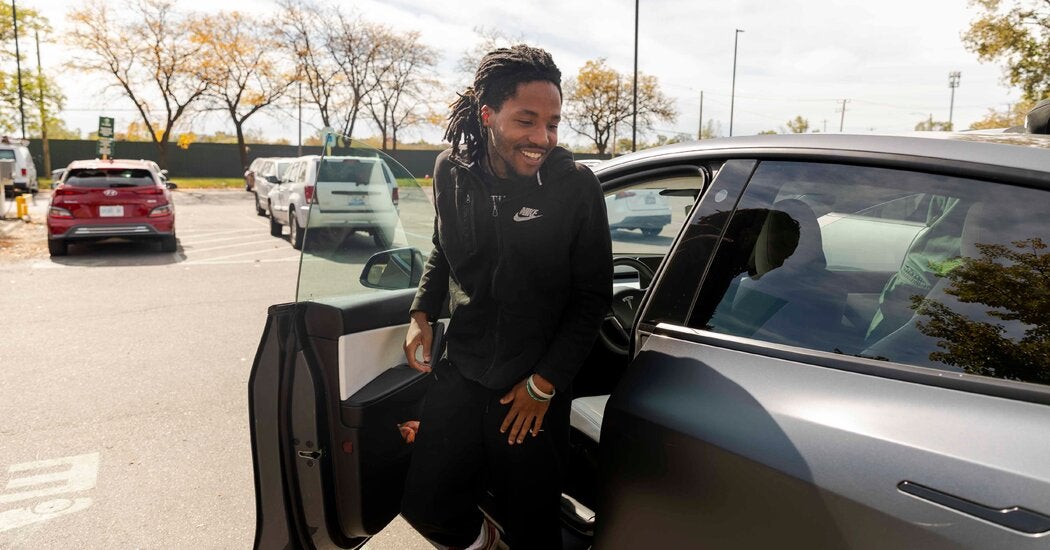
Today, only about 57 percent of teenagers obtain a driver’s license by the end of high school. In the 1980s and ’90s, that number was more than 80 percent. Does that statistic surprise you?
If you’re old enough to have a license, did you complete this rite of passage as soon as you were able? If you’re not yet old enough, do you have a plan to get your license when you are? Or, is being able to drive not that much of a priority to you?
In “Old Enough for a Driver’s License? They’re in No Rush,” Callie Holtermann reports on the possible reasons Gen Z teenagers are no longer racing toward this milestone:
While the decline in teen licensure has attracted headlines for more than a decade, some of the most common theories about its causes are also the flimsiest, said Jean M. Twenge, a professor at San Diego State University and the author of the book “Generations.”
For one, the decline in teenagers’ getting their driver’s licenses began well before ride-sharing apps existed. (Uber did not allow teens to ride alone until 2023; Lyft didn’t until this year.) And while teenagers with lower household incomes are more likely to delay getting their licenses, the overall trend has not fluctuated with economic upturns or downturns, she added.
Rather, she credits the shift to a broader pattern of American teenagers postponing the milestones associated with adulthood.
As improvements in medicine and technology have extended American life expectancies, parents have been having fewer children, who grow up with less independence — a phenomenon that Twenge calls a “slow-life strategy.” Today’s teenagers are also less likely to date, work, drink alcohol and have sex than those in previous generations. (Would the famous “Clueless” stinger — “You’re a virgin who can’t drive” — even be an insult anymore?)
“They have gotten more attention from their parents, their parents are more likely to not encourage independence, maybe not even allow independence,” she said. For a person who never walked to school alone as a child, “the prospect of getting a driver’s license on your own is scary, because you haven’t done these intermediate steps.”
She added: “If you think about the emotions that were associated with getting a driver’s license back then, it was just, like, longing and impatience. And now it’s fear and anxiety.”
The article continues:
Since the 1990s, the internet has also enabled more socialization and entertainment to take place inside the home. Teenagers no longer need to drive to the theater to see a movie (they have Netflix) or the mall to buy a new pair of jeans. (Online shopping, anyone?)
Ky Rogers, a 17-year-old in Lakeville, Minn., said that most of her friends had not been rushing to get their licenses. She plans to get hers sometime next year, but for now she calls herself a “passenger princess” who is content to coordinate rides with her parents and friends.
“I genuinely think it’s because we do everything online now,” she said. “We see each other online, hang out online, call, text, everything.”
Ky’s mother, Tanya Rogers, 56, said she was shocked by her daughter’s reluctance to start driving. As a teenager in the 1980s, she rushed to take her road test so she could drive to her job at a movie theater, and more generally so she could skirt parental supervision.
She is not pushing Ky to drive, especially because she knows that insurance gets less expensive as a teenage driver gets older. Mostly, Tanya said, “I was pleasantly relieved that she didn’t need to escape from my husband and I.”
Students, read the entire article and then tell us:
How much does what you read in the article reflect your observations about teens and driving? How important is it to you and your peers to be able to drive? Why do you think fewer young people are rushing to get their license?
When you think about driving, how do you feel? Do you associate being behind the wheel with freedom and maturity or, as Professor Twenge suggests, fear and anxiety? What else comes up for you?
If you drive, what was the experience of learning like? Who taught you? How did you prepare for any tests you had to take? How did the tests go? How did you feel afterward?
The article raises points about teens and independence: that some aren’t given much freedom by their parents, while others don’t particularly seek out experiences independent of the family, like driving, getting a job or starting to date. Do you think your generation is in more or less of a hurry to grow up than generations past? Why do you think that is?
The article suggests that teen life now is different in many ways from teen life in decades past. What are the most significant changes, in your opinion, based on what you’ve learned from your parents about what their childhoods were like? What might they not understand about what it’s like to be a teenager today?
Student Opinion, produced by The Learning Network, invites teenagers to add their voices to the conversation around New York Times articles. Find a teaching guide here.
Students 13 and older in the United States and Britain, and 16 and older elsewhere, are invited to comment. All comments are moderated by the Learning Network staff, but please keep in mind that once your comment is accepted, it will be made public and may appear in print.


