By Anthony Salcito, SVP & President, Enterprise, Coursera
The rate of AI deployment is outpacing the rate at which people are gaining the skills needed to use it effectively. According to Deloitte, 43% of leaders say their organization is highly prepared when it comes to their technology infrastructure, yet only 20% express the same level of preparedness with their talent.
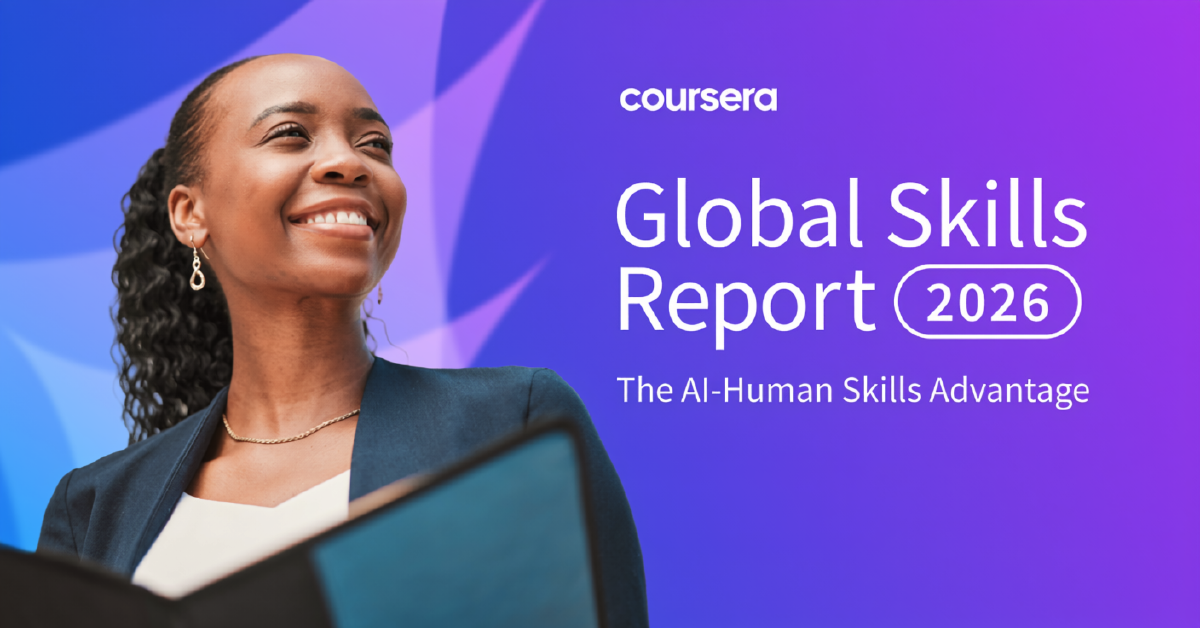
To help leaders across institutions equip their workforces with the critical skills learners need to turn AI disruption into productive AI diffusion, I’m excited to share the eighth edition of Coursera’s annual Global Skills Report (GSR). This year’s report introduces the AI-Human Skills Synergy Index—the first of its kind in the world. The Index reveals how learners across 98 countries are developing AI and human skills together, alongside the wider conditions that influence how individuals put these capabilities into practice.
The Global Skills Report 2026 arrives at a defining moment for the global workforce—and for Coursera and Udemy. The integration of our two companies positions us to create one of the most comprehensive skills platforms in the world. Drawing on a subset of learning data from more than 300 million Coursera and Udemy learners, the 2026 edition features the broadest dataset in the GSR’s eight-year history. Key findings include:
Learner skill-building and national AI readiness align most strongly in Europe
- Twenty-five of the 31 European countries examined for the report sit in the top half of the Synergy Index, which is led by Germany and France.
- Other countries in the ‘Leading’ tier of the ranking include Japan (3rd) and Korea (4th), the United Arab Emirates (6th), the United States (8th), and Singapore (10th).
- The ‘Competitive’ tier is populated by major Asia-Pacific economies including Indonesia (29th), Malaysia (36th), and India (40th).
Learners are building AI and human skills together
- Across the most common AI-human skills pairs, foundational and applied AI skills repeatedly connect with innovation, judgment, and stakeholder alignment.
- These combinations help prepare learners to meet employer demands for AI-enabled work such as finding valuable applications of AI, protecting the quality of decisions when using AI, and coordinating AI adoption.
- Leaders should identify where AI and human skills can be developed independently and where it is beneficial to develop them in tandem.
AI learning is becoming more applied and specialized
- Generative AI remains the leading AI skill of interest among learners.
- Analysis of both Coursera and Udemy data finds that learners are now enrolling in GenAI content at a combined rate of more than 45 enrollments per minute, up from 25 per minute in 2025.
- Learner interest in AI agents, orchestration, security, infrastructure, and personalization reveals growing demand for building, connecting, securing, and guiding AI systems.
Critical thinking leads human skills development
- Critical thinking and judgment are the report’s top human skills, followed by skills pertaining to ethics, governance, and complex problem-solving. Enrollments in critical thinking rose by 107% year over year.
- The wider pattern shows human skills being developed to safeguard the quality of AI-supported work, translate governance frameworks into everyday decisions, and help individual contributors lead through influence and coordination.
- Learners are increasingly expected to develop these skills earlier in AI-exposed career paths, such as those for software developers, data analysts, and finance managers.
- To help learners gain these critical skills, we recently announced new content from Harvard Business School Online, Columbia Business School, Johns Hopkins University, and more.
Trusted credentials are gaining value as workforce signals
- Micro-credential enrollments grew 33% year over year, with AI micro-credential enrollments specifically growing 122%, indicating rising participation in structured pathways that make newly developed skills visible. To meet this growing demand, partners launched 25+ new Professional Certificates, about half of which focused on AI, on Coursera.
- In Coursera’s 2026 Micro-Credentials Impact Report, 95% of surveyed employers said micro-credentials are a key differentiator between candidates, while 87% rated them as highly important in hiring.
The growing demand for AI proficiency will drive organizational value only when paired with deliberate investment in human capabilities. People still need to frame the right problems, assess the quality of AI-supported work, manage risk, communicate decisions, and coordinate action.
The learning signals in this report show where momentum is building. It’s up to leaders across businesses, governments, and educational institutions to turn that momentum into impact. I hope that this report provides you and your institutions with the insights required to approach, and direct, change with confidence.