
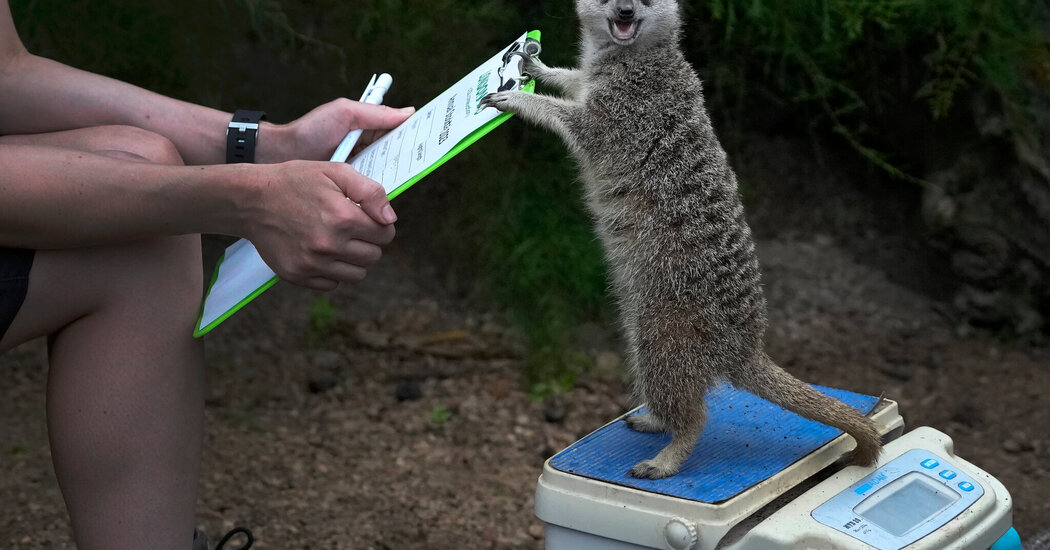
Every week during the school year we take a photo published somewhere in The New York Times, strip it of its caption and context and then ask students: “What’s going on in this picture?”
Thousands of students regularly participate in our comments forum by posting their responses.
To help students practice looking more closely, we collaborate with Visual Thinking Strategies (V.T.S.), a nonprofit organization that trains educators to facilitate open discussions about art.
V.T.S. begins each discussion with three simple questions:
Trained facilitators from V.T.S. respond to students in our comments section to encourage deeper thinking.
Here is an example of an exchange about the photo above:
Emma, a student from Little Rock, Ark., wrote: “This is a marine biologist working with dolphins. They were hurt by environmental causes and we are the ones that are killing them.”
A moderator replied: “@Emma, thanks for your comment. It sounds like you’re thinking about the ways in which human activity can impact animals, specifically the connection between these humans and dolphins. You mentioned that the dolphins could be hurt and are wondering about the cause, possibly environmental or human-inflicted. What do you see that makes you say that?”
This photo collection is focused on animals, but we choose images about all sorts of topics.
Educators from V.T.S. help us select each week’s photograph.
When scouring The New York Times for intriguing photos, we look for a variety of qualities. For example, we seek images about interesting subjects that still offer some familiarity for students.
We look for photos with strong narratives, so students can see a story.
We try to find pictures that offer enough ambiguity that there is a problem for the group to solve.
The photos should intrigue without stumping.
And they should offer enough complexity to inspire debate.
Our audience is primarily high school and middle school students.
But elementary students often join the conversation, too, via their teachers.
Teachers of English language arts, science and social studies have their classes use these prompts to practice analyzing primary sources and using evidence to support an interpretation. Teachers tell us the feature is especially useful for English-language learners.
We hope you’ll bring your students, too!

