
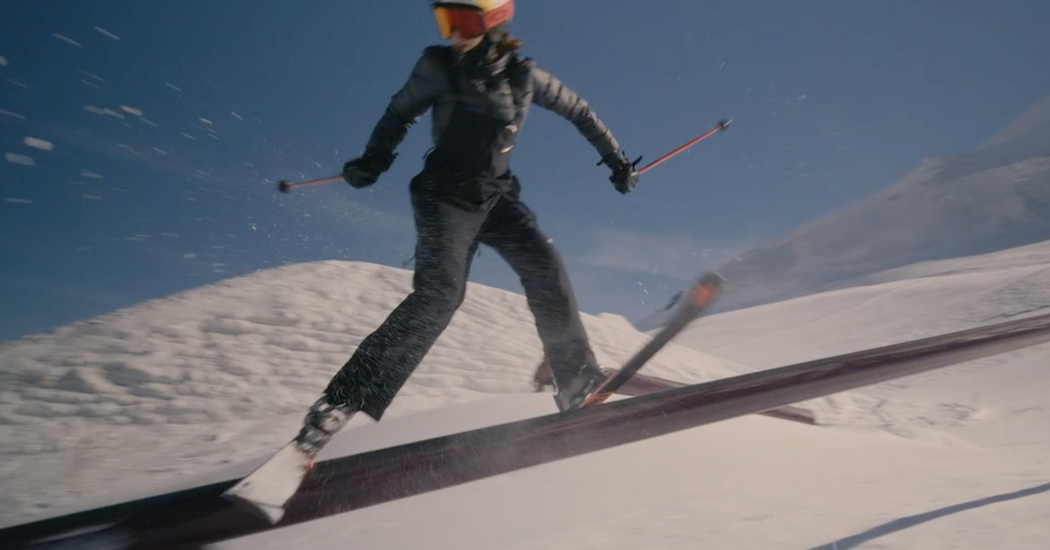
In one of those essays, “I Admit It. I’m in Love With Fear.,” Eileen Gu, an 18-year-old freeskier who won gold in the women’s freeski big air competition and silver in freeski slopestyle, writes that, for her, risk-taking is “addictive”:
FOR THE LAST 10 OF MY 18 YEARS, I’ve pursued a tumultuous love affair with fear. I’m a professional freeskier, and twin-tipped skis, 22-foot halfpipes and double-cork rotations are my main sources of adrenaline, the truly addictive core of extreme sports.
Like all bewitching lovers (at least the ones in the novels I read, for lack of real-world experience), this significant other can be … mercurial. “Fear” is really an umbrella term for three distinct sensations: excitement, uncertainty, and pressure. I’ve learned that the nuanced indicators of each of these feelings can be instrumental to success when recognized and positively leveraged, and harbingers of injury when ignored.
Though it’s easy to label extreme sport athletes as fearless or capricious, the countless hours I’ve spent visualizing tricks and practicing them in foam pits (foam. particles. everywhere) and on airbags (think giant Slip ’N Slide) suggest otherwise. It’s biologically counterintuitive for us to place ourselves in positions of risk, and while we make every effort to physically prepare, no amount of metaphorically safety-netted practice can equate to the unforgiving snow slope that rushes up to meet us after a steep kicker launches us into the air. Instead of ignoring fear, we build unique relationships with it by developing a profound sense of self-awareness and making deliberate risk assessments.
The work begins with visualization. Before I attempt a new trick, I feel a tightening high in my chest, between the base of my throat and the top of my diaphragm. I take a deep breath and close my eyes. As I ascend the gargantuan takeoff ramp, I imagine extending my legs to maximize lift. Then I picture twisting my upper body in the opposite direction I intend to spin, generating torque before I allow it to snap back the other way.
Now, in my mind, I’m airborne. I see the backside of the takeoff immediately, then my flip draws my vision to the cloudless sky above me. My ears register the wind as a kind of song, every 360-degree rotation providing the beat to the music of my motion. As my feet come under me halfway through, I spot the landing for the briefest of moments before I pull my body into the second flip. I imagine my legs swinging under me as I return to a forward-facing position and meet the ground with my weight in the front of my boots. 1440 degrees. I smile. Then I open my eyes.
In the split second following my visualization, the knot in my chest flutters and spreads — those famous butterflies reaching their final stage of metamorphosis. Excitement, the child of adrenaline, my true love and addiction. That tantalizingly precarious balance between confidence in my ability to execute the trick safely and excitement for the unpredictable experience to come. I’ve heard this state called “the zone,” which is indeed where I was when I became the first female skier in history to land the double cork 1440 last fall.
Students, read the rest of Ms. Gu’s essay and watch the accompanying videos. Or explore one or more of the other articles in the series on getting hurt, trying new tricks, dealing with bad weather and skiing nearly blind in the Paralympics. Then tell us:
Would you describe yourself as a risk-taker? Do extreme feats, physical or otherwise, excite you?
What is the most daring thing you have ever done? It could be a physical feat, such as an extreme sport, or it could be something else, like speaking in front of a large group, having a brave conversation or trying something new. How did it make you feel?
Ms. Gu describes several steps she takes to face her fear, including visualization and practice. What do you do to ease your worries when taking a risk?
Ms Gu writes that feelings of fear “can be instrumental to success when recognized and positively leveraged, and harbingers of injury when ignored.” Can you think of a time when fear motivated you to take a risk that led to success? What about a time when it protected you from going too far?
What do you think is the difference between being reckless and making “calculated risks,” which is what many of these athletes say they do? When you are taking a risk, how do you assess the dangers of it? How do you know when to push forward and when to pull back?
What did you learn about fear and risk-taking from Ms. Gu, or from the other athletes you read about? What lessons from them can you apply to your own life?
Want more writing prompts? You can find all of our questions in our Student Opinion column. Teachers, check out this guide to learn how you can incorporate them into your classroom.
Students 13 and older in the United States and Britain, and 16 and older elsewhere, are invited to comment. All comments are moderated by the Learning Network staff, but please keep in mind that once your comment is accepted, it will be made public.
