By Crystal Chen, Product Marketing Lead, Coursera for Business
On 12-22-2020, a group of employees at Coursera established the Asian Identities Employee Resource Group. In just the first few months of its launch, we have been able to serve Coursera and create a stronger sense of community, inclusion and belonging. We were able to host our company’s first-ever virtual Lunar New Year celebration. We created Brave Space forums for employees to process the rise in anti-Asian hate and the tragic impact of COVID-19 surges in Asian regions. And we’ve staged countless events to showcase the many cultures, traditions and stories of the Asian and Pacific Islander diaspora.
The journey toward establishing this group started in January 2020—back when we were all still in the office. It was a Thursday evening, and we were screening the movie “Always Be My Maybe.” One of our longest-tenured senior engineers, Jon Wong, was sitting next to our CEO, Jeff Maggioncalda, in the front row of the screening room. Jon was chowing down on snacks and Jeff peered over and asked what it was he was eating. And that was when our CEO had Strawberry Pocky for the first time in his life.
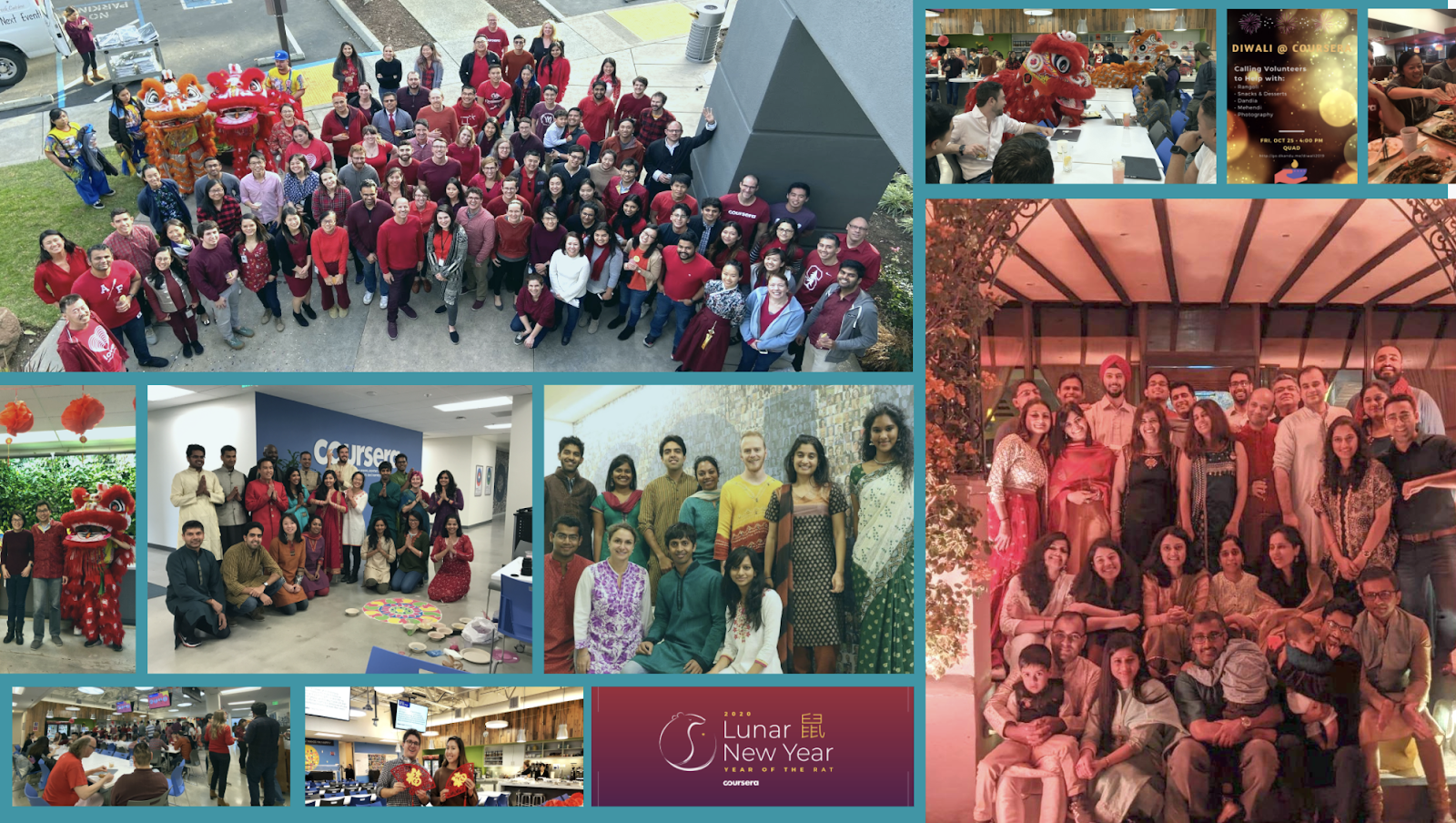
I love that moment, as I love all the other cultural celebrations we’ve had at Coursera. From Diwali to Mid-Autumn Festival to dumpling-making nights and movie nights, there are so many ways that we celebrate our Asian heritage with the people who mean so much to us.
Last year, we opened 2020 with the first-ever official Coursera-sponsored Lunar New Year. It was a huge cross-functional effort and it was buzzing— there were 30 volunteers on the planning committee alone! There were events for a whole week, and decorations, and for those of us who couldn’t “go home” that year, a little sense of home.
The success of the event led us to wonder—besides throwing great parties—what else could we tackle together?
What would it look like if we could balance cultural values with professional success? What if we could overcome the “model minority” and “worker bee” stereotypes? Could we drive broader awareness of underserved markets in Asia Pacific—and help Coursera build a truly global operating mentality?
And what if we could be better allies to other groups at Coursera?
During the police brutality tragedies of May and June 2020, my heart ached. I felt useless and clumsy, with zero clue how to help my Black friends and colleagues. Around that time we sent out an internal survey at Coursera about race dialogue at work, and many Asian respondents said they didn’t know how to think or talk about race. Many people also said they were only comfortable talking about race and equity with members of their own group. That moment was a wake up call for me. My feeling alone and useless wasn’t going to help anyone. Maybe if we could have a place to learn from each other how to talk about the tricky and hard things like race, diversity, inclusion, and equity, we could not just become better Courserians, but better allies, and better friends.
That’s why I’m so proud and happy to share that the Asian Identities ERG now exists.
The AI ERG exists to contribute to Coursera’sstrength in diversity.
To keep Asian and Pacific Islander people at Coursera;
To teach us how to be better allies to our friends—
And how to advocate for ourselves;
To share with everyone the rich and varied cultures of which we are so proud,
And also,
To bring Coursera to all corners of the earth
To reach learners with the good stuff
That is going to change their lives.
Building from those who came before us
and to whom we owe our abilities—
we are here to begin again, every day, as our best selves.
Crystal Chen, on behalf of the AI ERG
Cheri Kau (Chair) & Doug Kim (Co-Chair) & Richard Wong (Executive Sponsor)
How odd to celebrate someone for not being who we’ve been programmed to expect. But American entertainment worked hard on the mold that Cicely Tyson refused to fit. So, really, what we’ve been saluting all these decades was historic defiance. She died on Thursday, at 96, just after the release of “Just as I Am,” a juicy, honest, passionately Cicely memoir …
… Tyson had a remarkable physical presence, someone sculpted as much as born. Her body was dancer lithe. She seemed delicate. But only “seemed.” She was delicate the way a ribbon of steel holds up its part of a bridge. The deceptive nature of her fineness was right there in the name. Cicely Tyson. Poise and punch.
Daily Word Challenge
Can you correctly use the word lithe in a sentence?
Based on the definition and example provided, write a sentence using today’s Word of the Day and share it as a comment on this article. It is most important that your sentence makes sense and demonstrates that you understand the word’s definition, but we also encourage you to be creative and have fun.
Then, read some of the other sentences students have submitted and use the “Recommend” button to vote for two original sentences that stand out to you.
If you want a better idea of how lithe can be used in a sentence, read these usage examples on Vocabulary.com.
Students ages 13 and older in the United States and the United Kingdom, and 16 and older elsewhere, can comment. All comments are moderated by the Learning Network staff.
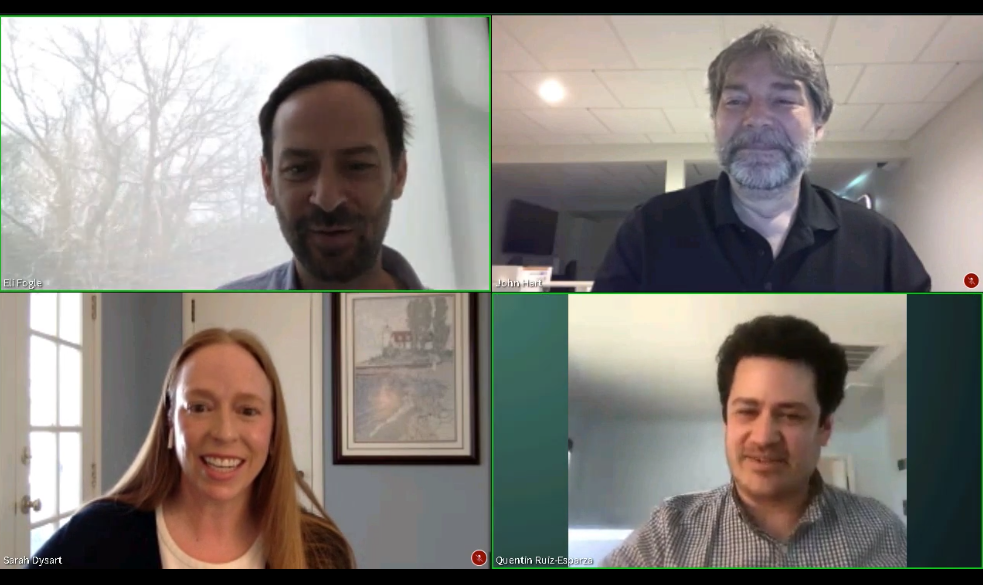
The Faculty Forum at this year’s Coursera Conference was a tremendous success. Our guest panelists were Sarah Dysart from the University of Michigan, John Hart from the University of Illinois at Urbana-Champaign, and Quentin Ruiz-Esparza from Duke University. We had sixteen participants from thirteen different universities in attendance.
Together, we examined challenges associated with limited faculty time during online course development and delivery and discussed opportunities and strategies for successfully overcoming these issues.
Some of the main topics we explored in the forum were:
how to produce high-quality, engaging video lectures given scarce faculty time
approaches for motivating faculty to dedicate the necessary time for course development and delivery
ways to address the ongoing lack of post-launch support for faculty to maintain and iterate courses
how to correct underestimations around the time commitment for faculty and support staff in both course development and delivery
Over the course of the session, panelists and attendees combined to produce valuable insights and strategies for how to help faculty maximize their time during course development and delivery. Among the ideas that emerged were:
allocating project management tasks to project management experts instead of instructional designers or faculty
using checklists, regular checkpoints, and constant communication to maintain timelines and consistent standards
utilizing instructional designers with specific subject matter expertise to support faculty, especially for STEM content
being transparent with quality expectations and expected workloads before course development begins
creating sandbox courses for faculty to explore, giving them insight into the authoring experience and platform-specific features
leveraging instructional designers or course assistants to monitor content performance dashboards post-launch and make data-driven course improvements
We want to thank our guest panelists for their expertise, experience, and insights, and our attendees for creating and contributing to a dynamic discussion that proved rich with actionable takeaways for all. Coursera Conference continues to offer unparalleled opportunities to bring together a diverse array of experts and perspectives. This session was an excellent example of how we can unite to solve pressing challenges and create impactful new approaches.
For more details on how to develop and deliver high-quality online courses, you can log in to the Coursera Conference website and view the recorded sessions on-demand.
Ready to take your mobile development skills to the next level? We’ll show you how in our new Learn React Native with Expo course.
We kicked off our mobile development curriculum with courses that showed you how to build iOS apps with SwiftUI or Android apps with languages like Java and Kotlin. Now, we’ll teach you how to use a framework that can do both.
React Native is a mobile development framework you can use to build apps that run on most mobile devices. We’ve partnered with Expo, who developed a set of tools and services that helps you develop, build, and deploy universal React apps, to teach you how to get an app up and running in no time.
Until recently, our mobile development curriculum was taught primarily with text and video. Now, with Learn React Native, you’ll start applying the skills you’ll gain from the course immediately by building a mobile app right in your browser.
Who is the course right for?
Learn React Native is perfect for learners who want to use their web development skills (HTML, CSS, JavaScript, etc.) to branch into mobile development. Plus, the framework’s compatibility with both Android and iOS makes it a valuable tool for mobile developers looking to maximize their audience or break into a new market.
What skills will you take away from the course?
After taking Learn React Native, you’ll be able to use the framework’s core components to quickly build a working application. Plus, with Expo, you can preview your apps on both your computer and your smartphone.
You’ll also learn how to add CSS-like styling to your mobile apps, along with basic accessibility and navigation features like multiple screens and tabs.
Recap
We’ve partnered with Expo to create our new Learn React Native course, which teaches learners how to use the mobile development framework to create applications that run on both Android and iOS.
Summer is quickly approaching. Warmer weather coupled with rising vaccination numbers means that many people will be flocking to beaches across the country. How do you feel about beach days? Who do you usually go to the beach with? What sort of food do you eat there? How do you spend your time: swimming in the sea, surfing the waves, lounging in the sand or enjoying another activity?
Tell us in the comments, then look at the rest of this slide show illustrating the booming housing market in the Hamptons, a group of popular beach communities on the East End of Long Island.
Students 13 and older in the United States and the United Kingdom, and 16 and older elsewhere, are invited to comment. All comments are moderated by the Learning Network staff, but please keep in mind that once your comment is accepted, it will be made public.
For Joseph Altuzarra, the decision to bring his runway shows back to New York — much like his decision four years ago to take them to Paris, where he was born and raised — was “a very emotional, personal decision.” He made it while working in the city during the pandemic.
“I felt a really strong kinship with the city that I hadn’t felt as deeply in a long time,” Mr. Altuzarra said. “I missed the energy.”
Daily Word Challenge
Can you correctly use the word kinship in a sentence?
Based on the definition and example provided, write a sentence using today’s Word of the Day and share it as a comment on this article. It is most important that your sentence makes sense and demonstrates that you understand the word’s definition, but we also encourage you to be creative and have fun.
Then, read some of the other sentences students have submitted and use the “Recommend” button to vote for two original sentences that stand out to you.
If you want a better idea of how kinship can be used in a sentence, read these usage examples on Vocabulary.com.
Students ages 13 and older in the United States and the United Kingdom, and 16 and older elsewhere, can comment. All comments are moderated by the Learning Network staff.
Back in January (2021), I wrote about the Talent Development Platform market and how I identified what is a TDP, among other items.
In March (2021), I identified where the Corporate Learning System market is heading, including the identification of three groups that will define the segments.
Both of these items are mentioned because they not only dovetail into one another (Group two), but a trend is developing that shows that Group three will splinter, with some bouncing into Group Two, by Combo mode no less, and others not, albeit a chunk (not a majority) will add just enough to spin it, as a talent development platform or some angle around that.
The Talent Development Platform space is especially fluid, far more so, I have found time-wise, compared to other learning system segments of recent note, including LXPs.
Skill Platforms (those that identify themselves as) will definitely be Group two. That is very clear, but one component, that I initially didn’t see, to be honest, and transparent, was how combo (they play at least 50-50, employees to customers, although many tend to skew 60-40, 70-30 employees to customers), would go when it comes to a talent development platform. Especially those vendors who have very strong e-commerce capabilities, and multi-tenant aspects (customer education, B2B/B2C requires a multi-tenant, and capabilities and reporting data on them, are all over the place).
This added to a further question, would a vendor who goes 60-40 or 70-30 customers to employees (customers being the higher number) push more into being a TDP, then say an LMS or some other type of learning system (a learning platform, digital learning platform, learning suite, ecosystem are just a few).
What I see trend wise, indicates that my initial forecast that Talent Development Platforms will become by 2025, the #2 segment behind LMSs, is on track.
There is though, no doubt in my mind, that many LMSs will offer TDP feature sets, without going full TDP, sort of half and a half here. Thus, some analysts and others will point to the TDP market as #1 and the end of the LMS (a favorite among naysayers who say this yearly).
Talent Development Platforms – The Initial Four
In my initial assessment of what a TDP requires to have the initial four components (and this still holds true):
Learning as the core component – Not a bit here, some capabilities here, or a streamlined angle – Learning with all at least 85% of the learning environment and 85% administration functionality as part. To see these items, please view/download my learning systems template.
3rd party content marketplace – Has to exist. At least five vendors, although more is better. Some vendors are going deep integration with say GO1, which has over 250 publishers on it, or they have a partnership with GO1, and again the mass number of publishers. Open Sesameis a favorite among vendors as well, and they too have 200 plus publishers. This is fee-based content/courses here in the marketplace. Others you will often see with vendors include Linkedin Learning, Biz Library, Udemy, and Coursera (which I am still trying to figure out why). Only one vendor BTW, that I am aware of, has a partnership with MasterClass. That vendor btw is in the talent development platform segment.
Skills mapping tied to job roles – Some refer to this as career mapping – but you know it is all nomenclature here.
Skills tied to job roles tied to opportunities – The platform offers opportunities – from an actual job within the company, to say a project manager role for a specific project. The end-user will see what skills they have in relation to what skills they need to have for this opportunity. A next capability – which not everyone in TDP has, but I believe will – is the ability to tap machine learning into the skills missing and produce content/courses for the learner to take/complete OR focus on a specific content chapter for example, without having to complete it – leveraging the full power of why web-based training and thus e-learning was created in the first place. If the learner has all the skills required for the opportunity or thinks they have enough, they can then click a button that might say “Apply”. Some vendors will use another term, but it means basically the same thing. The manager or whoever will view the learner applicant and if they see a fit, ‘approve’ for that person to go to the next step – whatever that might be, for consideration for that role.
This does not mean the system includes a recruiting capability per se (, I think crosses the line into trying to be light parts of a HCM). The better route is simply connect with your own HRIS or HCM and push/pull data that way.
That was the standard four, but two new components have popped up more than enough times, to say they must be included for the TDP segment.
Skills/Job Roles Library – This isn’t just the client adding their own skill dictionaries or skill whatever into the platform, this is via a third party whether fee-based or not (paid by the vendor, not you) that appears in the system (on the back-end). The administrator or you, or combo, can go thru and see all the skills available, and job roles, and even add their own/remove ones not relevant that they are going to use. In some instances, the removal is not doable, but the adding is pretty constant. This is for skills and job roles. After all, Chief Happy Clown is not a common job role you see, but maybe at your company, your boss is one! HA!
Vendors go lots of different ways when it comes to skills/job roles libraries (an industry term, that vendors may or may not use), and this feature appears across quite a few learning systems today, not just TDPs.
The two biggest 3rd party players for skills/job roles are EMSI and Burning Glass. They go deep integration via multiple APIs (for those who are curious tech-wise, but again it is already set up in your system – since that tech stuff is for the vendor). The data is constantly updated, and any redundancies are removed. EMSI for example has over 33,000 skills, the job roles (it is quite extensive number too), is data pulled from job postings from over 1,000 sites. I can’t recall Burning Glass’s numbers.
Vendors in some cases will also scrub Linkedin for data (skills/job roles), other job boards (always a risky endeavor, if they don’t know which ones to really tap into), ask clients to add their own (very common), come up with some competency model (common), and other sites that publish public data. There are a couple of vendors who acquired platforms/systems that already have large skill/job role data pieces, and then there a few who go IBM Talent Watson as their core.
Personally, I think the best fit are those who let a 3rd party entity, who does this every day and pulls the data every day, and thus has checks and balances set up, and have that go into the system/platform – via a series of APIs via deep integration. Then, allow clients to add/remove and that’s it.
Anyway, a TDP is going to have the above. There are vendors I should add who have EMSI say for skills and Burning Glass for job roles, although according to EMSI, the majority of their clients go with the full package of skills/job roles.
Strong Skill Management functionality – I refer to it as an entire category, but you can state it as strong skill capabilities
The list of all the skill capabilities is quite extensive, some of which are “future tech” – which means very little if any vendor has it today, but it will be there for plenty by the end of 2022.
View All Skill Capabilities– it is on a template, which you can use in any way you see fit, take a piece here or use it all.
Here are some key highlights that a TDP now must have
Ability to upload your own Skills Library (or skills categories)
System allows you to add/edit/delete skills within the system’s skill library
System comes with a built-in skills library
Future tech – AI in system can scan documents, courses, content, audio and video files and produce skill results (I should add, a vendor who is not a TDP, but a learning suite – Fuse, is launching this specific feature this Fall, 2021)
System can generate a playlist based on skill rating, skill level or any other skill related variable
Future tech – Learner can view “Coaching or Expert” list, and select individual(s) based on their expertise in a skill or skills
System comes with a video skills validation component with digital coaching and skill-based scenarios and role playing (There are vendors who have this today, ironically, none are TDPs)
TAGS- Administrator can create TAGS by Skills, Interest, Job Role, etc.
Administrator can create skills and skill taxonomies
Administrator dashboard shows information around skills – (Skill proficiency levels, top skills sought out by learners, Most Popular content tied to a skill or skills, Least popular skill or skills, least popular content by skill, skill comparison data) – One TDP already has this – okay most of it, but still!! – I think it is a must feature for not just the TDPs but any learning system. It could be AWESOME, not as AWESOME as Mr.Pibb (the soda), but very, very close.
Manager can see the skill(s) for each employee in their team/department
Built-in Skills Validation tool (Remember I prefer the term ‘validation’ over assessment)
Ability to add skills validation, prior to learner gaining access to content
Link to a career development framework and match skills, job level, and job role to available courses/content
Match a skill or a series of skills to a piece of content/a playlist
Identify by each learner, skills currently developing
The learner can self-validate themselves on a skill or skills
Manager can provide a skill-rating validation of an employee (who has completed their own skill validation rating)
The system identifies what each skill rating represents (1 to 5 scale)
The system provides proficiency details for each skill rating identified 1-5, thus someone who is 1 means they are proficient at only this and so forth
Curriculum/learning path can set by skills, interests, job roles matched to skill or skills
The system provides examples on how to develop your own skill taxonomy or assists you with building one (at no additional charge) – Some TDPs already do this.
What is now obvious and a change to the TDP framework
This was something that as noted way up at the beginning, I didn’t see. I admit I am not Nostradamus, but who is? Uh, besides him.
However, just like the sage of the past, I studied the stars, contacted the local wizard, and viewed the trend lines as many do, when reading palms – I am certain he did this when he wasn’t involved in Alchemy. Oh, wait that was Newton.
What I am seeing, what is coming to the TDPs are vendors who will have full e-commerce. Not everyone mind you, the majority won’t, but this little (okay not little) feature/functionality tapped into multi-tenant, will arrive in the TDP space. There is one TDP with complexity at the multi-tenant level already, and basic e-commerce (although my gut says they will go full tilt here), and that is Schoox. But from the TDP side of the house – the multi-tenant is already there (Degreed and Juno Journey each have that capability).
The group that will arrive into the TDP space, at a higher rate than what I initially saw are Combo systems, those employee/customer education systems. They will come. Not just like those who arrived for Field of Dreams (“They will come, Ray”), but everyone who isn’t a baseball fan (sorry movie reference).
I mention in all seriousness, the number of Combo systems that will bounce into TDP. This is because they will hit the 80% threshold for being a TDP, and then hit the 80% threshold of a system who is at least 30% customer education/B2B/B2C, and thus could even tap into the association market (that follows a B2B/B2C approach when it comes to learning/training).
There will be combo systems that do not call themselves a TDP, then there will be combo systems who call themselves a TDP or say they are a TDP as though it is a component, and yes, there will be those who stretch the truth, like you, as a child stretched a piece of gum.
However, there will be quite a few who will be Combo TDP. Today, TDPs are all about employees, but one already has seen the B2B/B2C side, and is moving in. Another will take those folks, but they still are more on employees (like 95-5) here.
What none of them see, are the combo systems as even a threat. Yes, they are seeing them when it comes to RFPs and competition, since many people are unaware those vendors are TDPs and thus quite different in many ways to an LMS, LXP, or some other type of learning system.
Make no mistake though, that these combos, the ones who really want to grab a greater customer base and are already pushing heavily into skills and job roles, will arrive. And because they are combo, they will have feature sets that the TDPs are lacking, simply because many today, those combos, are LMSs or some learning system that has the LMS standard functionality, but refuses to call themselves that.
Again, I stress that not every combo system today will go Combo TDP. But many, many will. I believe a chunk will go right up to the edge, spin the TDP angle – push heavy on skills and job roles – otherwise who will know – but stop short of saying Talent Development to their customers, with the exception via their website or some marketing.
Who is the first one likely to cross over?
EdCast XP. EdCast XP, for an additional fee, can go customer education here with something called Customer Academy and if you add “Career Mapping” an add-on today, you are now a Combo TDP. If you only add “Career Mapping” to EdCast XP, you are now a TDP.
I would like to see them just make the jump already, include “career mapping” as part of their system, and call themselves a talent development platform – again, this is for EdCast XP. Then if you want the true Combo TDP, add customer academy.
This is EdCast XP, not Spark.
One Final Note
The Talent Development Platform market is very fluid. Don’t be confused that a Talent Management system or Performance Management System is the same as a TDP. They are not. That would be like comparing a Model T-Ford to a Tesla, with the TM system, being the Model T.
Bottom Line.
The other day, as I pondered this new trend, a visitor to my property came out of nowhere, clearly expressing an interest in the topic.
Javalina recognizing the impact of Combo TDPs in the TDP segment
As they say, if a Javalina is interested.
So should you.
Because Combo TDPs are coming.
They will disrupt.
They will shake TDPs to add functionality they never even thought about.
The world of work is always evolving. The skillset needed to succeed in a particular field changes every year as technology evolves, and the role of automation continues to grow. This means employers constantly need to adapt the part played by their staff in making their business a success. For the employees of today, the one-track career path is a thing of the past. In such a dynamic employment landscape, workers are expected to flexible and be prepared to learn a new skill whenever necessary.
The work environment is now also a learning environment, one in which upskilling is part and parcel of the job. As members of the workforce constantly retrain and broaden their abilities, being open to learning will no longer set you apart from your peers in the job market. It’s no longer enough to be a learner, you need to be the right kind of learner.
Know How to Learn
At Alison, we’re not just experts in teaching, we’re experts in learning. Deciding to take an online course in order to improve your CV or upgrade your earning potential is only half the battle. In order to maximise the benefit of our free online courses, you need to develop an Intentional Learning Mindset.
Many people in today’s job market struggle to learn the new skills required of them because they don’t know how to learn. An Intentional Learning Mindset is an approach to learning which sees you live as you learn and learn as you live. Unlocking this mindset allows you to approach learning as a holistic experience that, instead of feeling daunting, seems natural. Equally, it means that you integrate learning into your everyday experience. An Intentional Learning Mindset isn’t just an approach to Alison, it’s an approach to life!
As the jobs market continues to evolve, this attitude to learning is becoming increasingly important to employees who are required to be evermore adaptable and willing to retrain.
Here are six ways to develop your Intentional Learning Mindset and future-proof your career.
6 Ways to Develop an Intentional Learning Mindset (with free courses!)
Every Moment is a Learning Opportunity
Every moment is alive with learning opportunities and being able to harness this potential means you’re always open to engaging new ideas and taking in new information. and are two excellent practices that allow you to centre yourself and take in the moment, and harness its potential. An Intentional Learning Mindset isn’t just about actively engaging with learning material, it’s about cultivating a disposition which sees each moment as a learning opportunity and is able to capitalise on it.
Growth is Always a Option
Cultivating Intentionality allows you to fully engage in the task of learning. This is the vital first step but it needs to be twinned with an equally engaged attitude focused on results. This is where a Growth Mindset comes into play. A Growth Mindset means that, while you’re learning, you’re always intent on expanding your capabilities and growing your skillset. You focus on the building of experience and the practice accrued, rather than focusing on what you haven’t yet learned or the difficulties that come with acquiring new knowledge. A Growth Mindset means you always think of your learning journey in terms of progress.
Discard Distractions
Fundamental to fostering an Intentional Learning Mindset is the belief that the act of learning has an inherent value and thus requires commitment. In order to fully take in the material you’re learning, you need to deliberately think about what you’re doing. Trying to learn while splitting your attention means that you’re not respecting the skill you’re aiming to learn. You’re also frustrating yourself because you won’t learn at the rate you could if you devoted yourself fully to your studies. Intentional Learning means distractions go out the window!
Regular Achievable Goals
Intentional Learning requires commitment and can be a difficult mindset to master and equally hard to maintain. To encourage your commitment to the task at hand, it’s vital to set yourself regular, manageable goals so that you can chart your progress while also marking your achievements on your learning journey. This provides encouragement and inspiration, both of which make it easier to stay committed.
Committed Learning = Committed Practice
Intentional Learning should lead to Intentional Practice, which should then lead to Intentional Working. Translating education into concrete work experience can be difficult and is often where many students struggle. While a teacher can help you learn information, it’s up to the student to put it into practice effectively. is crucial for turning your learning into action. By critically diagnosing your work situation, you can identify how to apply your newly gained knowledge in a way that boosts your performance while also improving the functionality of the workplace.
Feedback is Part of the Learning Journey
Learning doesn’t stop once it’s been put into practice. An Intentional Learning Mindset is a holistic approach to gaining knowledge and is applied at all moments. However, sometimes knowledge can only be gained from without, and if you’re applying a new skill in the workplace, it’s going to be observed by your peers and managers. The likelihood is that the application of your new skillset is going to be able to be finetuned. To continue learning, it’s important to reach out to those around you for feedback so that you can adapt your newfound knowledge and continue to advance. Asking for and receiving feedback can seem overwhelming, so building your confidence and self-belief are central to developing an Intentional Learning Mindset.
Linear regression is a fundamental machine learning algorithm used for predictive modeling and data analysis. Learn more about it as Curriculum Developers Alex and Sophie guide you through our new course: Linear Regression in Python.
In the latest addition to our Codecademy Live series, our Curriculum Developers will teach you the fundamentals of linear regression and its various applications. Linear regression is a technique for modeling quantitative outcomes using any number of predictors. For example, you could use it to understand the relationship between a person’s income and other attributes such as education level and years of experience.
Learning about linear regression will prepare you to explore other kinds of machine learning models and enable you to read and understand research papers in just about any field of study!
Along with the walkthrough, Sophie and Alex will also be hosting 30-minute office hour sessions every Thursday between May 20th and June 3rd (and possibly longer — we’ll keep you posted). Open to all learners, the office hours are a great opportunity to connect with the developers behind some of your favorite courses and ask any questions not answered during the stream.
How to watch
The live sessions will be streamed every Tuesday at 11am EDT from May 18th to July 13th (except July 7th) on YouTube, Twitch, Twitter, and Facebook. We’ll be focused on the live chat on YouTube, so join us there if you want to be part of the conversation in real time.
Each session will last for about an hour, but don’t worry if you can’t make it — they’ll all be recorded so you can watch them later at your convenience. For more details, check out the Codecademy Events page.
First, we’ll introduce you to simple linear regression and show you how to implement it in Python with both quantitative and categorical predictors. Then, we’ll move on to multiple linear regression and walk through some of the math behind the model before covering tools used to improve and build more flexible models, such as interactions, polynomial terms, and data pre-processing. Finally, we’ll discuss ways of comparing a few different models in order to choose the “best” one. The last session will walk through the entire workflow with some real (and more messy!) data.
Below, you’ll find detailed descriptions of each session.
Session #1: Introduction to simple linear regression
In this session, we’ll introduce the concept of simple linear regression and learn how to implement it in Python. Linear regression is a machine learning technique that’s used to predict and analyze quantitative outcomes, such as salary, time spent on a website, or adult height. In the process, we’ll review algebra and graphing skills and learn about concepts that are applicable to many different machine learning algorithms.
In this session, we’ll demonstrate how to include a categorical predictor with two or more categories in a simple linear model. For example, we’ll learn how to predict the price of a New York City apartment based on the borough where it is located. This will help us build our intuition for how to create and interpret more complex linear models.
Session #3: Introduction to multiple linear regression
In this session, we’ll build our first linear model with more than one predictor. As an example, we’ll use simulated data from a math class to predict student quiz performance based on hours of studying, number of completed assignments, and whether or not the student ate breakfast.
Session #4: The matrix representation of the linear regression problem
In this session, we’ll dig into some of the math behind multiple linear regression. While there are a number of Python modules that allow us to fit a model without understanding this math, it is difficult to troubleshoot, interpret, and learn new technologies without it. This session will give you enough understanding to accomplish these things while still bypassing detailed algebra and calculus!
In this session, we’ll learn about some useful tools for modeling non-linear relationships using linear regression. This will allow us to build more flexible models, representing real-life relationships that cannot be summarized with a straight line.
In this session, we’ll learn about data pre-processing that is useful prior to fitting a linear regression model. These kinds of transformations are potentially helpful when the assumptions of linear regression are otherwise violated. Pre-processing can also make the regression output more interpretable and therefore easier to communicate to a non-technical audience.
Session #7: Comparing and choosing a linear regression model
In this session, we’ll discuss ways of comparing possible regression models and choosing the “best” one for prediction or analysis. In different business and research settings, the word “best” might mean different things. For example, if you need to be able to explain your model to a broad audience, you may want to prioritize interpretability over small gains in accuracy. By the end of this session, you’ll understand some of the most common methods for choosing a model.
In this session, we’ll walk through the full process of pre-processing some data, fitting a few different linear models, choosing the “best” one, interpreting the results, and using our model to make predictions for new data. We hope this session inspires you to build your own linear regression model to solve a problem that interests you!