fbpx
Home Blog Page 1510

Addressing the teacher retention crisis: key themes from the Westminster Education Forum

0
Addressing the teacher retention crisis: key themes from the Westminster Education Forum

Author: Isabel Drury, Partnership Manager at FutureLearn

The Department for Education made a splash last month when it shared proposals to increase teacher starting salaries to £30,000 by September 2022, making it the biggest sustained pay increase since 2005. But will this salary increase be enough to attract new teachers into the profession, are these changes coming soon enough, and what about supporting and retaining early career teachers in their first 3-5 years in the classroom? 

These topics were the subject of lively debate at the most recent Westminster Education Forum policy conference in Whitehall, London, titled ‘Reforming Initial Teacher Training Provision in England – implementing the new core content framework, improving NQT retention, and next steps for the teacher training system.’ The forum was attended by a range of experts in Initial Teacher Training (ITT), including leaders in Initial Teacher Education (ITE) from school trusts, universities, School-Centred Initial Teacher Training (SCITT) providers, and other teacher training bodies. 

As the FutureLearn platform offers over 100 short courses and microcredentials aimed at teachers to support their professional learning and development, I attended the forum to find out what more we could do to support teachers in these challenging and critical early years in the classroom. The forum provided an opportunity to debate incoming policy changes to funded early professional development for Early Career Teachers (ECTs), with a special focus on the new core content framework for Initial Teacher Training that is due to be implemented in September this year.

Across the event, three key themes stood out to me:


Mentoring

As identified in the 2019 Carter review, the speakers emphasised quality mentoring as critical to teacher retention in the initial years of classroom practice. Some of the most common issues raised were matching ECTs with subject-specific mentors; the difficulties of finding mentors in small schools; as well as finding space in the timetable for mentoring. 

Offering a perspective from a SCITT in East London, Niall Dosad, Assistant Head Teacher at Colgrave Primary School, shared reflections on the practicalities of getting to grips with the Early Career Framework (ECF) and spoke of the need for clear, consistent and effective mentoring. 

Meanwhile, Dr Deborah Outhwaite, from the Derby Teaching School Alliance, urged the forum to consider how experienced teachers, who take on this pivotal mentoring role, are leaving the school system all too often. This was echoed by Shona Findlay, Head of ITE at the Harris Federation, who spoke of the need to recognise and value the work of teacher mentors (or “hidden teachers”) through offering CPD and raising the profile of mentoring.


Community and Partnership

Partnership between schools and universities in Initial Teacher Education (ITE) also emerged as a key factor in successful teacher training and retention. 

Rachele Morse from the University of Southampton spoke of the difficulties for student teachers in moving into their Newly Qualified Teacher (NQT) year, when workload increases significantly, and the need to establish an ongoing community of practice and community of learning. This was echoed by Maria Cunningham of the Teacher Development Trust, who spoke of the ‘cliff edge’ between the ITT and ECF as an important area of focus in teacher training.

In the Suffolk and Norfolk SCITT, Anna Richards spoke of the collaboration between local schools and the University of Suffolk to allow teacher trainees access to academic resources. The importance of building professional relationships and networks was also identified as a key part of keeping teachers in the profession.


Ongoing access to CPD

There was much discussion of the need for teaching practitioners to have lifelong access to research and journal articles well beyond their ITE phase.

Louise Ling of the SEND Teaching School warned of the lack of access to academic literature in schools and the need to make this available to help mitigate the particularly high attrition rates in years 3 and 4 of teaching.

Dr Clare Brooks, Director of the Centre of Teacher and Early Years Education at the UCL Institute of Education, emphasised that a curriculum for ECTs needs to be broad, balanced, and offer ongoing professional development. Many speakers also emphasised the need for subject-specific teacher training. 

Where CPD is offered in ‘Twilight’ sessions, Katrin Sredzki-Seamer, Director at the National Modern Languages SCITT, warned of the impact on teachers’ work-life balance and the need for training to be provided flexibly. 

Overall, I was struck by the absence of conversation about the potential for online teacher training and CPD across the conference. Combined with quality mentoring and lifelong CPD opportunities, an online community of practice could do much to help NQTs teaching in remote or rural areas, to learn from diverse perspectives and gain support from their professional peers.

Category Research insights

February’s industry round-ups

0
February’s industry round-ups

Opinion: Coronavirus quarantine could spark an online learning boom
The Conversation, 23rd February 
The spread of the coronavirus disease known as COVID-19 is a public health emergency with economic and social ramifications in China and across the world. While the impacts on business are well documented, education is also facing the largest disruption in recent memory. Institutions around the world are responding to travel bans and quarantines with a shift to online learning. The crisis may trigger an online boom for education – or at least make us more ready to cope with the next emergency.

Feature: How the skills gap is changing the degree path
Education Dive, 17 February 
This piece argues that nontraditional education providers are proving to be stiff competition as bootcamps can prepare information technology and web-development workers in months, and multinational firms such as Google now produce their own certificates that promise to be gateways to meaningful entry-level work. It discusses the different responses American colleges are taking to rival this, for example, some colleges are strengthening transfer pathways between two and four year schools, bringing industry-recognized credentials into the curriculum and putting more weight on training experiences. David Soo, Chief of Staff at Jobs for the Future commented “While colleges don’t need to become vocational programs, they will need to find new ways to meet the needs of students and the economy or they risk losing out on that huge future market for lifelong learning.”

Editorial reporting: Will Coronavirus Crisis Trigger an Enrollment Crisis?
Inside Higher Ed, February 13
U.S. colleges could see a major enrollment pipeline cut off if the coronavirusepidemic persists. Meanwhile, Australian universities are missing more than half their Chinese students weeks before their fall semester begins. As the number of students from China studying in the U.S. grew rapidly, fueled by a big increase in tuition-paying undergraduates, colleges and universities grew reliant on them to balance their budgets. The coronavirus threatens student flows and other forms of collaboration. Just how severe the impact will be willdepend on many unknown variables.

Opinion: Forget lifelong learning. What we need is learning for life
Ed Technology, 12 February
Julia Taylor, subject specialist in inclusive practice at Jisc, highlights that the UK is facing a crisis in adult and lifelong learning. A recent report reveals that there has been a rapid decline of mature learners, with nearly four million “lost” since 2010. In conjunction, the demand for reskilling and digital skills means that employees need to get accustomed to the digital workplace. Taylor argues that technology has a big role to play in upskilling workers and universities need to continue to think creatively about how they can best support inclusive educational experiences. She states “forget lifelong learning, which tends to conjure up outdated images of local evening classes in dusty halls. What we need is learning for life: a baseline belief that education supports every stage of every person’s career, no matter who they are or what their previous experiences of learning may be.”

New research: 71% of managers believe in the value of non-traditional qualifications
Ed Technology, 5 February

Research revealed on behalf of AVADO, the UK’s leading apprenticeship and digital skills provider, has uncovered that managers across the country see apprenticeships as the most effective route to a thriving career. In a managerial survey, 71% emphasised their belief in the value of non-traditional qualifications, including apprenticeships. Conversely, only 32% of managerscited a university degree as the most valuable asset when entering the workforce. The nation is facing a shortage of skilled professionals in cybersecurity systems, mobile computing, cloud computing and data analytics. With government focus remaining firmly in the realm of digital skills training and acquisition, apprenticeships could be key to closing the UK’s digital skills gap and innovating the workforce.


Category Research insights

Opening up pathways for women in STEM

0
Opening up pathways for women in STEM

Author: Professor Josie Fraser, Deputy Vice-Chancellor at The Open University and member of the FutureLearn Board of Directors

As I write this, I’m looking ahead to the weekend when the world will be celebrating International Women’s Day (Sunday March 8th). Celebrating women’s achievement and promoting an equal and enabled world is important to me. A lot of my work choices are based around a strong desire to promote equality – with equality in education and in STEM (science, technology, engineering and mathematics) as particular interests. 

From sponsoring the Women @OU network at The Open University, to being an engaged Aurora Champion at my University (sponsoring women in Higher Education through leadership training), to being involved in the Institute of Coding (in which The Open University and FutureLearn are active partners, working with many universities, the Office for Students, and a number of technology companies to transform computer science education and increase diversity in technology).

I have a privileged position, having had a fully funded higher education (thanks to means-tested grants back when I was 18 and going to university from a working class Midlands family). I’m also privileged in that I have been in constant employment since I graduated – in universities and medical research organisations. I’ve studied and worked in the UK (Leeds, Bradford, Medical Research Council in London, Cambridge, and The OU in Milton Keynes) and have also worked in the USA (my oldest daughter was born while I was working at University of Massachusetts Medical School). The opportunities that education has opened up for me have included lots of chances to travel – I’ve attended conferences all over the place in my discipline (neuroscience) – from San Antonio to Budapest. 

Education was the key that enabled travels I couldn’t have imagined, the fascinating people I have met along the way – and led me to my passion for developing all kinds of people through education.

Diversity – whether that’s more women engineers, more male nurses, more BAME colleagues in leadership positions, or more disabled people in technology – is so important. There is plenty of evidence that diverse teams are more effective. I believe that education opens doors and opportunities for all kinds of people. My professorship is a joint research & teaching chair – I love all aspects of academic life – and what education has done for me perhaps explains why I am so passionate about better access to quality education for all, which is, of course, The OU’s founding principle. 

There’s no doubt that in some parts of the world, as we approach International Women’s Day, access to education for women and girls can be challenging. I’m particularly proud of projects at The Open University that connect women to education and have equality at their heart. GATE for instance, which stands for Girls’ Access to Education in Sierra Leone, aims to address the lack of female teachers in the country. Few role models and the relatively small proportion of girls who complete a full high school education, make it hard for girls to aspire to a career in the teaching profession. As part of GATE, funded with aid from the UK Government, the OU has designed an innovative pathway to the teaching profession for young women in rural areas. Young women who were unable to complete secondary schooling are selected to become learning assistants and do practical work in schools whilst studying distance learning programmes to become qualified teachers. It empowers teaching assistants, who have become a valuable resource, and offers a higher level professional qualification and career path.

There are other great examples too. In some of the poorest districts in Zimbabwe, OU study materials are helping girls who have never been enrolled in school or who have not completed their basic education. The programme is called SAGE (Supporting Adolescent Girls’ Education), and it is part of the UK Aid funded Girls’ Education Challenge, supporting up to 1.5 million marginalised girls to have access to quality education in 17 countries. The OU materials are designed to be accessible and relevant.

Enabling education to travel distances and reach places where access to a campus is unlikely, is vital for our global future.

The Open University and other distance learning specialists will play an increasingly vital role in the future of education; as will the platforms where flexible, online-enabled learning is made available to people everywhere, like FutureLearn. I am delighted to join the board of FutureLearn at a time when FutureLearn and its partner universities (including The Open University) are collectively embarking on something as new and exciting as microcredentials. The concept is for a university-validated and industry-approved, employment focused, bite-sized, high quality piece of learning. This is learning that is ideal for career enhancement. Microcredentials are beginning to be rolled out across the world, with FutureLearn at the forefront. The opportunity for forward-thinking universities to work together on FutureLearn and create a suite of training opportunities for people who want to up-skill in an area of existing expertise, or re-skill to take a new career direction, is very exciting. 

This form of learning in selective chunks, as top-ups, standalones or ultimately stackable (as we work towards a goal of making themed microcredentials, which could be creatively put together to make qualifications), gives a creative, personal aspect to lifelong learning, designed to serve new generations of learners that are emerging. At The Open University, this is an opportunity to extend our current qualification-focused approach to lifelong learning, to additionally serve someone who may already have a first qualification, but who wants to learn flexibly in smaller pieces, in order to top up their education, for their current job or the one they want next.

My own two daughters are a constant reminder for me of the changing nature of learners.

They are a generation who have grown up with smart phone technology that connects them to classmates old and new, to their homework and to their teachers, and they expect to have learning at their fingertips – they are more likely to ask Siri or Alexa than they are to ask mum or consult a text book. My eldest daughter is already eyeing the microcredentials on FutureLearn – I’m happy to report that she’s interested in one of The Open University offers! My daughters have grown up around universities, in developed countries, and they assume that they will go to a campus-based university in a few years time when they reach 18. Despite this, they also foresee wanting a good digital experience, having more than one career in their likely long lifetimes, and they expect to learn new things over time.

So, I’m excited by the opportunities that FutureLearn brings for current and future learners – with a range of university partners who offer microcredentials, we are able to learn from each other’s experiences and together create the possibility for credentials to stack up to truly bespoke learning for individuals all over the world.

It doesn’t seem that long ago that I was a STEM PhD student working on potential treatments for Alzheimer’s disease, alongside helping my supervisor with an early foray into technology-enhanced learning – a simulated experiment that she was developing. I could not, back then, have imagined my journey – in research or in education – and I certainly couldn’t have conceived of a time when I would be on the Board of FutureLearn – a company bringing learning to my fingertips on my mobile phone. Indeed, I’m not sure I even had a mobile phone while doing my PhD in the early 90s…

Being part of revolutions in learning is exactly what The Open University and FutureLearn are all about. Bringing learning to people everywhere, to create equality of opportunity is something I could only have dreamt I would be a part of, back at the start of my career. So there is definitely lots for me to celebrate this International Women’s Day!


Category Research insights

IoC Conference 2020: Is tech finally takings its representation problems seriously?

0
IoC Conference 2020: Is tech finally takings its representation problems seriously?

Author: Dr Ryan Rushton, Senior Project Manager at FutureLearn

The statistics on diversity and inclusion across the technology industry are still very troubling. Women account for almost 50% of the UK workforce, yet only 19% of professionals in technical roles are female, and even fewer (4%) are from BAME backgrounds. But for two days, the consortium of university, industry and outreach partners that is the Institute of Coding (IoC), took a long, hard look at how the tech world is addressing the disparities in gender, race, age and economic background that still plague its educational and employment offerings. 

There were some fantastic keynote speakers in Dr. Anne-Marie Imafidon and Timandra Harkness, with Dr. Imafidon in particular highlighting the challenges the world of digital skills and tech still needs to tackle if it is to attract and retain people from a truly diverse pool of talent. 

One theme that she touched on, and that was covered in some of the panel sessions, was rethinking how we sell a career in tech to women in particular. Educational and employment offerings will often focus on motivations that research shows are more compelling to men, while minimising the importance of altruism, which is emerging as a key motivator to women in a potential career. In a collaborative research project between the IoC’s observatory and Deloitte, a key finding was that women were far more motivated to begin their career in tech if they understood that they’d have the chance to make a positive difference to peoples’ lives.

Here at FutureLearn, we have been really excited to be able to support IoC partners to deliver on their aims of more inclusive and accessible education. We are one of the course providers for the University of Durham’s groundbreaking TechUp Women project that has just celebrated its first graduation – taking 100 women from underrepresented backgrounds in tech and retraining them over an intensive year-long project that combines face-to-face and online learning, as well as mentoring from women at the forefront of the industry.

Educational and employment offerings will often focus on motivations that research shows are more compelling to men, while minimising the importance of altruism, which is emerging as a key motivator to women in a potential career.

We have also been very pleased to launch our Digital Skills for the Workplace collection of courses, a collaboration with the University of Leeds, which are all about helping people gain the digital and soft skills they need to flourish in the modern world of work. In particular, we were aiming to reach women and people from BAME backgrounds and so worked closely with UKBlackTech and TechMums to help us design these courses and represent what their learners were actually interested in and to ensure we were including course contributors who represented their experience. So far, this co-designed process seems to be working with 50% of surveyed learners identifying as female or non-binary. In March, we will be running hands-on sessions with these organisations and their learners to test how successful we have been in producing something that serves their needs and feels welcoming. 

One of the main things I took away from the conference was that there is no one-size-fits-all approach to reaching those who have historically been excluded from the worlds of digital skills, technology and coding. For some it will be the kinds of large scale interventions we are making with our Digital Skills for the Workplace courses that sets them on their journey, while for others it will be the local hands-on hackathons, digital boot camps and summer schools that look to reach people on a 1-2-1 basis where the IoC will make a difference. What’s clear though is that disruption of traditional models, mixed with collaboration across higher education institutions, industry and outreach organisations needs to be at the very heart of finding new, innovative ways to solve these problems.

Category Research insights

Melting Glaciers: Effects on the Environment, Humans, and Biodiversity

0
Melting Glaciers: Effects on the Environment, Humans, and Biodiversity

Recently, the temperature in the Arctic appears to have hit a new continental high, close to 70 degrees.

That’s leading to continued melting of glaciers in the Arctic and around the world. But how will that impact the world’s ecosystems?

Dr. David Hik is an Associate Dean of the Faculty of Science as well as a Professor of Biological Sciences at Simon Fraser University. For more than 30 years, Dr. Hik has been studying mountain regions and has seen firsthand the impact climate change has had.

A recent study he did found that 80 percent of the glaciers in Alberta and British Columbia could melt in the next 50 years. 

Below, listen to the conversation or read the transcript, and hear Dr. David Hik’s thoughts on:

  • Effects of glaciers melting on the environment and humans
  • How fast glaciers are melting
  • Why glaciers are important
  • What cities and countries will be most vulnerable to sea-level rise
  • How to prevent glaciers from melting
  • How does climate change affect plants and animals
  • How do animals adapt to climate change
  • What happens to animals that cannot adapt to the changes in their environment
  • What is biodiversity and why it’s important

Want to hear more from Dr. David Hik?

Enroll for free in

Or if you’re a member of the press, or .

___________________________________________________________________________

Transcript

Coursera [00:00:00]: From Coursera, this is Emma Fitzpatrick, and today, I’m talking to Dr. David Hik of Simon Fraser University in Canada. There, he’s an Associate Dean of the Faculty of Science as well as a Professor of Biological Sciences. 

For more than 30 years, Dr. Hik has been studying plant and animal populations and how they interact with each other as well as their environment.

Much of his work has been in mountain regions, specifically the Yukon. That’s a territory in Northwest Canada, near Alaska. It’s a wild mountain area that includes Canada’s largest mountain peak glaciers and glacier-fed lakes. 

Through his research in that area, he’s seen firsthand the impact of climate change and has been studying the long-term effects of a warming planet.

A recent study he did found that 80 percent of the glaciers in Alberta and British Columbia could melt in the next 50 years. 

Today, we’re talking with him in more detail about the impact climate change will have on our environment, how that will impact animal, plant, and human life, and the importance of biodiversity overall.

 Let’s go ahead and get started.

I’d love to hear, from your perspective, how has the landscape in the Yukon, where you’ve done a lot of research over years and decades, changed from when you first visited it? 

What kind of firsthand ways are you seeing climate change affect that area you know so well?

Dr. David Hik[00:01:24]: Well, the Yukon is a remarkable place. Many people know it, probably from the Klondike Gold Rush and the sort of colorful history of what happened at the end of the 1800s. 

But, it is a landscape that I first visited in 1988. The Southwest Yukon is home to wild forests and big mountain peaks–the largest ice fields outside of the polar regions.

And I’ve been studying those environments for all of that time. But in many ways, the biggest changes are the things that you see happening right in front of you, year after year as you return. 

So, for example, about 20 percent of the surface area of those glaciers has been lost in the last 50 years, and it’s highly visible. The glaciers are thinning by a meter a year. That means the surface is melting, and they’re getting thinner and smaller. And all of that water is flowing out through the rivers and the lakes and ultimately into the oceans. 

Just four years ago, we had one of those big rivers that’s fed by the Kaskawulsh Glacier essentially divert from the Arctic Basin into the Pacific Basin. And so, lake levels dropped by two meters, and the color of the lake changed. 

So, those are just some of the really dramatic examples that we’ve seen in the glaciers. But we see the same thing happening in the forest and in the Alpine–and if you look a little more closely to some of the plants and animals that are living in those environments as well.

Coursera [00:02:44]: And of course you’re a scientist, so you’ve got that eagle eye to really be noticing these things. 

But if you were someone who lived in the area, these would all be changes that you couldn’t help but notice either.  

Dr. David Hik [00:02:55]: That’s right. And so for the people who live in that part of the world–fairly small communities, far away from larger centers, out along the Alaska Highway.  Many of them, the traditional homes of First Nation People in Northwestern Canada. They experience these changes firsthand.

So, for example, that decrease in the lake level: that affects how people are able to go fishing, or in winter, to travel across the ice safely to trap lines. 

Another big disturbance in the 1990s and early part of the 2000s was a huge outbreak of spruce bark beetle. So, the forest there is predominantly white spruce, and the bark beetle killed about 350,000 hectors of the forest in that part the Yukon–and left all of these standing dead trees. And that leads to the potential for a greater forest fire risk. 

Coursera [00:03:44]: Yeah, It’s hard to talk about some of these issues without talking about all of the ways that they’re interconnected with the different ecosystems around.

As you study glaciers melting, do you specifically look at that one issue? Or do you look at it as a domino effect? Because this is happening, X, Y, and Z are also going to happen?. 

Dr. David Hik [00:04:04]: The thing that connects all of the changes we’re seeing, especially in mountains and in the Arctic, are related to changes in what we call the cryosphere.  

So, the cryosphere is the frozen part of the natural environment. It’s snow, it’s ice, and it’s permafrost or frozen ground. When snow and ice and frozen ground either thaws or melts– when it undergoes a phase change from being a solid to a liquid–those effects are dramatic. 

That’s what we’re seeing in the parts of the world that are changing most rapidly, and that fundamentally is a one-way street as the Earth gets warmer and is what precipitates all of these other changes in the system.

Coursera [00:04:46]: Yeah. And on that front, how fast exactly are glaciers, ice, snow–that cryosphere that you mentioned– how fast are they melting?

Dr. David Hik [00:04:55]: Well, globally, glaciers are melting quite rapidly. The big ice sheets in Greenland or in the Antarctic are a little more stable, but mountain glaciers around the world, the mid-latitude glaciers–say in Europe or North America or the Himalaya–they’ve been melting quite rapidly.

They probably can stabilize if the global temperature increases around 1.5 degrees, but at two degrees, we see these glaciers disappear almost entirely by the end of the century.

And that has huge impacts on water that feeds the largest rivers in the world. Half of humanity relies on water that flows out of mountains either from snow or glaciers, into the lowlands.

Since industrial times, atmospheric CO2 has increased from about 280 parts per million up to where it is right now, about 415 parts per million.  And that’s led globally to an increase of 1.1 degrees. 

And we see the projections are at the current rate that greenhouse gases are increasing in the atmosphere. And the feedback that then has on global temperatures is equilibrating somewhere above 450, 550 parts per million, which could lead to warming of two and a half degrees by the end of this century.  

We expect to see a two-degree warming with about 450 parts per million CO2 in the atmosphere.

So, we’re on that trajectory, and this is why there’s such an urgency to try to stabilize carbon emissions as quickly as possible within this decade to prevent the most dangerous warming from occurring.

Coursera [00:06:24]: Is there anything we can do to slow the melting of the glaciers or prevent that from happening? Does it all come back to reducing carbon emissions? 

Dr. David Hik [00:06:31]: Well, it does. I mean, the bottom line is we don’t know how to reconstruct ice sheets or Arctic sea ice or rain forest or coral reefs–or all of the other life support systems on Earth that are a result of natural biodiversity and ecosystems. 

If we wait for things to fully break down, that is rather late to start to try to restore that damage. 

So, we really need to look at the commitments that the international community has made and find actions that will reduce those emissions–and try to stay within that safe space, where we won’t see a loss of glaciers, or we won’t see a loss of biodiversity or natural ecosystems.

Coursera [00:07:10]: Can you talk through some of those ideas that you see as a good solution and way to drastically reduce carbon emissions so that we can stop this rise of the climate, which results in the melting of glaciers?

Dr. David Hik [00:07:24] : Well, I think the increase in alternative energy sources–so solar, wind, geothermal–those are being implemented much more rapidly than was initially predicted and could certainly replace a large part of the fossil fuel consumption.  Adoption of electric vehicles, more efficient ways of transportation, seem to be being adopted very quickly as well.

Those are important changes. But, conservation of energy will be important as well. Things like moratoriums on developing Arctic oil and gas–or both stopping deforestation and active efforts to plant trees and capture carbon in natural ecosystems, forests, wetlands.

So, several things: some of them are technological, and others are preventing and halting the decline of critical ecosystem services that are actually extremely important in stabilizing the atmosphere of the planet.

Coursera [00:08:16]: And as you’re having these conversations and thinking about these issues often, do you personally hold out hope that these large changes and drastic things that need to happen to slow the rate of climate change will happen in time before that point of no return?

Dr. David Hik [00:08:33]: You know, if you had asked me a couple of years ago, I would have been a little more despondent, but I’m increasingly optimistic that we can bend the emissions curve. 

That it’s possible to think about how we emerge from this emergency in a way that benefits humanity, all species, and we can live within the planetary boundaries of the resources that we have on Earth.

Coursera [00:08:55]: Any cities or countries that would be most vulnerable to climate change and specifically would be most affected by things like sea-level changes?

Dr. David Hik [00:09:04]: So, sea-level rise is a function of glaciers melting, and of the thermal expansion of water. As water gets warmer, it occupies a larger volume.

And the oceans are getting warmer. The five warmest years in the ocean in the last 70 years have been 2019, 2018, 2017, 2016, and 2015. 

Every year, there’s more heat in the oceans, and this will contribute to an increase in sea level. And so, anywhere on coastlines in every country around the Earth, where people live within a meter of the current high-tide level, will be experiencing a higher frequency of storm surges, an inundation of flooding.

Some areas will be more vulnerable than others. And I think whether it’s industrial ports, like where I live in Vancouver or a place like Miami that’s sitting right on the limits of where the sea level is, or Bangladesh–one of the most densely populated countries in the world lives in a very low lying part of Asia. 

Forty percent of its productive land is projected to be lost with sea-level rise by mid-century. And 20 million people that live in the coastal areas of Bangladesh are already affected by salinity and drinking water and contamination of groundwater. And that leads to more health problems, like an increase in diarrhea outbreaks.

So, every part of the world will be affected, and as a result, that just emphasizes to me that this is a global issue that needs a global response.

Coursera [00:10:24]: And as we’re talking about ways that we as humans can adapt, I know we’re already starting to see how the world around us is already adapting plants, animals, et cetera.

Just recently, a study came out that modern plankton look so different than they did historically. They now have thinner shells because of the warming ocean. 

Do you see, from your own experience and work in the Yukon, animal species adapting like this, that you’ve seen firsthand?

Dr. David Hik [00:10:54]: Yeah. It’s fascinating. In Yukon, we’ve been able to do things like look at changes in the tree line or the shrub line. So, one of the fairly universal responses to warming that we observe is a shift, an upward shift, in the limit of treeline, the altitudinal limit of treeline and shrub line and Tundra.

So, in a sense, when glaciers melt, that creates new ground that can be occupied by plants and ultimately by animals. 

In Yukon, we’ve been able to show that shrubs–little willows and birch shrubs– are advancing upslope and that their density is increasing at about 5 percent per hector per decade.

Now, that may not seem like very much, but it’s also visible to the eye.  If I took you there ten years ago, and I took you there this year, one of the very first things you’d notice when you looked up at those hillsides is that the treeline and the shrubs seem more dense, and they’re moving upslope. And we see that in many parts of the world.

And that, of course, means that the species that live at the tops of the mountains, they run out of room. Sooner or later, there’s no more mountain for them to occupy, and there are some good examples now of species that are restricted to high mountains, and mountain tops that are actually disappearing.

Coursera [00:12:03]: So, when we talk through adapting versus going extinct, are those types of plants and animals–where they’re in a more vulnerable ecosystem, or there’s really just not a place for them to relocate and adapt– are those the ones that you think will be more likely to go extinct versus adapt? 

Dr. David Hik [00:12:22]: Right? So, people often sort of think the options that species have as to move, adapt, or perish. 

So, for a species that’s adapted to a certain temperature, maybe they just have to move around the other side of the boulder and sort of track their preferred climate.

Often, we look at individual species, but species exist within a larger community. And a lot of the work that I’ve been focusing on looks at species interactions so herbivores that eat plants or pollinators that rely on a variety of different species. 

There’s other species that have been around for a very long time. My favorite species that I’ve been studying for many years are rock rabbits, or pikas, that live in boulder fields–high, high in the mountains–and they’ve been around for 40 million years. And clearly, they’ve been able to adapt to a variety of situations. They probably have survived warm periods and cold periods and Refugio in mountains, and they’re still there.  

But our concern right now is that the rate of change in the climate system– the change in temperature, change in snow change in precipitation–is occurring so quickly that they can’t adapt quickly enough.

And I think that’s the risk that we’re trying to mitigate is how much of a decline in species can we see in a particular place without losing the integrity of that system as a whole?

Coursera [00:13:41]: And do you know, from your research or studies, how long that adaption process happens?  The plankton example that we were talking about a bit earlier, that study was over 120 years.  

Dr. David Hik [00:13:53]: I mean, evolutionary processes can occur fairly quickly, or they can occur over very long periods of time. But that sort of range of variation is going to be limited to the environmental variation that has been typical of, say, the last 10,000 years or 100,000 years.  

We’re moving now into a climate state with warming that is being realized and predicted that is outside of the last 5 million years of Earth history.

So, that’s outside of the entire time that our genus has been on the planet, and for many other species, while they might’ve been around for a long period of time, they’ve slowly–over the last millions or hundreds of thousands of years–adapted to a set of conditions that are typical of what we see now.

 And as we move away from now into a warmer future, the rate of adaptation for some species could be very limited. For other species, they might be fine, and other species will simply move. They’ll simply shift their current range into an environment that’s more suitable in a different place. 

And I guess the short story is really that we’re still trying to understand and be able to better predict which species will be the winners in those scenarios and which we should be very concerned about and are at greatest risk of extinction.

There’s some other predictors of extinction– habitat loss and fragmentation, susceptibility to invasive species or diseases or parasites. There’s other things besides climate change, but climate change tends to exacerbate all of those other factors.

Coursera [00:15:21]: And when you’re thinking about what animals and plants you’re most concerned about as the planet warms, what are the ones on top of your list?

Dr. David Hik [00:15:29]: So, there are isolated populations, say at lower elevations or on mountain peaks, those are the individuals and the populations that are probably at risk. 

There’s no sort of easy way to tell which individuals are going to be at greatest risk. 

Small populations, probably at greater risk. There’s a variety of species that I think I’m concerned about, but I think a lot of species will find ways to surprise us.  The ones that are at greatest risk are the ones that don’t have any habitat left.

Coursera [00:15:29]: Yeah, and I’m intrigued by the idea that we brought up earlier about how interconnected everything is. Can you talk through exactly what biodiversity is and why it’s important?

Dr. David Hik [00:16:06]: So, biodiversity is a term that we use to generally describe the number of species that live in a particular area, and once we decide what species live in a place, that becomes our inventory of the health of a particular environment. 

So, we can do something like create a biodiversity intactness index. People have used this to try to determine if some habitats are at greater risk than others. And we set a limit of 90 percent of the total population that would exist in a pristine version of that habitat that’s sort of free of disturbance and human activity. 

If it drops below 90 percent, that’s where we start to set off alarm bells and can take action to prevent crossing a tipping point that could lead to species extinction and cause a collapse of the ecosystem. And the worrying thing is that 50 percent of the Earth’s surface now has dropped below that 90 percent threshold. 

So, we have ways of using biodiversity as a measure for how well a particular place on the planet is doing in the face of all of these other disturbances, of which climate changes is one of the most worrying.

Coursera [00:17:15]: And do you have an example to kind of walkthrough, if one plant or animal in an area went extinct, how it could affect the environment around it?

Dr. David Hik [00:17:25]: Well, many of the extinctions we’ve seen have been of large mammals, predators in some cases– species that haven’t gone extinct, but they’ve been lost from certain areas in the mountains. 

Mountain caribou in the Rocky Mountains have been in decline for a long period of time, partly from habitat loss or habitat change, partly from predation by wolves and cougars and other predators. And in a number of places, they’re down to sort of the last five or six individuals, so they’re functionally extinct. 

I don’t think people would notice a change in the ecosystem if caribou were lost from mountain environments. The predators that are there would probably switch to other prey, to deer or moose or sheep or something like that. 

But it’s a sort of intrinsic loss of beautiful things in nature that we will start to notice. We’ll start to eventually notice that there aren’t any rhinoceros or elephants or large cats in parts of Africa. We’ll start to notice that there’s species of fishes that have disappeared completely, from coral reefs as they disappear. 

The initial effect on individuals and on the world will be relatively small, but the cumulative effect of that overtime is going to be huge.

All of these changes that we’ve been discussing underpinned our motivation for putting Mountains 101 together. 

We tend to think of natural places, and mountains in particular, as very interdisciplinary environments. In my own work, I focused on ecological interactions, but I can’t avoid thinking about the physical parts of those environments, particularly snow and ice, and how species are affected by changes that are occurring in the cryosphere. 

And we work in a social environment, and we work with a community that lives in those places and experience firsthand the changes that occur as a result of warming or other disturbances.

So, we talk about the geological origins of mountains, the history of these places. But we also talk about climate, and we talk about the role of glaciers as water towers. And we talk about the natural hazards that occur as gravity moves rocks and mountain and water and snow down to the bottom. 

And I do two lessons on mountain biodiversity, focused on plants and the animals, and then we talk about the future of mountains and what some of the consequences of changes will be and what some of the options are for trying to preserve these unique places as well.  

So, I always think of a landscape, whether it’s a mountain or a coral reef or a forest in terms of those interconnections. And while we might zoom in on one species, like a pica, those individuals live within a much larger context. 

And the more we understand of that larger context–historical, and present and future–I think the more attentive we can be to make sure that we don’t lose them in the longterm.

Coursera [00:20:06]: To keep learning from Dr. David Hik, go to

And as always, and as always, thanks for listening and happy learning. 


Comment on Free March Wallpaper by Andrea Rennick

0
Comment on Free March Wallpaper by Andrea Rennick

Free March Wallpaper

Our free March wallpaper is here!

This month’s theme is all about the contrast between navy, gold, and pastels. It is one of my favorite color combos and I hope you will love it too.

Free March wallpaper features handwritten Good Run font. Which is also one of my recent favs. Every time someone asks me for handwritten signature font, it is an option I check first. Good Run is also a font used in our Rosalee theme header.

Looking for more? Check our previous wallpapers!

Included in the free download are three desktop options – one with the calendar and one without the calendar and one with a quote. The others include one wallpaper per device.

Your voice matters!

Let me know what you think about it. Do you prefer dark or light wallpapers? I always wonder about that.

If you have your favorite quotes and would like them to appear on the next free wallpaper make sure to post them in the comments below or send us your ideas via email.

Enjoy!

FOR PERSONAL USE ONLY.


We would appreciate if you can share this printable. It is really easy! Just click on the buttons below. It is completely free for you but helps us grow and produce even more content.

Share and help us grow. Thanks!


P.S This post includes affiliate links. By clicking them you are supporting us. Thanks!

Comment on Free March Wallpaper by Kate

0
Comment on Free March Wallpaper by Kate

Free March Wallpaper

Our free March wallpaper is here!

This month’s theme is all about the contrast between navy, gold, and pastels. It is one of my favorite color combos and I hope you will love it too.

Free March wallpaper features handwritten Good Run font. Which is also one of my recent favs. Every time someone asks me for handwritten signature font, it is an option I check first. Good Run is also a font used in our Rosalee theme header.

Looking for more? Check our previous wallpapers!

Included in the free download are three desktop options – one with the calendar and one without the calendar and one with a quote. The others include one wallpaper per device.

Your voice matters!

Let me know what you think about it. Do you prefer dark or light wallpapers? I always wonder about that.

If you have your favorite quotes and would like them to appear on the next free wallpaper make sure to post them in the comments below or send us your ideas via email.

Enjoy!

FOR PERSONAL USE ONLY.


We would appreciate if you can share this printable. It is really easy! Just click on the buttons below. It is completely free for you but helps us grow and produce even more content.

Share and help us grow. Thanks!


P.S This post includes affiliate links. By clicking them you are supporting us. Thanks!

Comment on Free March Wallpaper by Andrea Rennick

0
Comment on Free March Wallpaper by Andrea Rennick

Free March Wallpaper

Our free March wallpaper is here!

This month’s theme is all about the contrast between navy, gold, and pastels. It is one of my favorite color combos and I hope you will love it too.

Free March wallpaper features handwritten Good Run font. Which is also one of my recent favs. Every time someone asks me for handwritten signature font, it is an option I check first. Good Run is also a font used in our Rosalee theme header.

Looking for more? Check our previous wallpapers!

Included in the free download are three desktop options – one with the calendar and one without the calendar and one with a quote. The others include one wallpaper per device.

Your voice matters!

Let me know what you think about it. Do you prefer dark or light wallpapers? I always wonder about that.

If you have your favorite quotes and would like them to appear on the next free wallpaper make sure to post them in the comments below or send us your ideas via email.

Enjoy!

FOR PERSONAL USE ONLY.


We would appreciate if you can share this printable. It is really easy! Just click on the buttons below. It is completely free for you but helps us grow and produce even more content.

Share and help us grow. Thanks!


P.S This post includes affiliate links. By clicking them you are supporting us. Thanks!

Comment on How to Resize Blogger Photos Automatically by Shuhaizi

0
Comment on How to Resize Blogger Photos Automatically by Shuhaizi

How to Resize Blogger Photos Automatically

Today I want to share with you a fun little trick for automatically resizing your Blogger photos to fill the full width of your post area. Blogger offers several tools for resizing post images easily. I’ll get to my little trick in a second, but first I want to explain how to use the Blogger tools for uploading and resizing your photos for those that don’t already know.

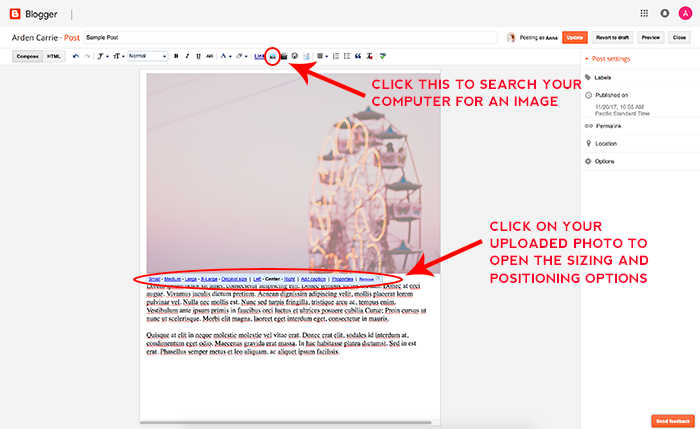
To use the Blogger resizing options, simply create a new post, add a photo, and then click on your uploaded photo to open the sizing and positioning options.

How to Resize Blogger Photos Automatically

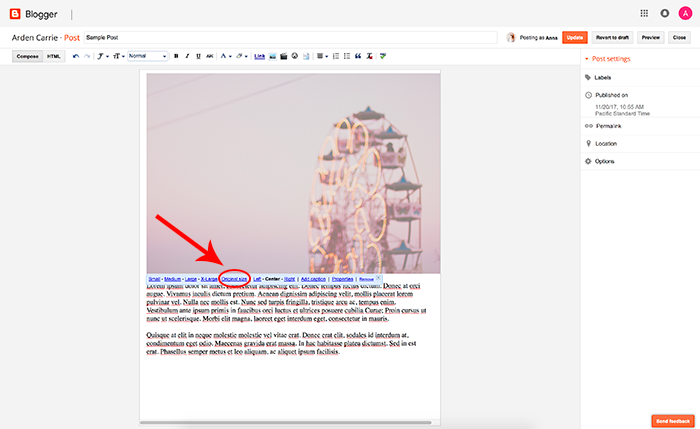
You can set the photo size to small, medium, large, x-large, or to its original size. You can also set the justification to left, center, or right. I recommend centering your photos and using the x-large setting (if you don’t use the trick below) so your photos can be seen in all their glory. The only draw back to using this option is that the x-large size sizes images to 640px, which means if you have a post area that is wider than 640px, the photo will still look a little small. That is where my fancy little trick comes into play, so let’s get to it!

RELATED POST: The 4 Best Places to Find Free Photos for Your Blog


STEP 1: RESIZE YOUR PHOTO

Resizing your blog photos is an important step regardless of whether or not you plan to use this photo sizing trick. This tutorial will still work on photos uploaded in their original size but because uploading original sized photos slows your site WAY DOWN, it is not recommended. The larger the image size, the slower it will load on your site…so trust me, just don’t do it!

Most blogs have a post area width somewhere between 600px-750px, so sizing your photos to 800px wide should work well on most blogs. You’ll want your image to be sized a little larger than your post width with this tutorial because it’s easier to bring an image down in size than it is to bring a small image up in size. Enlarging a small image will cause it to become pixelated and the quality will be low. So to keep things looking good, I recommend sizing your images to around 800px wide with this tutorial.

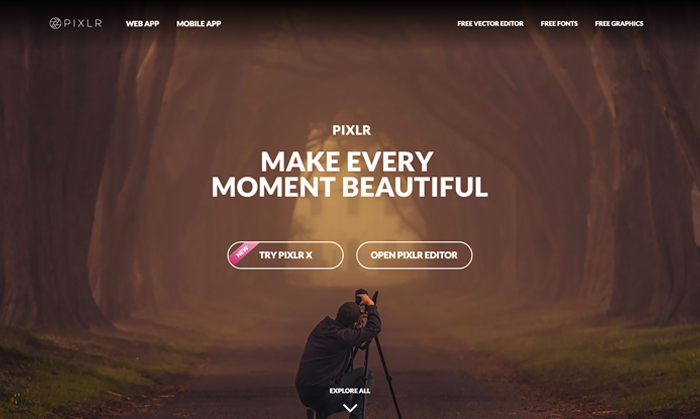
I use Photoshop to resize my images, but if you don’t have Photoshop, Pixlr is a free service you can use to do this. Here’s how to easily resize a photo using Pixlr:

How to Resize Blogger Photos Automatically

1) Hop over to Pixlr, scroll down and click “Launch Web App” under the Pixlr Editor option.

How to Resize Blogger Photos Automatically

2) Click “Open Image from Computer” and find the image you want to use from your computer.

3) Your image will appear and will be ready to be edited. At the bottom of the image you’ll see the current image size. My sample image is currently 4000px wide, which is WAY too large to be uploaded to a blog. So let’s change it to the recommended 800px wide. In the top navigation bar, click “Image” and then “Image size…”

4) Change the image width to 800 pixels. The height of the image will automatically adjust to keep the proper proportions. Click “OK.”

5) Now you just need to save the resized image, so go to “File” and then “Save.” Rename the file (if needed) and then click “OK.” Find the folder on your computer where you’d like to save the image and click “Save.” You’re now ready for the next step.

RELATED POST: 10 Ways to Make Your Blogger Blog Load Faster


STEP 2: ADD A LITTLE CSS

Now that your image is sized correctly you’ll need to add a little coding to achieve the automatic re-sizing. Don’t worry, you don’t need any coding experience for this.

1) First open up your Blogger dashboard and go to “Theme” and then “Customize.”

How to Resize Blogger Photos Automatically

2) Click “Advanced” and then scroll down and click on “Add CSS” and copy/paste the following code into the white box:

.post-body img {
max-width: 100%;
max-height: auto;
display: block;
margin: auto;
}

It should look like this:

How to Resize Blogger Photos Automatically

Note: the above code will only change the images you have set to “Original Size.” If you want ALL of your images to be sized to the full post width regardless of the Blogger re-sizing options you have them set to, add this CSS instead:

.post-body img {
width:100%;
height:100%;
display: block;
}

Now click “Apply to Blog” to save your changes.

RELATED POST: How to Achieve Pixel Perfect Images in Blogger


STEP 3: ADD A PHOTO TO A POST

Now just add a photo to a post like described in the beginning of this tutorial and make sure the photo is set to “Original Size” and your photo will now nicely fill the full width of your post area once you hit “Publish.” This trick will also apply to all previously posted photos as long as the photos are set to “Original Size.” If not, then you’ll want to use the second code option above.

How to Resize Blogger Photos Automatically

Oh so big and pretty!

How to Resize Blogger Photos Automatically

Please leave any questions you may have in the comments and I’ll do my best to answer them. Otherwise, enjoy your lovely automatically resized photos!

RELATED POST: SEO Quick Tip: How to Title and Size Images for SEO

Comment on How to Add Categories to a Menu on WordPress by Kate

0
Comment on How to Add Categories to a Menu on WordPress by Kate

how to add categories to menu in WordPressAs your blog content grows, it’s helpful to know different methods for featuring categories on your blog. One of the most popular ways of featuring categories is by adding links to certain categories on your menu bar.


If you are a food blogger, for example, you might have a primary menu option titled “Recipes” that when hovered over opens a drop-down with links to all of your categories of recipes. When someone clicks on the “desserts” link in the drop-down of your menu, it would then open a page that shows all of your posts that have the “desserts” category assigned to it.

Pages can be created featuring all of the posts within a single category or multiple categories. This tutorial will show you how to feature categories on your menu in WordPress.

RELATED: Categories vs. Tags – What’s the Difference?


When you create a new category in WordPress, a page is automatically generated that includes all the posts assigned to that category. To view the direct link to the page of a single category, go to WordPress Dashboard > Posts > Categories.

When you hover your mouse over the category title, a list of options will appear. Click on View to get the direct link to the single category page.

The link is found in the address bar of your browser. This link can then be copied and used in your menu bar as the direct link to that category.

direct link to category in wordpress - designer blogs

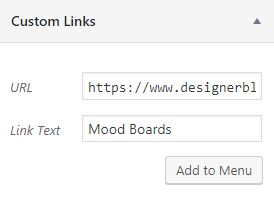
To add the category link to your menu bar, go to Appearance > Menus and then select or create the menu you wish to add the category link to. Then click on Custom Links.

Paste in the category url into the URL box and then title the link. Then click Add to Menu. You can click on the related post link below for further instructions on setting up and organizing a menu.

WordPress Menu Bar Custom Links - Designer Blogs

RELATED: How to Add a Navigation Menu in WordPress


What if you want to create a category page that includes posts from multiple categories? That’s doable too!

Step 1: Go to your WordPress Dashboard and select Posts > Categories. Be sure you have all of the categories created that you’d like included on your new page.

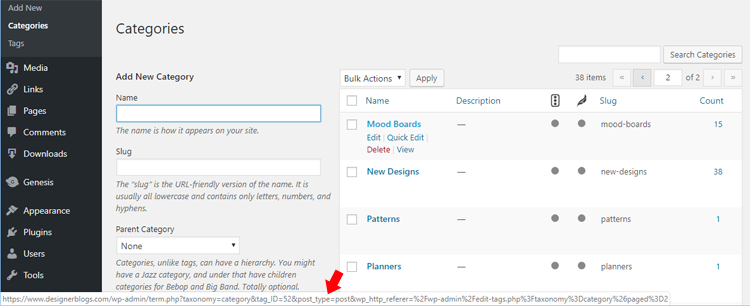
Step 2: Hover your mouse over one of the category titles you want to include and look at the bottom of your screen. You will see a long link similar to the example below.

https://www.designerblogs.com/wp-admin/edit-tags.php?action=edit&taxonomy=category&tag_ID=52….

Finding ID Number for Category - Designer Blogs

The link includes the ID number for your category. In this example, it’s ID=52. Do this for each category you want to include and note the ID numbers for each.

Step 3: Create a New Page with a title that will describe your categories. In this example, we’ll have a category page for Dessert Recipes that will include recipes from the following categories: cupcakes, cookies, and brownies.

Step 4: Under Page Attributes, select Blog as the Template type.

Blog Page Attribute

Step 5: Next you will need to enable a feature called Custom Fields. At the top of the page editor window, you will see a tab called Screen Options.

Screen Options in Post Editor - Designer Blogs

Check the box by Custom Fields.

Blog Post Custom Fields - Designer Blogs

Step 6: Scroll to the bottom of the page editor window until you see the newly added box for Custom Fields. Click the blue Enter new link and then enter the text “query_args” in the Name field box.

In the Value field box, you will use the category ID numbers that you noted in Step 2. Separate the categories with commas as shown below. Then save or publish your new category page.

Add New Custom Field - Designer Blogs

To add this new category page to your menu, go in your dashboard to Appearance > Menus. Select or create the menu you wish to add it to. Under Pages > Most Recent, you’ll see a list of your most recently created pages. Your newly created page will be listed there.

Check the box next to the page and then click Add to Menu. Again for more detailed information on creating and organizing your menus, please visit this post: How to Add a Navigation Menu in WordPress.

categorymenuexample

If you’d like help customzing the look of any of your category pages, we’d love to help you! Click here to request a quote.