fbpx
Home Blog Page 1511

Comment on How to Add Categories to a Menu on WordPress by Kate

0
Comment on How to Add Categories to a Menu on WordPress by Kate

how to add categories to menu in WordPressAs your blog content grows, it’s helpful to know different methods for featuring categories on your blog. One of the most popular ways of featuring categories is by adding links to certain categories on your menu bar.

If you are a food blogger, for example, you might have a primary menu option titled “Recipes” that when hovered over opens a drop-down with links to all of your categories of recipes. When someone clicks on the “desserts” link in the drop-down of your menu, it would then open a page that shows all of your posts that have the “desserts” category assigned to it.

Pages can be created featuring all of the posts within a single category or multiple categories. This tutorial will show you how to feature categories on your menu in WordPress.

RELATED: Categories vs. Tags – What’s the Difference?


When you create a new category in WordPress, a page is automatically generated that includes all the posts assigned to that category. To view the direct link to the page of a single category, go to WordPress Dashboard > Posts > Categories.

When you hover your mouse over the category title, a list of options will appear. Click on View to get the direct link to the single category page.

The link is found in the address bar of your browser. This link can then be copied and used in your menu bar as the direct link to that category.

direct link to category in wordpress - designer blogs

To add the category link to your menu bar, go to Appearance > Menus and then select or create the menu you wish to add the category link to. Then click on Custom Links.

Paste in the category url into the URL box and then title the link. Then click Add to Menu. You can click on the related post link below for further instructions on setting up and organizing a menu.

WordPress Menu Bar Custom Links - Designer Blogs

RELATED: How to Add a Navigation Menu in WordPress


What if you want to create a category page that includes posts from multiple categories? That’s doable too!

Step 1: Go to your WordPress Dashboard and select Posts > Categories. Be sure you have all of the categories created that you’d like included on your new page.

Step 2: Hover your mouse over one of the category titles you want to include and look at the bottom of your screen. You will see a long link similar to the example below.

https://www.designerblogs.com/wp-admin/edit-tags.php?action=edit&taxonomy=category&tag_ID=52….

Finding ID Number for Category - Designer Blogs

The link includes the ID number for your category. In this example, it’s ID=52. Do this for each category you want to include and note the ID numbers for each.

Step 3: Create a New Page with a title that will describe your categories. In this example, we’ll have a category page for Dessert Recipes that will include recipes from the following categories: cupcakes, cookies, and brownies.

Step 4: Under Page Attributes, select Blog as the Template type.

Blog Page Attribute

Step 5: Next you will need to enable a feature called Custom Fields. At the top of the page editor window, you will see a tab called Screen Options.

Screen Options in Post Editor - Designer Blogs

Check the box by Custom Fields.

Blog Post Custom Fields - Designer Blogs

Step 6: Scroll to the bottom of the page editor window until you see the newly added box for Custom Fields. Click the blue Enter new link and then enter the text “query_args” in the Name field box.

In the Value field box, you will use the category ID numbers that you noted in Step 2. Separate the categories with commas as shown below. Then save or publish your new category page.

Add New Custom Field - Designer Blogs

To add this new category page to your menu, go in your dashboard to Appearance > Menus. Select or create the menu you wish to add it to. Under Pages > Most Recent, you’ll see a list of your most recently created pages. Your newly created page will be listed there.

Check the box next to the page and then click Add to Menu. Again for more detailed information on creating and organizing your menus, please visit this post: How to Add a Navigation Menu in WordPress.

categorymenuexample

If you’d like help customzing the look of any of your category pages, we’d love to help you! Click here to request a quote.

Word + Quiz: metronome

0
Word + Quiz: metronome

: clicking pendulum that indicates the exact tempo of a piece of music

_________

The word metronome has appeared in 28 articles on NYTimes.com in the past year, including on March 20 in “‘Us’ Review: Jordan Peele’s Creepy Latest Turns a Funhouse Mirror on Us” by Manohla Dargis:

Jordan Peele’s new horror movie, “Us,” is an expansive philosophical hall of mirrors. Like his 2017 hit, “Get Out,” this daring fun-until-it’s-not shocker starts from the genre’s central premise that everyday life is a wellspring of terrors ….

…. A vibrant, appealing screen presence, Nyong’o brings a tremendous range and depth of feeling to both characters, who she individualizes with such clarity and lapidary detail that they aren’t just distinct beings; they feel as if they were being inhabited by different actors. She gives each a specific walk and sharply opposite gestures and voices (maternally silky vs. monstrously raspy). Adelaide, who studied ballet, moves gracefully and, when need be, rapidly (she racks up miles); Red moves as if keeping time to a metronome, with the staccato, mechanical step and head turns of an automaton. Both have ramrod posture and large unblinking eyes. Red’s mouth is a monstrous abyss.

_________

The Business of Learning

0
The Business of Learning

Pick a number.  Any number.  Better yet, let me toss you with some numbers. You have a dollar, I give you ten cents back.  Now, you are thinking to yourself, “I’ve been ripped off, I only got ten cents for my dollar.”  The next day, you give me another dollar and I give you 90 cents back.  Your response, knowing that the day before I gave you 10 cents, is going to likely be that you received a good deal.  In reality though, I have kept 10 cents from you.

But in your mind, the 10 cents originally, now 90 cents, is a sweet heart of a return.  Welcome to the Business of Learning.

It’s in the numbers

Let’s face it the whole corporate and even education space is about numbers.  If you want to have a program not cut at a university, you need the numbers to support saving it.  Want to keep that Mass Communication department? Show me the numbers of students that are in the program and now show me the numbers that you will have if you add this other department to it. 

On the corporate side, anyone who has ever run a training program or L&D, has to prove that the numbers are there.  Want to keep that budget of yours?  Show me the numbers.  Wish to add an e-learning program and that LMS you keep talking about?  What are the numbers?  You need an additional headcount, no problem, but uh, show me the numbers that will support those resources.

We would be fools if we believed that it isn’t about the numbers.  If you are involved with creating your own budget (based on the dollars that whomever you report to, gave you), then you will need to allocate that money.  E-Learning is not free.  It requires a constant stream of funds, a series of line items in your budget.   First, you purchase a learning system.  Then you will need content, regardless if it is off-the shelf or someone you hired to create the custom content or even yourself or your team building the content via a 3rd party authoring tool.

Ok, so that is done in year one.   Now in year two, you need those funds for the second year of your purchase.  And you want more content so you need funds for that.  Maybe you want to add another type of learning system to your system, creating a hub.  Well, you need funds for that. Plan to continue to market the system to your employees or customers.  That involves funds.  At least with customer training, you can offset the costs of everything, thru fee-based content, with employees it is a lot different.

And the cycle continues.  And with that cycle you will need a new budget with new line items for whatever is needed, including tying it back to the system already purchased.

A Learner is a Number

How many learners are you expecting in your first year?  You say 10,000.  Well, that is a number.   If the learner projections fall flat, besides having to figure out why, you will have a new set of numbers.

Let’s say you want to purchase 3rd party content through the learning system’s marketplace.  There is no reason to purchase it for every learner if you know that only 1,000 of those initial learners (out of the 10,000) are going to use it, or have it available to them.  Yet, it is quite common for folks to forget that, and thus waste those funds.  It would make more sense to purchase a series of 3rd party content, and place a percentage (another number) into Learners X catalog,  Learners Y catalog and so forth.  Breaking it up for maximum usage. 

ROI? Yeah, right.

There is no such thing as ROI when it comes to learning.  Oh, you can find some data, err, numbers to support your initiatives and tell your boss, see – the numbers support this is successful, but in reality, you are pulling numbers out of thin air. 

This is why training and learning execs will often point to an increase in productivity, happier employees and customers as validation.  Yes it is true, that happy employees produce more and are more likely to stay (when they have personal and professional development), because of learning/training versus when this doesn’t happen and all you provide is compliance and regulatory.

When the sales training executive or training/learning person goes to their boss and says, “Look, our sales increased 84% and Jimmy’s sales numbers went up 92% because he took a variety of our sales content,” you are fully aware that that is just one variable in the whole thing.  There are other variables that do not involve training or learning, but if you want that bigger budget you need to back it with data to support that.  This is the small print in the training/learning world for employees. 

With customer training or some other type of B2B training, it is quite different.

Want to make a million dollars in your first year with customer training?

You may think to yourself that is impossible in customer training or some other type of B2B (I include associations in the B2B market).   I can tell you first hand and from experience it is not only possible but depending on how you go about it, very feasible without having to price gouge your customers to do it. 

Too many folks in the customer training/B2B type of training think they have to charge a large amount because well, that is how they can recoup their funds.  But here are a few secrets on how to pull it off, without charging someone $300 or more for a course or a piece of content.

  • Calculate the first year for that learning system.  Exclude the setup fee for now. 

EXAMPLE

You purchase a learning system for $50,000 based on the projection that you will have 5,000 learners.  You have just made your first mistake.  What you should be saying to yourself is that a)you have no idea on how many learners you will acquire, but you think with the content you are providing, it could get X number.

To generate real revenue to back the number you just dropped, you should be thinking $50,000 divided by 12 is $4,166.66, but let’s just round it up to $4,167.  This means that you need to generate that amount of money per month to break even.

You decide to charge $150 for one course.

To reach the $4,167 dollars you need for that month, you will need 28 customers to buy that one course at $150 (for the month) to break even (actually you would be profitable by 33 dollars).

To reach the $50,000 mark for the first year (the cost of the system), if you have only 400 customers purchase that one piece of content for the year, you are now $10,000 dollars on the profit side for your system.

Thus if you truly score 10,000 customers buying one course at $150, you will generate 1.5 million dollars. 

And we haven’t even talked about a fee-based webinar. If you are buying a web conferencing tool, it is very feasible to be profitable six months into your purchase, even at a low price point.

Let’s jump back though to purchasing a piece of content.  You decide to charge $50 per course.  Even at that number, you will need only 1,000 learners (customers) to break even for the year.  And if you toss in a second course at $35 (which is the 2nd level after the base one they need to take which is $50), that is all pure profit, because you have reached the break-even at 1000 learners.

With these kind of numbers, any senior executive would green light additional funds for the next year budget.

My System bought your system, “na-na-na-na”

In 2019, acquisition numbers where the highest they have ever been (globally), in more than 10 years.  I’m not referring to the dollar amounts of the buys, rather the number of vendors acquiring other vendors, the number of PEs buying a vendor and/or the number of companies outside of the space jumping in by buying a learning system vendor.

This of course, and the amount of PE money flowing around to provide capital to vendors who either needed it to “compete” whether it is an infusion to R&D or marketing (often the case) to boost those, wait for it, numbers.

Already in 2020, we have seen Cornerstone acquire Saba, and a few other smaller buys (other vendors). 

When I walked around the LTUK trade show, I could count how many vendors were either privately on the market or had sent out letters of interest (to gauge if Vendor X wants to buy Vendor Y). I saw vendors who were barely staying afloat even though they had a big booth, implying that are generating large sums of money. 

I saw vendors whose numbers in yearly sales should be significantly higher, than what they actually have, indicating a serious issue within the company themselves, yet with a bigger size booth, implying that the number that is in your head (after all it is a big booth), must be quite high, otherwise, how could they afford the booth in the first place?

When a vendor buys another system, the numbers are often hidden because in the learning system industry, heck even in other e-learning product spaces, the vendors are private, thus having to show the amount to everyone is not a requirement. 

I”m not going to delve into ARR or other accounting principles that are necessities when buying other vendor or the capital for R&D, etc. 

What I am going to talk about are two numbers on top of sales that play a very important role, in you as the client of the system.

Vendors love to toss out their renewal rates to anyone who is listening, especially in those marvelous press releases.  The other number they love to present? The number of clients and the client growth i.e. number of clients they have added.

To be clear there are vendors who either have no understanding of how numbers work when it comes to renewal rates, and thus toss out numbers that to say the least are impossible.

A renewal rate is all about you the client of that system.  It is based on the number of current clients (not the ones they are about to sign), and the renewal of that client for their system.

Let’s say Vendor A has 50 current clients for 2018.  In 2019,  all 50 have renewed, which the vendor will say we have a 100% renewal rate and you think “wow, they must have a great system.” But what you fail to realize is that each of those 50 clients signed a three year deal with that vendor, so of course it is going to be 100%.  Again, I’m not referring to new clients who signed in 2019, rather for renewal rate in this example, the original 50 from 2018.

I know of one vendor who told me they renewal rate was 140%.  I told them that is impossible. If you have 50 original clients for 2018, and all 50 renewed that is 100%, you can’t go higher than that.  If you had 50 clients and now you have 65 clients for 2019, then only those original 50 who renewed in 2020, again, equal 100% (assuming they have all multi-year deals).  You wouldn’t count the other 15 who have signed up – those are new customers.

Every vendor wants clients, in fact, without them, they are not going to be around for long.  The more clients the assumption is the more revenue they are making, because sales are going through the roof, but there are plenty of vendors who will take a loss or a series of losses to land those customers, to give the impression they must be generating a large amount of $$$ because of the number of clients.

I know of plenty of vendors who are all about incurring debt (yes I can see why you think this is a bad thing).  They want more customers, so they undercut at a significant lower price point, because it is all about the numbers, of clients. 

Some vendors buy other vendors simply for the number of clients.  The system itself? Either is sunset within a year or two, or is running with a skeleton crew for those customers who will not move other to the system that has acquired their system.  If a customer has 1M users and does not want to go to the new system (i.e. the buyer), it would be foolish for the new buyer to sunset the system, because that would be a huge loss of yearly sales on that other system.   Eventually though, that customer will either need to switch over or exit out and go elsewhere.

I should note that I’ve yet to see a system when they buy another system – which may or may not be a competitor and most of the times they aren’t,  say publicly we are only interested in the clients and not the system itself.  That wouldn’t be good. 

One number that many folks forget about when someone buys someone else is the headcount at the vendor that just got acquired.  Many of those folks will not be joining the buyer, due to redundancy.  That is to say, Carolyn works in HR at the buyer, and Steve works in HR with the exact same role with the system that has been acquired. Steve is more than likely on the fast track for unemployment.  If Steve is a rock star, maybe he is kept but pushed into another role, assuming he has those skill sets, but for our scenario, Steve doesn’t and Steve is gone. 

You can bet that not all the sales people are coming over to the new company.  Only the best will go, the rest are cut.

Again, numbers.

Bottom Line

It would make a lot of sense if those folks who are being let go, are given access to the learning system that the used to work for, so they could hone up and learn new skills, yet I have yet to see that happen.

Thus the push of onboarding, upskilling that the vendor pushes (let’s say the new buyer, along with the one that just got bought) doesn’t apply to those who are cut do to redundancy. 

If anything those are folks who need it the most. 

But it comes down to numbers.

After all, I just gave you 90 cents for that dollar.

The other 10 cents?

Tax.

E-Learning 24/7

Sorry for the delay in writing the blog, due to being ill for the past week.  Going forward, the next blog will be published this upcoming weekend.


How to Start a Blog

0
How to Start a Blog

How to Start a Blog on WordPress - Designer Blogs

Are you a new blogger or a seasoned Blogspot or WordPress.com blogger wanting to switch your blog over to self-hosted WordPress? Or, are you wanting to build a website? Then you’ve come to the right place. In this post, we will show you how to start a blog.

This tutorial will walk you through you how to launch a self-hosted WordPress site on Bluehost (our preferred web host) in four simple steps.

Bluehost is one of the largest and most trusted web hosting provider’s out there. They have very affordable pricing, stellar customer service, are incredibly reliable, and they install WordPress automatically! Follow these four simple steps and you’ll have a self-hosted WordPress site set up in a jiffy.


How to start a blog

Step 1: Domain Hosting

The first step is to get your hosting in place, so head on over to Bluehost and click on that big green button.

Note: receive exclusive pricing by signing up through this link.*

Bluehost Exclusive Designer Blogs Offer - Designer Blogs

Select a plan

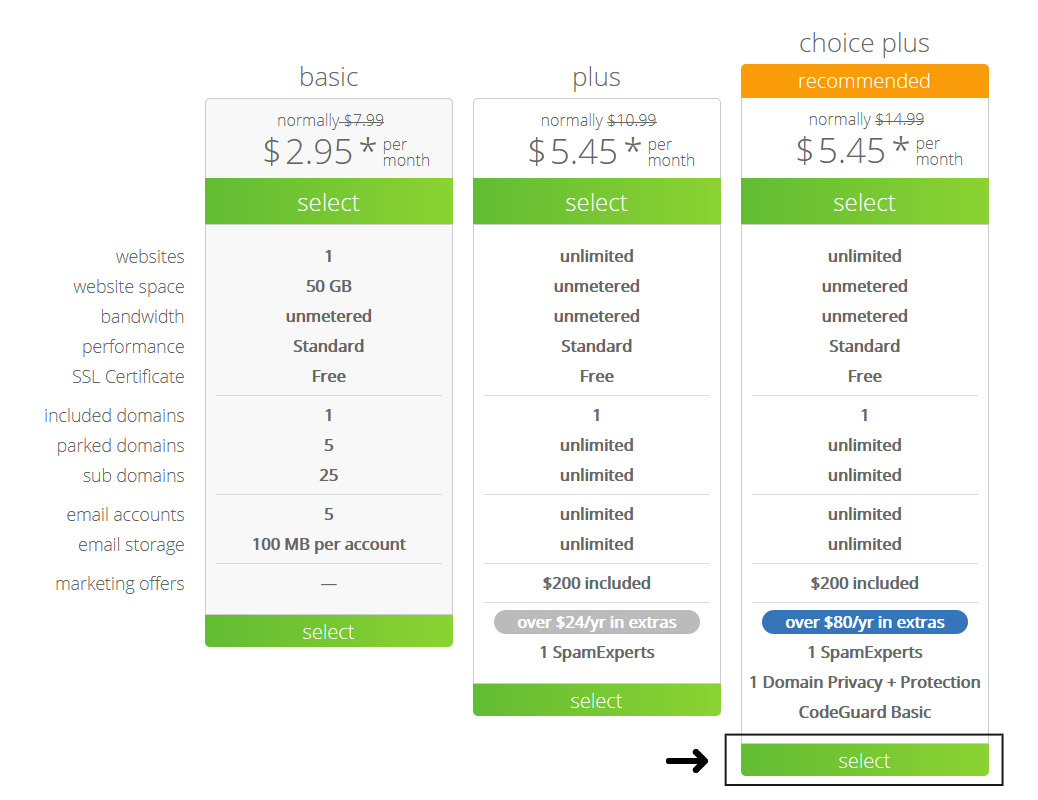
The “prime” plan is the most popular and really does give you the most bang for your buck, but if you want to start with the “basic” or “plus,” plans due to limited funds, know you can always upgrade in the future if needed.

Bluehost Hosting Plans - Designer Blogs

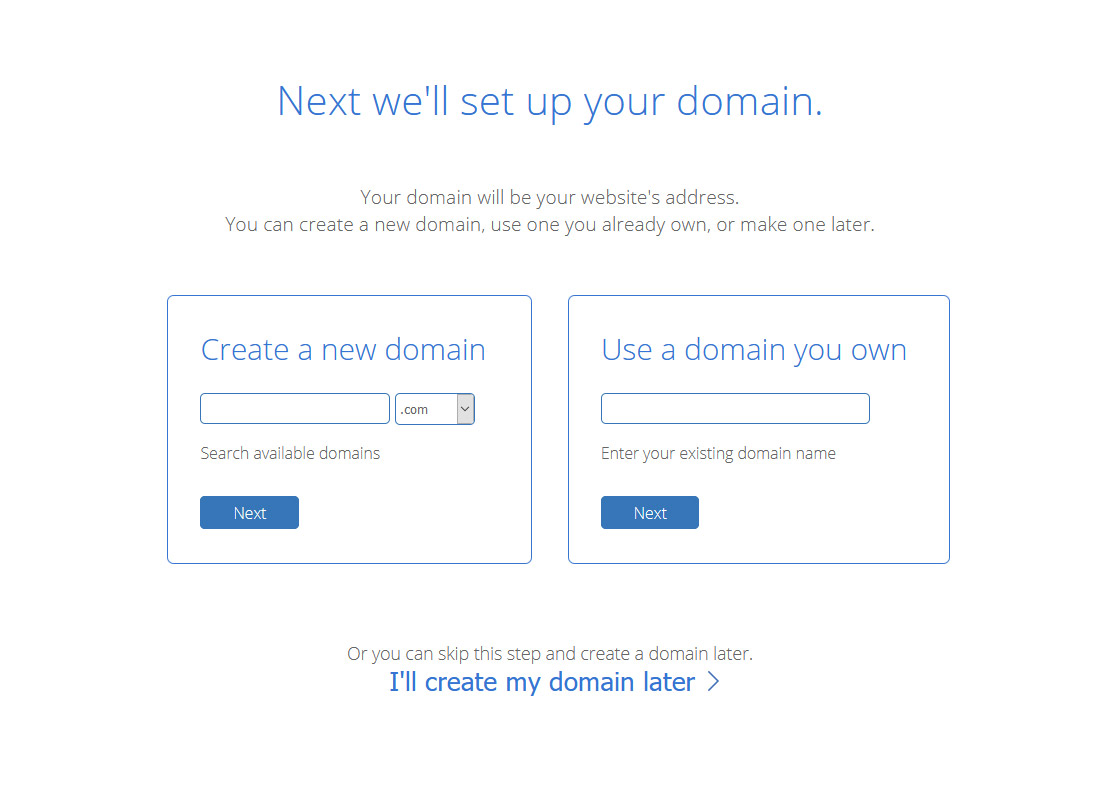
If you haven’t thought about what you want to call your blog, now’s the time.

Try your best to match your domain to the title of your blog (e.g. our site name is Designer Blogs, so we chose the domain www.designerblogs.com).

If the domain you are wanting isn’t available, try using different variations of your title (it will offer you some suggestions). If you already own a domain that you’d like to use, enter it in the area provided.

RELATED: 5 Blog Investments Worth Making (read this for tips on choosing a killer domain)

Bluehost Sign Up Page - Designer Blogs

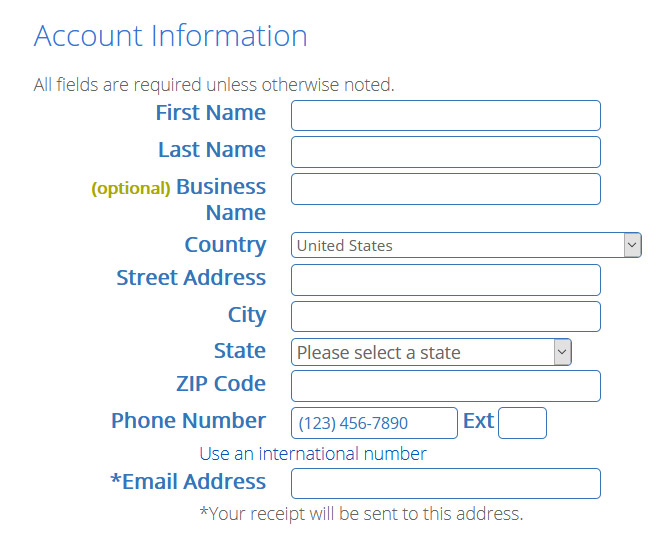
Follow the instructions and enter in your account information. Be sure to use a working email address because this is where your login info will be sent.

Bluehost Account Information - Designer Blogs

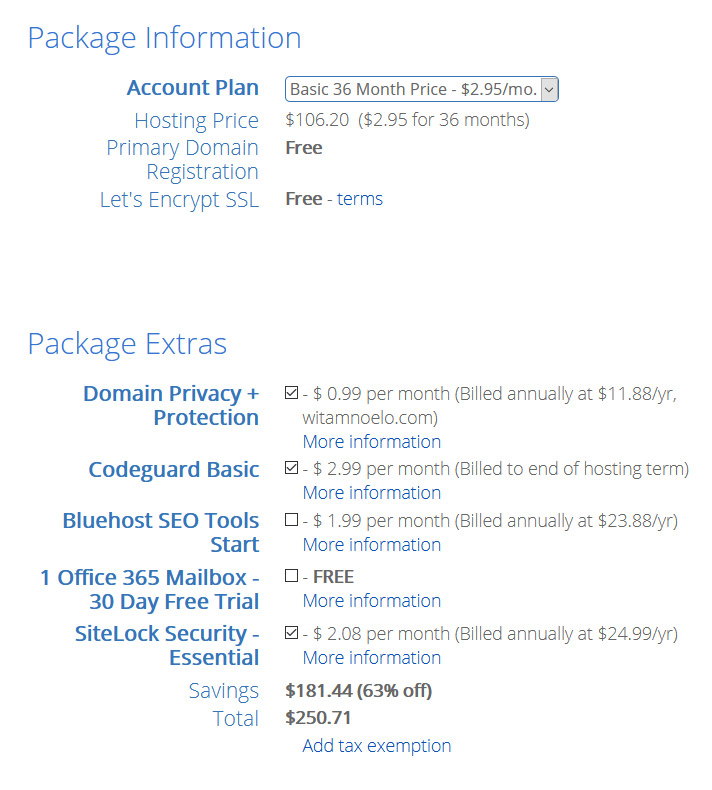
Now select your package details. A few extras you might consider adding are:

  • Domain Privacy + Protection: this protection keeps your personal information private (note: you will only see this option if you registered a new domain above. It will not show up if you used a transferred domain). This option is FREE with plus plan.
  • Codeguard Basic: this allows you to create and restore backups of your account’s files, databases, email accounts, etc. This option is FREE with plus plan.
  • Bluehost SEO Tools: tools to help you get better ranks in web browsers.
  • SiteLock Security – Find: this automatically scans your website for malware to ensure it is not being blocked or spammed and helps give your business instant credibility and trust in the eyes of your customers.
Bluehost Package Information - Designer Blogs

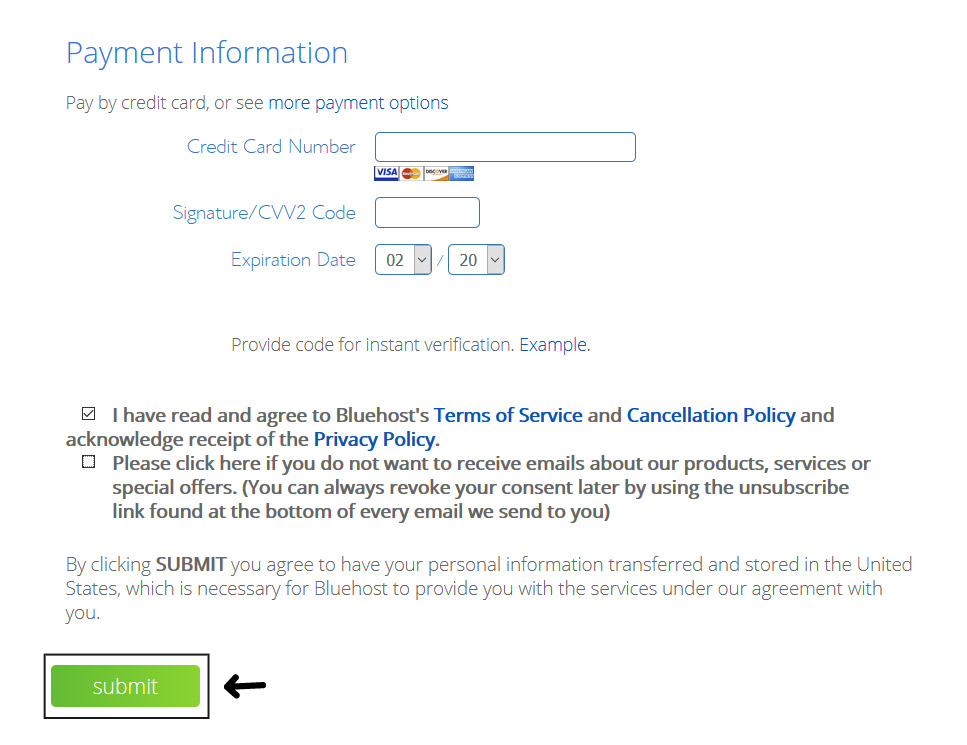
Finally, enter in your billing information, confirm that you’ve read the fine print, and hit submit.

Bluehost Payment Information - Designer Blogs

Your hosting account will now be in place.


Step 2: Activate Your Domain & Choose Password

Once you hit submit you’ll be asked if you want to add any upgrades or extras. Just skip them by clicking “no thanks” at the bottom of the screen.

Now you’ll need to log into your email and locate the emails sent to you from Bluehost.

If you don’t see them in your inbox, check your spam folder.

It’s important to locate these because they contain your login information.

In one of those welcome emails, you will be asked to activate your domain (if you chose a new one). Open the email and click on the button found inside to complete the activation process.

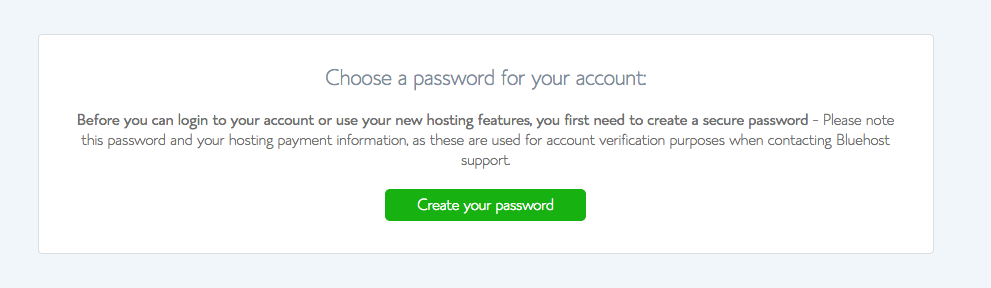
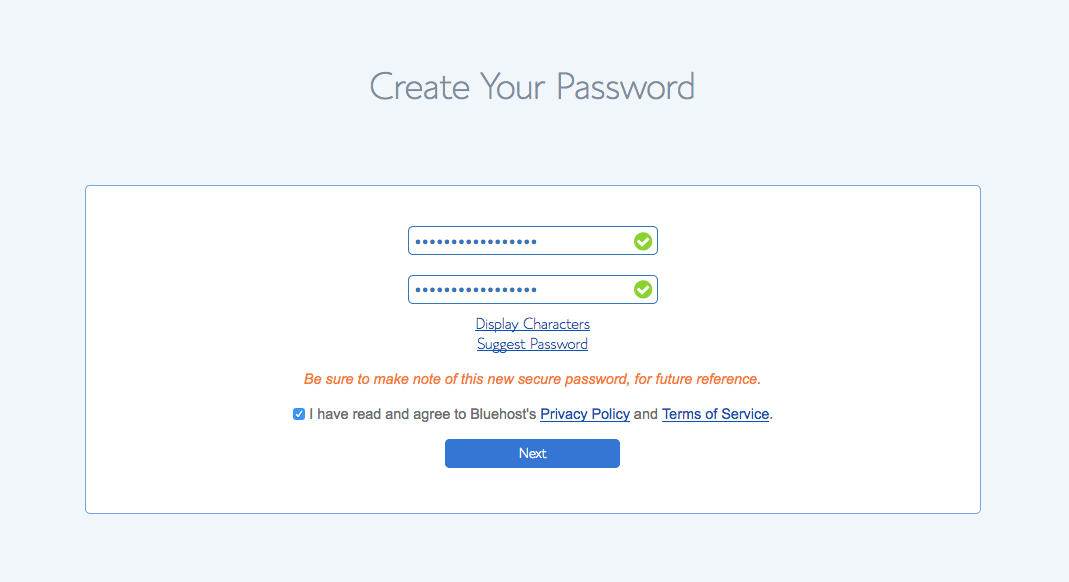
At the end of your purchase, you’ll be welcomed and asked to choose a password. Click the “create your password” button and choose a secure password.

Choose a Password - Designer Blogs
Create Your Password - Designer Blogs

This password will allow you to login and get started.


Step 3: Open WordPress

Bluehost automatically installs WordPress for you so you can start working on your new blog right away.

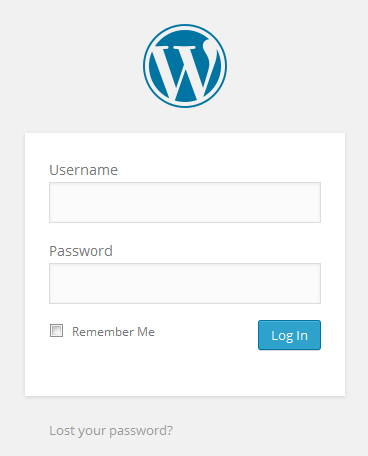
You can log into your site by going to yourdomain.com/wp-admin (“yourdomain.com” being your own personal domain).

This will bring you to the login area on the backend of your site. It’s a good idea to bookmark your login page so you can easily access it when you need to log in.

Enter in the login info you wrote down from the previous step and then click “Log In.”

RELATED: How to Change Logo on WordPress Login Page

WordPress Login Screen - Designer Blogs

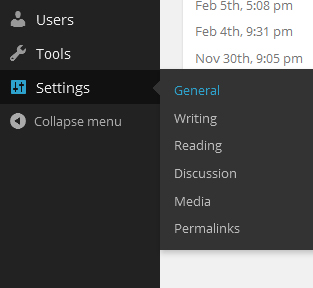
First, let’s get your basic settings in place, so in your dashboard go to “Settings” and then “General.”

WordPress Dashboard Settings - Designer Blogs

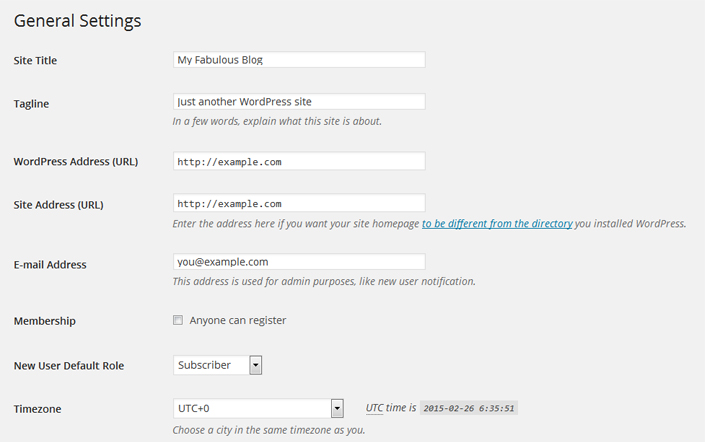
Enter in your site title, tagline, url, email and the other information it asks for and click “Save Changes.”

WordPress General Settings - Designer Blogs

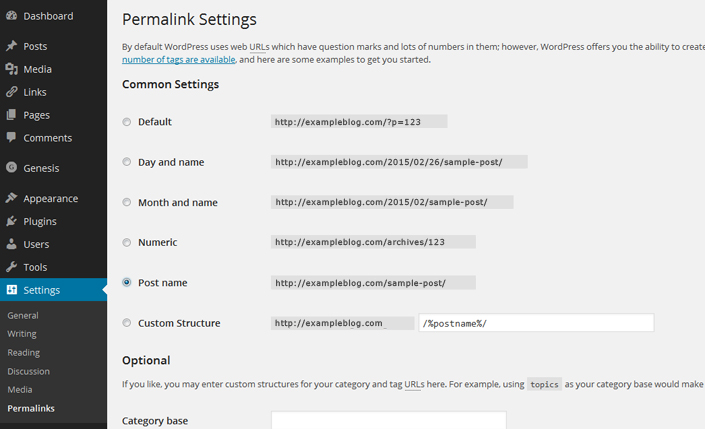
Now I highly recommend that you change your permalink settings for SEO purposes. To do this go to “Settings” and then “Permalinks” and then select the “Post name” option and click “Save Changes.”

WordPress Permalink Settings - Designer Blogs

I also recommend that you click through each of the options under “Settings” to get the additional options set up like you want.

You can also visit our WordPress Tutorials page for additional help in getting the other areas of your site set up.


Step 4: Make it Gorgeous!

Now it’s time to get your blog looking fabulous! You have a few options when it comes to the look of your site:

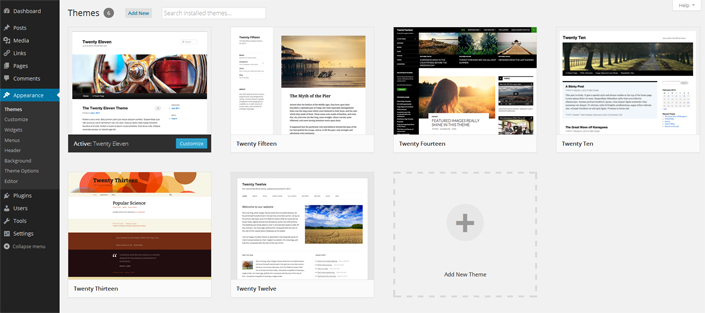
1) You can use one of the free generic themes that are included with your WordPress install. Go to “Appearance” and then “Themes” to find them. As you can see, they aren’t much to look at and there isn’t much variety, but if it’s not in your budget to spend money on a theme right now, then it’s a good place to start.

WordPress Default Themes - Designer Blogs

2) You can hire a blog design company (like Designer Blogs!) to create a fabulous design for you. We offer very affordable WordPress Themes or if you want a one-of-a-kind blog design, you can request a quote for a custom design. With either option, we take care of the design work (including install) so you don’t have to worry about a thing!

Designer Blogs Screenshot

We hope you’ve found this tutorial helpful and by now you know exactly how to start a blog. If you have any questions, please leave a comment below and we’ll do our best to answer!


*Disclaimer: this post contains affiliate links, which means your clicks and purchases help support Designer Blogs at no extra cost to you. We only recommend products we absolutely love.

Word + Quiz: totem

0
Word + Quiz: totem

1. emblem consisting of an object such as an animal or plant; serves as the symbol of a family or clan (especially among American Indians)

2. something that stands as an emblem or an honored symbol

3. a clan or family identified by their kinship to a common totemic object

_________

The word totem has appeared in 54 articles on NYTimes.com in the past year, including on Jan. 26 in “Japan’s Skateboarders Roll, Warily, Out of the Shadows” by John Branch:

Over the decades, like so many other anti-authority movements, skateboarding leaked into the mainstream. Skateboards — a mode of transportation, an instrument of art, a totem of defiance — now glide across American sidewalks, plazas and streets. These days, skateboarding style, fashion and culture have morphed into beacons for masses looking for calculated rebelliousness.

_________

Do You Have More Good Habits Than Bad?

0
Do You Have More Good Habits Than Bad?

Find all our Student Opinion questions here.

What healthy habits do you have? Think about your day, beginning when you wake up. What do you do regularly that is good for your physical, mental or spiritual health? How did you acquire these healthy habits?

What habits do you wish you had? Have you ever set out to build a new habit — and failed? What do you think it takes to make good, healthy habits? Willpower? Incentives? A buddy?

In “How to Build Healthy Habits,” Tara Parker-Pope writes about research on forming good, healthy habits. The article begins:

We’re all creatures of habit. We tend to wake up at the same time each day, brush our teeth, have morning coffee and commute to work, following the same patterns every day.

So why is it so hard to form new healthy habits?

Behavioral scientists who study habit formation say that many of us try to create healthy habits the wrong way. We make bold resolutions to start exercising or lose weight, for example, without taking the steps needed to set ourselves up for success.

Ms. Parker-Pope presents several research-backed tips for forming new healthy habits. Here are excerpts from three:

Stack your habits. The best way to form a new habit is to tie it to an existing habit, experts say. Look for patterns in your day and think about how you can use existing habits to create new, positive ones.

For many of us, our morning routine is our strongest routine, so that’s a great place to stack on a new habit. A morning cup of coffee, for example, can create a great opportunity to start a new one-minute meditation practice. Or, while you are brushing your teeth, you might choose to do squats or stand on one foot to practice balance.

Start small. B.J. Fogg, a Stanford University researcher and author of the book “Tiny Habits,” notes that big behavior changes require a high level of motivation that often can’t be sustained. He suggests starting with tiny habits to make the new habit as easy as possible in the beginning. Taking a daily short walk, for example, could be the beginning of an exercise habit. Or, putting an apple in your bag every day could lead to better eating habits.

Do it every day. British researchers studied how people form habits in the real world, asking participants to choose a simple habit they wanted to form, like drinking water at lunch or taking a walk before dinner. The study, published in the European Journal of Social Psychology, showed that the amount of time it took for the task to become automatic — a habit — ranged from 18 to 254 days. The median time was 66 days!

The lesson is that habits take a long time to create, but they form faster when we do them more often, so start with something reasonable that is really easy to do. You are more likely to stick with an exercise habit if you do some small exercise — jumping jacks, a yoga pose, a brisk walk — every day, rather than trying to get to the gym three days a week. Once the daily exercise becomes a habit, you can explore new, more intense forms of exercise.

Reward yourself. Rewards are an important part of habit formation. When we brush our teeth, the reward is immediate — a minty fresh mouth. But some rewards — like weight loss or the physical changes from exercise — take longer to show up. That’s why it helps to build in some immediate rewards to help you form the habit. Listening to audiobooks while running, for example, or watching a favorite cooking show on the treadmill can help reinforce an exercise habit. Or plan an exercise date so the reward is time with a friend.

Students, read the entire article, then tell us:

  • Do you have more good habits than bad? Tell us about some of your best and worst habits, and how you acquired them. How do they affect your life, in and out of school?

  • The article says that many of us try to create healthy habits the wrong way. How good are you at building new, healthy habits? Have you ever made bold resolutions without “taking the steps needed to set ourselves up for success”?

  • Which tips for building positive habits from the article do you find most useful and why? Which do you think would be hardest for you to successfully practice? Are there other tips you would recommend?

  • Have you ever successfully broken a bad habit? If yes, how were you able to accomplish it? What advice would you give others who might wish to discard the same bad habit?

  • What habits do you wish you had? Why? Is there one single habit you would most like to build or break? Does reading the article motivate you to try now? What tips and strategies would you employ to optimize your chances for success?

If you are inspired by the article, take the Times Healthy-Habits Well Challenge, a 28-day plan to nourish your body, mind and spirit, one daily challenge at a time.


Students 13 and older are invited to comment. All comments are moderated by the Learning Network staff, but please keep in mind that once your comment is accepted, it will be made public.

Lesson of the Day: ‘With Weinstein Conviction, Jury Delivers a Verdict on #MeToo’

0
Lesson of the Day: ‘With Weinstein Conviction, Jury Delivers a Verdict on #MeToo’

6. Fatima Goss Graves, the president of the National Women’s Law Center said that the verdict provided hope that we can “have a criminal justice system that reflects the reality of sexual violence.” What does Ms. Graves mean by that? What does Mr. Weinstein’s case reveal about sexual violence?

Following the verdict, The New York Times asked some of Mr. Weinstein’s accusers, legal experts and stakeholders in the #MeToo movement for their reactions. Those responses are compiled in the article “‘Finally’: Ashley Judd and Other Weinstein Accusers Respond to Verdict.” Here are excerpts:

Ashley Judd was the first actress to publicly accuse Mr. Weinstein of sexual misconduct.

The story of #MeToo, of what the movement is about, is that men no longer have tacit permission to use their power or prestige to sexually access girls’ and women’s bodies. Their power and position cannot be used in secret or in the open to exploit asymmetry of power. There will be consequences in the courtroom, in employment and in society. …

… I would love for Harvey to have a restorative justice process in which he could come emotionally to terms with his wrongs. The criminal justice system is a distant second to a more humane kind of process. This is what he has created for himself: prison, lack of remorse, lack of accountability. The man is going to prison for sex crimes.

Fatima Goss Graves is the president of the National Women’s Law Center.

What defense attorneys do is create a narrative that only one type of person could experience sexual violence, and that there is only one type of response. They discount behaviors that are actually really typical in an effort to blame victims. This moment we are in is an opportunity to disrupt the story of a typical survivor, and to disrupt the story of a typical response.

Chanel Miller wrote a memoir, “Know My Name,” about her experience as the victim in a high-profile sexual assault case.

Today we locked one man in one cell. We made progress because survivors keep speaking. Still, this was a case where many others looked away for decades. It was not just power that made him untouchable, people did. We cannot be afforded the neatness of closure. We should confront the question on our collective conscience: The next time you are aware of violence, will you be silent or speak?

Zelda Perkins is a former Miramax assistant who was the first woman to break a nondisclosure agreement with Mr. Weinstein.

Harvey going down for five years, 10 years, is not the end of this. This does not solve the problem. We can’t all just turn our eyes back to normal life and think everything is OK.

The fight absolutely doesn’t stop here. I think Harvey has become the ogre and the figurehead of this awful situation, but he is not the only one. And I think we have to remember that #MeToo was not about Harvey Weinstein. Tarana Burke did not start #MeToo because of Weinstein.

#MeToo has not been finished by him going to jail. And I hope this is the beginning of judges and juries understanding and taking the nuances of abuses of power more seriously.

If you have more time, read the entire article. Then, engage in a Big Paper discussion in response to the questions: What is your reaction to the Harvey Weinstein verdict? Do you think the verdict will change how sexual harassment and assault are viewed and prosecuted? How do you think this will shift how teenagers talk about consent, sex and harassment? What do you think the verdict means for the #MeToo movement at large?

Inside a Book

0
Inside a Book

What do you think this image is saying? How does it relate to or comment on society or the world today? Can you relate to it personally? What is your opinion of its message?

Tell us in the comments, then read the related book review to find out what it means.


Find many more ways to use our Picture Prompt feature in this lesson plan. You can find all our Picture Prompts in this column.

Fake Ice

0
Fake Ice

What story does this video inspire for you? Use your imagination to write the opening of a short story or poem from the perspective of one of the skaters or the spectator who is filming them.

Or, tell us about a memory from your own life that this video makes you think of.

Post it in the comments, then read the related article to learn more.


Find many more ways to use our Picture Prompt feature in this lesson plan. You can find all our Picture Prompts in this column.

Word + Quiz: flamboyant

0
Word + Quiz: flamboyant

adjective: marked by ostentation and often colorful display

noun: showy tropical tree or shrub native to Madagascar; widely planted in tropical regions for its immense racemes of scarlet and orange flowers; sometimes placed in genus Poinciana

_________

The word flamboyant has appeared in 209 articles on NYTimes.com in the past year, including on Jan. 29 in “Kobe Bryant’s Many Moves to the Net” by Guy Trebay:

“As a young player, Kobe was predominantly donning more casual wear, active pieces, baggy sweatsuits and Michael Jordan Bulls jerseys,’’ said Jamaal Richards, whose Instagram account MoreThanStats is a mother lode of images documenting the transformation of athletes into fashion leaders. “As he grew as a player, a superstar and celebrity, he turned more toward sartorial elegance and sleek bespoke suiting. It was a natural progression for him since he always had that professional mind-state, that mamba mentality.”

Off court as well as on, Mr. Bryant was precise rather than flamboyant, cerebral, reading the public situations in which he increasingly found himself — from magazine photo shoots to red carpets — for their utility to him over the long term.

_________