fbpx
Home Blog Page 1522

Learn and take action with three new Teach-Outs from JHU, Emory, and the University of Michigan

0
Learn and take action with three new Teach-Outs from JHU, Emory, and the University of Michigan

A guest post written by: 

Benjamin Morse, Design Manager

University of Michigan

Stephanie Parisi, Associate Director of Instructional Design

Emory University

@snparisi 

Rebecca G. Williams, Research Program Manager

Johns Hopkins University

@rebecca_gwen


Our world is evolving rapidly and the need to understand complex societal issues and engage in productive and civil discourse has never been higher. Today’s issues may be different than those in the past, but one thing is certain, we need more ways to facilitate connections, share information and narrative, and build skills and tools to take action.

What is a Teach-Out? 

Teach-Outs bring learners together from around the world to learn about and discuss salient social topics and consider actions to take within their own contexts (more at TeachOut.org). In a Teach-Out:

  • How, and how much, to participate is up to you
  • There aren’t quizzes or checkpoints
  • Experts come together to engage with the world in a broad discussion around key social issues central to our every day lives and relationships

Learn more about three brand-new Teach-Outs on gun violence prevention policies, education journeys, and the history and processes of primary elections from the experts that created them. 

Rebecca G. Williams, Research Program Manager

Johns Hopkins University

Johns Hopkins University (JHU) launched its first Teach-Out on January 20, 2020. This pilot learning event, Firearm Purchaser Licensing Teach-Out: The Background Check Policy Not Enough People are Talking About, has been a collaborative effort on behalf of the Center for Gun Policy and Research and Center for Teaching and Learning of JHU’s Bloomberg School of Public Health.

JHU has been a long-time proponent of web-based learning, launching 91 total courses and enrolling more than 7 million learners across 195 countries since 2012. In the wake of the tragic 2017 shooting at Marjory Stoneman Douglas highschool in Parkland, Florida, the surge of youth activism and rise of the gun violence prevention advocacy movement compelled researchers at the Center for Gun Policy and Research to create the first massive open online course (MOOC) on gun violence prevention.

Rebecca G. Williams interviewing Baltimore City residents in the East Baltimore neighborhood to learn their perspectives on gun violence and how it impacts them and their communities.

Our goal was to provide youth with the best available science and insights on gun violence as well as the skills to understand which interventions are the most effective. We invited experts outside of JHU and intentionally curated our content to reach a broader audience than that typical of other JHU online courses.

After the success of our online course Reducing Gun Violence in America: Evidence for Change, which incorporates the contributions of more than 20 experts representing organizations and institutions across the country and was promoted to national networks of youth advocates on behalf of March For Our Lives shortly after launching in May 2019, we saw an opportunity to further address learners’ interest in this subject in a Teach-Out.  

The Center for Gun Policy and Research and the Center for Teaching and Learning redefined the boundaries of JHU’s open education environment and have continued to harness the benefits of collaboration through their first adaptation of the Teach-Out model with Firearm Purchaser Licensing: The Background Check Policy Not Enough People are Talking About.

Stephanie Parisi, Associate Director of Instructional Design

Emory University

In April 2019, Emory launched their first Teach-Out titled “Making” Progress (read more about that project in this blog). The Teach-Out was integrated with an on-campus course and its development involved several members of the Emory and Atlanta community. The collaboration and creation of the Teach-Out was so powerful and impactful that even almost a year later, the connections made during the teach-out have generated more collaborations and conversations. Looking back at that experience, we knew we could take it to the next level the second time around.

This year, we chose to base our Teach-Out on themes from Emory’s Common Read, Educated by Tara Westover. The Journeys to Education Teach-Out collects perspectives from faculty, students, staff, administrators, and community members, including Richard Blanco, fifth presidential inaugural poet. Our hope is that participants will reflect upon their own unique educational journeys and consider sharing them as part of a larger conversation about the many ways individuals experience education in different stages of their lives. With the Teach-Outs, Emory’s motivation has been to facilitate conversations around difficult topics and promote the respectful sharing of perspectives. We care deeply about and are committed to community engagement and social impact.

Sonya Owens with Dr. Jan Barton. Videographer Raymond McCrea Jones and assistant, Dave.

Benjamin Morse, Design Manager

University of Michigan 

Since March 2017, the University of Michigan has launched 29 Teach-Outs on four platforms, collaborated with more than 250 experts, and engaged with more than 88,000 learners from around the world using this model. On January 29, 2020, we launched our 30th Teach-Out, the Why Iowa? A Primer on Primaries and Caucuses Teach-Out, on Coursera. This Teach-Out will delve into the history and processes of the U.S. presidential primary elections and will provide learners resources and strategies to get involved in their own contexts. 

This Teach-Out serves as a springboard into the 2020 election year in the U.S. and kicks-off our Center’s efforts to create a range of open online learning experiences focused on U.S. politics and civic engagement. On October 15, 2020, the University of Michigan will host a presidential debate just prior to the November general election. This is a tremendous opportunity for the university community to engage in shaping democracy and this initial Teach-Out is one way that we will connect University of Michigan scholars with engaged citizens. 


We hope that you join us, both as a learner and a teacher, in these Teach-Outs to help reimagine how we connect with one another in the digital age and what we can do as a society to solve our most pressing issues. In our collective experience, fostering these connections requires commitment to the core tenants of the Teach-Out model: bringing diverse perspectives together to learn about, discuss, and consider action, all built on a strong foundation of shared values and trust. 


About the authors

Rebecca G. Williams

In her role as a core member of the Johns Hopkins Center for Gun Policy and Research (JHCGPR) study team, Rebecca’s work is central to gun violence prevention research translation. At JHCGPR, she is responsible for managing the design and development of open education initiatives which first began with the first gun violence MOOC, Reducing Gun Violence in America: Evidence for Change. Rebecca attended University of Michigan’s 2019 Teach-Out Academy and is the Program Manager for Johns Hopkins University’s inaugural Teach-Out on Firearm Purchaser Licensing:The Background Check Not Enough People are Talking About. Learn more about her work by reading her full bio here. 

Stephanie Parisi 

Stephanie supports faculty as they prepare to design and teach online, hybrid, and blended courses at Emory University. She collaborates with faculty to envision massive open online courses (MOOCs) for the Coursera platform and also serves as an advisor for instructional design and eLearning development. She has been at the forefront of several innovative teaching projects, most recently the Teach-Out initiative. Formerly with the Center for Faculty Development and Excellence, Stephanie now serves as the Associate Director of Instructional Design with Goizueta Business School at Emory.

——–

—–

Benjamin Morse, Design Manager 

Benjamin facilitates the work of the Center for Academic Innovation by managing the scoping, design, and development of Teach-Outs (more at teachout.org) and other learning initiatives at the Center to deliver high-­quality online learning experiences with an emphasis on public engagement and actionable outcomes. (Full Bio Here)

 

This Professor’s ‘Amazing’ Trick Makes Quadratic Equations Easier

0
This Professor’s ‘Amazing’ Trick Makes Quadratic Equations Easier

The quadratic equation has frustrated math students for millenniums. But a math professor at Carnegie Mellon University in Pittsburgh may have come up with a better way of solving it.

“When I stumbled on this, I was just completely shocked,” said the professor, Po-Shen Loh.

Quadratics, which are introduced in elementary algebra classes, pop up often in physics and engineering in the calculating of trajectories, even in sports. If you had wanted to estimate how far a pass thrown by Patrick Mahomes would travel during the Super Bowl, you’d be solving a quadratic equation. The equations also show up in calculations for maximizing profit, a key consideration for anyone who wants to succeed in business.

Dr. Loh has not discovered something entirely new. Indeed, his method mixes together ideas dating back thousands of years to the Babylonians. But this is not how modern algebra textbooks present the topic.

“To find out that there’s this trick from thousands of years ago that you can import into here is amazing to me,” Dr. Loh said. “I wanted to share that as widely as possible.”

Dr. Loh mentors some of the top high school math students in the country as coach of the United States Mathematical Olympiad team. But he also wants to improve the teaching of all math students.

“Everyone assumes the only people I work with are Olympiad students,” said Dr. Loh, who is the founder of the educational website Expii. “That’s not true. My passion is everyone.”

A few months ago, Dr. Loh posted online a paper describing his method, and teachers have already tried it in their classrooms.

“I was really surprised that most of them were getting it,” said Bobson Wong, a math teacher at Bayside High School in Queens, New York, who used the approach in an algebra class where many students fear math. “They were able to do it on their own.”

The burst of pedagogical discussion about quadratic equations highlights the ability of the internet to spread new teaching ideas quickly.

“It’s innovation in education that’s being pursued the right way,” said Michael Driskill, chief operating officer of Math for America, an organization that recognizes top teachers and provides forums for them to exchange ideas. (Mr. Wong is one of the people that Math for America has designated as a master teacher.)

Mr. Driskill said Dr. Loh did not proclaim that he had something definitively better, but instead, “He put it out to teachers and asked, ‘Does it work in classroom?’”

First, a quick review about quadratic equations and parabolas.

Before students are presented with the quadratic formula, they’re taught a simpler method to solve certain equations. For simplicity, we’ll consider an equation where a = 1.

You might recall your teacher asking you to factor the jumble of symbols. That is, you hoped to find two numbers r and s such that

Multiplying out (x – r)(x – s) produces x² – (r + s)x – rs.

The key is to find r and s such that the sum of r and s equals 4 (that is, r + s = 4), and multiplying r and s produces –5 (r × s = –5). If they exist, then r and s are the two and only two solutions.

Figuring out the factors that work is essentially trial and error. “The fact that you suddenly have to switch into a guessing mode makes you feel like maybe math is confusing or not systematic,” Dr. Loh said.

Guessing also becomes cumbersome for quadratics with large numbers, and it only works neatly for problems that are contrived to have integer answers

Dr. Loh’s method eliminates this guessing game. But for many algebra students, the jumble of algebraic symbols is still confusing. So Mr. Wong tells them to sketch a parabola.

“If you graph it, it’s much easier for the kids to understand what’s going on,” he said.

This alternate method for solving quadratic equations uses the fact that parabolas are symmetrical.

The same method also works for equations that are not readily factorable.

That’s when students turn to the quadratic formula. But they often misremember it — the usual derivation is a bit convoluted involving a technique called “completing the square” — and get the wrong answers.

Dr. Loh’s method allows people to calculate the answers without remembering the exact formula. (It also provides a more straightforward proof.)

“Math is not about memorizing formulas without meaning, but rather about learning how to reason logically through precise statements,” Dr. Loh said.

Mr. Wong said Dr. Loh’s version is easier for students because it, “provides one method for solving all kinds of quadratic equations.”

Dr. Loh delved into mathematics history to find that the Babylonians and Greeks had the same insights, although their understanding was limited because their math was limited to positive numbers. It was only later that people came up with the concepts of negative numbers, zero and even more esoteric concepts like imaginary numbers — the square roots of negative numbers.

He even found out that a math teacher in Sudbury, Canada, named John Savage came up with a similar approach 30 years ago. An article by Mr. Savage in the journal The Mathematics Teacher in 1989 laid out almost the same procedure, although Dr. Loh filled in some nuances of logic in explaining why it works.

“I honestly can’t remember exactly where the eureka moment was,” Mr. Savage said in a phone interview. But it seemed to be an improvement over the usual way of teaching the subject.

He continued using that approach, as did some other teachers he knew. But the internet was still in its infancy, and the idea faded away.

“It never caught on,” Mr. Savage said. “Looking back on it, I should have pushed it a little more. I think it’s so much easier than the traditional way.”

Mr. Savage said he was excited to see the same idea revived 22 years after he had retired. “I was quite interested to read it now,” he said of Dr. Loh’s paper. “It’s quite interesting that he basically came up with the same idea.”

Word + Quiz: obviate

0
Word + Quiz: obviate

1. do away with

2. prevent the occurrence of; prevent from happening

_________

The word obviate has appeared in 16 articles on NYTimes.com in the past year, including on Dec. 30 in the Editorial “Double the Federal Minimum Wage”:

Over the past five years, a wave of increases in state and local minimum-wage standards has pushed the average effective minimum wage in the United States to the highest level on record. The average worker must be paid at least $11.80 an hour — more after inflation than the last peak, in the 1960s, according to an analysis by the economist Ernie Tedeschi.

And even as wages have marched upward, job growth remains strong. The unemployment rate at the end of 2019 will be lower than the previous year for the 10th straight year.

The interventions by some state and local governments, however, do not obviate the need for federal action. To the contrary. Millions of workers are being left behind because 21 states still use the federal standard, $7.25 an hour, which has not risen since 2009 — the longest period without an increase since the introduction of a federal standard in the 1930s.

_________

Quoting and Paraphrasing Experts and Research: The Times Tip Column

0
Quoting and Paraphrasing Experts and Research: The Times Tip Column

If you went through the exercise above, you no doubt noticed this pattern:

  • The first line of all Tip articles is a quote from an expert. (For example, “Hit the shark in the eyes and gills,” says Sarah Waries, the chief executive of Shark Spotters, an organization in Cape Town that employs 30 specialists to scan the city’s beaches with binoculars from the cliffs and sound the alarm when they see one in the water.”)

  • That same expert gives background and advice throughout the piece. (“It’s critical to stop the bleeding,” Waries says.)

  • The expert also usually gets the last word in the form of a final, fitting quote. (“Sharks are everywhere,” Waries says. “They’re in all the oceans.”)

Below are three STEM-focused articles from this column that we have chosen as mentors. We’ve excerpted the first paragraph of each, but please read them all in full.

“How to Enjoy Snowflakes”:

“It’s easier to appreciate snowflakes when you don’t have a shovel in your hand,” says Kenneth G. Libbrecht, a professor of physics at the California Institute of Technology in Pasadena, Calif., who studies snowflake morphology by growing ice crystals in his laboratory. Go out in the snow with dark clothing on and let a few flakes fall on your coat. Peer at them through a magnifying glass. Don’t assume you’ll see the archetypal, branching-star type called stellar dendrites, which require temperatures around minus 15 degrees Celsius. To see those in the wild, Libbrecht travels to a small town in northeastern Ontario. “The people there think I’m crazy,” he says.

“How to Hold a Venomous Snake”:

‘‘The snake will defecate on you,’’ says Jim Harrison, who extracts venom from approximately 1,000 snakes every week for use in drug research and development. Learn to ignore the stink. Collecting venom requires pinching a snake firmly behind its skull until it clamps its fangs over a sterile collection vial; snakes will squirt excreta in an effort to escape. ‘‘When I’m done extracting the cobras, I’m covered in feces and my wife won’t come close to me,’’ Harrison says.

“How to Fast”:

“Fasting is mental over physical, just like basketball and most other stuff in life,” says Enes Kanter, the 6-foot-11 center for the Portland Trail Blazers. Raised in Turkey, Kanter, 27, is a Muslim who has fasted from sunrise to sunset during the month of Ramadan since he was 8. This season, Ramadan aligned with the N.B.A. playoffs, so Kanter fasted through seven playoff games. During the year he forgoes food and water a day or two a week. “Don’t be scared to try it,” he says.

Now, answer these questions:

  • Whom does the writer quote in each of these columns? Why do you think the author chose them? Do you think they were good sources of information?

  • Look closely at when the author chooses to quote the experts and when she paraphrases the information they gave her. What is the difference? Why do you think she chose to quote the lines she did? Give some examples from the pieces to explain your reasoning.

  • What do you notice about how she works in quotations? How does she introduce them so they make sense and add a little color? For instance, the second paragraph of “How to Hold a Venomous Snake” begins this way: “Unless you’re a trained venom extractor, don’t pick up a snake with your hands. Even zookeepers and herpetologists keep out of striking distance by scooping speci­mens up with a pole called a snake hook. ‘Everybody thinks they know what they’re doing because they saw it on YouTube,’ Harrison says.” How do the first two sentences give practical information that leads us into the YouTube quote? How does that quote add a bit of humor to the piece?

  • Finally, look closely at the quotes that begin and end each piece. How would you describe the differences? Would the quotes work if they were flipped? What about any quotes you find in the middle paragraphs of these pieces? What observations can you make in general about the structure of a Tip column and how quotations work to build that structure?

Before you go, one last thing to notice. You may have been taught in school to cite your sources by using footnotes, or by putting them in parentheses after you’ve referenced the information. That’s not how journalists do it, yet they still make their sources clear.

If the article is online-only, sources are sometimes linked. For pieces like Tip, which appear both online and in print, sources are referenced in the reporting. For example, direct quotes, like “It’s critical to stop the bleeding,” from the shark piece, above, will have a “[name of person] says” somewhere in the sentence (“Waries says”). Paraphrases often start with a lead-in like, “According to …” or “Studies have found …” The Tip column quotes only one expert each week, so there is no need to keep adding “According to,” but, to continue our shark theme, notice the ways this paragraph from an Aug. 2019 article, “How Sharks Glow to Each Other Deep in the Ocean,” acknowledges its source:

In a study published Thursday in iScience, researchers reveal the secret behind this magical transformation: Molecules inside their scales transform how shark skin interacts with light, bringing in blue photons, and sending out green. This improved understanding of these sharks’ luminous illusions may lead to improvements in scientific imaging, as the study of biofluorescence in other marine life already has.

How does the first sentence make clear that the information comes from a particular study? How does the use of a colon help?

Lesson of the Day: ‘Trump Administration Adds Six Countries to Travel Ban’

0
Lesson of the Day: ‘Trump Administration Adds Six Countries to Travel Ban’

Find all our Lessons of the Day here.

Featured Article: “Trump Administration Adds Six Countries to Travel Ban” by Zolan Kanno-Youngs

In 2017, the Trump administration enacted a travel ban from seven Muslim-majority countries, arguing that it was necessary for the safety and security of the United States. The ban was later revised, and on Friday, the administration added six more countries to the list: Africa’s most populous country, Nigeria, as well as Myanmar, Eritrea, Kyrgyzstan, Sudan and Tanzania.

In this lesson, you’ll learn more about the policy, including the rationale behind it and criticism of it. Then you’ll form your own opinion based on statistics and first-person accounts.

What do you know about President Trump’s travel ban, which was enacted in 2017 and was recently expanded to restrict immigration from six more countries, four of them in Africa? Have you or has anyone you know been affected by it?

For more background information, read this excerpt from the featured article:

Days after he came into office, Mr. Trump signed an executive order that closed the country’s borders to people from seven predominantly Muslim countries, making partial good on a campaign pledge “for a total and complete shutdown of Muslims entering the United States until our country’s representatives can figure out what the hell is going on.”

The policy took even some of Mr. Trump’s own Department of Homeland Security officials by surprise and prompted widespread confusion at airports across the nation.

The ban drew several legal challenges but, after some adjustments, was narrowly upheld by the Supreme Court in June 2018. The ban initially restricted travel from Iran, Libya, Syria, Yemen, Somalia and Chad — as well as Venezuela and North Korea. Chad was later removed from the list. The court’s majority argued that the policy was not a Muslim ban, citing the inclusion of North Korea and Venezuela and the administration’s process of granting exemptions.

Chief Justice John G. Roberts Jr. also wrote for the majority that Mr. Trump had the statutory authority to make national security judgments in the realm of immigration. More than 79,700 visas have been subject to the ban since December 2017, according to the State Department.

Then read this excerpt about the recent expansion:

President Trump on Friday added six countries to his list of nations facing stringent travel restrictions, a move that will virtually block immigration from Africa’s most populous nation, Nigeria, and from Myanmar, where the Muslim minority is fleeing genocide.

Beside Nigeria, three other African countries, Eritrea, Sudan and Tanzania, will face varying degrees of restrictions, as will one former Soviet state, Kyrgyzstan. Myanmar’s Rohingya Muslims could also be caught in the crossfire.

All six countries have substantial Muslim populations. The total number of countries now on the restricted travel list stands at 13.

Immigrant visas, issued to those seeking to live in the United States, will be banned for Nigeria, Myanmar, Eritrea and Kyrgyzstan. The ban will also prevent immigrants from Sudan and Tanzania from moving to the United States through the diversity visa lottery, which grants green cards to as many as 50,000 people a year.

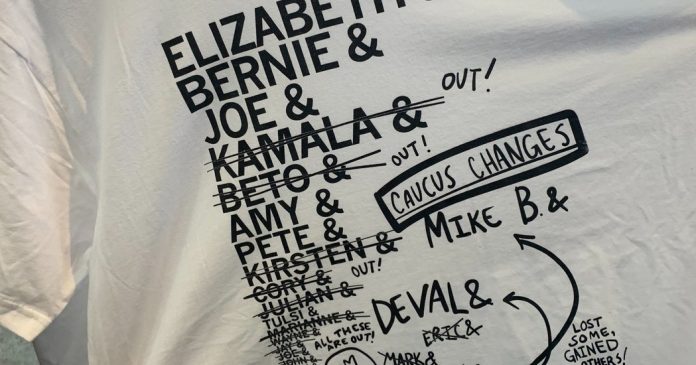
Highlight or list the key information in these excerpts that helps you understand the travel ban. See if you can summarize the main idea of these excerpts in one or two sentences. Then write down any questions you still have. If you’re in a classroom, share your thoughts with a partner and discuss.

What Is Your Reaction to the Results of the Iowa Caucuses?

0
What Is Your Reaction to the Results of the Iowa Caucuses?

(You can find out more about delegates and the nomination process here and watch a video on the history of the Iowa caucuses here. The latest results are here.)

In “Everyone’s a Winner in Iowa,” Lisa Lerer writes about the stakes for Monday’s caucuses:

Presidential campaigns aren’t peewee soccer. There are no participation trophies.

But for the campaigns, the delegate totals aren’t really the point when it comes to Iowa. The state awards only 41 of the 3,979 pledged delegates to the national convention. (California, by comparison, awards 415.)

But Iowa can give a candidate something more important than delegates.

Here’s how Pete Buttigieg put it, as he tried to persuade a group of voters in Jefferson to come out and caucus for him on Monday night.

“What happens on Monday will set the tone for the entire rest of the election,” he told voters gathered in the back of a furniture store. “What happens on Monday will reverberate throughout the country.”

The name of the game is beating expectations, creating the kind of momentum that can propel a candidate into New Hampshire, Nevada, South Carolina and beyond with a burst of enthusiasm.

For Amy Klobuchar, who’s been languishing in fifth place in the Iowa polls, that might mean placing third in delegates. For Elizabeth Warren, who’s been sliding behind Bernie Sanders in recent polls, it might mean besting her liberal rival in raw votes.

So, now imagine this scenario, one strategists say is not an impossibility, given how close recent polls have shown the race to be: Mr. Sanders wins the raw vote total, Joe Biden wins the delegate count and Mr. Buttigieg wins the rural counties.

Aides are already signaling that all three would come out of Iowa declaring victory.

Students, read the entire article, then tell us:

  • What is your reaction to the results of the Iowa caucuses? Who do you think was the big winner on the night? Who was the biggest loser? How do you think the results will impact the rest of the presidential race?

  • Are you excited about the 2020 primary season? How much attention have you been paying to the presidential race? Will you pay greater attention now that the primaries and caucuses are beginning?

  • What does Lisa Lerner mean by, “The name of the game is beating expectations.” Who do you think has the most to gain by a good showing in Iowa? Who has the most to lose?

  • Do you think the 2020 presidential race is an important one? Do you think it will have a big impact on you, your family and your community?

  • In “The Trouble With Iowa,” David Leonhardt questions why the small state always gets to go first in the primary season:

The combined population of Iowa and New Hampshire is 87 percent non-Hispanic white, which is roughly what the United States was in 1870. The states are also disproportionately older and completely lacking in cities with more than 250,000 residents.

And yet Iowa and New Hampshire are treated like a national microcosm every four years and given outsize influence in choosing the president.

This makes no sense. I know the usual justifications — that the states’ citizens take their democratic responsibilities seriously. But when you boil down that argument to its essence, it’s really an argument claiming that Iowans and New Hampshirites are intellectually and morally superior to other Americans.

Do you agree with Mr. Leonhardt that it is unfair that such a small, and primarily white, state should always go first? Or, do you think Iowa should continue to go first and play a pivotal role in the nomination process?

Course spotlight: women’s health after motherhood

0
Course spotlight: women’s health after motherhood

After giving birth, women can struggle to access reliable resources and trustworthy information regarding their own health. There can be confusion surrounding what is and what isn’t normal after childbirth and many mothers unnecessarily suffer in silence. Attempting to meet the needs of these women, Trinity College Dublin produced the course Women’s Health After Motherhood on FutureLearn.com. They collaborated with Universitat de Barcelona and received funding from EIT Health and Science Foundation Ireland to support the course. We spoke to Will Fox, Project Lead and Open Education Project Officer at Trinity College Dublin, to discuss the community focus of this course and the challenges, and advantages, brought about by collaboration.


Can you tell us a bit about the course, Women’s Health after Motherhood, who the course is aimed at and what it aims to achieve?

A study by the School of Nursing and Midwifery at Trinity College Dublin investigated women’s health experiences after giving birth. After talking to dozens of women, one theme came up again and again: the struggle to find quality health information postpartum.

Many felt that while they had been given so much support and advice along the journey from pregnancy to birth, that all seemed to evaporate once the baby was born. This was especially isolating to women who experienced health problems after giving birth. While they had heard about things like postpartum depression, they weren’t prepared for other health issues like incontinence and anxiety. They were shocked and embarrassed by these problems and didn’t know where to turn to find help. That’s why this course was developed: to provide vital information to women at a time when they need it most. It’s aimed not just at women who have recently given birth but also women who are either pregn

ant or plan to become pregnant. Partners are encouraged to join as well so that they can be better prepared for what their other half will go through.

What has been your experience of running this course online?

The response from students was hugely positive. There were so many personal stories in the discussion section from women who had suffered in silence; either too embarrassed to talk about their problems or they had their concerns brushed off by physicians. Many commented on how the experience of motherhood was so different than how they had imagined it to be and there was a strong sense of camaraderie and support between learners. As for women who had yet to become pregnant, they said they were glad they’d been given this information beforehand, that they felt so much more prepared for what was coming down the line. This response showed us why a free and accessible course on this topic was badly needed.


This course is a collaborative project between Trinity College Dublin, Universitat de Barcelona, and is supported by both EIT Health and Science Foundation Ireland. What has been the impact of collaborating with other education providers and organisations on this? What have been the pros and cons?

Two versions of the MOOC were created: an English-language and Spanish-language version. We said from the start that we wanted to build two courses that resonated with their respective audiences. The bulk of the course may have been made in Dublin but we didn’t want Spanish-language students to be watching a course tailored towards Irish audiences with a Spanish translation layered on top of it. The Spanish version needed to be something its audience could connect with culturally.

To achieve this, we brought the academics from Barcelona over to Dublin to shoot videos and record voice-overs, letting them put their own stamp on the course. The academics were only in Dublin for a few days so we had to squeeze a lot of work into a small time frame. The end result was definitely worth it, but there were some tough logistical problems at the time. Working with so many different stakeholders can mean more complications in terms of feedback and keeping everyone in the loop, but there were benefits too. More funding meant we were able to get more ambitious about the videos and interactive infographics we wanted to create and collaborating with well-connected organisations gave our marketing a serious boost.

What have been some of your key learnings from running this course?

Working on both an English and Spanish versions of this MOOC opened my eyes to all the tiny details that go into making a course applicable to different audiences. From videos to images to resources, if you want to make a course that connects with two distinct language regions, it has to be much more than a copy-and-paste. Getting feedback from the academics in Barcelona, who not only are fluent Spanish speakers but also have a strong grasp of local culture, was essential. Developing this course was also a good lesson in how important it is to have a main point of contact. The more people involved in making a course, the greater the risk of having too many cooks. So while we received input, advice and resources from a lot of different sources, there was always one person who had final say on the ultimate direction of the course. This helped to streamline what could have otherwise been a very messy production phase.

Category Research insights

Food Favors

0
Food Favors

Ahead of the Iowa caucuses, Amy Klobuchar, the senator from Minnesota, and hopeful for the Democratic nomination for president, hoped to endear herself to voters by sharing her Hot Dish recipe with the masses.

Ms. Klobuchar’s creation, the Taconite Tater Tot Hot Dish, has taken center stage at a number of gatherings that her campaign calls Hot Dish House Parties.

What do you think of Ms. Klobuchar’s attempt to connect with her fellow Americans through food? Have you ever bonded with someone during a shared meal?

Do you have any special dishes you like to whip up to curry favor or impress your friends? If you were running for president, what recipe would you share to connect with voters? What do you hope this dish would say about you as a presidential candidate?

Tell us in the comments, then read the related article to learn more about Ms. Klobuchar’s Hot Dish strategy.


Find many more ways to use our Picture Prompt feature in this lesson plan. You can find all our Picture Prompts in this column.

Word + Quiz: carte blanche

0
Word + Quiz: carte blanche

: complete freedom or authority to act

_________

The term carte blanche has appeared in 45 articles on NYTimes.com in the past year, including on Aug. 16 in “Momofuku’s Secret Sauce: A 30-Year-Old C.E.O.” by Elizabeth G. Dunn:

Born and raised on the Upper West Side, to the family that founded the specialty foods emporium Zabar’s, Ms. Mariscal began her career at Momofuku in 2011, as a public relations and events intern. Over the years, she quietly became Mr. Chang’s closest collaborator and confidante, a largely unknown force shaping matters as varied as menu design, branding and business development. “She’s the only person I’ve ever felt comfortable giving complete carte blanche to, in terms of what Momofuku looks like and what it should be,” Mr. Chang said. He recalled suggesting to the company’s board that Ms. Mariscal be named C.E.O. almost four years ago, when she was 26. She finally assumed the role in April.

_________

How Much Do You Know About the Bahamas?

0
How Much Do You Know About the Bahamas?

Can you find the Bahamas on a map? What else do you know about this Caribbean nation with about 390,000 people?