

Can you find the Bahamas on a map? What else do you know about this Caribbean nation with about 390,000 people?
Did You Watch the Super Bowl? What Did You Think?

Find all our Student Opinion questions here.
Did you watch the Super Bowl on Sunday? Were you rooting for Kansas City or San Francisco? Were you pleased with the final score? Were you surprised?
Or, did you watch the game for other reasons, like the commercials, the halftime show or just to be part of the annual ritual that millions of people participate in every year?
On the other hand, if you didn’t watch the Super Bowl, why not? Not liking football is reason enough, but did anything else affect your decision?
Benjamin Hoffman reported on the big game:
After a 50-year wait, the Kansas City Chiefs are Super Bowl champions once again, after Patrick Mahomes engineered a stirring fourth-quarter comeback Sunday to beat the San Francisco 49ers, 31-20, at a raucous Hard Rock Stadium.
It was a game of momentum swings, but the last one went to the Chiefs, who entered the fourth quarter trailing by 10 points but proceeded to score three touchdowns over the course of just 5 minutes 1 second of game clock, overwhelming a San Francisco defense that had simply been hoping to hold on to a lead.
“I mean we never lost faith — that’s the biggest thing,” Mahomes said in an on-field interview immediately after clock ran out.
Jon Pareles reviewed the halftime show:
On the surface, the Super Bowl halftime show by Jennifer Lopez and Shakira was a party: exultant voices, shaking hips in glittery costumes, irresistible global rhythms. They danced and belted through a quick-cutting megamix of their hits, sweetly and determinedly uniting flirtatious sexiness with sheer mastery of rhythm, melody and motion.
Yet the halftime show was also a no-nonsense affirmation of Latin pride and cultural diversity in a political climate where immigrants and American Latinos have been widely demonized. The explosive final segment began with Lopez’s daughter, Emme Maribel Muñiz, and a choir of children — some of them in lighted cages — singing Lopez’s “Let’s Get Loud” and a snippet of Bruce Springsteen’s “Born in the U.S.A.,” as Lopez appeared wrapped in a feathered American flag cape that reversed to a Puerto Rican flag. It looked like recognition for both Puerto Rico and for the Dreamers, the American-born children of undocumented immigrants.
Shakira and Lopez were Latina superwomen, smiling pop conquistadoras backed by phalanxes of dancers. They sang, shimmied and thoroughly outshone the brief appearances by their guests, both reggaeton stars: Bad Bunny, from Puerto Rico, and J Balvin, from Colombia.
And, Tiffany Hsu covered the Super Bowl ads:
Nostalgia was an early theme, with companies marketing their products with ads that showed love for the ’80s and ’90s.
Cheetos had the rapper MC Hammer and his zoot-suit-inspired pants in an ad that aimed to popularize the word Cheetle, Frito-Lay’s term for the orange dust the snack leaves in its wake.
Squarespace sent Winona Ryder, the Gen X star who has made a comeback thanks to Netflix’s “Stranger Things,” to Winona, Minn., where she was born. Bill Murray, with a sidekick from the rodent family, relived the 1993 comedy “Groundhog Day” for Jeep, and Mountain Dew Zero riffed on the 1980 film “The Shining” with an assist from the “Breaking Bad” actor Bryan Cranston.
A commercial for Avocados From Mexico features Molly Ringwald, the star of “Pretty in Pink” and other ’80s comedies.
The nostalgia mixed with sentimentality. And three simple commercials seemed to have left the deepest impression on viewers.
A spot from Google — about the 85-year-old grandfather of a Google employee searching for ways to remember his partner, Loretta — inspired a flood of “I’m not crying, you’re crying” social media posts. New York Life Insurance explored various forms of love using several real couples and relatives, without a celebrity in sight. WeatherTech’s commercial focused on the chief executive’s golden retriever, Scout, and the doctors who saved him from cancer.
Students, read one or more of the three articles, then tell us:
What is your reaction to this year’s Super Bowl? Were you surprised that Kansas City was able to come back from a 10-point deficit in the fourth quarter, or is that exactly what you expected from Patrick Mahomes, the Chiefs quarterback?
What did you think of the halftime show starring Jennifer Lopez and Shakira? Do you agree with Jon Pareles’s review that on the surface the show was “a party,” but that it was “also a no-nonsense affirmation of Latin pride and cultural diversity in a political climate where immigrants and American Latinos have been widely demonized”?
Were you impressed by the Super Bowl ads this year? Big companies paid as much as $5.6 million for 30 seconds of advertising time so that they could reach the expected audience of 100 million viewers. Were there any ads that stood out to you? Were there any that you thought were particularly good, or especially memorable?
What do you think about the Super Bowl in general, and the outsized role it plays in American culture?
Students 13 and older are invited to comment. All comments are moderated by the Learning Network staff, but please keep in mind that once your comment is accepted, it will be made public.
Lesson of the Day: ‘These Images Show the Sun’s Surface in Greater Detail Than Ever Before’

4. What is the story of the Daniel K. Inouye Solar Telescope? Where is it located and why? What features of the telescope are most fascinating to you?
6. The article concludes:
Joining the Inouye telescope in this coronal detective work are NASA’s Parker Solar Probe, now orbiting the Sun, and the joint NASA-European Space Agency Solar Orbiter, scheduled to be launched next week, in what amounts to a new coordinated effort to investigate our old shining friend.
What questions about the sun would you like scientists to investigate? How might the answers to your questions affect and benefit our lives?
7. Mr. Overbye writes:
Seen from afar, stars are gentle twinkling harbingers of romance and of the mysterious secret order of the universe. Grist for campfire philosophizing and armchair astrobiology.
What do you think he means by his statement? What romance or mysteries do you think stars like our sun hold? How often do you gaze at the stars at night? What do you think or feel when you stare into glistening lights in the night’s sky?
Going Further
Choose one of the following activities:
1) Research an intriguing question about the sun.
Today’s featured article only scratches the surface of the surface of our sun (O.K., bad pun). Many other questions and mysteries remain:
What is our sun made of? When and how did it begin? What is the weather on the sun? Why do we get sunburns and suntans? Why shouldn’t you look at the sun — even during an eclipse? What are the sun’s rogue plasma waves and magnetic islands? And many more …
You might consider using your research as the basis for an entry to our informational writing contest that runs until March 3, 2020, in which we’re challenging students to write an explanation, in 500 words or less, about any STEM-related concept that will engage and enlighten readers.
2) Do you think the United States should invest more in the study of the cosmos?
In “Will the United States Lose the Universe?” Mr. Overbye writes that “for more than a century, American astronomers have held bragging rights as observers of the cosmos. But that dominance may soon slip away”:
The United States is about to lose the universe.
It wouldn’t be quite the same as, say, losing China to communism in the 1940s. No hostile ideologies or forces are involved. But much is at stake: American intellectual, technical and economic might, cultural pedigree and the cosmic bragging rights that have been our nation’s for the last century.
In 1917, the 100-inch Hooker telescope went into operation on Mount Wilson in California, and Edwin Hubble eventually used it to discover that the universe is expanding. Until very recently, the mightiest telescopes on Earth have been on American mountaintops like Palomar, Kitt Peak and Mauna Kea. They revealed the Big Bang, black holes and quasars.
But no more. In 2025 the European Southern Observatory, a multinational treaty organization akin to CERN but looking outward instead of inward, will invite the first light into a telescope that will dwarf all others. The European Extremely Large Telescope on Cerro Paranal in Chile will have a primary light-gathering mirror 39 meters in diameter, making it 13 times more powerful than any telescope now working and more sharp-eyed than the iconic Hubble Space Telescope.
There are two American-led telescope projects that could compete with the European giant, if they are ever built: the Thirty Meter Telescope, slated for construction on Mauna Kea, in Hawaii, and the Giant Magellan on Cerro Las Campanas, in Chile. But both are mired in financial difficulties and political controversies, and their completion, if it happens, is at least a decade away.
The article concludes:
Now, as the wheels of the academic and government bureaucracy begin to turn, many American astronomers worry that they are following in the footsteps of their physicist colleagues. In 1993, Congress canceled the Superconducting Super Collider, and the United States ceded the exploration of inner space to Europe and CERN, which built the Large Hadron Collider, about 17 miles around, where the long-sought Higgs boson was eventually discovered.
The United States no longer builds particle accelerators. There could come a day, soon, when Americans no longer build giant telescopes. That would be a crushing disappointment to a handful of curious humans stuck on Earth, thirsting for cosmic grandeur. In outer space, nobody can hear you cry.
What do you think? Is the United States in danger of losing its supremacy in the study of the universe? What will be lost if we do? Should the United States invest more money in the building of large-scale telescopes?
3) Should telescopes be built on sacred land?
In “The Thirty Meter Telescope Can Show Us the Universe. But at What Cost?” John Edward Huth, a professor of physics at Harvard, writes:
On the Big Island of Hawaii, Mauna Kea, a dormant volcano, rises nearly 14,000 feet above sea level. There are currently 13 telescopes on its slopes, on land managed by the University of Hawaii. Mauna Kea is ideal for astronomy: It is dry, has little turbulent air and a large fraction of clear viewing nights. But Native Hawaiians have long voiced concerns over the construction of telescopes on Mauna Kea. To them, the mountain is sacred.
For the last four years, construction on a 14th telescope, the $1.4 billion Thirty Meter Telescope, has been delayed by legal challenges. The Hawaiian Supreme Court upheld the construction permit in October 2018. Just before construction was scheduled to start in July, protesters blocked Mauna Kea’s main access road. Thirty-eight arrests followed. On Wednesday the Board of Regents of the University of Hawaii is scheduled to consider a resolution to settle the standoff.
The protests are a culmination of a long period of disregard of indigenous claims to the mountain. The dispute also underscores the disconnect between Western science and the remarkable achievements of Polynesian astronomy, which enabled navigation across the vast Pacific to connect with tiny islands — mere specks, really — thousands of miles away. Polynesian people had been navigating this way for centuries, well before Magellan circumnavigated the globe in the 1500s with the aid of a compass.
The Thirty Meter Telescope would provide a powerful new window into the universe and be the first of its size and capacity in the Northern Hemisphere, giving astronomers access to now-hidden reaches of the sky.
With the ability to image atmospheres on exoplanets, perhaps we’ll discover evidence of extraterrestrial life. The telescope would also be able to capture images of the formation of galaxies in the early universe.
But at what cost? The continued neglect of Native Hawaiian culture in favor of Western scientific supremacy is simply not worth it. That’s why the best plan forward — for both indigenous science and Western science — is to locate the Thirty Meter Telescope elsewhere.
Do you agree? Should the plan to build the Thirty Meter Telescope on sacred lands be scrapped? Or is it more important to gather valuable information about the secrets of the universe?
January’s industry round-up

The Report: higher education ‘on-demand’
Ed Technology, 29 January
This opinion piece argues that traditional modes of teaching are fast becoming outdated, and if university evolved into an on-demand service, like Netflix, it would promote an education that truly knows no borders. This claim is backed up by statistics from the Unite Students Insight Report 2019, which found that access to digital learning material is a high priority for more than 90% of university students. Meanwhile, according to The UCAS Media Student Lifestyle Report, Netflix is the world’s most popular entertainment service, and 72% of UK students are currently active users. This piece argues that the education sector must harness this kind of power and remember that student’s want a varied learning experience with a blend of quality digital tools as well as face-to-face instruction. It suggests that ultimately, lecturers mustn’t view edtech and online material as a threat to their standing, but embrace them as tools for professional development and ways to enhance student experience.
Science Minister outlines the UK’s world-leading role in EdTech
Gov UK, 22 January
Science Minister, Chris Skidmore, opened the BETT Show with a speech on the importance of global collaboration post-Brexit to drive EdTech innovation in classrooms, staff rooms and lecture halls. His speech reiterated the government’s EdTech strategy aims, initiatives, pledges, investments and funding. Skidmore recognised the global challenges Edtech faces and the measures needed to overcome them. Skidmore ended on a hopeful note, “All in all, this increased investment and support should ensure the UK remains one of the best places to start and grow all types of digital tech businesses—including, of course, leading EdTech businesses.”
How higher education can adapt to the future of work
World Economic Forum, 21 January
This piece from the World Economic Forum lays out ways higher education can adapt to the future of work. It states that educators and higher education leaders must approach skills competency with a flexible growth mindset that will serve students well across the global, knowledge-based economy – and throughout their careers. It also claims that institutions need to invest in personalised, technology-enhanced learning and that the private sector, government, educators and policy-makers must work together to deliver multiple pathways for young people looking for their first foothold in the job market, as well as to re-skill and upskill workers striving to maintain their place in the workforce.
US Edtech Closes Decade with Record $1.7 Billion Raised in 2019
Ed Surge, 15 January
According to an EdSurge database of publicly announced funding deals, investment in edtech companies reached at least $1.66 billion across 105 deals in 2019, a five-year high in value and a 16% increase from the previous year. Eight of the top deals went to companies that offer educational services to employers and employees, typically focused on training them for purposes of retaining or internal promotion. Those eight—Guild Education, BetterUp, Coursera, Andela, Degreed, MindTickle, EdCast and A Cloud Guru—accounted for 39%of edtech investing in 2019.
Australian academics debate long term impact of bushfire crisis
THE, 14 January
Australian academics are debating the long-term impact of the country’s wildfire crisis on its universities, with a key role identified for institutions in assisting the recovery of disaster-hit communities. Although the crisis could undermine Australia’s lucrative international education industry, with would-be students deterred by images of charred towns and smog-choked cities, it could also reinforce the country’s position at the front line for climate education and research.
European youth needs action now as the skills gap is too wide
Forbes, 13 January
The European Commission has vowed to implement reforms to tackle the Youth Unemployment Rate (YUR) in the EU. The current YUR rate stands at 14.2% in comparison to the US rate of 8.10%. Skills shortages is one of the main reasons the YUR is kept so high across Europe. According to the ‘Skills For Jobs’ database by the Organisation for Economic Co-operation and Development (OECD), at least 80 million workers in Europe suffer from a mismatch in terms of qualifications.
Category Research insights
Add a slider to your blog (Smart Slider 3 set-up)


Image sliders are a great way to enhance the look of your blog, website, or even a post. Today I would like to show you how you can add and set-up Smart Slider 3 on your WordPress blog.
Set-up Smart Slider 3 on your blog
Smart Slider 3 is a free plugin with a premium version available. All our premade, which includes slider comes with it already installed since it is part of our themes. We have a premium version available too which we usually include with our custom WordPress themes without any additional charges.
In this post, I will show you how you can install this slider on your WordPress or if you already have it, how you can set-up Smart Slider 3 to display your photos on the homepage or in your WordPress post.
Get the plugin
First thing you need to do before setting-up Smart Slider is installing it on your WordPress. It’s easy! To make it even easier below, you will find an image with all essential elements marked with red.
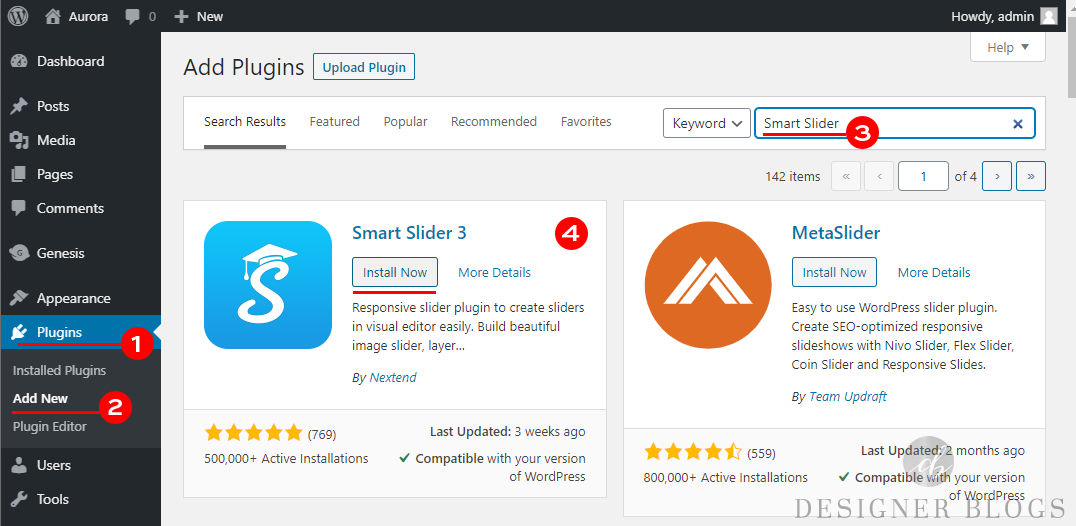
Go to your WordPress Dashboard, click on the Plugin tab on the left (#1), and from the drop-down list, pick ‘Add New’ (#2). In the new window right corner (#3), there is a place for typing in what you are looking for. Put ‘Smart Slider’ there, and you should see a Smart Slider 3 poping up as a first search result.
All you need to do is click ‘Install Now’ (#4) and ‘Activate’ once the button changes to the blue activate the button.
Congratulation! You have now successfully installed a slider plugin!
Create a slider
Once the Smart Slider 3 is installed, you will be able to find it under its tab on the left of your WordPress Dashboard.
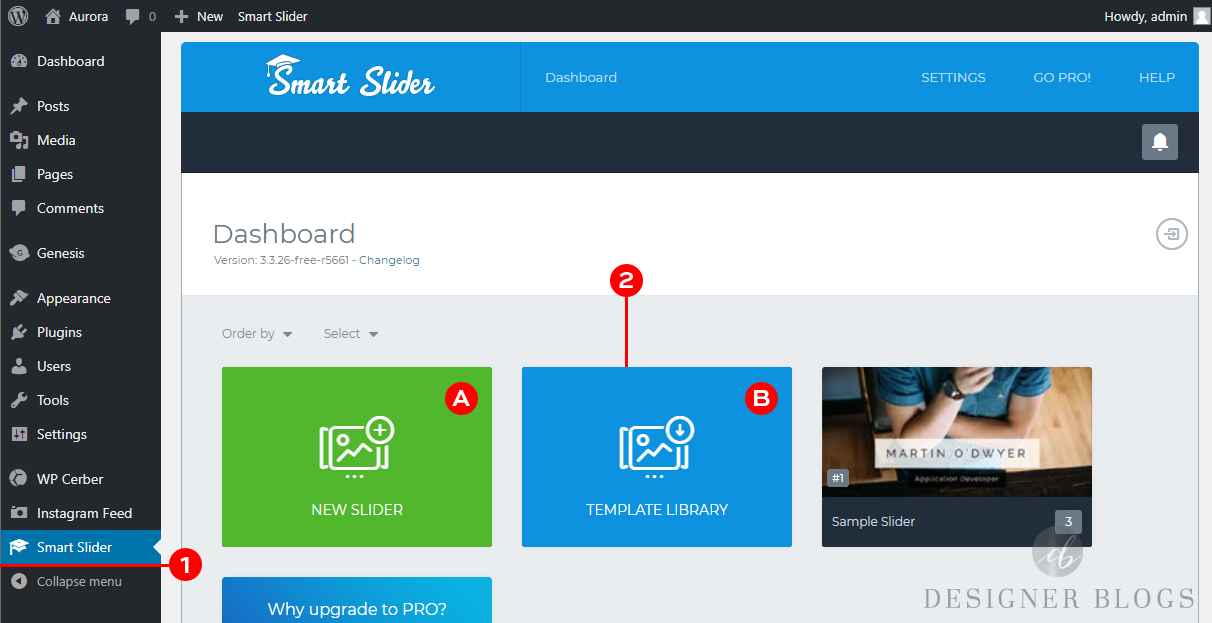
There are lots of options available with this plugin; however you do not need to worry about them if you are just starting because the default setting will be just fine for now.
Take a look at the central area (#2) and decide if you want to create a slider from scratches (Option A for those picky and more advanced ones!) or use a premade template (Option B, recommended for beginners).
There is also a Sample Slider already created if you would like to play with it. All new sliders, which you will create, will appear here too.
In this post, we will focus on creating and editing a slider from scratches.
Creating a slider from scratches
This option will let you create any slider you need, consequently, it will require a little bit more work then basing on an already created layout. Clicking a large green button labeled ‘new slider’ will prompt the following pop-up window.
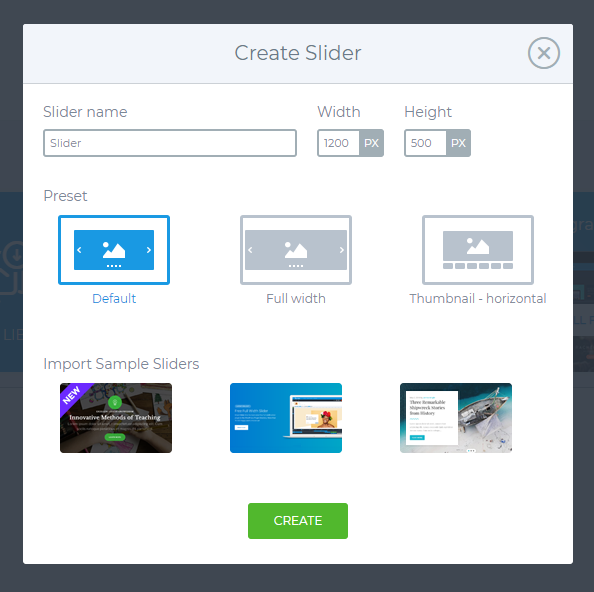
You can specify here your slider name, size and decide if you want it to be:
- Default – cover only the space of container it is in (we are using this type of slider on Rosalee theme)
- Full width – cover the entire width of your browser window (like on Aurora theme)
- Thumbnail – if you want thumbnails of your slides to be displayed under the main slider image
You will be able to change those later too, so the easiest way is keeping it all as it is and directly clicking ‘create’.
Editing your slider
Now you are editing a freshly created slider.
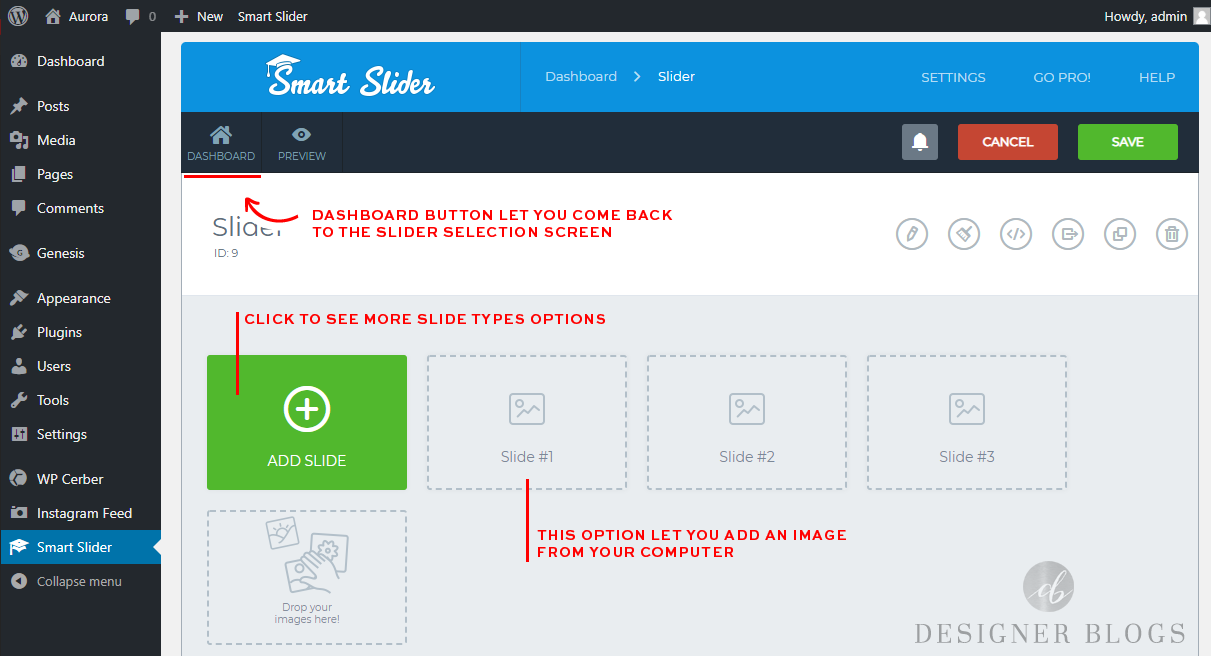
To add an image to it, you can drag and drop your photo into a grey slider area, or you can click on any from the top three rectangles with dashed borders.
Types of slides
For more slide options, you can pick a green ‘add slide’ button. It will allow you to select one of the following:

- Image – This is the same option as those showed before
- Empty – a slide with just a text
- Video – video slide which supports YouTube and Vimeo links
- Post – slide with one of your WordPress post or page
- Static Overlay – very specific kind of slide which will show over the top of all other slides. It is perfect if you want to have a photo slider with your logo over it
- Dynamic – use for the slider which will generate its content automatically, for example, recent posts slider
Once you add a slide, the main slider panel will change to show your new slides and general slider settings.
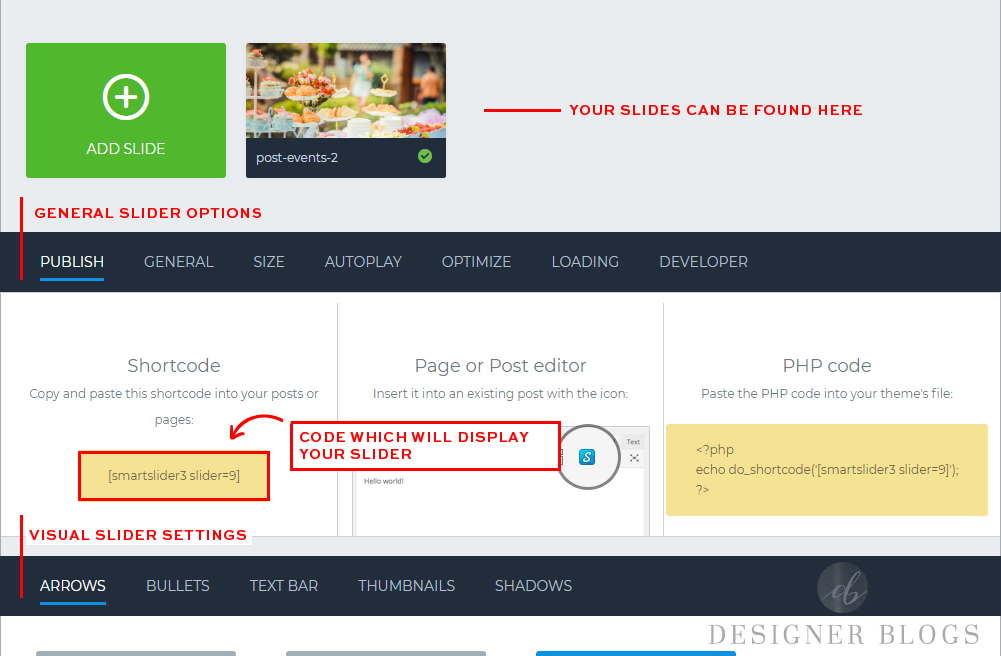
You can still add new slides using the ‘add slide’ button. To change the order of your slides you can drag and drop them.
Slider settings
Each new slider has some default general and visual settings added so you can leave them as they are. You may consider checking:
- Autoplay – to make your slider play automatically if you want it to change photos on its own
- Arrows – to set up more fancy indicators for next and previous slide
- Bullets -to add small dots under your slider, which will let your visitors quickly access each slide.
When you are happy with your settings, remember to hit ‘save’ in the top right corner and use the ‘preview’ button to see your slider.

Here is how the slider with one image I just create look like with default settings:
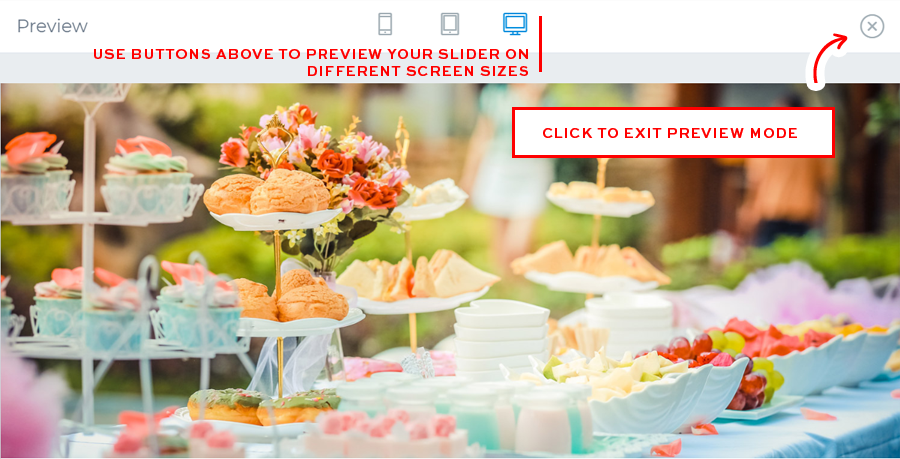
Now you can add more slides and add text to them if needed. Smart Slider 3 offers you lots of options, even with the free version. To access those available for your slides, exit the preview mode and hover the slider you want to edit.
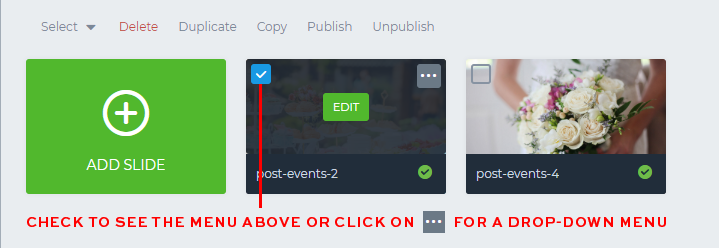
If you already have a slider created and set up by us, you can ‘Duplicate’ a slide instead of creating a new one
The green ‘edit’ button at the center of your slide will take you to the new screen, which will focus only on this slide.
You can add buttons, text, headings, and more images to your slides. It may require some practice before you will be happy with the results, but believe me that with Smart Slider, there are almost no limits (and they are not paying me for saying so! They do not sponsor this post!). Here is the look at your slide edition screen:
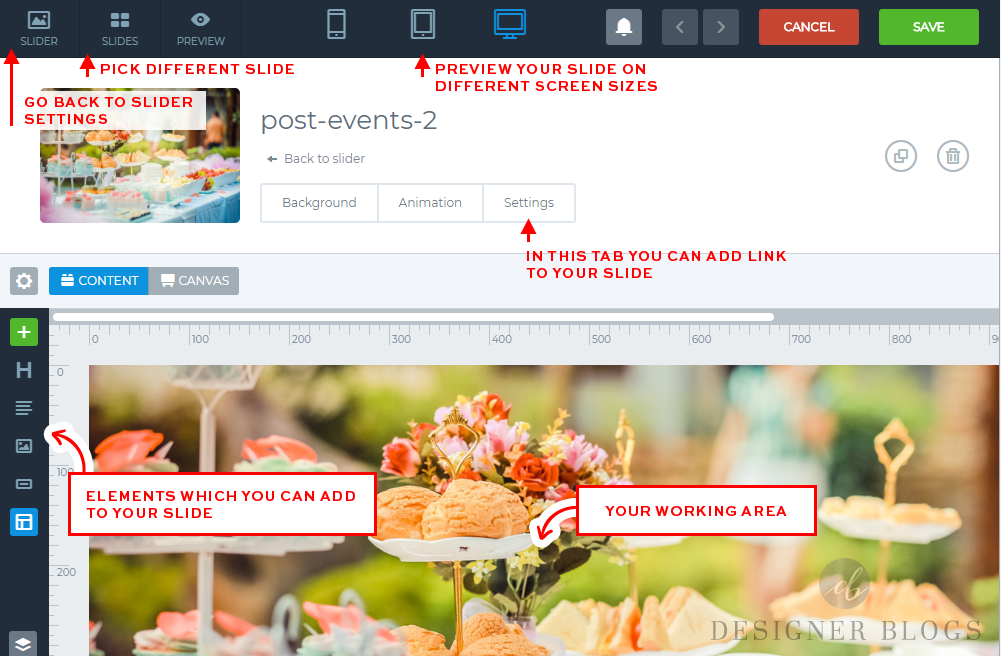
Remember always to click ‘save’ in the top right corner after you are done with editing your slide.
Once your slider is ready, you can add it to your blog or website as your Smart Slider 3 set-up is done!
Adding Smart Slider to your site
There are a few ways you can do so. If you want to add a slider to your site homepage, you will need a widget area for that. If your template does not have one, you can contact us or buy a widget area coding in our accessories shop as it may be a little bit difficult to add.
With the widget area ready, you can use a Smart Slider widget, which allows you to choose a slider from the drop-down list and add an optional title.
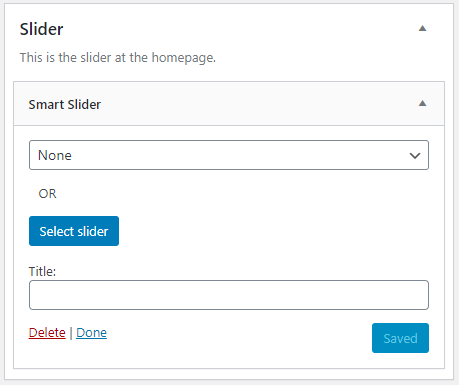
A slider will also appear everywhere where you add it’s shortcode. Feel free to copy/paste it to your post or Custom HTML widget area.
There is even a Gutenberg block for this slider, so make sure to give it a try.
Should I purchase a pro version of Smart Slider 3?
There is no right answer to that. To be honest, the free version is usually more than enough for beginners. If you are looking for options that are available only with a pro (specific slider templates or slides types), then you should invest in it. I bought my pro version over a year ago, and I was very skeptical about it at the beginning. I felt lost with the number of options it offers, and I couldn’t use its full potential. Now I LOVE it, and I can’t imagine working with any other slider and it is why I decided to write a post about it.
We include Smar Slider 3 with almost all our designs. I wanted to give you a tutorial on how you can edit the slides on your own as you often ask me about that.
Give it a try and support us
If you will decide to go with a Smart Slider 3 pro consider using a link from this post (you can click on any Smart Slider link in this post) as they are connected with our affiliate account. It will not cost you any extra and you can support us a little bit. I would be really thankful for that! I would never recommend a product that I’m not using by myself or which I did not test.
Show us your sliders
I hope this tutorial for setting up Smart Slider 3 was helpful. If you created any slider using it make sure to share a link to it in the comments below. I would love to see it!
P.S This post includes affiliate links. By clicking them you are supporting us. Thanks!
Word + Quiz: epochal

epochal ˈe-pə-kəl , ˈe-ˌpä-kəl adjective
: highly significant or important, especially for bringing about or marking the beginning of a new development or era
_________
The word epochal has appeared in 49 articles on NYTimes.com in the past year, including on Nov. 13 in “Cheeseburgers, Oil and Minimum Wage: Building a Museum of Capitalism” by Jennifer Schuessler:
Thirty years ago last week, the Berlin Wall came down, a surprise event that soon brought the rest of Soviet-style communism down with it.
But a few days before the anniversary of that epochal moment, a crowd gathered in a Greenwich Village gallery to celebrate the opening of the latest iteration of the Museum of Capitalism, a roving exhibition dedicated to looking back on the system that triumphed in 1989 from some imagined future when it, too, has disappeared.
_________
Is It Offensive for Sports Teams and Their Fans to Use Native American Names, Imagery and Gestures?

The night was winding down at The Rieger, an upscale casual restaurant in Kansas City, and a couple of Denver Broncos fans in town for a game last month were standing at the bar, engaging in some friendly ribbing with supporters of the hometown Chiefs.
At some point, the Broncos fans walked through the dining room. That’s when a Chiefs fan responded with a gesture as synonymous with the team as its red jerseys: He sliced his hand through the air in a chopping motion while bellowing a rhythmic chant.
Slowly but surely, most of the 50 or so diners dropped their silverware, turned toward the rivals and joined in, chopping the air in unison and chanting in a rising chorus that filled the restaurant.
This city’s beloved football team has left an unmistakable imprint on the local culture, whether it be the tradition of wearing red on the Fridays before games or the custom of modifying the national anthem’s final line to “and the home of the Chiefs” before kickoff at Arrowhead Stadium.
But perhaps the most indelible symbol of Chiefs fandom is one that unifies believers and divides others: the tomahawk chop.
Now that the Chiefs are on one of the biggest stages in sports, contending in the Super Bowl for the first time in 50 years, there is new scrutiny on the tradition.
For many fans, the chop and its accompanying chant — a pantomimed tomahawk motion and made-up war cry, also employed by fans of the Atlanta Braves, the Florida State Seminoles and England’s Exeter Chiefs rugby team — are a way to show solidarity with their team and to intimidate the opposition. But to many Native Americans — locally and afar — and others, the act is a disrespectful gesture that perpetuates negative stereotypes of the nation’s first people and embarrasses a city that fancies itself a hub of culture and innovation in the Midwest.
“It doesn’t show K.C. pride,” said Howard Hanna, the chef and owner of The Rieger, describing his dismay as the impromptu chop unfolded in his restaurant. “It makes us look stupid.”
The Chiefs have largely escaped the hottest embers in the national debate over American Indian mascots and imagery in sports. Their name does not evoke a slur like the Washington Redskins, and their mascot is not a red-faced caricature like Chief Wahoo, the logo that the Cleveland Indians began phasing out two years ago.
The organization has worked with Native Americans over the past six years to reconsider and reform some of its traditions. That dialogue resulted in the team’s discouraging fans from dressing in Indian regalia and asking broadcasters to refrain from panning to those who disregard the request. The team makes informative announcements about Native American history and tradition during some games, and a group of Natives hands out literature at the stadium. The team sometimes invites Native people to bless the drums that are ceremonially beaten before games.
The Chiefs have shown little appetite, however, for preventing their supporters from doing the chop.
“The Arrowhead Chop is part of the game-day experience that is really important to our fans,” Mark Donovan, the team president, recently told The Kansas City Star.
The local Indian community’s views on the tomahawk chop run the gamut, Crouser said, from those who think it is fine to others who are offended.
“As an organization, part of our mission is to empower Indian people,” said Crouser, who is a member of the Standing Rock Sioux. “And things like the tomahawk chop don’t empower Indian people. It’s still very stereotypical and mocking of an entire race of people.”
A survey of Native Americans — conducted by researchers at the University of Michigan and the University of California, Berkeley, and set to publish next month — found that around half of respondents were bothered or offended when sports fans did the tomahawk chop or wore Indian headdresses. Opposition was even greater among those who frequently engaged in Native traditions, with 65 percent saying the chop bothered them, according to the report, which will appear in the academic journal “Social Psychological and Personality Science.”
Other research suggests that even when Natives see mascots or imagery as positive, they can still do psychological harm, damaging the self-esteem and ambitions of American Indian youth.
“There’s no way that the use of Natives as mascots is honoring,” said Stephanie Fryberg, a University of Michigan professor who is Tulalip and worked on the survey. “That’s an illusion.”
The tomahawk chop causes ambivalence among some Chiefs fans — they understand why Native people might find it offensive, but say they do it to celebrate their team, not to demean Indians. Several fans said they would have no problem giving up the chant and replacing it with something else, but that the team would have to lead that effort.
Joyce Parker, 65, cringed as she admitted that she does the chop at games.
“It’s just that caught-up-in-the-moment group joy,” said Parker, a fan from Prairie Village, Kan., a suburb that is a 10-minute drive southwest of Kansas City. “Yes, I feel bad about it.”
Lesson of the Day: ‘Holding Tight to a Racing Tradition’

Going Further
Option 1: Image Inquiry
Skim the article again and circle or highlight three words that you believe best summarize Indian Relay and the importance of the competition for families.
Then choose three photographs from the article that you believe best embody or express the three words you selected. Look closely at all of the images and consider some of the following questions from our Critiquing a Photograph work sheet:
What is the subject of this image? What is the setting?
What draws you to this image? How does it engage the viewer?
What feeling or feelings does it evoke? What ideas or themes does it suggest? What mood or tone does it set?
Option 2: Sports in Your Family
Are there sports or other competitive events that you do with your family? Does your family preserve traditions around dance, hunting, yoga or gymnastics? Maybe you prefer watching sports on TV with your family members or going to sports games. Or do you connect and preserve traditions with your family in other ways, like hand-clapping games, farming, a common love for math or sharing recipes?
Choose one meaningful tradition in your family. It could be related to playing or watching sports or something entirely different that is important to your family’s culture, heritage and traditions. Now, describe a compelling moment in that family tradition. You can use the first three paragraphs of the featured article for inspiration:
Richard Long Feather is searching for his son Jace among the bareback riders as they storm toward the grandstand at the Crow Fair. Stepping away from the rail and onto the dirt of the track, Richard raises his arms above his head as a signal: In one motion, he is telling Jace where to aim and warning Jace’s horse to slow down.
Before Jace even reaches his father, he leaps from the back of his horse. Hitting the ground bounding, Jace grabs a handful of mane of a second horse, held by his brother, Jestin, and swings himself onto its back. Jestin slaps the second mount on the rump, and it fires back onto the track. Richard hands off the first horse to a fourth teammate and braces for the next exchange. Dust swirls. The crowd cheers.
This is Indian Relay.
How does the writer get your attention in these first paragraphs?
How does the setting come to life through his language and vivid description?
Do you feel as if you are at the Indian Relay competition? What about the writing makes you feel that way?
As you select a powerful moment from your own family tradition to write about, see if you can bring that moment to life by choosing descriptive language, employing metaphors and making a strong choice about tone and voice.
Reflect on the following as you write:
Where does this event typically take place? Are there smells, colors or feelings that you associate with it?
Is there any equipment or tools you need to participate? Do any of those objects hold a meaningful or sacred power or significance?
Who participates in these events? What do they look like as they are participating? Do they have to wear certain clothing?
Using a mentor model to enhance learner experience

A short summary of the research paper ‘Genomic Education at Scale: The Benefits of Massive Open Online Courses for the Healthcare Workforce’, which appeared in Frontiers in Genetics in November 2019.
Written by Dr Ed Miller, Dr Michelle Bishop and Amelia McPherson
‘Whole Genome Sequencing: Decoding the Language of Life and Health’ was launched on FutureLearn in 2016 by Health Education England’s Genomics Education Programme (GEP). The three-week course forms part of the programme’s strategy to educate the current and future NHS workforce about the importance of genomics in today’s healthcare practice.
Having selected FutureLearn as the most appropriate platform, the GEP course development team was dedicated to making best use of the opportunities for social and connected learning it offers. In particular, the team considered the mentor model – which allows designated mentors to interact with and guide learners as they progress through the course – and decided to recruit a team of external expert mentors who are enrolled on genomics training programmes and working on the front line within the UK’s National Health Service (NHS), in addition to the course team.
To date, the course has run seven times, attracting over 10,000 learners. Evaluation of the course, recently published in Frontiers in Genetics, suggests benefit to both learners and the team of expert mentors who are recruited to help run each course.
The decision to use specialist mentors was based on the hypothesis that these experts would add value by bringing real-life experience of using genomics in healthcare, as well as having the knowledge and experience to add to discussions and clarify any misconceptions that arose. Recent evaluation also showed, however, that the experience of mentoring additionally benefits mentors by allowing them an opportunity to engage with other healthcare professionals and patients that they wouldn’t ordinarily interact with as non-patient-facing professionals. The work can also be counted formally towards education and training competencies within their training programmes.
Mentors are drawn from a pool of clinical scientists and clinical scientists in training on HSST and STP programmes. Ahead of each launch, they are given a short training session, based on a model by Leon Urrutia et al, 2015, which covers the course content, expectations of the role, and their duties. Mentors are then allocated shifts to ensure that there is a constant support network for learners, as well as making the commitment manageable for mentors. On average, 10 mentors oversee every run and have one 1.5 hour shift per week.
The GEP’s recent report in Frontiers in Genetics is based on the evaluation of 440 learners who provided end-of-course reflections, 360 learners who completed the post-course survey and 14 mentors who facilitated the course. Key findings regarding the mentor model in particular include:
- Learners valued the mentor’s contribution and felt that it enhanced their experience by engaging with professionals working at the ‘coalface’ of genomic medicine.
- Mentors felt the training received prior to the courses starting prepared them for the role. Equally, the support and guidance given by the GEP during the runs also enhanced their experience.
- The mentors found their experience to be an unexpected learning opportunity, discovering how genomics was perceived by patients, and learning from the course participants, in addition to developing skills that could be used in their own clinical practice.
“the process of being a mentor itself allowed me to reflect on how I can improve my own training skills, ways of using open questions to stimulate independent thought.”
“Realising I’m part of a group of genomics professionals involved in work that other health professionals and the public/patients view in wonderment and amazement”.
In recruiting mentors externally and developing a structured approach to training them, the GEP believes it has developed a sustainable mentor model that adds value and could be applied to other MOOCs. Likewise, the use of frontline professionals as mentors is a model that could be replicated and has been shown to add value to the experiences of both learners and mentors. The authors encourage the use of this model in the development of other MOOCS.
Category Research insights
Real world solutions for the digital skills gap

Author: Dr Rachid Hourizi, Director of the Institute of Coding
The Institute of Coding (IoC) was created to respond to the UK’s digital skills gap and since our launch in 2018, we have grown into a large national consortium of educators, employers and outreach groups.
The demand for people to fill roles within the digital technology sector has grown by 150% over the past 4 years and this demand is only set to increase across every industry. To tackle the gap and ensure that this cross-industry demand is met, the IoC is working to encourage a larger and more diverse group of learners into digital careers through higher education. The IoC is also focussed on improving inclusion and diversity in digital education because it is essential to ensuring that the digital sector continues to grow the right way.
Since our launch, the IoC has been providing a new and inclusive approach to digital learning. With our 30+ university partners and education providers, we’ve launched over 100 courses and events in varying formats and engaged over 32,000 learners on these courses. Our courses are formed with input from industry, so our learners know they’re getting the skills employers need, and enable people already in work to gain the digital skills required for their jobs. It’s our hope that by delivering our courses and events in flexible formats, we can make them available to many different people and encourage a larger and more diverse group of learners onto digital skills courses.
We are going to explore this further at our upcoming conference in February. With an overarching focus on lifelong learning, we want to explore how we can make digital skills education as inclusive as possible, so that more people can access education throughout their lives. With contributions from groups including Google, Amazon Web Services and BT Group, the conference is a great way to discover the latest steps being taken towards inclusion in the digital sector. If you’d like to attend, please email ioc@bath.ac.uk and view the programme here.
We’re also looking forward to our other plans for 2020, including the launch of FutureLearn and University of Leeds’ new. This collection features short online courses in essential digital and professional skills, for a more tailored and accessible education experience.
If you or someone you know would like to join 32,000 other learners and start your digital skills journey today, you can view all of our partners’ courses on our course catalogue. If you would like to get in touch with us to discuss potential collaborations, please email IoC@bath.ac.uk.
Category Research insights
