Author: Charles McIntyre, Chairman and co-Founder of IBIS Capital and EdTechX
Replicating the real world to understand better how to solve a problem, was most dramatically played out in the rescue of Apollo 13. In 1970, the lunar landing was aborted after an oxygen tank failed two days into the mission. Houston had to find a solution for the lunar module to support three men for four days when it had in fact been designed to support two men for two days on the lunar surface. Using an exact replica of the lunar module on earth, NASA was able to test and provide an improvised solution to the astronauts to provide a safe return.
Today, the mirroring of physical objects has become increasingly common with the emergence of digital twins. A near-real time digital representation of the physical attributes of a factory, product or process. So for example, running a digital replica of a jet engine for 10,000 hours to learn about the impact of component stress on the performance and safety of the aeroplane.
However, is there a role for the digital twin in the way we learn itself? What happens when we create a digital replica of ourselves, our learning avatar? There is already a lot of data we can collect about how we learn. Artificial Intelligence is applying this personal data to adaptive learning and predicting where our weaknesses lie. As we understand better the mix of auditory, visual and kinesthetic learning for each individual, so the bespoke nature of the pedagogy can be adapted.
So now imagine, we combine a detailed data map of our personal learning process with a sophisticated artificial neural network. Our digital avatar can now apply itself to a whole series of learning tasks and work out which approach, and forms of content, best apply to us. Having completed this filtering process on our behalf, our twin now is able to provide us with the quickest and easiest way for us to acquire the relevant knowledge we are after.
We can now send our digital twin into the lecture theatre or let it loose on working out how to use our new digital camera. Helping us learn and understand in a way only we, at very personal level, can. This may all seem like the realms of sci-fi but it is closer than you think.
First of all, we are already leaving a vast trail of digital fragments of ourselves which are being greedily hoovered up across social media, from the likes of Instagram, Facebook, LinkedIn and Twitter. These fragments provide a detailed picture of who we are, how we react, and how we learn. Second, you don’t have to go far in Silicon Valley to find companies like Oben, who are creating 3D avatars that look and talk like their human counterparts. Oben’s avatars, within a short period of time, can “learn” how to speak like you and then interact with others in your place, in multiple ways and in multiple languages!
What we are witnessing is the collaboration between artificial intelligence and the human learning process. The populist scare stories of robots replacing humans is not the dystopian future we are heading for, instead, we are looking at the integration of capabilities. The soft skills that are innate to homo sapiens such as creativity, problem solving and empathy, are combined with the hard skills of data processing and analytics. Robot and human, a “co-bot” working in harmony. The robot in this case is not the processing brute of yesteryear, but increasingly a learning machine in its own right. Artificial intelligence is now modelled on the learning process of the human brain, so that there is an iterative process of learning which provides feedback loops on the progress being made. Artificial neural networks are experiencing a growth in capability similar to Moore’s law, doubling every 2.6 years. By 2050, it is expected that this deep learning will be equivalent to the capabilities of the human brain.
The world of education will need to respond to this changing landscape. We are past the Spotify-moment where we digitise content and deliver it, broadcast fashion, to the world. We are at the point where personalised and adaptive learning can be matched ever more efficiently to our own learning style, through the collaboration of our digital twin and deep learning. Bespoke content for a pre-tested bespoke learning process using AI and our twin. Perhaps time for a new word – the “twAIn”…
Whether you’re aiming for a promotion, a career change, or even a degree—learning can take you anywhere. But first you need to know where you’re going.
Throughout January, we’ve been sharing expert advice and research-based strategies to help you set your goals and achieve them.
Take a look at these four strategies that you can use throughout the year.
Step 1: Define the right goal for you
With Professor Richard Shell
Professor Richard Shell, an award-winning scholar, teacher, and author at the Wharton School of the University of Pennsylvania, shares this first tip with us: Start by asking the right questions.
Here are the key questions to ask:
Want to uncover more tips for success? Check out this video with Professor Shell, or listen to his advice on planning for the future.
Step 2: Set and keep your goals
With Professor Laurie Santos
Yale Professor Laurie Santos, instructor of The Science of Well-Being on Coursera, shares WOOP (wish, outcome, obstacle, plan) — a goal-setting strategy backed by 20 years of research!
Check out this step-by-step guide:
Dive deeper into the WOOP framework in this video.
Step 3: Beat Procrastination
With Professor Barbara Oakley
So you’ve set your goal. Now how do you overcome procrastination?
Introducing The Pomodoro Technique – a time-tested strategy proven to beat procrastination built by Francesco Cirillo and shared by engineering Professor Barbara Oakley, at Oakland University, in one of the world’s most popular online courses, Learning How to Learn.
Explore five steps to beat procrastination:
Want to learn more? Here’s a video on this technique.
Step 4: Find a friend who will help you stay on track
With Professor Rich Mayhew
We have a final tip from Professor Mayhew, a faculty member at UC Davis who identifies one key action you can take that will help you improve the odds of reaching your goals.
For more success tips, check out this video from Professor Mayhew Achieving your Optimal Performance.
Ready to take the next step? Achieve your goals with an accountability partner!
What advice or strategies have inspired you this year? Join Tristen, Liz, Charissa, and Yash and share your pro-tips with us by tagging @coursera in your social media posts.
What would be better to celebrate this month then hearts?
Free February wallpaper features gorgeous hand-drawn hearts from the romantic card collection and handwritten Springfield font. I think it is a perfect duo to create lovely valentines day cards or seasonal printables.
Included in the free download are three desktop options – one with the calendar and one without the calendar and one with a quote. The others include one wallpaper per device.
Your voice matters!
Let me know what you think about it. Do you like such bright desktop backgrounds or would you prefer something darker for next month?
If you have your favorite quotes and would like them to appear on the next free wallpaper make sure to post them in the comments below or send us your ideas via email.
Enjoy!
FOR PERSONAL USE ONLY.
We would appreciate if you can share this printable. It is really easy! Just click on the buttons below. It is completely free for you but helps us grow and produce even more content.
Share and help us grow. Thanks!
P.S This post includes affilate links. By clicking them you are supporting us. Thanks!
In just a couple of days, the San Francisco 49ers and Kansas City Chiefs will meet in Miami to face off in Super Bowl LIV.
Are you planning to watch the big game? If so, who do you think will win? What are you most looking forward to — the game, the commercials, the parties or the halftime show?
Does your family have special viewing traditions related to the Super Bowl? What types of special snacks or foods do you indulge in? Who do you spend the day with?
Tell us in the comments, then read the related article for a look at some of the vibrant art that will be on display at Miami’s Hard Rock Stadium.
It’s a train wreck in five acts, mostly unfolding offstage. We are behind the scenes in the aftermath of one concert and in the anxious run-up to two others. We are in a recording studio during an especially messy session and in the rambling country house where Becky takes refuge after everything falls apart. I say we are there because Perry’s camera is like a human presence: clammy, curious, caught between the urge to follow Becky everywhere and the impulse to run away from her.
…. But as terrifying and grinding as it can be — long scenes play out in what feels like real time against horror-movie soundscapes, dread dangling from the camera like a lens cap — Becky’s story is also tender and funny. The music and images ache with nostalgia for the ’90s and early 2000s, when the action takes place. The five chapters spread out over six years or so and are punctuated by home-video-style flashbacks to the band’s earlier glory days. Those clips capture them in the full, bratty ebullience of youth, acting out in ways that foreshadow the darker, heavier times to come.
How much time do you spend on your phone? Do you think of it as time well spent? Or, do you ever wish you were on it less?
Do your parents, or other adults in your life, try to control how much you use your phone? Are they worried that too much screen time is bad for you in some way? Are you worried?
The latest research, published on Friday by two psychology professors, combs through about 40 studies that have examined the link between social media use and both depression and anxiety among adolescents. That link, according to the professors, is small and inconsistent.
“There doesn’t seem to be an evidence base that would explain the level of panic and consternation around these issues,” said Candice L. Odgers, a professor at the University of California, Irvine, and the lead author of the paper, which was published in the Journal of Child Psychology and Psychiatry.
The debate over the harm we — and especially our children — are doing to ourselves by staring into phones is generally predicated on the assumption that the machines we carry in our pockets pose a significant risk to our mental health.
Worries about smartphones have led Congress to pass legislation to examine the impact of heavy smartphone use and pushed investors to pressure big tech companies to change the way they approach young customers.
The article goes on to say:
But some researchers question whether those fears are justified. They are not arguing that intensive use of phones does not matter. Children who are on their phones too much can miss out on other valuable activities, like exercise. And research has shown that excessive phone use can exacerbate the problems of certain vulnerable groups, like children with mental health issues.
They are, however, challenging the widespread belief that screens are responsible for broad societal problems like the rising rates of anxiety and sleep deprivation among teenagers. In most cases, they say, the phone is just a mirror that reveals the problems a child would have even without the phone.
The researchers worry that the focus on keeping children away from screens is making it hard to have more productive conversations about topics like how to make phones more useful for low-income people, who tend to use them more, or how to protect the privacy of teenagers who share their lives online.
In 2011, the American Academy of Pediatrics published a paper that warned doctors about “Facebook depression,” but later revised its statement:
Megan Moreno, one of the lead authors of the revised statement, said the original statement had been a problem “because it created panic without a strong basis of evidence.”
Dr. Moreno, a professor of pediatrics at the University of Wisconsin, said that in her own medical practice, she tends to be struck by the number of children with mental health problems who are helped by social media because of the resources and connections it provides.
Concern about the connection between smartphones and mental health has also been fed by high-profile works like a 2017 article in The Atlantic — and a related book — by the psychologist Jean Twenge, who argued that a recent rise in suicide and depression among teenagers was linked to the arrival of smartphones.
In her article, “Have Smartphones Ruined a Generation?,” Ms. Twenge attributed the sudden rise in reports of anxiety, depression and suicide from teens after 2012 to the spread of smartphones and social media.
Ms. Twenge’s critics argue that her work found a correlation between the appearance of smartphones and a real rise in reports of mental health issues, but that it did not establish that phones were the cause.
It could, researchers argue, just as easily be that the rise in depression led teenagers to excessive phone use at a time when there were many other potential explanations for depression and anxiety. What’s more, anxiety and suicide rates appear not to have risen in large parts of Europe, where phones have also become more prevalent.
“Why else might American kids be anxious other than telephones?” Mr. Hancock said. “How about climate change? How about income inequality? How about more student debt? There are so many big giant structural issues that have a huge impact on us but are invisible and that we aren’t looking at.”
How much time do you spend on your phone on an average day? And, what do you typically do?
Does using your phone have a positive effect on your overall well-being? Does it help you build relationships, connect with resources and make you feel less isolated? What are the other positive benefits?
Does the way you use your phone have any negative effects? For example, does using it ever make you feel anxious, lonely, depressed or just sleep-deprived?
Are you ever worried that you spend too much time on your phone? Do you worry that it gets in the way of socializing with friends? With studying? With exercising? With spending time with family? Or with sleeping? Have you ever tried to spend less time on your phone?
Do your parents, or the adults in your life, worry about how much time you spend on your phone? How have they expressed these concerns? Have they ever tried to limit your screen time? How have you responded?
The article presents two sides of an argument: On the one hand, phones increase anxiety, depression and sleep deprivation among teenagers. On the other hand, the phone is “just a mirror that reveals the problems a child would have even without the phone.” Which argument do you find yourself agreeing with more? Why? There are numerous case studies presented in the article: Is there one that supports your point or best reflects your own experience with phones and mental health?
Students 13 and older are invited to comment. All comments are moderated by the Learning Network staff, but please keep in mind that once your comment is accepted, it will be made public.
The New York Times editorial board recently endorsed two Democratic candidates: Elizabeth Warren and Amy Klobuchar. In its editorial, the board wrote of Senator Warren:
Senator Warren is a gifted storyteller. She speaks elegantly of how the economic system is rigged against all but the wealthiest Americans, and of “our chance to rewrite the rules of power in our country,” as she put it in a speech last month. In her hands, that story has the passion of a convert, a longtime Republican from Oklahoma and a middle-class family, whose work studying economic realities left her increasingly worried about the future of the country. The word “rigged” feels less bombastic than rooted in an informed assessment of what the nation needs to do to reassert its historic ideals like fairness, generosity and equality.
Of Senator Klobuchar, the board argued:
Ms. Klobuchar speaks about issues like climate change, the narrowing middle class, gun safety and trade with an empathy that connects to voters’ lived experiences, especially in the middle of the country. The senator talks, often with self-deprecating humor, about growing up the daughter of two union workers, her Uncle Dick’s deer stand, her father’s struggles with alcoholism and her Christian faith.
Which candidate would you endorse?
Be sure to justify your pick by describing the qualities you value most in your candidate, such as character, experience, accomplishments, stance on the issues and electability.
Who do you think will win the Iowa caucuses? Who do you think will win the Democratic nomination? Explain your reasoning.
Feel free to consider the latest polling information, but heed the warning from the article: “The only bulletproof prediction through political history is that people who make political predictions will keep getting things wrong sometimes.”
What do you think this image is saying? How does it relate to or comment on society or the world today? Can you relate to it personally? What is your opinion of its message?
Can you give any specific examples of when you’ve done this or witnessed someone else who did? What did you learn from the experience?
Tell us in the comments, then read the related article to find out what Carl Richards, the “Sketch Guy,” has to say about taking credit and blaming others.
Find many more ways to use our Picture Prompt feature in this lesson plan. You can find all our Picture Prompts in this column.
University of Michigan’s School of Public Health is ranked in the top five public health research institutions in the US and is taught by leaders in the field. In the Population and Health Sciences Master of Public Health program you’ll get hands-on practical experience with community public health issues and gain expertise in the issue area of your choice including epidemiology, biostatistics, nutrition, and more.
In a recent webinar from the Population and Health Sciences and Admissions teams at Michigan Public Health, two current students join staff to share their experience working toward their MPH online while continuing their current jobs. Read our highlights and watch the full webinar below.
Michigan’s Population and Health Sciences MPH program is the School of Public Health’s first online master’s degree. It’s created an opportunity for learners from around the country to earn their Master of Public Health from the number one public university in the country regardless of where they are physically or what stage in their lives. Michigan Public Health’s program and admission staff explained the importance of a strong public health force implemented across all areas of society in a recent webinar, “public health work prevents disease, prolongs life, and promotes physical health”.
Public health professionals are the people who work to make health services run more efficiently and equitably, and often work with whole communities or populations as opposed to individuals – public health is health care on a large scale, based on data, community interaction and partnership, and education promotion. An MPH degree can be part of almost anyone’s path to a practical and impactful career promoting a healthful and equitable society.
I’m too busy to go back to school.
The current class of students include a unique and dynamic group from across the United States. Students come from all different types of backgrounds, from recent graduates to physicians in the midst of a 30-year practice, nurses, researchers, fitness coaches, and medical scribes, to name a few, many of whom continue to work while pursuing their MPH online. The diverse student group that make up the Population and Health Sciences (PHS) program has created a valuable and dynamic online network of peers to study with, work with, and learn from.
Current online MPH student Bano Ahmed shared how she has been able to add her studies to her life with a full-time job, “I’m a pharmaceutical technician, my hours can be irregular. So, finding time to do my work can be difficult, but I get to choose when I do my work, so it’s been really nice. There are days that I have to fly, I’ve been in the airport doing school work or in a live session with my classmates.”
What are the classes like?
Students are completing their classes 100% online, which means they’re able to download lectures, complete readings, finish assignments, and chat with faculty and peers from their mobile phone. In the inaugural cohort, students have been traveling, changing jobs, moving homes, and having children – all while continuing to learn. Logging in from airports, Ubers, from home or work, they’ve been able to add their online degree study into their already full and busy lives.
The PHS program offers an accredited, University of Michigan degree that you can earn in less than 2 years from wherever you are in the United States. About 15 hours of work a week is all it takes. Can you fit that into your life?
Kathy Heselschwerdt is a current online Master student in the program and says its been easy to see the value her courses will have in her future career, “I think some of my favorite [courses] have been Social Determinants of Public Health and Nutrition and Public Health. But, one thing that I really value about all of the classes is that we’re learning new skills but we’re given the opportunity to apply those skills to research interests that we want to learn more about. So, it’s learning new skills but in a way that’s really useful for you now and in your future career interests as well.”
Bano agrees that she too has enjoyed the courses in the program, in large part because of the accessibility and openness of the PHS faculty, “My two favorite classes have been Principles of Epidemiology for Public Health and Nutrition and Public Health. Epidemiology – I knew I was going to like. But Nutrition? I was totally shocked that I liked that class. But the professors are also just so nice and so willing to help. They’re constantly telling us if we need anything just to contact them, so it’s a very friendly online environment.”
The program lets students tailor their degree to their specific interests through a variety of elective tracks. You pick one to two elective tracks and this is how you gain specialized expertise in the areas and issues that matter most to you. You can launch or boost your career in the work that you’re passionate about with these elective track specializations.
How do I know Michigan Public Health is right for me?
If you’re unsure if Michigan Public Health is going to meet your needs, our advisors and faculty are always willing to talk with you about finding the right fit. Faculty lead for the PHS program and Associate Dean of Education, Sharon Kardia, like most of the staff at the school, take a hands-on approach to helping students through the program as well as through the initial decision they make to attend the program.
“I got a phone call from Dr. Kardia and talking to her is what made me choose Population and Health Sciences. I was actually accepted into the epidemiology residence program at Michigan and that was going to be what I was going to do. But, then, talking to Dr. Kardia, I just changed my mind, I was like ‘no, [epidemiology] is not what I want to do’. The online program is going to fit me more and is just more flexible,” says Bano. She is earning her MPH in the hopes of one day working at the Centers for Disease Control and Prevention (CDC) following in the footsteps of many other Michigan Public Health alumni.
When Kathy considered her graduate program options, she thought most about how it was going to fit into her real life and her real goals. “I had my bachelors degree in public health so going into graduate studies, I already knew that was my passion. It was really important to me that the program was reputable so that was one reason that I was interested in UofM specifically. I chose this program because I really wanted to keep working full-time while I was in school, but still have that opportunity to interact with campus when I wanted to and have the connection with this group of students and with the faculty. That’s been my experience so far, so I’m very happy with my choice.”
Who can I talk to if I’m interested in the online MPH from Michigan Public Health?
Program and Admissions staff like Lisa and MaryBeth are always willing to talk to interested students about the program, connect them with other current students, and walk them through the application requirements. Michigan Public Health prides itself on its unique holistic application review process: students are not dismissed because of one weak application component, staff look at the full package of a student and what they may bring to our school and community. The process honors our mission to offer quality public health education for a better community for all.
Kathy’s advice to students preparing their applications is, “start your SOPHAS (the Common Application for Schools of Public Health) application as early as possible because there are a lot of pieces to put together. You want to make sure that you’re being really thoughtful about your statements and essays and who you’re asking for those referrals.” She adds, “It isn’t as intimidating as it might feel going into it. The School of Public Health was really helpful about answering questions and the SOPHAS application has a chat and email feature that I used quite a bit. They were really helpful as well. So, you’ll have all the help that you’ll need right away.”
Interested in hearing from more students from the School of Public Health? Check out the We Are Michigan Public Health series where you can find the stories of students, alumni, and faculty from across our community.
Michigan Public Health’s Population and Health Sciences MPH program will have its priority deadline for applications on February 15th. After this date, and once the admissions committee has reviewed, they will start officially sending acceptance offers to applicants. The most important thing about this deadline is that applicants who apply by this deadline will have the best shot at potentially receiving merit scholarship funding. The final application deadline is May 1, 2020.
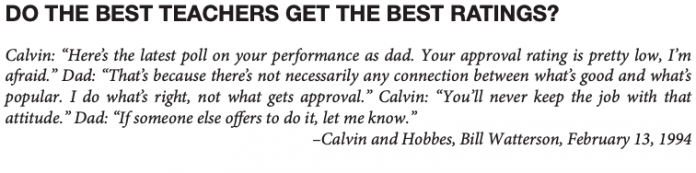
Header note, this quote appears at the top of the cited article by Kornell and Hausman (1)
By Megan Sumeracki
For most of us who teach in higher education, the end of the semester means administering teaching evaluations and can be a bit stressful for some. However, the beginning of each semester means reading those evaluations. In theory, these evaluations would allow us to see our courses through our students’ eyes, providing wonderful insights into the areas in excel and other areas for improvement. Personally, I do feel that some of my students’ hand-written qualitative comments can be constructive and useful. However, there’s a lot of reason to be wary of teaching evaluations overall. Some research has shown biases in teacher evaluations by students, and you can read more about this in the blog written by Cindy here.
In addition to this, an analysis published by Nate Kornell and Hannah Hausman (1) demonstrated that the best teachers—those that fostered meaningful learning in their students—do not always get the best ratings. In their analysis, they looked at numerous studies evaluating the relationship between student evaluations of teaching and educational experience, performance in the course, and performance in subsequent related courses.
When Kornell and Hausman reviewed the literature, they concluded that there was a small relationship between teaching evaluations and performance in the course. The studies examined used grades on a common final exam (i.e., the final exam was the same across multiple sections of the course with different instructors) as the measure of performance in the course. In other words, students that got better grades on the final were slightly more likely to rate their teachers as more effective. They concluded that this relationship was very small and that student grades on a final common exam did not account for a lot of the variance in teaching evaluations provided by the students. This paper was published in 2016. In the next year, Uttl and colleagues (2) published a large meta-analysis, or a systematic mathematical analysis of the effect sizes across studies, on the topic. They concluded that there was no relationship between instructor evaluations and student learning (using measures of overall course performance, final exams, and other achievement tests). Taken together, it seems that learning does not much influence students’ teaching evaluations of their professors, and may not influence evaluations at all!
What was particularly interesting about the Kornell and Hausman analysis was that they also looked at how teaching evaluations were related to performance in subsequent related classes. In other words, they wondered whether students that rated their teachers as more effective during evaluations were better prepared for related classes that they too later, and thus performed better in those courses. This is extremely important if our long-term goal is to help our students learn and be able to apply what they have learned later on. The studies that Kornell and Hausman analyzed specifically examined how much instructors contributed to students’ knowledge in the later courses (called value-added measures). However, they found no relationship between teaching evaluations and student performance on subsequent related courses. Looking at the best controlled studies on this topic (3,4), instructors who contributed more to students’ knowledge in later courses actually had the lower teaching evaluations from their students! Thus, if the goal is for an instructor to help their students learn and be better equipped to apply the knowledge later in future courses, then those with the lower teaching evaluations did the best job.