fbpx
Home Blog Page 1526

Teaching Effectiveness vs. Teaching Evaluations

0
Teaching Effectiveness vs. Teaching Evaluations

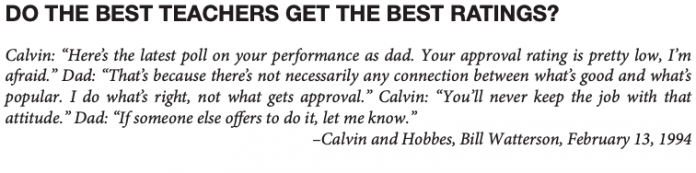
Header note, this quote appears at the top of the cited article by Kornell and Hausman (1)

By Megan Sumeracki

For most of us who teach in higher education, the end of the semester means administering teaching evaluations and can be a bit stressful for some. However, the beginning of each semester means reading those evaluations. In theory, these evaluations would allow us to see our courses through our students’ eyes, providing wonderful insights into the areas in excel and other areas for improvement. Personally, I do feel that some of my students’ hand-written qualitative comments can be constructive and useful. However, there’s a lot of reason to be wary of teaching evaluations overall. Some research has shown biases in teacher evaluations by students, and you can read more about this in the blog written by Cindy here.

In addition to this, an analysis published by Nate Kornell and Hannah Hausman (1) demonstrated that the best teachers—those that fostered meaningful learning in their students—do not always get the best ratings. In their analysis, they looked at numerous studies evaluating the relationship between student evaluations of teaching and educational experience, performance in the course, and performance in subsequent related courses.

When Kornell and Hausman reviewed the literature, they concluded that there was a small relationship between teaching evaluations and performance in the course. The studies examined used grades on a common final exam (i.e., the final exam was the same across multiple sections of the course with different instructors) as the measure of performance in the course. In other words, students that got better grades on the final were slightly more likely to rate their teachers as more effective. They concluded that this relationship was very small and that student grades on a final common exam did not account for a lot of the variance in teaching evaluations provided by the students. This paper was published in 2016. In the next year, Uttl and colleagues (2) published a large meta-analysis, or a systematic mathematical analysis of the effect sizes across studies, on the topic. They concluded that there was no relationship between instructor evaluations and student learning (using measures of overall course performance, final exams, and other achievement tests). Taken together, it seems that learning does not much influence students’ teaching evaluations of their professors, and may not influence evaluations at all!

What was particularly interesting about the Kornell and Hausman analysis was that they also looked at how teaching evaluations were related to performance in subsequent related classes. In other words, they wondered whether students that rated their teachers as more effective during evaluations were better prepared for related classes that they too later, and thus performed better in those courses. This is extremely important if our long-term goal is to help our students learn and be able to apply what they have learned later on. The studies that Kornell and Hausman analyzed specifically examined how much instructors contributed to students’ knowledge in the later courses (called value-added measures). However, they found no relationship between teaching evaluations and student performance on subsequent related courses. Looking at the best controlled studies on this topic (3,4), instructors who contributed more to students’ knowledge in later courses actually had the lower teaching evaluations from their students! Thus, if the goal is for an instructor to help their students learn and be better equipped to apply the knowledge later in future courses, then those with the lower teaching evaluations did the best job.

What’s Going On in This Graph? | Feb. 5, 2020

0
What’s Going On in This Graph? | Feb. 5, 2020

These graphs, which show the extent to which U.S. neighborhoods are racially integrated (white and nonwhite) for 1980, 2000 and 2017, appeared elsewhere on NYTimes.com.

After looking closely at the graphs above (or at this full-size image), think about these three questions:

  • What do you notice? If you make a claim, tell us what you noticed that supports your claim.

  • What do you wonder? What are you curious about that comes from what you notice in the graphs?

The questions are intended to build on one another, so try to answer them in order. Start with “I notice,” then “I wonder,” and end with a catchy headline.

2. Next, join the conversation by clicking on the comment button and posting in the box that opens on the right. (Students 13 and older are invited to comment online. Teachers of younger students are welcome to post what their students say.)

3. After you have posted, read what others have said, then respond to someone else by posting a comment. Use the “Reply” button or the @ symbol to address that student directly.

On Wednesday, Feb. 5, our collaborator, the American Statistical Association, will facilitate this discussion from 9 a.m. to 2 p.m. Eastern time to help students’ understanding go deeper. You might use their responses as models for your own.

4. By Friday morning, Feb. 7, we will reveal more information about the graphs at the bottom of this post. Students, we encourage you to post an additional comment after reading the reveal. How does the original article and the moderators’ comments help you see the map differently? Try to incorporate the statistical terms defined in the Stat Nuggets in your response.


  • Read our 2019-20 introductory post, which includes the archives of past releases by topic and graph type.

  • Learn more about the “Notice and Wonder” teaching strategy and how and why other teachers are using this feature from our on-demand webinar.

  • Sign up for our free weekly newsletter so you never miss a graph, and add our 2019-20 “What’s Going On in This Graph?” live-moderated discussion Wednesdays to your Google calendar (2/5, 2/12, 2/26, 3/4, 3/11, 3/18, 3/25, 4/1, 4/8). Graphs are always released by the Friday before to give teachers time to plan ahead.

  • Go to the A.S.A. K-12 website, which includes This is Statistics, resources, professional development, student competitions, curriculum, courses and careers.

Word + Quiz: de facto

0
Word + Quiz: de facto

adjective: existing in fact, whether with lawful authority or not

adverb: existing in reality or fact

_________

The term de facto has appeared in 517 articles on NYTimes.com in the past year, including on Jan. 20 in “France’s Unofficial Minister for Fashion Isn’t Afraid of a Redesign” by Tina Isaac-Goizé:

“In the beginning, everybody thought I was crazy,” said Ms. Poirson, who is officially one of three secretaries of state to the minister for the ecological and inclusive transition and, unofficially, France’s de facto minister for fashion.

Both a champion of the industry and its rare critic, Ms. Poirson, 37, is playing a role in negotiations regarding President Trump’s threats to impose tariffs on handbags and other luxury goods, also known as the “handbag war.” Last year, she also spearheaded wide-ranging legislation that included banning brands from destroying an estimated 630 million euros (or $700 million) of unsold goods annually, a common practice in the industry. Prime Minister Édouard Philippe has said France would be the first to formally adopt this measure.

_________

Do You Think the World Is Getting Closer to Securing the Promise of ‘Never Again’?

0
Do You Think the World Is Getting Closer to Securing the Promise of ‘Never Again’?

What do you think? What does “Never again” me to you? Do you feel that genocide is still possible in 2020?

Do you think the world has learned the lessons of history? Is international law stronger? Is education better? Is the media too omnipresent to allow a systematic campaign of hatred and violence against any minority group?

In “75 Years After Auschwitz Liberation, Worry That ‘Never Again’ Is Not Assured,” Marc Santora writes about the relevance of “never again” to today’s world:

But as the 75th anniversary of the liberation of Auschwitz approaches, an occasion being marked by events around the world and culminating in a solemn ceremony at the former death camp on Monday that will include dozens of aging Holocaust survivors, Piotr Cywinski, the director of the Auschwitz-Birkenau State Museum, is worried.

“More and more we seem to be having trouble connecting our historical knowledge with our moral choices today,” he said. “I can imagine a society that understands history very well but does not draw any conclusion from this knowledge.”

In this current political moment, he added, that can be dangerous.

All one has to do is look at the backdrop against which this anniversary is taking place.

Across Europe and in the United States, there is concern about a resurgence of anti-Semitism. Toxic political rhetoric and attacks directed at groups of peoples — using language to dehumanize them — that were once considered taboo have become common across the world’s democracies.

And as the living memory of World War II and the Holocaust fades, the institutions created to guard against a repeat of such bloody conflicts, and such barbarism, are under increasing strain.

Many historians and individuals have emphasized the importance of preserving the stories of survivors, and the physical memory of the Holocaust in places like Auschwitz, which now is a memorial and museum:

While the two main gas chambers were blown up by the Nazis before they fled, the ruins still testify to their existence. Visitors can see the ovens used to incinerate the remains of those slaughtered.

The train tracks leading into Birkenau, where cattle cars would arrive crammed with Jews who were swiftly herded into the gas chambers, are no longer used but remain a ghastly reminder of the scale, reach and industrialization of the murder apparatus.

Ronald S. Lauder, the cosmetics billionaire and philanthropist, has made it his mission to help preserve the site, helping to raise $110 million to that end.

He said that while historians can speak to events, there was simply no substitute for hearing the stories of real people in a real place made of real brick and mortar.

And this anniversary was special, he said, simply because with the passage of time, there are fewer witnesses left to tell their story.

“Almost half the survivors have died in the last five years,” he said in an interview. “This will be the last time we get people together.”

The article concludes with a quote by Zofia Posmysz, a 96-year-old Polish survivor of Auschwitz, who was concerned about Mr. Putin’s comments:

“I fear that over time, it will become easier to distort history,” she said in her apartment in Warsaw. “I cannot say it will never happen again, because when you look at some leaders of today, those dangerous ambitions, pride and sense of being better than others are still at play. Who knows where they can lead.”

Students, read the entire article, then tell us:

  • What do you know about the Holocaust? Where did you learn this information — from school, books, friends or family? Have you ever been to a Holocaust memorial, remembrance or museum? What lessons have you drawn from what you have read, seen and heard?

  • What does “Never again” mean to you? What responsibility do each of us have in making sure the phrase lives on not just as words but as a reality?

  • Piotr Cywinski, the director of the Auschwitz-Birkenau State Museum, believes that we have “trouble connecting our historical knowledge with our moral choices today.” Do you agree? Have we fully learned the lessons of the past? Is enough being done to prevent a future genocide?

  • The article mentions “the resurgence of anti-Semitism,” “toxic political rhetoric” and “attacks directed at groups of peoples” as indications that “Never again” has an uncertain future. What do you think? Are these three phenomena warning signs that mass prejudice and hatred are on the rise? Or, is the world a very different place from Europe in the 1930s, and therefore no comparisons should be made?

  • The world feels much smaller than it did in the 1930s. Journalists can report stories from almost anywhere instantaneously. Travelers can easily fly between continents. Billions of people have cellphones in their pockets with cameras that can document human rights abuse. Do all of these changes provide safeguards against future genocides?

    Additional background: The Times has been extensively covering China’s mass detention of ethnic minorities in the Xinjiang region. Last month, the newspaper reported:

As many as a million ethnic Uighurs, Kazakhs and others have been sent to internment camps and prisons in Xinjiang over the past three years, an indiscriminate clampdown aimed at weakening the population’s devotion to Islam. Even as these mass detentions have provoked global outrage, though, the Chinese government is pressing ahead with a parallel effort targeting the region’s children.

Does that information change your opinion in any way?

  • The United States Holocaust Memorial Museum is committed to studying and researching anti-Semitism and genocide around the world. The museum currently has case studies from 11 countries that provide information “on historical cases of genocide and other atrocities, places where mass atrocities are currently underway or populations are under threat, and areas where early warning signs call for concern and preventive action.” Do these studies give you more confidence that the world is well organized and united to prevent future genocides? Or do they make you more concerned that “Never again” is a very fragile promise?

  • What suggestions do you have for world leaders, international organizations and ordinary people to help prevent a future holocaust?

Lesson of the Day: ‘Before the Liberation of Auschwitz, a March of Misery’

0
Lesson of the Day: ‘Before the Liberation of Auschwitz, a March of Misery’

Now, reflect on what you heard:

  • What was your experience listening to the oral history recordings?

  • How was that experience different from reading about the death marches in a textbook or in another secondary account?

  • What are you left feeling or wondering about after listening to the oral histories?

Read the article, then answer the following questions:

1. The article starts with a description of a monument: “But there are only four names. Another 21 people are identified by their inmate numbers. And 17 have never been identified.” Why is this important? What does this illuminate about the struggle to piece together parts of Holocaust history?

2. Why has it been hard to document the death marches before liberation? What are some of the theories about why they occurred?

3. What does Zofia Posmysz remember about the time before and during the death march? What do Holocaust scholars observe about the memories of survivors?

4. What propelled Jan Stolarz, a retired miner, to lead a memory march?

5. What was Bernard Halat’s experience witnessing the death marches? What was the moment of hope that he remembered seeing?

Option 1: Reflect

The death marches of 1945 took place 75 years ago. The people who somehow survived those forced marches, as well as the people who witnessed them, are getting older. Perhaps most have already died. Mr. Santora writes:

Until recently, it would have been possible to find people who lived in the towns and villages along the route who could recall seeing the columns of starving and abused prisoners flanked by Nazi soldiers walking past their homes.

Their numbers, like the survivors, grow fewer every year.

And he ends the article with the following sentence:

For the millions who died during the Holocaust, including the thousands who did not die in the camps but along lonely stretches of frozen roads and snow-covered fields, their stories were buried with them long ago.

Does it matter that soon, as time passes, there will no longer be any firsthand witnesses who survived what happened during the Holocaust — or saw them? What does that mean for the purpose of recording history? What does it mean for the power of teaching future generations about a dark past? What relevance, if any, does that unavoidable reality have for preventing future genocides?

Weekly News Quiz for Students: Kobe Bryant, Outbreak in China, Grammys

0
Weekly News Quiz for Students: Kobe Bryant, Outbreak in China, Grammys

Above is an image related to one of the news stories we followed over the past week. Do you know what it shows? At the bottom of this quiz, you’ll find the answer.

Have you been paying attention to the news recently? See how many of these 10 questions you can get right.

Morning Moods

0
Morning Moods

Do you tend to wake up on the “wrong side of the bed” or “bright-eyed and bushy-tailed”? Do mornings invite optimism and inspiration, or provoke repeated hits of the snooze button and caffeine swigging?

How do you handle friends or family members who have opposite morning dispositions?

Tell us in the comments, then read the related article to see one columnist’s advice about how to deal with conflicting morning attitudes.


Find many more ways to use our Picture Prompt feature in this lesson plan. You can find all our Picture Prompts in this column.

Word + Quiz: indomitable

0
Word + Quiz: indomitable

: impossible to subdue

_________

The word indomitable has appeared in 82 articles on NYTimes.com in the past year, including on June 5 in “For U.S. Women, a Rare Question Mark Comes With a Ready Answer” by Andrew Keh:

LONDON — Erica Dambach recognized that the words she was using to describe her former player Alyssa Naeher — “very quiet and reserved,” “unassuming,” “very, very humble” — were not ones most people immediately associate with an indomitable athlete.

Dambach, who coached Naeher for three seasons at Penn State, said she once had those very same concerns about Naeher’s serene demeanor. But then she watched Naeher play.

“When she steps over the line, she takes on the personality of one of the top goalkeepers in the world,” Dambach said. “You can see the fire in her belly. You can see the fire in her eyes. She becomes that winner that you know is inside her.”

_________

Do the Grammy Awards Represent the Best in Music Today?

0
Do the Grammy Awards Represent the Best in Music Today?

Find all our Student Opinion questions here.

Did you watch the Grammy Awards on Sunday? Were any of your favorite artists nominated? Did any of them win? When you consider the list of winners — such as Billie Eilish, Lizzo and Lil Nas X — do you think their wins will bring them greater respect among fans or within the music industry? Will it lead to more people listening to their music or going to their concerts?

In short, what, if anything, do you think a Grammy Award bestows upon its winner? You may want to peruse last year’s winners as well as the 2020 winners as you consider these questions.

Before Sunday night’s award ceremony, Jon Caramanica wrote about how many younger artists have been suspicious of the music industry’s “biggest night” for years. He also explained that new allegations of misconduct at the Recording Academy, which oversees the Grammy Awards, made by Deborah Dugan, the organization’s chief executive, seemed to confirm the worst suspicions. He wrote:

Now, on the eve of the 62nd annual Grammy Awards on Sunday, the legitimacy of the organization that hands out the trophies is in full-fledged crisis. Given Dugan’s allegations of behind-the-scenes misbehavior, it has to be asked: Can the Grammys be trusted?

Or perhaps: Have they ever been trustworthy? The question long predates the current scandal, and what Dugan unearthed seems only to confirm longstanding critiques of the awards show. The Grammys’ claim to authority has been brittle for some time, in large part because it has failed to keep up with the ways pop is evolving. During the 2010s, an era in which hip-hop and its influence have been not just ascendant but dominant, only one nonwhite artist, Bruno Mars, won the Grammy for album of the year; the results in the song and record of the year categories are only slightly better. The academy’s resistance feels willful and hopelessly prejudiced.

Superstars of this generation are taking notice, and taking umbrage. In 2016, Frank Ocean declined to submit his album “Blonde” for Grammy consideration, telling The New York Times that the Grammy process “doesn’t seem to be representing very well for people who come from where I come from, and hold down what I hold down.” Last year, Drake diminished the importance of winning awards during his acceptance speech for best rap song, and in 2017, expressed bafflement at winning that same prize for “Hotline Bling,” which was, he pointed out, “not a rap song.” Kanye West — who has won 21 Grammys, but never in a major category — has long made the Grammys a target of his ire.

However, after the awards ceremony, Mr. Caramanica noted that perhaps this year’s Grammys represented a change:

But this year may well be remembered as one of severe, jolting transition for the Grammys, and not just because of the behind-the-scenes conflagration about conflicts of interest, irregularities in the nomination process, sexual harassment and more that overshadowed the event. Instead, Sunday night’s show featured several impressive moments spotlighting some of pop music’s youngest innovators: Tyler, Lizzo, Billie Eilish, Rosalía. And while there were plenty of the usual serious-as-a-snore Grammy performances, they faded from memory thanks to the night’s cleverest and hungriest attendees.

That there’s room for those performers on the show now is, in part, a positive side effect of the institution’s own necrosis. The Grammys have systematically alienated a whole generation or two of hip-hop and pop stars, many of the most crucial musicians of the last two decades. Think about everyone who was not in attendance this year: Drake, Beyoncé, Jay-Z, Taylor Swift, Kanye West, Rihanna, Justin Bieber, Kendrick Lamar. What’s left? The veterans who are a part of the show’s firmament, but more intriguingly, the new kids on the block.

Students, read the entire article, then tell us:

  • Do you think the Recording Academy “has failed to keep up with the ways pop is evolving”? Do you think this year’s award ceremony marks a change? Give a few examples that support your stance. What do you think the Grammy Awards represent today? Is it popularity, innovation, musicianship, some combination of these or something else?

  • Who are your favorite musical artists? What are your favorite songs, albums and music videos? Have they won or been nominated for Grammys? Does this matter to you? Do you think it matters to the artists, or to most fans? Explain.

  • The article mentions how the artists Frank Ocean, Drake and Kanye West have been critical of the Grammy Awards. Do their statements affect the way you think about the Grammy Awards? Do you think the decision to, say, not submit an album for Grammy consideration offers a solution to problems outlined in the article? Explain.

  • The article’s writer argues, “Broadly speaking, nonwhite artists, female artists, and artists who come from the worlds of hip-hop and R&B are consistently marginalized, honored in genre categories but shut out in the four major categories (album, song and record of the year, and best new artist). Add it all up, and you get impending irrelevance.” What are your thoughts on this stance on the Grammy Awards becoming irrelevant and the causes for it?

  • What are your thoughts on other entertainment industry awards like the Golden Globes and the Oscars? Are they on par, in your opinion, with the Grammy Awards when it comes to recognizing achievement in their artistic fields? Give a few examples to support your stance.


Students 13 and older are invited to comment. All comments are moderated by the Learning Network staff, but please keep in mind that once your comment is accepted, it will be made public.

Lesson of the Day: ‘What Is the Coronavirus? Symptoms, Treatment and Risks’

0
Lesson of the Day: ‘What Is the Coronavirus? Symptoms, Treatment and Risks’

Find all our Lessons of the Day here.

Featured Article: “What Is the Coronavirus? Symptoms, Treatment and Risks” by Roni Caryn Rabin.

Have you heard anything about the coronavirus? Are people in your school or community concerned about contracting it?

The coronavirus is a respiratory virus named for the spikes that protrude from its membrane, which resemble the sun’s corona. The outbreak began in Wuhan, China, in a live seafood, poultry and wild animal market, but it has now appeared in 11 other countries, including the United States. According to Chinese health authorities, the coronavirus has killed at least 56 people and sickened at least 2,000.

In this lesson, students will learn more about the virus and how people are reacting to it, both in Asia and in the United States.

Now, using those same close observation skills, look through all of the photographs in the article. What observations can you make and what conclusions can you draw?

  • What story does the series of photographs tell?

  • Are you able to get a sense of how the virus is transmitted? What do you notice people doing to contain the virus?

  • Did you notice that the outbreak happened at the time of the Lunar New Year? What do you notice about how the outbreak affected celebrations?

  • What other questions do you still have?

As you read the featured article, keep these images in mind and see what more information you are able to gather.

Read the article, then answer the following questions:

1. In your own words, why has there been so much panic and fear in response to the coronavirus?

2. Why hasn’t the World Health Organization declared a global health emergency? How did some of the physicians quoted in the article explain and support the W.H.O.’s decision?

3. How were scientists able to identify how the virus is transmitted? What conclusions have the Chinese Center for Disease Control and Prevention been able to reach through its observation and study?

4. How is the coronavirus similar and different from other epidemics like SARS and MERS? How does it compare with annual influenza outbreaks? What do these comparisons tell us about how dangerous this new virus is?

5. How did the outbreak initially happen, and why has it been so difficult to contain?

6. What can people do to protect themselves? What role are United States health officials taking to prevent an outbreak?

You started this lesson by looking at photographs to understand the epidemic. Now that you have read more information about what is happening, take some time to analyze one or two graphs or maps from this article and answer the following questions from our What’s Going On in This Graph? feature:

  • What do you notice? If you make a claim, tell us what you noticed that supports your claim.

  • What do you wonder? What are you curious about that comes from what you noticed in the graph?