fbpx
Home Blog Page 1562

Teenagers in The Times: October 2019

0
Teenagers in The Times: October 2019

Here is the October edition of Teenagers in The Times, a roundup of the news and feature stories about young people that have recently appeared across sections of NYTimes.com. We publish a new edition on the first Thursday of each month.

For ideas about how to use Teenagers in The Times with your students, please see our lesson plan and special activity sheet, both of which can be used with this or any other edition.

_________

Education

_________

Civics, Politics, Economics and Business

The Democrats Worth Staying Up Past Bedtime For

For the way-too-young-to-vote crowd, 2020 events are still a draw.

On Climate Change, Biden Has a Record and a Plan. Young Activists Want More.

No presidential candidate has Joseph R. Biden Jr.’s experience in the trenches of the climate wars. For a youth-driven movement, though, he may not be the man of the hour.

Are School Debate Competitions Bad for Our Political Discourse?

This Opinion essay argues, “They can be a good credential for aspiring leaders, but they favor a closed-minded and partisan style of argument.”

She Was Raped by a Classmate. She Still Had to Go to School With Him.

The case jolted a working-class town, prompting a walkout by students and a debate over whether school officials are equipped to address sexual assault.

Kansas Student Charged With Felony After Making Gun Shape With Fingers

School officials in Overland Park, Kan., were made aware of the threat by a student through the district’s website, which allows students to report safety concerns, the police said.

An Entire College Team Gives Up Football

Down to 28 players, the Grinnell team voted to call it quits with seven games left, out of concern for its own welfare and as a protest over the administration’s level of support.

Coco Gauff, 15, Wins Her First Singles Title

Gauff, the American tennis phenom, defeated Jelena Ostapenko, 6-3, 1-6, 6-2, in Linz, Austria, to add another highlight to her breakout season.

Gender Inequality at the Executive Level in the Learning System Market

0
Gender Inequality at the Executive Level in the Learning System Market

We have a problem. It appears everywhere you go in the learning system space. It is something in one way you wouldn’t expect in 2019, and yet in another way, based upon other industries such as tech, it is in alignment, and not in a plus perspective.

What I am referring to is gender at the executive level, and the low numbers of female executives in an industry which prides itself as forward-thinking.  Even worse, the number of C-level female executives compared to the male counterparts, is significantly lower, even by the percentile in the tech industry (depending on the source). 

Female executives who are non C-level continue to be placed in departments that traditionally (in the last several years in the tech industry) are common – Human Resources, Marketing and Customer Service.

Leadership development, which usually falls under Learning and Development (L&D),  an area that is heavily targeted in the learning system space, points towards a trend that should be disturbing to anyone who is seeking a system from a vendor, who pushes the L&D narrative. Overwhelmingly the ratio of males to female in leadership development programs within the learning system market (LMS, LXP, DLP, SEP, learning platform) are skewed higher towards males.

Background

Over the past several months, a study was developed to look at the issue on whether there is equality or inequality with gender in the workplace of learning systems.  While e-learning is where learning systems fall, rather than examining the entire e-learning industry, the research looks specifically at the learning system market, which makes up a large percentile of sales. 

Vendors in the following countries, United States, Canada, Scotland, Ireland, England, Germany, France, Italy, The Netherlands, Denmark, Switzerland, and India, were analyzed. Vendors of all sizes, employee wise and revenue wise, are included in the study. 

Where to Start

To try to find where the issue starts, if there is such a starting point, is to examine if the vendors in the learning system industry, have a leadership development program, and if so, what are the numbers of individuals by gender. 

Could this one area make such a difference early on, that it creates a ripple effect that in the short-term and in other cases, long-term continue to perpetuate this cycle of inequality in leadership positions?

If there are companies where the percentage of female leaders are higher than males, are there any contributing factors or is it just random?

Does department or certain departments a component? And if so, to what degree?  Can trends be identified, and if yes, what can be done to change the narrative?

The Findings

The best way to present findings, I believe is to just put it out there, and provide some level of analysis or insight into them. 

Executive Roles – Men to Women

Identifying or listing what would be considered an executive is no easy answer.  I say this because it is quite common for a smaller size company to have say, a director be listed as an executive, whereas at a much larger company, director is mid-level.  Thus, executive here is noted as Director of higher at learning system companies that are small (less than 100 employees) and VP or higher at any company that has more than 100 employees. 

Overall, the study found only 36% of executives are women, compared to 64% that are men.  While some companies had more than 30 female executives, they still had a higher number of male executives. 

Even if the company was founded by a woman, the numbers still showed as a whole (there were a few exceptions), more male executives than female.

At companies that were over 100 employees,  percentage of women who have the title of VP or higher is 32%.  In some instances the ratio of men execs to female execs was more than two to one.

At smaller size companies, in a few cases, the ratio was even higher.

From a country standpoint there was not a specific country where the percentage nor ratios were different from the overall, i.e. there are still more male executives than female executives. 

C-Level

35% of vendors in the learning system space do not have any women at the C-Level.  The majority of the companies who do not, were those with less than 100 employees, but there were exceptions. 

Of those who had C-Level female executives (65%), 21% are CEOs.

Job titles including Chief Marketing Officer, Chief People Officer and COO were slightly lower.

Learning system companies that were founded by women, were more likely to have more females at the C-Level than companies that were founded by men. 

By Department

When asking various folks about departments where they would think would have a high percentage of women executives, Marketing, HR and Customer Service were noted as the most probable. And true to form, the analysis shows this to be accurate. 

Overwhelmingly, Marketing has the highest percentage of female executives by department, with Customer Service/Support second, followed by HR. Sales and Finance rounded out the highest numbers by department. 

The lowest? Engineering.

Leadership Development

In an industry where the majority of vendors focus on the L&D department as the key customer they seek, it may come as a shock to learn that 44% learning system vendors do not have their own internal leadership development program. 

Of that group, 42% do not have any C-Level female executives.

For those who do have a leadership development program, the findings reveal that there are more males in the leadership programs than women, not just overall, but also on average by company.  There are exceptions, of course. 

One trend line that does appear is that companies founded by women were more likely to have a higher percentage of females in their leadership development than males.

The Final Take

The data backs what many of us I think would assume to be the case in terms of the number of executives by gender, in that, more would be men than women. 

But there are trends that need further exploration including the lack of a leadership development program, which aligns (at least for now), to the lack of C-level female executives in those same companies.  

Is this due to lack of female candidates at those companies or are there other factors in play?

As for those vendors who have a leadership development program, the study did not examine what criteria is considered when it comes to those vendors who have more men in their leadership programs than women.

In regards to the female executives, the data speaks for itself.

The industry has a systemic problem, and one that should be recognized, so that companies themselves can look within and ask how to fix it. 

Will it be overnight? The answer clearly is no. 

But until vendors realize there is a problem, then it will be business as usual.

And that should be unacceptable

To

Everyone.

E-Learning 24/7

– Data collected from May 2019 thru September 2019. 100 vendors in multiple countries. 


What We Can Learn About Teamwork and Culture from the San Antonio Spurs

0
What We Can Learn About Teamwork and Culture from the San Antonio Spurs

After living in San Antonio for almost four years, my wife and I will finally be settled into the DFW area by the end of March. There’s a lot we will miss about San Antonio and that includes the San Antonio Spurs. Even if you’re not into the NBA, it’s basically a civic obligation to cheer for the Spurs and to attend a game here and there. It’s a very similar community feeling like they have about the Green Bay Packers up in that part of Wisconsin.

Below is a picture I took at a recent game. The Spurs were beating the Houston Rockets by 30 points and the starters were mostly out of the game. In the photo below, you see #30, David West, who chose to sign with the Spurs as a free agent for LESS MONEY because he wanted to be on a winning team (he “sought meaning, not money” as the NY Times put it).

IMG_2345

You also see #14 Danny Green, a solid starter, and #40 Boban Marjanovic, who is 7 foot 3 inches tall and was somehow found in Serbia by the Spurs and their management.

During pre-game warmups, Boban was smiling and enjoying himself like nobody I’ve seen in a long time. He’s probably still a bit shocked that he’s playing in the NBA. He’s not just talented – everybody says he has a great attitude and work ethic.

The Spurs, with their championships and their 50-win seasons are the model of consistency and teamwork. I grew up a Detroit Pistons fan and, over 25 years, that team has gone from winning championships to being terrible to winning another championship and then being horrible again. The Spurs have 16 seasons (going on 17) in a row where they’ve won 50 games.

Yes, they’ve had great players, but there’s a culture of teamwork and unselfishness. The Spurs (after learning their lesson with Dennis Rodman) have learned to draft and sign players who FIT into their culture and system.

Here’s a recent interview with head coach Gregg Popovich:

“Gregg Popovich broke down what he looks for in players, and it was an inspiring life lesson“

“For us, it’s easy. We’re looking for character, but what the hell does that mean? We’re looking for people — and I’ve said it many times — [who] have gotten over themselves, and you can tell that pretty quickly. You can talk to somebody for four or five minutes, and you can tell if it’s about them, or if they understand that they’re just a piece of the puzzle. So we look for that. A sense of humor is a huge thing with us. You’ve got to be able to laugh. You’ve got to be able to take a dig, give a dig — that sort of thing.”

You can get a sense of the Spurs’ sense of humor in these hilarious local TV ads for the HEB grocery stores:

“Getting over yourself” can be a a great thing to look for when interviewing and hiring — is it all about that person or is it about the people they are helping? Ask them to talk about projects
 is it about what HE or SHE did or is it about what others accomplished under their coaching or leadership? Are they willing to be a part of a system (but, in the workplace, also help change and improve that system)?

It’s said that getting hired into Toyota, in any job, is more competitive than admission to Harvard. I’ve been told that it’s because they aren’t hiring just for skills and abilities, but for attitude.

How many hospitals have talked about getting “any warm body” to fill an open position? I’d rather see organizations hiring for attitude, culture, and fit. With the “any warm body” talk, is it any wonder that some organizations struggle to hire people?

Back to Coach Pop:

“And [you have to] feel comfortable in your own skin that you don’t have all the answers. [We want] people who are participatory. The guys in the film room can tell me what they think of how we played last night if they want to. [Former Assistant GM] Sean Marks would sit in on our coaches’ meetings when we’re arguing about how to play the pick-and-roll or who we’re going to play or who we’re going to sit.”

This reminds me of Lean thinking
 relying less on KNOWING the answer and valuing, instead, the process of FINDING answers through structured experiments.

“Spring in Autumn 2019” Celebrating my 41 years as a writer, by Lucila M. Del Rosario

0
“Spring in Autumn 2019” Celebrating my 41 years as a writer, by Lucila M. Del Rosario

“Spring in Autumn 2019” Celebrating my 41 years as a writer

“Primavera en Otoño” Celebrando mis 41 años como escritora.

Por Lucila M. Del Rosario, UD60935HPS69985.  Sept 19, 2019

Celebrating my 41 years as a writer and the growth of art in 3 generations of my family at  https://omiamericaproductions.com/ In 1977 when I was 15 years old I started writing my first poems and I all of you continue being part of my inspirations and my dreams becoming true.

In 1977 celebrating the month of Independence  in the Dominican Republic and in homage to the patriarch Francisco Del Rosario Sanchez, I presented one of my first poems in front of all the professors and students of my beloved study center “Liceo United States of America”. There between applause and excitement my fellow students shouted: “I love Lucy, I love Lucy.” At that time, I knew that I was born to express my emotions, ideas and inspriation through the written word. From that moment the director of the school labeled me “The poet”.  In 1983 my sister urged me to publish all the poems I had written from 1977 to 1983. Thus was born book “Spring Dreams” which I published at the age of 18.  This book later was published in an international book fair and in 2008 was part of the colecction of 8 my bilingual books and now in 2019 “Spring Dreams in Autumn” is part of the book colecctions of 3 generations of my family. So, there is always spring in our lives and souls, no matter what it is in Autumn.

“Primavera en Otoño”  En 1977 celebrando el mes de la patria en Rep. Dominicana y en homenaje al  patriarca Francisco Del Rosario Sanchez, presentĂ© uno de mis primeros poemas frente a todos los profesores y estudiantes de mi amado centro de estudios “Liceo Estados Unidos de America”. Alli entre aplausos y algarabia mis compañeros de estudios gritaban: “yo quiero a Lucy, yo quiero a Lucy”.  En ese momento supe que nacĂ­ para expresar mis emociones, ideas e inspriaciones a travĂ©s de la palabra escrita. Desde esa ocasiĂłn  la directora del Liceo Estados Unidos de AmĂ©rica me bautizo “La Poetiza”.  En 1983 mi  hermana me instĂł a publicar todos los poemas que habia escrito desde el 1977 hasta el 1983. Asi naciĂł el Libro “Sueños de Primavera” publicado a mis 18 años de edad. Luego presentado en la Feria Internacional del Libro  en Rep. Dominicana. En el 2008 fue parte de una colecciĂłn de 8 libros bilingues ; y ahora en el 2019 “Sueños de Primavera en Otoño” es parte de la colecciĂłn de tres generaciones en la Familia.  AsĂ­ que siempre hay  primavera en nuesras vidas y alma no importando que sea en Otoño.   

Puedes obtener mås información en mi canal en YouTube Lucila Del Rosario videos;   Lucila del o en Rosario Books y  https://omiamericaproductions.com/ o enviar un email a omiamerica@gmail.com

Global education market insights: Australian International Education Conference

0
Global education market insights: Australian International Education Conference

Australian International Education Conference October 2019 – a summary by Fiona Reay, Development Partnership Lead at FutureLearn

Alongside many of our Australian partners, FutureLearn spoke at Australia’s largest international education conference #AIEC to learn more about the country’s second largest export worth A$32.4 billion – including 400,000 student enrolments onshore and 26,000 offshore studying Australian education products. Here, Fiona Reay, Partnership Development Lead, unpacks the top talks that sparked discussion around championing global experiences, student recruitment, new growth markets including Vietnam, and the inclusion of international students.

1. Educators the critical voice to “lead the way”

2. The future of transnational education – what does TNE 4.o look like?

3. Regional importance for building a sustainable future

4. Vietnamese growth market for higher ed

1. Educators the critical voice to “lead the way”

Kim Beazley, Governor of Western Australia, former Deputy Prime Minister and Ambassador to the USA provided a lens that spans geo-political borders to the audience of international education professionals – a quarter visiting from overseas. He noted that great political leaders also possess an uncommon administration capability alongside the better known “vision-setting” piece, and he compared those in politics with their sense of isolation and wariness as rather in step with those in teaching.

Beazley encouraged Australia to further develop its “soft powers” in education, research and collaboration alongside its status of being an energy and mining super power, and referenced the Scandanavian countries investments (60% of GDP and more) in public sector programmes to improve their societies in the longer term.

He also encouraged those in Australian education to reinvigorate a deeper involvement of community in welcoming international students – as English language skills and a better understanding of society (including tolerance) are really built amongst community conversation. He lamented the days of Australia’s Colombo Plan which fostered exchange students and scholarships amongst Asia and the Pacific, and encouraged further uptake of the New Colombo plan which has expanded to mentorship and internships for Australian students to develop overseas. One in five domestic Australian students now experience a learning abroad experience.

2. The future of transnational education – what does TNE 4.0 look like?

Greta Thunberg, microcredentialing and transferable skills featured heavily on a multi-sector panel discussion thinking 10-50 years from now. Janelle Chapman, Executive Director of TAFE Queensland, Matt Durnin, Regional Head of Research East Asia at the British Council, Fiona Reay,  Partnership Development Lead at FutureLearn and Howard Errey, Education Developer at RMIT, provided their perspectives after hearing from Karen Welsh, Branch Manager of the Department of Education, who shared the latest developments on the Australian Commonwealth Government’s strategy for transnational education strategy, due for release in 2020. Australian education institutions are needing to refocus and transform transnational education to meet ever-changing and increasing demand from students, technology, governments, markets and industry, both locally and internationally.

Mobile-first and flexible, stackable learning were seen as musts in a hyper-connected world where students may not want to physically travel for international experiences, valuing their environmental impact alongside their goals to be a more global citizen. Learning relevant and timely on-the-job skills, being strongly linked to tangible employment outcomes, were also crucial factors. The “love of learning” purely for fascination and academic pursuit may fade away in a competitive, resource-depleted world where employers can hire talent from virtual marketplaces and choose the most cost-effective bid.

The panel also debated education as a potential “luxury product” versus being a fundamental human right. The audience asked about ways to take their products to market and how to convince students of the future that their education offering is worth the financial and time investment in a world where digital bootcamps, design sprints and more democratised access to information through 5G internet will allow their customers to learn for free in a flexible environment. A “try before they buy” model of using “taster courses” and “information evening” experiences is already in market for new entrants to the education space who are already disrupting the traditional bricks and mortar model of higher education delivery.

3. Regional importance for building a sustainable future

Rebecca Hall, Senior Industry Specialist at Austrade, chaired a session on unleashing the growth potential of Australia’s regional universities in attracting international students. The education sector needs to diversify its ecosystem more broadly from the current trend of students seeking overpopulated Australian urban centres, and more broadly governments need to manage wider population decline in regional areas.

Rob Lawrence from Prospect Research and Marketing asked the question “do we need regional?” in marketing Australian education and concluded while the sector may need it for policy, frameworks and domestic funding – it doesn’t need to be used to students. Regional universities need to market themselves standing consistently behind an overall “brand of Australia” which resonates overseas with its reputation around landscapes and environment. Customer behaviour on location choice still seems to be weighted more to family connection, with students choosing to locate to where they have a sibling or other family connection. Course choice and the relevant employment pathway is increasingly becoming more prominent as the main influencer in decision-making as the Australian international education market matures.

Greg Slatcher, Director of International Marketing and Recruitment at Deakin University, spoke of the drive to create a more internationally attractive Warrnambool Campus in regional Victoria (outside of the metropolis of Melbourne city) and their tactics around subsidising accommodation costs, creating meaningful social connections on campus and providing work experience opportunities in local industries as the key drawcards to grow regional student hubs.

4.Vietnamese growth market for higher ed

RMIT University spoke of their journey setting up local campuses in Hanoi and Ho Chi Minh City and the global experiences this creates for their students around the world, sharing with the audience an insight into the market dynamics of a fast-growing market that remains somewhat under the radar of many. Australia trails behind the UK, France and the US (on par with Taiwan) for international suppliers of education in Vietnam, who have set a strategic view to enhance foreign investment in their education sector. Vietnam aimed to set up a group of five universities of excellence by 2020, and has built partnerships with German, Japanese, Taiwanese and British universities. There is a mix of government, private and foreignly owned operators, with various western institutions offering branches and joint centres with local educators to bring in an international perspective. Vietnam does not cap student enrolments in foreign universities onshore, though demands 50% of academic staff to be of PhD level. 

There is further growth potential in the vocational education and secondary schools sector, although it remains early days and higher education for adults remains the priority for transnational education offerings. The challenges in Vietnamese education are similar to those experienced elsewhere in early higher education markets, including the regulation of online learning, attracting foreign investment, competition, quality assurance and equitable access.

Conclusion 

The Australian international education sector remains very reliant on recruitment agents who provide 75% of onshore enrolments. It needs to think more broadly about marketing a wider variety of its education portfolio and build up its product suite through the lifelong learning cycle through  professional development (and even preparation for retirement!) to be export ready. Younger “digital native” populations will demand their presence in online and mobile channels, and not think so strictly about barriers of language and borders.

Category
Research insights

What’s Going On in This Graph? | Nov. 13, 2019

0
What’s Going On in This Graph? | Nov. 13, 2019

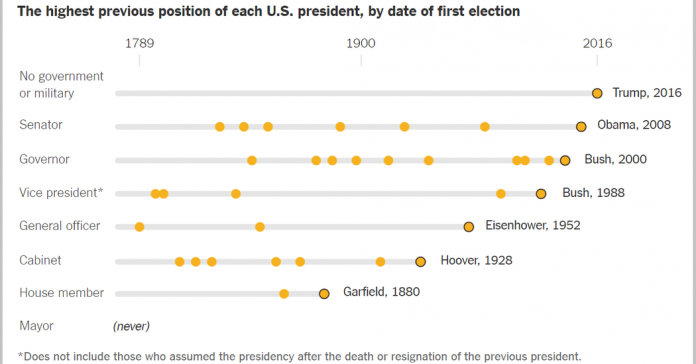
This graph originally appeared elsewhere on NYTimes.com. By Friday morning, Nov. 15, we will provide the “Reveal” — the graph’s free online link, additional background and questions, shout-outs highlighting student comments and headlines, and Stat Nuggets.

To add other relevant information to your analysis, you may want to use the graph below to compare the prior experience of our presidents to the experience of 2020 Democratic candidates.

After looking closely at the graphs above (or at this full-size image), think about these three questions:

  • What do you notice? If you make a claim, tell us what you noticed that supports your claim.

  • What do you wonder? What are you curious about that comes from what you notice in the graph?

The questions are intended to build on one another, so try to answer them in order. Start with “I notice,” then “I wonder,” and end with a catchy headline.

2. Next, join the conversation by clicking on the comment button and posting in the box that opens on the right. (Students 13 and older are invited to comment online. Teachers of younger students are welcome to post what their students’ comments.)

3. After you have posted, read what others have said, then respond to someone else by posting a comment. Use the “Reply” button or the @ symbol to address that student directly.

On Wednesday, Nov. 13, our collaborator, the American Statistical Association, will facilitate this discussion from 9 a.m. to 2 p.m. Eastern time to help students’ understanding go deeper. You might use their responses as models for your own.

4. By Friday morning, we will reveal more information about the graph at the bottom of this post. Students, we encourage you to post an additional comment after reading the reveal. How does the original article and the moderators’ comments help you see the graph differently? Try to incorporate the statistical terms defined in the Stat Nuggets in your response.


Lesson of the Day: ‘Anxious and Cooped Up, 1.5 Million Kashmiri Children Are Still Out of School’

0
Lesson of the Day: ‘Anxious and Cooped Up, 1.5 Million Kashmiri Children Are Still Out of School’

Find all our Lessons of the Day here.

Featured Article: “Anxious and Cooped Up, 1.5 Million Kashmiri Children Are Still Out of School”

After India revoked the autonomy of the Kashmir region in August, soldiers and militants have claimed the streets and most schools shuttered their doors indefinitely.

In this lesson, students will consider what their own life would be like without school, examine the impact of the current crisis on the lives of school-age children in Kashmir and choose a youth or image profiled in the article to write about.

Imagine you couldn’t go to school anymore.

Whether you love, hate or occasionally dread school, imagine that all of a sudden no children could attend school: How would this affect your life?

Take a few minutes to reflect on how life would be different: What would your first day, week or month be like? How would you try to adjust to life without the routine and community of school? How would you feel? What would you do? What would you miss the most?

Write a short journal entry describing what you imagine life without school would be like.

Background Information

Before you read the featured article, here is some relevant background information.

On Aug. 5, India’s Hindu nationalist government unilaterally revoked the autonomy of the Muslim-majority Kashmir region, a disputed territory fought over by India and Pakistan.

The Indian government imposed curfews, cut phone and internet service (which has since been partially restored), and detained over 2,000 people, including teachers, lawyers and journalists.

Three months later, most schools have been closed indefinitely.

Read the article, then answer the following questions

1. What has Aliya Khan, a fifth grader, been doing every morning since India revoked Kashmir’s autonomy thirteen weeks ago? Why do you think she does this despite her mother’s attempts to dissuade her? How does Aliya’s story illustrate the author’s claim that education stands as “one of the crisis’s most glaring casualties”?

2. How many schools have been closed in Kashmir? Why are many parents afraid to send their children to schools that remain open?

3. How have the school closures affected the lives of Kashmiri children — physically, socially and emotionally? Give three examples from the article.

4. What are some of the things Kashmiri students miss the most? Why are many “desperate” to get back to school, according to the article?

5. How are some teachers and educators, like Mufeed Ahmad Malik, trying to make sure the children are still learning even if they are not in school? Why does Mr. Malik fear that if schools don’t reopen soon, some children will “go down the wrong path”?

6. Why do Indian-backed officials in Kashmir blame parents for not sending their students to school? How persuasive is their argument? If you were a parent in Kashmir today, would you send your child to school?

7. What is your reaction to the article? How did your writing from the warm-up activity compare to the actual experiences of young people in Kashmir who can’t attend school? How does reading the article affect your view of your own schooling and your relationship to school?

Choose one or both of the following questions to respond to in writing.

1) The article features many children whose lives have been affected by school closures in the region, such as Mehak Javid Bhat, an 18-year-old, who was preparing for medical school when her high school shut down, or Reyan Sofi, a fourth grader, who recently told his father, “You should either burn my books and my uniform or send me to school.” Which student did you find most interesting or affecting? Which did you relate to most?

Select one student featured in the article and write about how you connect with his or her story. What can we learn from it?

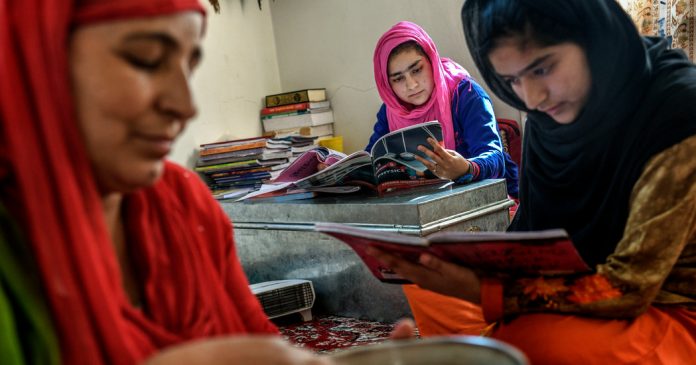
2) Look at the photos featured in the article: What do you notice about them? What story do they tell about the current crisis in Kashmir and its impact on children? Which photo do you find most interesting, surprising or memorable?

Choose one image and write about how it illustrates the ways that children have been affected by the loss of school.

Popeyes Chicken Sandwich

0
Popeyes Chicken Sandwich

Have you tried a Popeyes chicken sandwich yet? If so, do you think it lives up to the hype? If not, would you wait in long lines just to get a taste of one? What do you think makes this sandwich different from all the others?

Have you tried any other “viral” foods, like Burger King’s Impossible Whopper, the Starbucks “unicorn Frappuccino” or avocado toast? What made you want to try them? Were any as good as they were made out to be?

In your opinion, what is it that makes a food trendy?

Tell us in the comments, then read the related article to find out more about the Popeyes frenzy.


Find many more ways to use our Picture Prompt feature in this lesson plan. You can find all our Picture Prompts in this column.

Word + Quiz: Sisyphean

0
Word + Quiz: Sisyphean

1. both extremely effortful and futile

2. of or relating to Sisyphus, a figure from Greek mythology best known for having to roll a boulder up a hill in Hades, only to have it roll back down, over and over for eternity

_________

The word Sisyphean has appeared in 30 articles on NYTimes.com in the past year, including on May 24 in “The Women’s World Cup’s Other Inequality: Rich vs. Poor” by JerĂ© Longman:

Women’s international soccer has long faced a Sisyphean battle to gain respect and support. The American women’s team continues to find it necessary to sue U.S. Soccer for gender discrimination. Players in Australia and elsewhere have refused to play matches, and stars in other countries went public with complaints on everything from training pay to a lack of games.

It has been a particularly tough slog in the Caribbean, where soccer has been blighted by corruption, and the women’s game especially has been widely dismissed. When Trinidad and Tobago arrived in Dallas for the final qualifying round of the 2015 Women’s World Cup, its coach, Randy Waldrum, sent out a financial S.O.S. via Twitter.

“I need HELP!” Waldrum wrote at the time. “T&T sent a team here last night with $500 total. No equipment such as balls, no transportation from airport to hotel, nothing.”

_________

Do You Read Reviews?

0
Do You Read Reviews?

Find all our Student Opinion questions here.

Note: This question, like three others we’re asking this week, are inspired by our Review Unit and related contest, in which we invite teenagers to write their own takes on a work from any of the 13 categories of creative expression that The Times reviews. If you are participating in the contest, we invite you to use this as a kind of “rehearsal space” to post ideas and see how others respond.

And, of course, even if you’re not participating, we’d love to hear your thoughts.

How do you decide if you want to see a movie? Do you check sites like Rotten Tomatoes? Ask your friends? Read newspaper reviews? Check TikTok?

How much, in general, do those other opinions sway you?

Is everyone qualified to be a critic? What’s the difference between the kinds of user-submitted reviews you read online and cultural criticism by a professional critic? Don’t worry if you’re not sure. Below, we’ve rounded up several pieces that ask questions about the role of reviewers and cultural criticism in our world today.

In “A Times Arts Critic Reviews His Own Role,” the movie critic A.O. Scott explains what he does:

By the end of this year, if recent history is any guide, around 900 movies will have opened in theaters in the United States. Hundreds more will have made their debuts on streaming platforms, along with more than a million hours of serial programming on traditional networks, cable channels and web-based broadcasters like Netflix, Hulu and Amazon. Defying periodic reports of its demise, live theater is flourishing: on Broadway and off, in Brooklyn and Chicago, in London and Louisville. Nearly every week brings new dance recitals, chamber music concerts, pop albums, museum and gallery exhibitions — am I missing anything?

Everyone is always missing something, but the critics who write for The New York Times — in staff positions and as regular freelancers — collectively strive to miss as little as possible, and to provide some help to readers faced with the overwhelming abundance of contemporary culture. How to make sense of it all? How to choose?

Those are difficult questions, and they aren’t the same question. Part of the critic’s job is to offer consumer advice. You want to know if a given performance or exhibit is worth your time. But criticism doesn’t stop with warnings and recommendations. (The Times doesn’t use stars, thumbs or letter grades, but especially worthy productions are designated Critic’s Picks.) Whether or not we like the thing we’re reviewing, we are interested in what it means, how it works (or doesn’t), why it matters (or doesn’t), and how it reflects and is part of the larger world. We assume that readers are looking not only for advice, but also for ideas, arguments, provocations and the occasional joke. We hope that, even if you skip the movie, give up on the show or can’t get tickets to the opera, you’ll at least find something worth reading.

In a 2015 column, “Is Everyone Qualified to Be a Critic?”, two Times critics discuss what it takes to pass judgment on the arts. Adam Kirsch writes:

Everyone, upon encountering a work of art, has some kind of response. In this sense, everyone really is a critic 
 To be able to say what you feel and why: That is the basic equipment of a critic.

In the same column, however, Charles McGrath argues:

If for a start we require that critics know what they’re talking about — that their judgments are actually informed — the field thins considerably, and if we also insist on taste and discernment, then the number of valuable and useful critics dwindles pretty drastically.

A 2010 edition of the Sunday Book Review asked six essayists to consider the question: What is the role of the critic today?