fbpx
Home Blog Page 1580

Custom Design Feature | Planet Castor

0
Custom Design Feature | Planet Castor

A few months ago we were asked by Planet Castor to create a website that would showcase their teaching materials. What they had in mind was very different than anything we’ve done before, so we were excited to take on the project.


Finding the perfect style

Each of our design processes starts with a mood board. It helps us define the perfect style, colors, and fonts for the projects we work on. Planet Castor’s order was assigned to our custom designer Kate. The owners of Planet Castor sent her their logo files and described to her their vision. They wanted their site to be simple, modern, and if possible, with a dark-colored background. They wanted the graphics to feature planets, stars, and anything else related to cosmos and space.

Planet Castor’s teaching materials refer to school subjects as “planets,” so, for example, science is called “planet science” or math is called “planet math” etc. Planets are an integral piece of their branding so it was important that they were included in their mood board.

Since the client didn’t yet have a clear vision of what they were wanting, Kate decided to come with three different mood board options. It helps to have a few options which can then be mixed, matched, and altered until we find something that fully resonates with the client.

Even though Mood Board #2 was originally a little busy, it won in the end with a few small adjustments. The final mood board version looked like this:


Creating the website design

As mentioned in the beginning, this site was very different from other projects. Not too long ago we created a site for Ashleigh who also sells teaching supplies. Even though both sites have the same purpose, they looked totally different from each other. We love creating entirely unique and one-of-a-kind designs for all of our clients.

We encourage you to visit Planet Castor’s website and browse through their custom category pages for free teaching resources.

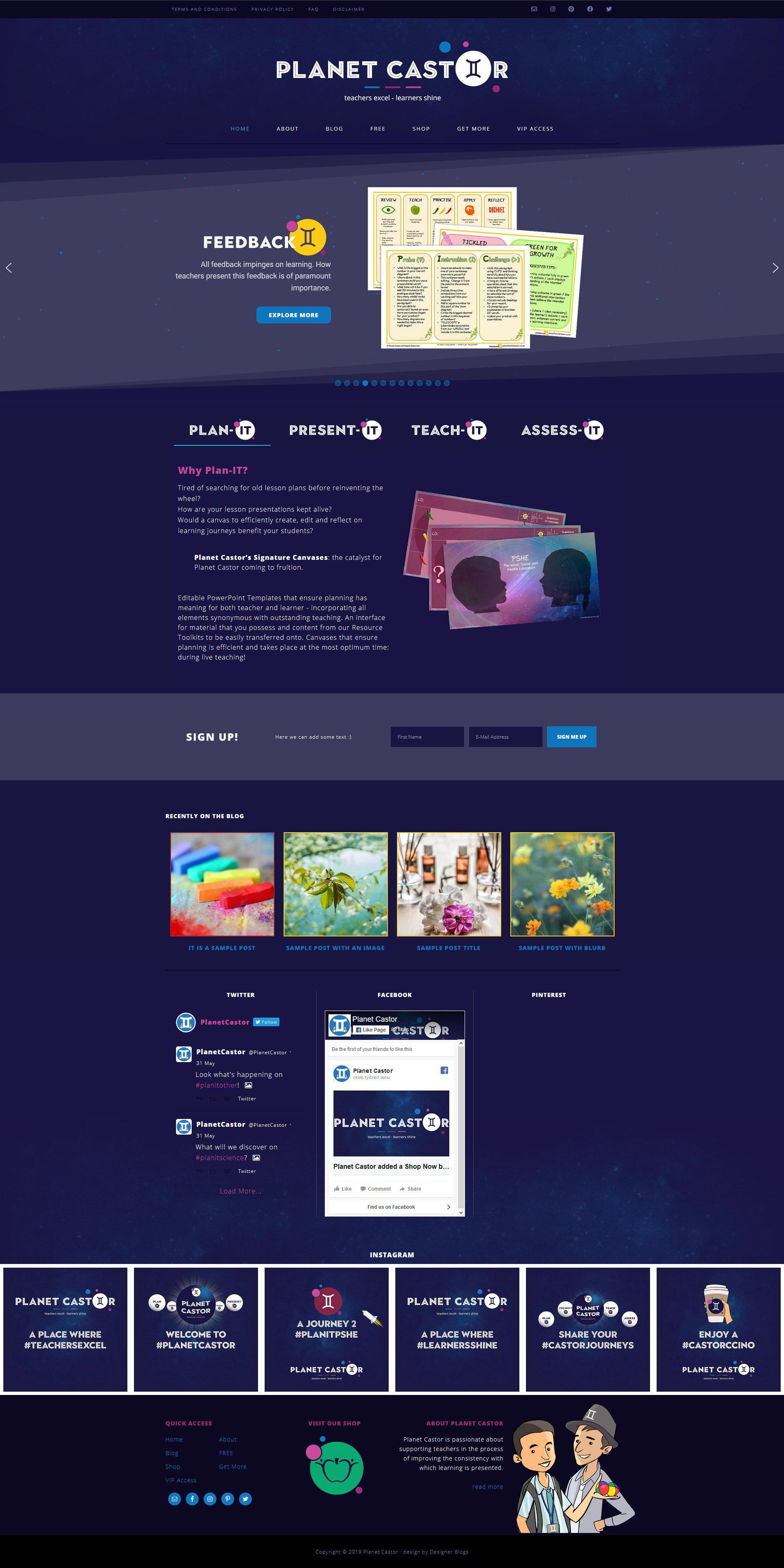
Here is a full-length view of the final website design:

Click here to view larger


Final thoughts

Working with Planet Castor was a pleasure. It took about a month to create their website from start to finish and we are really happy with the results. Planet Castor shared this great feedback about their project:

At every stage of the process Kate has kept us up to speed with all developments. She has ensured our vision has driven the design and we are overjoyed with the responsive site that she has created. Revisions were always warmly received and the designer was always straight forward and direct in what could be achieved. Her skillset has ensured that we are left with a unique and engaging site. Our venture has taken a lot of time and energy to get to this stage and it has been an absolute pleasure enlisting Kate from Designer Blogs to bring it closer towards completion. I can highly recommend Kate for all your future website needs.

Kindest regards to Kate and the wider Designer Blogs Team.”

Planet Castor

If you are looking for a custom blog or website design, visit our Custom Design Services page to request a quote.

Lesson of the Day: ‘How to Develop an Appetite for Insects’

0
Lesson of the Day: ‘How to Develop an Appetite for Insects’

Find all our Lessons of the Day here.

Featured Article: “How to Develop an Appetite for Insects”

Scientists who study bugs are thinking harder about how to turn them into good food. In this lesson, students explore the stigma against eating insects, plus how and why researchers think we should undo it.

If insects were to show up in your next school lunch, how would you feel?

In “A Change in the Menu,” a winning entry from our 2019 Student Editorial Contest, Grace Silva urges Westerners to reconsider their aversion to bugs. Her essay begins:

According to the Food and Agriculture Organization of the United Nations, an estimated two billion people eat bugs as part of their standard diet. That’s nearly a quarter of the global population, and yet most countries in Europe and North America, despite the nutritional and environmental benefits, are fiercely reluctant to the idea of consuming bugs.

And she concludes:

The Western consensus is best stated by New York Times writer Ligaya Mishan: “Europeans, and by extension European settlers in North America, never had a bug-eating tradition. Indeed, we largely consider insects dirty and drawn to decay, signifiers and carriers of disease; we call them pests, a word whose Latin root means plague.” This is a ridiculous stigma that we need to shake. The adoption of bugs into a normal diet would not be unlike the transition from raw fish being largely unaccepted in America, to sushi becoming a normal meal option.

Have you ever eaten insects before? Are they accepted in your culture or country as a healthy part of a complete meal? Or do you generally regard them as “pests”?

What do you think about Grace’s proposal? If you’ve never eaten bugs before, would you be willing to try them? Why or why not?

Read the article, then answer the following questions:

1. What is entomophagy? Why is it in the news right now?

2. How did Christopher Columbus help deepen the stigmatization of entomophagy?

Word + Quiz: fatuous

0
Word + Quiz: fatuous

fatuous ˈfa-chü-əs , -tyü- adjective

: devoid of intelligence, silly

_________

The word fatuous has appeared in 13 articles on NYTimes.com in the past year, including on July 23 in the dance review “Petipa: Precursor to Modern Ballet or Hierarchical Elitist?” by Alastair Macaulay:

And though dance made an important contribution in most Petipa ballets, in several it was far from their raison d’être. “King Candaules” (1868) ends, after its title character has died, with a scene in which his queen is haunted by his ghost until she drops dead; that, Ms. Meisner writes, is followed by a tableau in which, amid the other gods in the cloud-filled heavens, Venus-Astarte points “at the corpse of the hubristic queen who had dared to compete with the goddess of beauty.”

Fatuous, yes — and all too characteristic of other Petipa ballets. Such a narrative epitomizes what the Bolsheviks would soon want to sweep away.

_________

Lesson of the Day: ‘That Music You’re Dancing To? It’s Code’

0
Lesson of the Day: ‘That Music You’re Dancing To? It’s Code’

Find all our Lessons of the Day here.

Featured Article: “That Music You’re Dancing To? It’s Code”

Collectives in cities around the world are bringing computer languages to the club. Students learn about this new approach to music-making and make predictions about how it might shape the future.

Watch the following video, which shows a musician making music by creating code. As you watch, think about the following:

Do you know how to code? What have you created using computer code?

Read the article, then answer the following questions:

1. Describe in your own words what Sonic Pi is and what it does. How has it evolved over time in terms of who uses it and for what purpose?

2. How is using Sonic Pi to create music a different experience from the percussion Melody Loveless composed using traditional means?

3. How does Sonic Pi serve as an inspiration, or a muse, for musicians? Find at least two quotes from the article that demonstrate this.

4. The reporter writes, “That egalitarianism is a crucial part of the algorave ethos.” What does that mean? What examples can you find in the article to support this idea about egalitarianism in code-derived music?

5. How is code compared in the article to other written languages like English or Spanish? What purpose is code mostly used for at present? How is this changing?

Have a small group discussion on where you think music is headed. Is “live coding” the future?

Compare the appeal among artists of using a laptop to create code in real time at a performance versus playing already-recorded music, as many D.J.s do, or using instruments, as many bands do. How do you think the experience compares for the audience?

The checklist to prepare your career for the 2020s

0
The checklist to prepare your career for the 2020s

At the turn of the 21st century, employees the world over were preparing for Y2K. Those with giant PCs were convinced their files would be wiped, others were researching a new fandangle machine called a ‘Blackberry’. Some were cancelling their flights to conferences, afraid that their plane may just fall out of the sky.  

As we draw nearer to the year 2020, we’re a little less naïve about technology. But we are, once again, facing a new era.  While 2020 may not be a new century, the turn of this decade is worth just as much weight given that technology is now doubling in capacity every 18 months. 

So, how can employees approach the next 10 years in the workforce feeling prepared, not panicked?  We’ve got it sorted with this 4-step checklist.  

1. Check your robot risk level  

First things first. To prepare for the next season of your working life, you’re going to need to know whether your current job will actually, you know… exist. 

Get started with the ABC’s useful ‘Could a robot do your job?’ predictor tool. Enter your job, and a snapshot of how automation is affecting your industry will appear. Although not exhaustive, this tool helps break down which elements of your job are most at risk. 

Girl being greeted by robot.

2. Audit your skills 

Identifying what you excel at today, and pairing them with the opportunities of tomorrow, will keep you in good stead for the years ahead. 

Start by listing out your technical skills. These should include programs you’re familiar with, the technology you’ve used and the courses you’ve got under your belt.  

Next look at the roles you’d like to move into in the next decade – particularly in areas that are set to boom. Are there any gaps you’ll need to fill to get there? More on this in Step 4.  

3. Develop your personal brand 

With robots set to take over the more mundane tasks in the workforce, standing out in human-centric skills will help you nab the jobs that technology can’t take care of. 

Developing a personal brand can help you highlight your soft skills (think empathy, communication, storytelling, emotional intelligence, creativity, and having a growth mindset). 

Carve yourself out as a thought leader by highlighting these skills on your LinkedIn profile and CV.  Take time every week to post your latest ideas and share inspiration on work platforms such as Slack. Better yet, attend events and conferences in your industry.  

4. Step it up with bite-sized learning 

In the 2020s and beyond, some industries are predicted to replace as much as 44% of certain roles with automation. But despite the influx of intelligent tech, research shows that the robots are not going to take over completely. 

In fact, skilled human workers are estimated to be in shortage of around 1.5 million by 2022. That means there are some serious gaps that still need to be filled by people. 

While humans are most definitely still in the game, our skills need to adapt to the technology around us. To do this, upskilling is a necessity. Enter bite-sized study. 

Bite-sized study covers a range of snackable learning options including micro-credentials, undergraduate single subjects and postgraduate single subjects.  

These allow you to develop a specific skill with just a few hours of study a week – meaning you can stay relevant with new skills for the future of work without having to give up your day job.  

Remind yourself of the skills you need to hone from Step 2, and then check out which bite-sized learning courses can get you there.  


Keen to prepare yourself further for the future of work?  

The Definitive Guide to Future-Proofing Your Career is the report every career-conscious Australian needs to remain relevant in the 2020s and beyond.  

Baby Advice for New Parents: How to Get a Newborn to Sleep

0
Baby Advice for New Parents: How to Get a Newborn to Sleep

Listen to Mary Kohn of the University of Colorado share newborn baby care tips for right after birth and more.

She covers if you can hold a newborn too much, how to get newborns to sleep without being held, and when babies sleep through the night naturally.

Want to hear more from Mary?

Enroll for free in her Newborn Baby Care Specialization.

Or if you’re a member of the press, set up an interview with Mary.


Purdue University Announces Master’s in Electrical and Computer Engineering on edX

0
Purdue University Announces Master’s in Electrical  and Computer Engineering on edX

Master’s Degree in Electrical and Computer Engineering

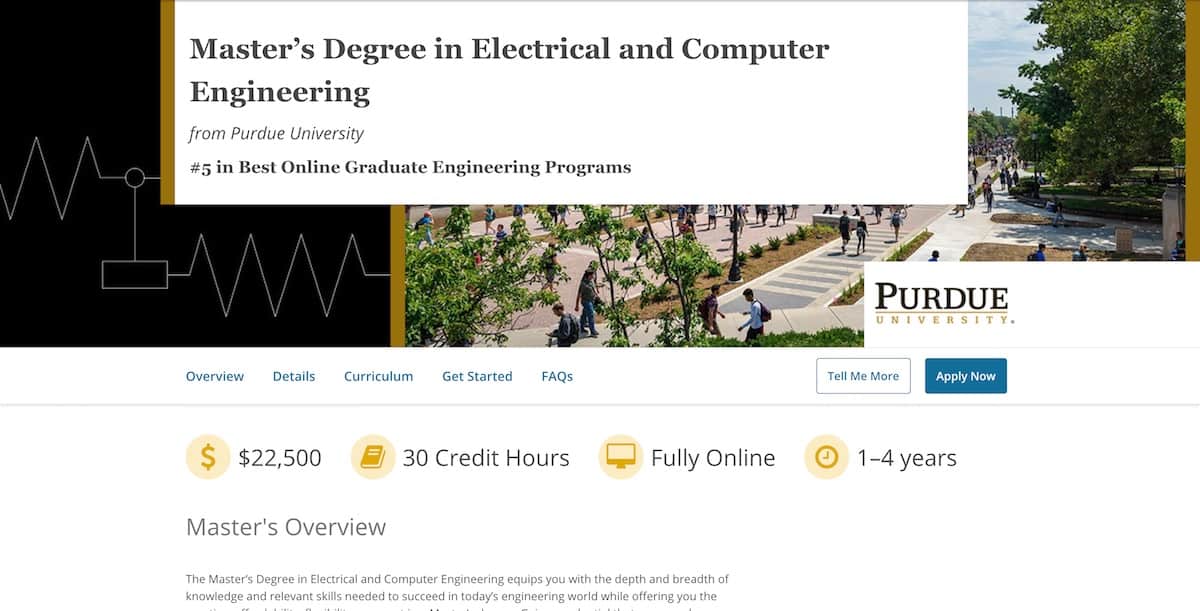
Purdue University became the 7th edX partner to launch a MOOC-based Master’s degree with the company.

The Master’s in Electrical and Computer Engineering costs $22.5k and consists of 30 credits ($750/credit). It can take anywhere from 1 – 4 years to finish.

This degree competes head-on with a similar degree from the University of Colorado, Boulder which will be offered through Coursera. The degree is similarly priced and costs $20k for the same number of credits ($667/credit). The CU Boulder version of the degree also allows students to earn a smaller 9 credit graduate certificate.

The CU Boulder degree, which was announced much earlier, has initiated a limited launch this month. The full program launches in January 2020, the same as Purdue (which probably isn’t a coincidence).

As always what excites us are the courses that are part of these degrees being launched to the general public for free to audit. Early this year Class Central compiled a list of over 400 such courses.

CU Boulder has launched 21 courses in the field of Electrical Engineering (EE) while Purdue has 8 courses. CU Boulder plans to release around 100 courses. Overall around 300 EE MOOCs have been launched by universities around the world.

The other thing that differentiates CU Boulder’s degree is that there is no application process and is purely performance based. i.e Students need to complete a series of courses for credit in a “Pathway Specialization” and pass with an overall GPA of 3.0 or better.

This degree from Purdue is edX’s 11th degree and edX also lists another 13 degrees in its upcoming degree partners.

So far MOOC-providers have announced over 35+ Masters Degrees. A complete list of currently available MOOC-based online degrees, along with their prices, can be found in Class Central‘s pricing charts.

Besides its master’s degree in electrical and computer engineering, Purdue plans to launch two other online degrees on edX in 2020:

  • An online master’s degree in mechanical engineering
  • An online master’s degree in civil engineering

The civil engineering degree will be developed from the ground up. By contrast, the other two will be based on master’s degree programs currently offered by Purdue on its own online education portal, where they cost $40k. On edX, the degrees will cost less than $25k.

In 2017, Purdue acquired Kaplan University, a for-profit online university until then managed by the Kaplan Higher Education corporation. Following the acquisition, Kaplan University was re-branded as Purdue Global and turned into a nonprofit.

Although the upcoming engineering degrees will be offered on edX and not on Purdue Global, Kaplan Higher Education will remain involved in the degree programs by providing admissions and analytics support to Purdue.

Word + Quiz: neophyte

0
Word + Quiz: neophyte

noun: any new participant in some activity

noun: a new convert being taught the principles of Christianity by a catechist

noun: a plant that is found in an area where it had not been recorded previously

_________

The word neophyte has appeared in 58 articles on NYTimes.com in the past year, including on Oct. 1 in “The Evolution of the Hard Hat” by Murray Carpenter:

Hard hats are now so ubiquitous that they often go unnoticed. They are often embellished with union stickers and American flags, perched on the heads of men and women ambling to work, lunch coolers in hand. They are reliable props for V.I.P.s at ribbon cuttings, and in the crowds at political rallies.

… They’ve also become emblems of authority, revealing much about their owners. A shiny new hard hat can suggest a neophyte. But a well-worn one represents experience as easily as a carpenter’s broken-in tool belt or a logger’s weathered but well-oiled boots. Even the color can denote status: Some workplaces require one color for employees, another for contractors and yet another for apprentices.


_________

Do Films Like ‘Joker’ Endorse (or Even Promote) Violence?

0
Do Films Like ‘Joker’ Endorse (or Even Promote) Violence?

Find all our Student Opinion questions here.

In creating the new film “Joker,” Warner Bros. set out to make a boundary-pushing production. The early reaction has included critical praise, but also deep unease about the film’s violence and message.

Some worry that the “violent, hyper-realistic movie is potentially dangerous — that rather than critiquing the societal failings that have given rise to America’s mass-shooter crisis, the film legitimizes such atrocities and could provoke more of them.”

Do you think a film like “Joker” can be dangerous to society?

In “‘Joker’ Movie Is a Risk, but a Calculated One, for Warner Bros.,” Brooks Barnes and Nicole Sperling write:

Hollywood’s latest comic book movie, “Joker,” arrives in multiplexes on Thursday night, and it has all the makings of a juggernaut.

The R-rated film, which portrays the DC Comics villain as sharing the psychological traits of real-life mass shooters, is expected to collect at least $80 million in the United States and Canada by Sunday. If the film reaches that total, it would give Warner Bros. its biggest non-sequel opening in two years. “Joker” has artistic legitimacy, having won the top prize at the Venice Film Festival last month. Its star, Joaquin Phoenix, has been singled out as a surefire Oscar nominee.

But “Joker” is also causing deep unease. Some people, including a few rank-and-file employees on the Warner Bros. lot, worry that the violent, hyper-realistic movie is potentially dangerous — that rather than critiquing the societal failings that have given rise to America’s mass-shooter crisis, the film legitimizes such atrocities and could provoke more of them.

Amid the critical praise are scorching reviews that use words like “irresponsible.” The F.B.I. has warned about ugly online chatter surrounding “Joker,” prompting the police in cities including New York and Los Angeles to step up theater security and reigniting the debate over First Amendment rights versus Hollywood accountability. Relatives and friends of those killed during the 2012 movie theater massacre in Aurora, Colo., sent a letter to Warner Bros. expressing disquiet over “Joker” and its empathetic depiction of the character.

Warner Bros. has gone on the defensive. “It is not the intention of the film, the filmmakers or the studio to hold this character up as a hero,” the studio said in a statement.

Students, read the entire article, then tell us:

  • Do films like “Joker” endorse (or even promote) violence? Why or why not?

  • Do movies that offer a sympathetic portrayal of violent criminals have the potential to promote violent acts in real life? Are movie studios acting irresponsibly when they fund and market a film like “Joker”? Or is the “unease” about this film, or any other Hollywood film, unfounded — because after all, it’s just art and entertainment, not real life.

  • Do you agree with the relatives and friends of those killed in the Aurora shooting that the film company should take to heart the credo, “with great power comes great responsibility” and help to “build safer communities with fewer guns”?

  • Do you ever watch violent films? What draws you to this kind of entertainment? Have you ever seen any negative effects of violent films on you or your peers?

  • Should violent entertainment — like films, television and video games — be restricted in any way?

  • Do you plan on seeing “Joker”? Why?

THIS BLOG IS CLOSED – VISIT MY NEW ONE…

0
THIS BLOG IS CLOSED – VISIT MY NEW ONE…

arun

I’m a Learning & Performance Geek with a passion for helping to empower people and solve challenging problems.
I’ve created an app called Learn2Learn to help people future-proof themselves with the super-skill of learning.
In my day job at DeakinCo, I use design thinking to take the lead creative role delivering 70:20:10 performance solutions for some of Australia’s largest companies.
In my spare time, I’m an award-winning fiction writer and hobbyist multimedia designer. Most importantly, I’m a proud dad to 3 eccentric small individuals who, along with my wonderful wife and life partner, have taught me more than anything else in the world.

If you think we’re on the same wavelength, please be sure to connect with me on Twitter/LinkedIn and use the form above to sign up for my email list.