fbpx
Home Blog Page 1581

THIS BLOG IS CLOSED – VISIT MY NEW ONE…

0
THIS BLOG IS CLOSED – VISIT MY NEW ONE…

arun

I’m a Learning & Performance Geek with a passion for helping to empower people and solve challenging problems.
I’ve created an app called Learn2Learn to help people future-proof themselves with the super-skill of learning.
In my day job at DeakinCo, I use design thinking to take the lead creative role delivering 70:20:10 performance solutions for some of Australia’s largest companies.
In my spare time, I’m an award-winning fiction writer and hobbyist multimedia designer. Most importantly, I’m a proud dad to 3 eccentric small individuals who, along with my wonderful wife and life partner, have taught me more than anything else in the world.

If you think we’re on the same wavelength, please be sure to connect with me on Twitter/LinkedIn and use the form above to sign up for my email list.

Lawyer, or law professional?

0
Lawyer, or law professional?

The title ‘lawyer’ has long been coveted. It’s the respect, the earning potential, and the opportunity to fight on behalf of vulnerable people that continues to inspire pursuit of the role.

A law degree is the first step, but even then, nothing is guaranteed. The prerequisites for employment can be intimidating, and hunt for employment can be competitive – it’s enough to turn any aspiring law professional off.

What many people don’t realise is the breadth of roles suited to a law graduate, aside from the role of lawyer, barrister, or solicitor. Whatever your career destination, law can set a strong foundation, and offer the versatility to work across industries in a range of high-impact roles.

Working as a lawyer

As an experienced criminal defence lawyer working in Melbourne, Damian McNally was the perfect person to chat to about a career in law. Damian takes care of cases big and small, from minor traffic offences, to serious cases like fraud, assault and murder. While having a high IQ will get you far, strong interpersonal skills may take you further.

“You need to be able to deal with a judge who may sit in their ivory tower, but also deal with a client who’s sitting in a prison cell who has absolutely nothing to their name.” says Damien.

Lawyers come into contact with people from all walks of life, and to be able to relate and empathise with them is the mark of a good lawyer.

Damian McNally in front of court

Damian McNally – Criminal Defence Lawyer in Melbourne

With a law degree, you unlock the door to a large range of different industries. Every organisation in every field of work must abide by the law, so there’s never a shortage of career paths for a law graduate.

“Law is not for the faint-hearted, but there’s so many different avenues that you can go down, that – if you are passionate and willing to work hard – you’ll truly be rewarded”.

Working as a law professional

While law can be competitive, those who have a law degree are often sought after in a range of industries.

Law graduates can find freedom in choosing to put their skills to use in various areas of work, depending on what aligns with their values. Across their career span, they also also have a variety of roles to choose and shift between. It’s an enviable position when you think about it.

A law degree provides graduates with highly transferable skills, honing their ability to:

  • Think and write analytically
  • Confidently present in public
  • Develop opinions and communicate persuasively
  • Conduct research and compile reports
  • Simplify complex theories
  • Apply strategic thinking to reach an outcome
  • Teach, counsel and work in collaboration with others

Study law online

While law is an age-old occupation, the study of law doesn’t have to take that same traditional form. With courses available completely online, you’ve got the flexibility to earn a qualification on your own terms.

These courses with leading universities, available through Open Universities Australia, are designed to bring you closer to the law-based role of your dreams:

To express your interest in any courses that we offer – fill out the form on this page, and we’ll put you in touch with a friendly student advisor.

If you’re keen to explore on your own, simply head over to our website to browse the extensive catalogue of courses from universities across Australia.

Unlimited for healthcare

0
Unlimited for healthcare

According to the World Health Organisation, the global life expectancy increased by 5.5 years (to 72 years) between 2000 and 2016.

As life expectancy increases, so too does the pressure on healthcare services and professionals.

Medical research advances, the technological revolution of healthcare, and the increased acknowledgement and understanding of mental illness means care has become more complex.

Unlimited gives you limitless access to a range of courses which can help you respond to these changes in healthcare, as you learn in your own time from world-leading healthcare experts.

With Unlimited, you’re welcome to delve into pretty much any topic that makes you happy (from business to coding), but below are five of our top healthcare courses for professionals and enthusiasts looking to improve their effectiveness and broaden their understanding of key healthcare issues ➡️


Digital devices are revolutionising healthcare as we know it.

Explore the impact of new technologies on healthcare professionals and patients. 

You’ll study different types of wearable devices and sensors, and learn how digital devices in healthcare are designed and regulated.

You’ll also consider the impact of the miniaturisation of implantable devices, and the challenges around devices’ use of big data on healthcare systems.

Join this course if: you want to understand digital medicine and the impact of medical technology on healthcare. 


In a rapidly changing world, the complexity of care is increasing and being able to respond to change is vital.

Explore the issue of change in healthcare environments, and learn how to improve your response to change at work. 

You’ll explore the reasons change is necessary and look at ways to empower others to manage change positively. 

Join this course if: to learn how to preserve and improve the quality of service provision, whilst adapting to change.


1 in every 100 people in the UK are on the autistic spectrum. Autism is a lifelong developmental disability affecting how a person communicates with and relates to others and the world. 

Explore the spectrum of Autism and discover shared difficulties and how the condition affects people in entirely different ways.

Consider the social communication skills, sensory sensitivities, repetitive behaviours and the co-occurring conditions which affect those living with Autism. 

Join this course if: you want to understand Autism through lived experiences of people on the spectrum.


Dementia is one of the foremost priorities in global health and is estimated to affect over 44 million people worldwide. This has a huge impact on individuals and society. 

Discover key issues in dementia care and research. You’ll explore four less common forms of dementia through the eyes of people affected. 

With world-leading experts at UCL, you’ll learn how research into the signs, stages, symptoms and causes of these forms can bring us closer to defeating dementia.

Join this course if: to gain insight into dementia through the stories, symptoms and science behind four less common diagnoses. 


Have you ever wondered how what you eat affects your health? Nutrition plays a key role in human health and disease prevention. 

Explore the food health crisis of modern times, and learn how nutrition can help humans experience longer and healthier lives.

You’ll explore the foundation of nutrition and metabolism in the human body, and learn how to assess a healthy nutrition plan for different ages and stages of life. 

Join this course if: you want to learn how food affects our physical and mental health. 

Healthcare is changing. Go Unlimited to learn how you can harness theses changes to look after yourself and others better.

Teenagers in The Times: September 2019

0
Teenagers in The Times: September 2019

The September edition of Teenagers in The Times is always bursting at the seams, thanks to the many back-to-school pieces across sections.

If you’re new to this feature, it is a roundup of stories about young people that have recently appeared on NYTimes.com, and it publishes on the first Thursday of each month during the school year.

For ideas about how to use Teenagers in The Times with your students, please see our lesson plan and special activity sheet, both of which can be used with this or any other edition.

Hong Kong Students Begin School Year With Gas Masks, Class Boycotts and Protests

After a summer of demonstrating in the streets to demand greater rights, students brought their activism to school.

Protesting Climate Change, Young People Take to Streets in a Global Strike

Anxious about the future and angry about the failure to curb the crisis, millions joined an urgent call for action against climate change.

How the Climate Kids Are Short-Circuiting Right-Wing Media

“Young people like Greta Thunberg are participating in the culture wars while also managing to float above the fray,” according to this Op-Ed.

Greta Thunberg, on Tour in America, Offers an Unvarnished View

With her typically blunt, often biting remarks, the Swedish teenager has offered Americans an outsider’s view of themselves.

Climate Protesters and World Leaders: Same Planet, Different Worlds

September 20th’s global climate protests put the gap between activists and many of the world leaders preparing to meet in New York City next week into stark focus.

Palestinian Harvard Student Blocked From Coming to U.S. Is Allowed to Enter

Ismail Ajjawi, who was denied entry to the United States, was allowed to enter on Monday and was at Harvard University for the start of classes.

Iranian Students Set to Start at U.S. Universities Are Barred From Country

The students, who were mostly headed to schools in the University of California system, had visas in hand when they were blocked from their flights this month.

School Collapses in Kenya, Killing at Least 7 Students

The wooden structure at Precious Talent Top School crumbled as the school day began on Monday, officials said.

Syrian Children Saved a German Village. And a Village Saved Itself.

Four years after Germany took in over one million migrants, integration is quietly working, one village at a time.

Deadly Fires Stun Rio: A Boys Soccer Dorm, a Storied Museum, and Now a Hospital

At least 11 patients were killed in a fire at a Rio de Janeiro hospital, once again raising questions about hazardous building conditions in the city.

When Active-Shooter Drills Scare the Children They Hope to Protect

As fears about mass shootings rise, school preparedness programs include some “completely stupid” scare tactics, child trauma experts say.

Get Vaccinated or Leave School: 26,000 N.Y. Children Face a Choice

Religious exemptions for vaccinations are no longer available. With the start of the school year, some parents face a reckoning.

Before 1st Day of School, a Quiz on How to Use Your Giant Schoolbag

As students all over the world begin new school terms, German pupils’ experiences are rooted in special rites and a philosophy that teaches independence.

Saving Money, and Your Sanity, on College Visits (Hint: Resist the Swag)

Most counselors suggest starting near home and visiting a mix of college types, like an urban college, a large public university and a small, liberal arts campus.

_________

Described as a counterpart to Anne Frank’s diary, a journal written by Renia Spiegel, a Jewish girl who lived in Poland during World War II, is being published in English.

Coming of Age as an Immigrant Child Bride

The teenage heroine of Angie Cruz’s new novel, “Dominicana,” holds the weight of her family’s American dream on her shoulders.

What the Skateboarders Are Wearing at the LES Skate Park

An asphalt expanse under the Manhattan Bridge is still a place to flex your skate moves and your style.

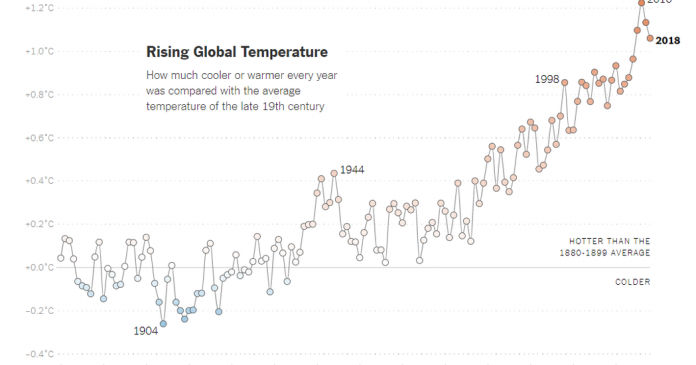
What’s Going On in This Graph? | Oct. 9. 2019

0
What’s Going On in This Graph? | Oct. 9. 2019

This graph originally appeared elsewhere on NYTimes.com. The horizontal line at +0.0 degrees C is the average global temperature for the period 1880 – 1899.

By Friday morning, Oct. 11, we will provide the “Reveal” — the graph’s free online link, additional background and questions, shout outs highlighting student comments and headlines, and Stat Nuggets.

After looking closely at the graph above (or at this full-size image), think about these three questions:

  • What do you notice? If you make a claim, tell us what you noticed that supports your claim.

  • What do you wonder? What are you curious about that comes from what you notice in the graph?

The questions are intended to build on one another, so try to answer them in order. Start with “I notice,” then “I wonder,” and end with a catchy headline.

2. Next, join the conversation by clicking on the comment button and posting in the box that opens on the right. (Students 13 and older are invited to comment online. Teachers of younger students are welcome to post what their students’ comments.)

3. After you have posted, read what others have said, then respond to someone else by posting a comment. Use the “Reply” button or the @ symbol to address that student directly.

On Wednesday, Oct. 9, our collaborator, the American Statistical Association, will facilitate this discussion from 9 a.m. to 2 p.m. Eastern time to help students’ understanding go deeper. You might use their responses as models for your own.

4. By Friday morning, we will reveal more information about the graph at the bottom of this post. Students, we encourage you to post an additional comment after reading the reveal. How does the original article and the moderators’ comments help you see the graph differently? Try to incorporate the statistical terms defined in the Stat Nuggets in your response.


  • Read our 2019-20 introductory post, which includes the archives of past releases by topic and graph type.

  • Learn more about the “Notice and Wonder” teaching strategy and how and why other teachers are using this feature from our on-demand webinar.

  • Add our 2019-20 “What’s Going On in This Graph?” 22 live-moderated discussion Wednesdays to your Google calendar (10/9, 10/16, 10/23, 10/30, 11/6, 11/13, 11/20, 12/4, 12/11, 1/8, 1/15, 1/22, 1/29, 2/8, 2/12, 2/26, 3/4, 3/11, 3/18, 3/25, 4/1, 4/8). Graphs are always released by the Friday before to give teachers time to plan ahead.

  • Go to the A.S.A. K-12 website, which includes This is Statistics, resources, professional development, student competitions, curriculum, courses and careers.

What’s Your Favorite Punctuation Mark?

0
What’s Your Favorite Punctuation Mark?

Find all our Student Opinion questions here.

Do you feel confident with a comma? Confused by the semicolon? How do you feel about exclamation points? Did you know that most typewriters didn’t have an exclamation point 50 years ago? (How did anyone convey their enthusiasm in writing before 1970?!)

Odd as it may seem, punctuation has been in the news lately, with heated debates about the exclamation point — or the sudden proliferation of that mark — as well as considerable praise and consternation for the em dash (featured in this sentence between the words “point” and “or”).

Do you pay attention to punctuation in your writing for school? How about within your texts or emails? Do you have a favorite mark?

In “Where Do We Stand on the Exclamation Point?,” Emma Goldberg writes:

Meredith Golden says that finding your soulmate on Tinder is easy, as long as you swear off one vice. It isn’t cigarettes or cheese fries. It’s slimmer, sneakier. That cardinal sin: the exclamation point.

“Punctuation should not be excessive, especially in an opening message,” said Ms. Golden, who ghostwrites for those struggling on the dating apps. She has seen too many hopes dashed by an overly enthusiastic greeting.

Conveniently, her rules also apply to the workplace. The sly devil is just as loathsome in the office, where it has been said to ring unprofessional. So much so that Tami Reiss, a product strategist, created a Gmail plug-in called Just Not Sorry, that alerts users when they’ve exceeded the appropriate number of marks (two) in a work email.

“This isn’t Vegas on a girls trip,” said Ms. Reiss. “The triple exclamation point is great when your best friend just got engaged, but at work, it can come off as juvenile.”

The author notes that the exclamation point has its defenders too:

To Jonny Sun, a writer on “BoJack Horseman” and a viral tweeter, the exclamation point is the wild child. “It’s a rebellion against the weighty rules of grammar that were passed down to us,” he said. “The exclamation point is a way of saying we’re bucking these rules because they feel old fashioned and dusty.” The period, in contrast, “feels like a sigh.”

The article continues:

Eager to please and good with kids, the exclamation point skews feminine. The writer Amelia Tait calls it “emotional labor” in grammatical form, shouldering the responsibility to ease tension or hurt. Gretchen McCulloch, a creator of the podcast “Lingthusiasm,” said it functions as a “social smile” and a mark of sincerity in a time when irony abounds. It just wants to Marie Kondo your sentences — to clear out a small space and spark some joy. (Its origin is the Latin symbol for joy, io.)

Clare Palo, a social media editor at New York Magazine, declared last week that the anti-exclamation point movement “has gone too far.” Her whole life she has been told by friends, the internet and, most recently, her landlord, to tone down her punctuation. What’s so wrong, she asked, with wanting to spread some digital cheer? Her colleague Madeleine Aggeler noted that at this point in the digital evolution of language, ending a sentence in a period (“okay.”) can be misread as: “Why don’t you crawl into a cave and die?”

Ms. Palo thinks Gen Z may turn the tide all the way. “Gen Z-ers use exclamation points more casually because they grew up texting,” she said.

In a related article, “The Em Dash Divides,” Kate Mooney writes about another much-debated form of punctuation:

For some writers, the em dash is a vice that their editors occasionally forgive but more often forbid. It has been duly cast as an alluring alternative to the comma, colon, semicolon and full stop in the “distracted boyfriend” meme.

The longest of the dashes — roughly the length of the letter “M” — the em dash is emphatic, agile and still largely undefined. Sometimes it indicates an afterthought. Other times, it’s a fist pump. You might call it the bad boy, or cool girl, of punctuation. A freewheeling scofflaw. A rebel without a clause.

Martha Nell Smith, a professor of English at the University of Maryland and the author of five books on the poet Emily Dickinson (the original em dash obsessive), said that Dickinson used the dash to “highlight the ambiguity of the written word.”

“The dash is an invitation to the reader to make meaning,” Dr. Smith said. “It can also be a leap of faith.”

Students, read one or both of the articles, then tell us:

  • How do you feel about the exclamation point? Are you concerned about “exclamation-point inflation”? Do you agree with Tami Reiss when she says: “This isn’t Vegas on a girls trip. The triple exclamation point is great when your best friend just got engaged, but at work, it can come off as juvenile”? Or do you lean more toward Jonny Sun, who argues that “the exclamation point is a way of saying we’re bucking these rules because they feel old fashioned and dusty”?

The glorious em dash — the king of all punctuation marks! The em dash is bold, daring, and versatile. What other punctuation mark can be a semicolon, colon, comma, and parentheses?

Semicolons are by the book foot soldiers; they do a good job linking two would-be sentences. The em dash, on the other hand, is a colorful punctuation mark — it can be used to make a strong point! The comma is great for describing, listing, and linking clauses, but it is easy for commas to flood a sentence. The em dash comes to the rescue when the commas take over a sentence — saving it from sinking in a sea of commas. …

The em dash — the Swiss Army knife of punctuation — can greatly improve your writing — just don’t overdo it!

Write your own simile, metaphor or other kind of comparison to illustrate your viewpoint on your favorite or least favorite punctuation mark.

Baby Advice for New Parents: How to Get Newborn to Sleep

0
Baby Advice for New Parents: How to Get Newborn to Sleep

Listen to Mary Kohn of the University of Colorado share newborn baby care tips for right after birth and more.

She covers if you can hold a newborn too much, how to get newborns to sleep without being held, and when babies sleep through the night naturally.

Want to hear more from Mary?

Enroll for free in her Newborn Baby Care Specialization.

Or if you’re a member of the press, set up an interview with Mary.


Solving the “Data Explosion” Problem with University of Illinois Data Mining Pioneer Jiawei Han

0
Solving the “Data Explosion” Problem with University of Illinois Data Mining Pioneer Jiawei Han

Jiawei Han, a professor of computer science at the University of Illinois at Urbana-Champaign, was recently named a Michael Aiken Chair, one of the University’s highest awards. The endowed chair is the latest honor in Han’s distinguished and pioneering career, with notable accomplishments including creating core data mining algorithms and co-authoring the textbook that is considered by many to have defined the field. Professor Han is also a busy and successful teacher with a love for “train[ing] the younger generation, whether at UIUC or all over the world on Coursera.” Professor Han had three PhD students graduate in May, with one becoming a professor at Georgia Tech, one joining Google, and one joining Facebook. Students taking his classes as part of the Online Master of Computer Science in Data Science degree have an opportunity to learn from him through videos and can ask him questions directly during live office hours. 

In this conversation, Professor Han shares his perspective on the history and the future of data mining, the challenge of the “data explosion” problem, and why he thinks the University of Illinois offers set students up for long term success. 

Can you explain what you mean when you talk about a “Data Explosion” problem?

Originally, people would say they are ‘data poor’ and that they couldn’t get enough data. Now there is lots of data–the new problem is actually extracting knowledge from it.

Whether you’re a journalist, a biologist, an engineer, or in almost any other discipline, there is this ‘data explosion’ problem: you need to turn unstructured data into structured knowledge. That means spend[ing] a lot of time figuring out how to structure your unstructured data into networks, and then how to mine that data. 

For example, I have a group of students who work on how to handle biomedical literature. With biomedical literature, we can easily get 36 million papers – but to effectively use this huge corpus, you would have to ask experts to label which terms are genes, which are proteins, which are diseases.

It’s not realistic to ask humans to go through 1,000 papers and go over every sentence and label them. So, we take existing dictionaries with lists of genes, diseases, or chemicals as our starting place. Then, we take the massive unlabeled corpus and try to build a network that can find patterns and linkages automatically with a machine. Data mining can replace humans’ boring work. 

You founded the data mining group several decades ago. What led you to get into this field to start with, and what has your research group accomplished over the years?

It’s a long journey! I started with databases. In the 1980s, when I did my PhD, lots of people built database systems allowing us to index them, sort them, and search them in powerful ways. I talked to my advisor and said I want[ed] the database to have intelligence, so my PhD thesis was essentially feeding the database logic and defining rules to make the database more intelligent. 

Later, I found that if you ask humans to build the rules for the database, it is still a prohibitive burden. You have limited experts, and you have unlimited data and unlimited problems – you cannot scale up. The best way is to let data show the pattern by itself: data mining. 

I clearly remember the first international Knowledge Discovery for Data (KDD) workshop in 1989, it was just 20 to 30 people in a workshop. But I got together with some of my collaborators to write and present a paper on a method to dig rules out of data. After a few years, lots of people found this direction promising, and by 1995 they held the first international conference on KDD. To everybody’s surprise, 500 to 600 people attended!

For the second conference, they elected me to be co-chair, and I shifted the majority of my research from deductive databases to inductive databases – from “you give me rules, I will get more data” to “give me more data and I will develop rules.” I had many students joining me to work on this, and we wrote several very impactful papers and algorithms. Two of these algorithms are so influential that they are introduced in many textbooks on pattern discovery. In the Spark Machine Learning Library, they have only collected two algorithms for pattern discovery – FPGrowth and PrefixSpan – and both are from my group.

And you’re teaching this influential research in your Coursera course on pattern discovery.

Yes, in 1999, I finished the first data mining textbook (Data Mining: Concepts and Techniques), and it basically defined what data mining is. The major contribution of this book is that it defined the key issues of data mining and the key things a student needs to learn. Data mining has its own dedicated algorithms, like pattern discovery, and we also use a lot of statistics and machine learning techniques like classification and cluster analysis. 

What sets the U of I data science track apart from other universities?

Because the field and applications are so broad, we need lots of different types of experts. At UIUC, we have professors from very different backgrounds; we have people from computer science, but we also have people from library information science, and we have people from statistics. So, I think UIUC has a unique advantage just because the university has so many great departments that students wouldn’t typically have access to.

The field of data mining has changed a lot over your career – where do you see it going?

Data mining basically serves as a bridge between core techniques like machine learning, statistics, and optimization and their application to real world problems – and we are not confined to any approach, as we can use and develop different technologies for different problems. That’s the reason data mining has life, because you are facing the real world, which is so diverse.


In 2019, Should You Learn Python or Javascript First?

0
In 2019, Should You Learn Python or Javascript First?

Unsure which programming language you should learn first?

Charles Severance, also known as Dr. Chuck, is a professor at the University of Michigan School of Information and has taught over one million students on Coursera about programming, coding, and technology.

Below, Dr. Chuck talks about whether Python and Javascript are still worth learning in 2019, which language you should learn first, and the best way to learn them.

He also shares his tips for getting your first programming job, why everyone should learn how to code, and what he looks at when hiring.

Want to hear more from Chuck?

Enroll for free in his Python for Everyone Specialization (or one of Dr. Chuck’s other classes).

Or if you’re a member of the press, set up an interview with Dr. Chuck or learn more about the topics he can speak to.


How a Self-Taught Engineer Landed a New Job in Tech

0
How a Self-Taught Engineer Landed a New Job in Tech

Alina is a self-taught engineer from Berlin, Germany who turned to Coursera to gain the skills and knowledge she needed to break into the tech field. 

Real-life projects for hands-on practice

When I started on this self-teaching road, there were many online resources to choose from but I stopped at Coursera because unlike other platforms, it offers a complete experience: lectures, readings, tutorials, and real-life projects for hands-on practice. I like that courses cover introductory, intermediate, and advanced material, so that the learning continues whatever stage I’m at. It’s also important to know that I’m being taught by experts in the field who have the knowledge and training to be teaching in these subjects.

As a self-taught engineer, I basically learned everything I know about software and data systems online. I studied Foreign Languages and Literature in school, but I transitioned into tech in 2017 after one and a half years of intense study while on maternity leave.

I completed the following courses:

From these courses, I learned how to code; how to store, manipulate, analyze, and interpret data; and how to use mathematical concepts like big O notation and algorithms. With this knowledge, I then knew what to look for in a job.

The Job Search

I listed all my certificates on LinkedIn and the projects that I completed in my Coursera courses on Github. Recruiters reached out to me and many of these conversations turned into interviews. My course certificates conveyed that I’m a persistent and dedicated learner. While not all my interviews resulted in a job offer, they gave me the opportunity to better understand my weaknesses and knowledge gaps. I jumped right back into online courses to address those needs and fill in those gaps. I am happy that Coursera offered me the chance to gain knowledge in a lot of new topics that are in demand and prove that I have the skills needed for the job!

To Be Continued…

Since the start of my self-learning journey and transition to tech, I’ve gone through multiple roles in data analysis, software development, software engineering, and data engineering. I’m thrilled to be working in a career I love!

What’s next for me? Well, my goal is to keep getting better at programming, to return to computer science fundamentals, and really dive deeper into the topics of which I’ve only scratched the surface. I’m currently enrolled in Big Data Essentials: HDFS, MapReduce and Spark RDD from Yandex, and I also want to learn more about distributed systems and container technologies.

The possibilities of what I can learn is endless, so I’m looking forward to seeing what the future has in store for me.