Today, we’re happy to share that Coursera has raised an additional $103 million of investment in a Series E equity round. With this round, we welcome SEEK Group, a global leader in investing, scaling and operating online employment and education businesses, as our new investor. Existing investors Future Fund and NEA also joined the round.
The Fourth Industrial Revolution, marked by advancements in automation and artificial intelligence, is dramatically reshaping our lives, businesses, and jobs. Coursera is at the forefront of preparing individuals, companies, and governments to address these challenges head-on and turn this disruption into an opportunity. The additional funding gives us the resources and flexibility to further expand internationally and to accelerate the development of a learning platform that currently serves 40 million learners, 1,800 businesses, and over 150 top universities.
Even with our rapid growth and global reach, we still have so much more to do. As the future of work and the future of learning converge, there is an enormous opportunity for us to make the world’s best education available to hundreds of millions around the world and change the way they learn. We are so grateful to our learners, partners, enterprise customers, and employees who helped us get to this point and will propel our innovation and growth in the years ahead.
Answering your most pressing questions about the new Computer Vision Specialization on Coursera are Radhakrishna Dasari, Computer Science and Engineering Instructor and Dr. Junsong Yuan, Associate Professor of Computer Science and Engineering and Director of the Visual Computing Lab from the University at Buffalo, The State University of New York.
An integral part of this Specialization is the use of MATLAB, a leading mathematical computing software for engineers and scientists. Dr. Brandon Armstrong, Senior Online Content Developer at MathWorks, will be discussing how learners can apply and build skills in computer vision using this industry standard tool.
Instructors Radhakrishna and Dr. Yuan: Vision is one of the key senses through which humans learn and navigate through this world. Human vision and the brain evolved over millions of years, enabling us to perform many visual tasks quite effectively. Over the last few decades, it’s been challenging to make a computer see and analyze the visual world as we do! We’ve seen significant progress, however, in the past few years because of the rapidly developing interdisciplinary field of computer vision that adds intelligence to imaging. Its main goal is to automatically understand and interpret images and image sequences. Computer vision has numerous practical applications that are starting to permeate day-to-day life and have been in the spotlight of mainstream media. If you own a smartphone, for example, you have a thinking camera. We are excited to create a resource that compiles advances of this happening field and help start beginners on their path to understanding.
2. Why was this Specialization created?
Instructors Radhakrishna and Dr. Yuan: Computer vision is a vast interdisciplinary field, with numerous journals and conferences continuously publicizing its advances. Computer vision can be overwhelming for someone who does not know where to begin. This Specialization was created to serve as a primer. Our key focus was on summarizing its evolution and highlighting the perspectives of academia and industry, as both are big players in advancing this research area.
Instructors Radhakrishna and Dr. Yuan: The ideal learner is anyone who wants to learn computer vision fundamentals, such as an undergraduate/graduate student or professional working in a STEM discipline. The first course gives an overview of concepts and applications and the next three cover them in detail. Learners should have some programming experience (in any computer language) and basic knowledge in mathematics, especially linear algebra, calculus and probability theory.
4. What can someone expect to learn?
Instructors Radhakrishna and Dr. Yuan: After successful completion, learners will be well versed in computer vision concepts and key application areas. Through four projects, they will become very familiar with programming in MATLAB®, and acquire confidence in implementing new image processing, computer vision and machine learning projects. They will also be aware of venues/resources to monitor in order to keep pace with this rapidly evolving field.
5. What is MATLAB?
Dr. Armstrong: MATLAB® is the leading mathematical computing software for engineers and scientists developed by Mathworks. People are often surprised to learn that MATLAB is nearly 40 years old. Cleve Moler, professor of math and computer science, created MATLAB using syntax that mirrors common science and engineering notation, so his students could focus on solving math and engineering problems. Today, over 3 million people around the world use MATLAB to solve complex problems in industries such as aerospace, automotive, and energy production.
Dr. Armstrong: Students will learn, apply, and build skills in computer vision using an industry standard tool. They’ll first learn image processing theory and then dive into real world examples. For example, self-driving cars require computers to detect image features like lanes, track the motion of objects such as cars, and recognize items like pedestrians. Learners will use MATLAB to implement these fundamental concepts through projects in each course.
Students will also get to use MATLAB apps. These are built-in graphical tools that enable rapid prototyping and allow for fast experimentation of ideas without writing code, so learners can focus on key concepts.
7. What is particularly exciting about this new Specialization?
Instructors Radhakrishna and Dr. Yuan: Despite recent advancements, there are still many unsolved problems in the computer vision field and there is no fixed way to solve them. The same problem has been approached with different solutions. That is why the fourth course – which introduces deep learning – is very exciting! We demonstrate how several problems discussed in earlier courses are solved effectively by using deep learning. But does that mean deep learning can solve all computer vision issues? We gather various perspectives from industry and academia to answer this question.
Dr. Armstrong: Computer vision is an incredibly important field with applications from autonomous robots to cancer detection. Solving these challenges requires working with large cross-disciplinary teams. MATLAB gives scientists and engineers from many different fields the ability to work together to accomplish tasks – from simulation and prototyping to deploying code on actual devices – more quickly than traditional coding. Students completing this Specialization will be more equipped for a career in computer vision and gain valuable experience with MATLAB, an in-demand software package that’s a required skill for many jobs in this area.
MathWorks is excited to partner with the University at Buffalo to give learners access to the same tools used by computer vision professionals. As part of their MOOC Support Program, MathWorks collaborates with Coursera partners to provide free support using their software. They work one-on-one with instructors to create auto-graded assignments, give access to MATLAB, and provide learning resources that teach software functionality. For Coursera partners interested in learning more, email moocsupport@mathworks.com.
What do you think this image is saying? How does it relate to or comment on society or current events? Can you relate to it personally in any way? What is your opinion of its message?
noun: model of excellence or perfection of a kind; one having no equal
noun: colored beads of sugar used as a topping on e.g. candies and cookies
noun: a flat disk of chocolate covered with beads of colored sugar
adjective: eminent beyond or above comparison
_________
The word nonpareil has appeared in 10 articles on NYTimes.com in the past year, including on Oct. 30 in the Opinion column “The Internet Will Be the Death of Us” by Frank Bruni:
Technology has always been a coin with two sides: potential and peril. That’s what Mary Shelley explored in “Frankenstein,” which is celebrating its 200th birthday this year, and it has been the main theme of science fiction ever since.
The internet is the technology paradox writ more monstrous than ever. It’s a nonpareil tool for learning, roving and constructive community-building. But it’s unrivaled, too, in the spread of lies, narrowing of interests and erosion of common cause. It’s a glorious buffet, but it pushes individual users toward only the red meat or just the kale. We’re ridiculously overfed and ruinously undernourished.
Imagine your school has started a new method of teaching and learning. Instead of being led through lessons by teachers, you and your classmates now use a personalized, web-based learning platform. This program is tailored to your individual abilities, needs and interests and you can complete it at your own pace. Your teacher no longer directs the class, but acts as your personal “mentor,” helping you with assignments as needed and meeting with you for 10 minutes a week to check on your progress.
How similar does this scenario sound to the way your classes function right now? Is this a program you would want at your school? Why or why not?
The seed of rebellion was planted in classrooms. It grew in kitchens and living rooms, in conversations between students and their parents.
It culminated when Collin Winter, 14, an eighth grader in McPherson, Kan., joined a classroom walkout in January. In the nearby town of Wellington, high schoolers staged a sit-in. Their parents organized in living rooms, at churches and in the back of machine repair shops. They showed up en masse to school board meetings. In neighborhoods with no political yard signs, homemade signs with dark red slash marks suddenly popped up.
Silicon Valley had come to small-town Kansas schools — and it was not going well.
“I want to just take my Chromebook back and tell them I’m not doing it anymore,” said Kallee Forslund, 16, a 10th grader in Wellington.
Eight months earlier, public schools near Wichita had rolled out a web-based platform and curriculum from Summit Learning. The Silicon Valley-based program promotes an educational approach called “personalized learning,” which uses online tools to customize education. The platform that Summit provides was developed by Facebook engineers. It is funded by Mark Zuckerberg, Facebook’s chief executive, and his wife, Priscilla Chan, a pediatrician.
Many families in the Kansas towns, which have grappled with underfunded public schools and deteriorating test scores, initially embraced the change. Under Summit’s program, students spend much of the day on their laptops and go online for lesson plans and quizzes, which they complete at their own pace. Teachers assist students with the work, hold mentoring sessions and lead special projects. The system is free to schools. The laptops are typically bought separately.
Then, students started coming home with headaches and hand cramps. Some said they felt more anxious. One child began having a recurrence of seizures. Another asked to bring her dad’s hunting earmuffs to class to block out classmates because work was now done largely alone.
“We’re allowing the computers to teach and the kids all looked like zombies,” said Tyson Koenig, a factory supervisor in McPherson, who visited his son’s fourth-grade class. In October, he pulled the 10-year-old out of the school.
In a school district survey of McPherson middle school parents released this month, 77 percent of respondents said they preferred their child not be in a classroom that uses Summit. More than 80 percent said their children had expressed concerns about the platform.
“Change rarely comes without some bumps in the road,” said Gordon Mohn, McPherson’s superintendent of schools. He added, “Students are becoming self-directed learners and are demonstrating greater ownership of their learning activities.”
John Buckendorf, Wellington High School’s principal, said the “vast majority of our parents are happy with the program.”
Students, read the entire article, then tell us:
— How much classroom time do you spend learning online? Do you enjoy it and wish you had more of it? Or would you rather spend more time offline, working with your teachers and classmates? Why?
— What do you think about Summit Learning? Would you want to learn with a personalized, online learning program instead of in a classroom led by a teacher? Why or why not?
— What specific concerns would you have about using a program like Summit? What aspects of the program do you think you would find most beneficial? In your opinion, do the potential benefits outweigh the drawbacks? Why or why not?
— What do you think of the community’s reaction to Summit Learning in their schools? Do you think they are just being resistant to change, as Diane Tavenner, Summit’s chief executive, suggested? Or are their concerns legitimate? If Summit Learning came to your school, do you think parents, teachers and students would embrace it or reject it?
— What are your thoughts on Silicon Valley’s efforts to “remake American education in its own image” — that is, an institution heavily reliant on technology? Are programs like Summit Learning the future for public school students? If so, what potential impact might this new method of teaching and learning have on society?
Students 13 and older are invited to comment. All comments are moderated by the Learning Network staff, but please keep in mind that once your comment is accepted, it will be made public.
1. What is the Impossible Whopper? What makes it so impossible? How does it “validate” a “young industry that is looking to mimic and replace meat with plant-based alternatives?”
2. What is Impossible Foods? Who started the company and why?
3. What is the secret to the Impossible Whopper’s taste? How has Impossible Foods tried to mimic the look and taste of beef hamburgers?
4. What criticism has the Impossible Foods company faced? In your view, has the criticism been fair?
5. How does the production of meat contribute to climate change? What is the impact of the Impossible Whopper in comparison?
6. How does the Burger King version of the Impossible Burger compare nutritionally to the traditional whopper?
Finally, tell us more about what you think:
— What is your reaction to the article? How successful do you think the Impossible Whopper will be? Could plant-based burgers ever replace beef ones?
— Have you ever had a Whopper? How would you rate it against burgers from other restaurants or fast-food chains? Have you ever tried a veggie burger? How would you compare the taste to a beef burger? Would you try the Impossible Whopper?
In addition to greenhouse gas emissions, the food system has environmental challenges, like overtaxed agricultural lands; the dead zones that form each year in the Gulf of Mexico, fueled by nutrient runoff from Midwestern fields growing animal feed; and the pollution associated with concentrated animal feeding operations, or so-called factory farms.
Consuming lots of meat is also making people in the United States and other affluent nations unwell, according to a recent report on sustainable diets in the medical journal The Lancet. People in the United States would be better off eating much less red meat, the report said, while those in undernourished parts of the world, like South Asia, would benefit from eating more.
The World Cancer Research Fund has said that limiting red meat to 3.5 ounces — a little less than a quarter-pound burger — no more than three times a week reduces cancer risk. Going lower than that, sticking to one 3.5-ounce serving of red meat a week, reduced related greenhouse gas emissions by nearly half, the Lancet report said.
Have you ever considered the ethical dimensions of eating hamburgers, or meat in general? Which of the concerns cited by Ms. Pierre-Louis are most significant and why? Should Americans cut down on or eliminate their consumption of hamburgers?
— Are you, or is anyone you know, a vegetarian? If yes, what are the benefits and challenges of being a vegetarian? If you eat meat, does this article persuade you to consider becoming a vegetarian or persuade you to consume more vegetarian alternatives to meat?
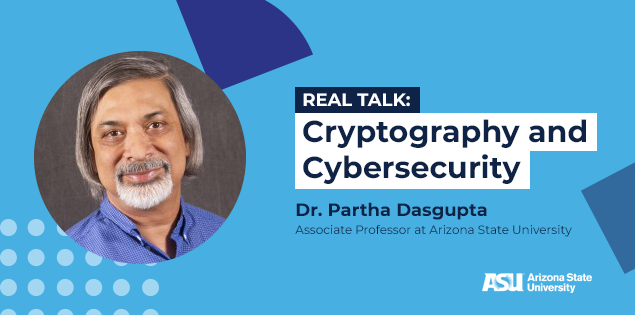
Cryptography is an essential practice for our data-driven world. In this Q&A, Dr. Partha Dasgupta, an Associate Professor at Arizona State University (ASU) with experience at DARPA, shares some of his insights on the state of cryptography.
For computer science students, the ASU Online Master of Computer Science (MCS) degree is an opportunity to learn from world-class faculty like Dr. Gupta in a flexible, affordable online format. Here’s the Q&A:
After last year’s disclosure of the EFAIL vulnerability, what is the future of the PGP standard for end-to-end email encryption?
Dr. Gupta: The PGP standard is not compromised by EFAIL. EFAIL uses complicated vulnerabilities in the applications that support PGP to extract secret data. These vulnerabilities are essentially programming defects in the applications, and not design defects in PGP. They can be (and have been) fixed.
Password managers like LastPass are becoming an increasingly popular tool — and thus an increasingly appealing target for hackers. How secure are they?
Dr. Gupta: The security of password managers depends on the implementation of these applications. Super secure password managers would store passwords on local storage, secured by long passphrases and not store the passphrase anywhere. However, such an approach is “dangerous” since there is no way of recovering anything if the password store is corrupted, deleted, or lost, or the passphrase is forgotten. Hence other, more usable methods are implemented, giving rise to weaknesses that can be exploited by hackers. Of course, if a hacker succeeds in introducing a virus into the computer that has a password manager, then all passwords are trivially exposed. There is no known defense against this hacking attack.
Blockchain protocols are designed to be fundamentally secure, but several recent hacking incidents have called that premise into question. Should we still be looking to blockchain as a “trustless” solution for business applications like smart contracts and supply chain tracking?
Dr. Gupta: Blockchain is fundamentally secure, as long as it is a distributed blockchain and it has a large number of trusted miners. That is the design specification of a blockchain network, and the security methodology works as long as the bad actors are a minority of the miner community. Hackers have targeted communities with low numbers of miners and added large numbers of colluding miners to compromise the security — hence the term “51% attack.” Once again, this is an example of badly-designed implementation and not a fault of the blockchain design.
Last November, Deputy Attorney General Rod Rosenstein called for tech companies to use “responsible encryption” that balances consumer desire for secure products with the government’s need to ensure public safety. Is “responsible encryption” possible? What would it look like?
Dr. Gupta: There is no such thing. Data that can be accessed by a government can also be accessed by a bad actor. Much has been written about why encryption with law-enforcement backdoors is a disastrous product that no one will use. We went through this drama with the Clipper Chip in 1998. This is just a replay of that old, failed attempt at backdoor encryption.
The race to come up with quantum-proof encryption techniques before hackers gain access to a quantum computer is heating up. Is this threat a likely scenario, or science fiction?
Dr. Gupta: Partially both. There has been some work on quantum-proof symmetric encryption, but nothing exists for public key cryptography. However, quantum computing is terribly underpowered, and it is not clear whether it is possible to build anything that will compromise conventional cryptography. A good discussion can be found on Bruce Schneier’s blog.
Is it important for a computer science grad student to follow trends in cryptography?
It is more important for a CS student to understand the basics of cryptography, rather than following trends. Cryptography is a well-established set of algorithmic procedures that secures data in a variety of applications. It is not as well understood by the CS community as it should be, as data security is an important facet of today’s world.
Any recommendation you can give to a computer science student who wants to learn about cryptography?
Cryptography is logical, mathematical, and practical. The student should definitely learn about “public key encryption” and its importance in web-based secure communications. Of course, to understand public keys, one also needs to know about hash functions and symmetric key encryption. Apart from taking courses, there is a large volume of self-study material available via Wikipedia and YouTube.
The Online Master of Computer Science from Arizona State University gives you the opportunity to do high-level coursework in specialized topics like blockchain, data mining, artificial intelligence, and cybersecurity.
Have you ever moved? If so, what was it like for you? Was it hard to make new friends, fit in and learn the customs of your new hometown? Did you enjoy getting to start over in a new place? What did you learn from the experience?
If not, would you ever want to move to another home, city, school, state or country? Why or why not? What do you think would be the best and hardest parts of living somewhere new?
Tell us in the comments, then read the related article to find out what it was like for this writer to grow up in 10 different countries.
Find many more ways to use our Picture Prompt feature in this lesson plan.