For Antonetta, yoga is not just an activity, but a lifestyle. She’s always looking for ways to deepen her connection to her practice – it led her to study Sanskrit, the language of yoga.
Antonetta owns her own studio, Sacred Yoga in Adelaide, where she teaches a small group of committed students. The income generated from the studio is a secondary goal, while passing on knowledge is at the core of what Antonetta does. To pay her bills, Antonetta does contract work as a production accountant for low budget film projects – the fixed-term work enables her to schedule in yoga and her latest passion project – the study of Sanskrit.
Yoga is based upon the ancient Indian language of Sanskrit, so Antonetta decided to learn the language for herself, to become more immersed in her yoga practice. Through Open Universities Australia (OUA), Antonetta was able to study Sanskrit online as a single subject, provided by Australian National University (ANU).
Although the language is not spoken widely today, it lives on in the practice of yoga, and adds another layer of meaning for those who practice. “There’s no money in Sanskrit, but we understand that we’re studying for the joy of knowledge.”
Antonetta joins her classmates once a week for an online class, and outside of that, works on her own to complete assignments on deadline. She’s thrilled to have learned to read and write the alphabet in less than a year.
Learning is not always a means to an end – it’s a joy in itself. As they say, it’s not about the destination, but the journey. So if there’s a subject you’ve been hanging out to study, why not jump in?
OUA offers a huge range of single subjects, at both an undergraduate and postgraduate level. It’s university-level learning, but you’re free to take what you need, whether that’s new knowledge for your career, or knowledge simply for the love of it.
To study Sanskrit online, or to express your interest in any of the courses on offer through OUA – fill out the form on this page, and a friendly student advisor will get in contact. Otherwise, head over to our website to browse over 270 degrees and 1600 subjects from leading Australian universities.
In this 3-course Specialization you’ll learn how to use Python to understand statistical studies and reports from three experts: Dr. Brenda Gunderson, Lecturer IV and Research Fellow, Department of Statistics, Dr. Kerby Shedden, Professor, Department of Statistics, and Dr. Brady T. West, Research Associate Professor, Institute for Social Research. We spoke with the instructors to learn more about the Specialization’s unique lab-based approach and the big ideas you can use across multiple domains.
1. What is Statistics with Python? This Specialization aims to introduce a broad audience of learners to modern statistical thinking. Not only will Statistics with Python introduce essential statistical concepts in a fun and engaging way, but it will also give you several opportunities to analyze real data using Python, and apply the concepts to real problems. We truly love teaching and emphasizing the real-world applications of statistics, and we think this blend of an applied pedagogical approach with popular software for data management and analysis makes for a very unique and exciting Specialization. We think that the three courses will appeal to people who are curious about statistics and the broadness in application is also why so many folks are interested in the discipline these days. You will leave this Specialization armed with some pretty powerful tools enabling you to gain interesting insights from data.
2. What excites you about Statistics with Python? It may be surprising how easy it can be to manipulate data and then perform statistical analyses using Python.
You don’t have to be a programming expert to effectively use Python for statistical analysis.
People may have an immediate negative reaction when they hear “statistics” because they took a difficult class or because they only think of mathematics. To our team, statistics is a discipline that focuses on how to effectively work with real-world data and make decisions based on that data, and this Specialization takes the approach that anyone can approach data with modern statistical thinking. The detailed examples that include careful explanations of the Python code should appeal to a wide audience, and this certainly excites us about the potential of this Specialization to disseminate knowledge about statistical thinking.
3. Who should take this Specialization? The ideal learner for this Specialization would be anyone who frequently has to deal with numbers in their everyday life, and would like to make more meaning out of those numbers. This could be an undergraduate or graduate student in any field that makes use of quantitative research who wants to expand their analytic skills: a small business owner who wishes to visualize and analyze trends in sales and clientele; an academic or clinical researcher familiar with Python (or any statistical software for that matter!) who wants to broaden their statistical knowledge; a government employee responsible for analyzing data; a market researcher who wishes to perform inferential statistical analyses using Python; the list goes on and on. Anyone who has the opportunity to work with data and is interested in broadening their computing and statistical skills would benefit tremendously from this Specialization. Anyone with even a basic curiosity about how Python can be used to analyze data (no experience required!) would really get a lot out of these three courses.
4. Why was this Specialization created? There are several Coursera courses on Python or statistics, but no Specialization has combined these topics in the way that this Specialization does. This Specialization will walk you through a wide variety of examples of real statistical analysis using Python, and this blend of hands-on experience with top-notch instruction fills an important need in data science education.
5. After completing this Specialization, what will learners be able to take away? After you complete this Specialization you’ll be able to demonstrate a strong working knowledge of applied statistics, including basic conceptual knowledge of study design, descriptive statistical analysis, data visualization, confidence interval construction, hypothesis testing, regression modeling, and analysis of clustered or longitudinal data. What makes this Specialization unique is that you can demonstrate that you have hands-on experience performing all of these types of analyses using Python software, which will look very attractive on a resume in today’s job market.
Codecademy’s very own Nick Duckwiler (left) and Ryan Tuck from Warby Parker (right) in our office. (📷: Mitch Boyer)
Last month, Codecademy and Warby Parker came together to work on a special Learn SQL from Scratch Capstone Project. It was during this time when I met Ryan Tuck, a Data Engineer at Warby, who played a major part in this partnership. So when he decided to drop by our office for the final QA round, I had to break out my notebook and ask some questions. Enjoy.
Hey Ryan, let’s start off with a question I’ve had for a while — what is a Data Engineer? (Is it similar to a Data Analyst or a Software Engineer?)
At Warby Parker, data engineers are responsible for creating and maintaining the plumbing required to support the data and reporting needs of the business. We use software engineering practices to automate the work of data cleaning, normalizing, and model building so that data is always ready to be consumed by data analysts in every department.
What languages/frameworks do you use at Warby?
On data engineering, we use Python as our general purpose programming language, as do most of the other teams in our Technology department. When it comes to databases, we use PostgreSQL for the majority of our SQL needs, and are beginning to use Amazon Athena and Google BigQuery for some of our larger datasets. We use Looker as our exclusive business intelligence entry point to all of this data.
What are some of the projects you worked on?
I’ve had the privilege of working with a lot of of smart people in every department at our company to help them solve their varied data needs, from reconciling financial data with the Accounting team to automating and modeling standardized performance metrics for our team of over 200 customer experience advisors.
As part of a team of five supporting the data needs of a rapidly growing company, I’ve tried where possible to focus on helping our analysts solve their own problems. This includes helping people learn Python and commit to our codebase, guiding the creation of data models in SQL, and encouraging people to submit pull requests to add features in Looker, our BI tool.
Seeing dozens of otherwise “non-technical” colleagues opening up PRs on a daily basis, and consequently being part of the democratization of tech that we value at Warby Parker, is probably the most rewarding “project” I’ve been a part of.
One project finished recently during our first annual “Hackweek” is called Pipes, which allows anyone at the company to easily move large amounts of data from wherever to wherever (Looker, Google Sheets, PostgreSQL, BigQuery, etc) on a regular cadence, or manually through a simple one-line chatbot interface. The adoption has been overwhelmingly positive and we’re looking to grow this sort of tooling out even more.
“We use software engineering practices to automate the work of data cleaning, normalizing, and model building so that data is always ready to be consumed by data analysts in every department.”
What got you into the data field?
I’ve always been drawn to analytical fields like math, and became pretty proficient in Excel during some internships in college. Once I had learned to program and learned more about data science and its applications in artificial intelligence, I knew that anything I could do to immerse myself in the world of data would be a step in the right direction.
Three and a half years ago, I landed a job as a junior software engineer at Warby Parker not fully knowing what I was in for, but am so glad I got the opportunity to help build tools to support an interesting and ever-changing data-driven culture here.
Where did you learn SQL and Python?
I had a background in C++, and was exposed to Python through an Intro to Data Science course. When Warby Parker hired me onto the Data team in 2015, I had never written a SQL query in my life, but picked it up quickly and within a few months started up internal SQL training classes, which I still teach on a monthly basis.
What does your tattoo say?
The ultimate cheatsheet.
This is Bayes’ Theorem, which is an equation that describes how to update probabilities given new evidence. Two summers ago I worked on building a tool to help predict weekly fantasy football performance. Some colleagues suggested a Bayesian approach would be appropriate, since there aren’t really enough data points in an NFL season to be able to use statistical approaches that require larger datasets, and I’d want to regularly update my predictions after each player’s latest performance.
I did a deep dive into understanding the (simple) math underlying Bayes’ Theorem and came out of that experience with a whole new worldview, understanding my entire knowledge of the world as a big and intricate probabilistic model that I was continuously updating with every experience I ever have. It was pretty transformative, and I figured that was worth a tattoo.
What is a concept in SQL/Python that’s essential to your work?
Donald Knuth said, “Premature optimization is the root of all evil.” I’ve generally found this to be true, and try to live by it in my work. For example, I’ll generally prefer to keep a data model simple by rebuilding it for all time on a daily basis using a single SQL query instead of making a more complicated model that requires iteratively adding to a table, keeping track of state, updated timestamps, when something last ran, etc.
A wise man once said, “Duplicating data makes things go fast,” but databases are already impressively fast to begin with, without implementing anything to improve performance. Ultimately, I almost always approach a problem thinking about optimizing for my time over machine time, for readability over performance, and for introducing as little cognitive overhead as is required by the problem at hand. Only once performance issues or readability issues present themselves will some code be worth a rewrite.
Last question! Since you wrote Warby Parker’s internal SQL training courses, I know there gotta be some inner Curriculum Developer in you. Can you teach a SQL concept in 2 minutes?
Sure! Have you ever written a query that yields some result set and you think, “I’d love to query the stuff I just produced like it was a table?” Enter the WITH clause.
Suppose I have a mega query that gives the transaction summaries:
select
    transactions.date as transaction_date,
    sum(items.price) as total_cost,
    count(*) as number_of_items
from
    transactions
inner join
    customers
    on
    customers.id = transactions.customer_id
inner join
    transaction_items
    on
    transactions.id = transaction_items.transaction_id
inner join
    items
    on
    items.id = transaction_items.item_id
Using WITH, I can create a temporary table within my query that I can SELECT from and treat it just like a regular old table.
I will put everything from the previous query in a parentheses and use WITH to give it the name transaction_summaries.
Then I’ll apply the date and customer filtering down below for a more readable query, to separate out all the JOIN logic from the actual WHERE filters that I want to apply on that data.
with transaction_summaries as (
  select
      transactions.date as transaction_date,
      sum(items.price) as total_cost,
      count(*) as number_of_items
  from
      transactions
  inner join
      customers
      on
      customers.id = transactions.customer_id
  inner join
      transaction_items
      on
      transactions.id = transaction_items.transaction_id
  inner join
      items
      on
      items.id = transaction_items.item_id
)

select
        *
from
        transaction_summaries
where
        first_name = 'beyonce'
        and
        transaction_date > '2018–01–01'
order by
        total_cost desc
limit
        5
If you’re familiar with subqueries, this does a similar thing but makes the SQL far more readable, even if your query isn’t quite as performant as it would have been. This is essentially an implementation of the mantra “Don’t Repeat Yourself” that’s common in the world of programming.
Incredible. And love the SQL styling! 😍
Huge shout out to Ryan and the whole Warby Parker team for making this partnership happen. Special hat tips for behind-the-scenes support from:
A Day in the Life of a Software Engineer (via Life of Luba)
With Airbnb came a revolution of sorts in the world of vacation travel and culture. We sat down with Luba Yudasina, a YouTuber, an opera singer, and a Software Engineer on the Airbnb’s Homes Platform team, to discuss software engineering and her programming journey—from Codecademy to Airbnb!
Hey Luba, let’s start with the basics! What does a Software Engineer on the Platform team do at Airbnb?
Homes Platform’s mission is to create the building blocks to power all Homes categories. Any project undertaken by our team should be reusable and extensible in some way. This means that as a backend engineer, I have a lot of opportunities to work on impactful technical projects that create systems and services to support Homes, as well as collaborate across teams to come up with the best architectural decisions and designs.
Recently, our team wrote a blog post on classifying Room Types into categories using Machine Learning and computer vision. The room-type classification problem largely resembles the ImageNet classification problem, except our team’s model outcomes are customized room-types.
After a few experiments with various models, the team chose ResNet50 due to its good balance between model performance and computation time. To make it compatible with our use case, we added two extra fully connected layers and a Softmax activation in the end.
Let’s rewind a little bit. Coming from a chemical engineering background in college, how did you make the switch into programming?
I went to the University of Waterloo in Canada—a university with the biggest co-op program in the world. Co-op means that to obtain a bachelor’s degree you must complete a certain number of internships. If you are in Engineering at Waterloo, you must complete 5 internships to graduate.
In my first and second years, I interned at chemical engineering companies and afterwards I couldn’t see myself working in the field full-time. That’s why I’m particularly grateful that I studied at Waterloo: if not for co-op, I probably would not have realized I didn’t want to work in chemical engineering until getting a full-time job after graduation.
I happened to have a lot of friends in Computer Science and Software Engineering right when I realized Chem Eng wasn’t for me. They really encouraged me to try coding, and when I decided to follow their lead I never looked back! My first online programming course was Web Development on Codecademy 🙂
“It’s a really cool time to be a software engineer and even cooler to be a female software engineer, because this is the time when women start to embrace their own unique identities and be ok with not being ‘one of the dudes.'” -Luba Yudasina
When I decided I wanted to learn computer science on my own, my goal was to get an internship in the field because working as a software engineer at a tech company would be the best test to really know if it was for me.
I happened to be in Munich, Germany on academic exchange for a whole year when I was learning how to code, so I hustled as much as I could while being there to get experience to learn quicker and have something to put down on my tech resume.
Almost immediately after arriving in Germany, I got a part time job as a developer at a game publishing company. I had a good friend in Computer Science at my German university: her and I ended up working on an Android app as a side project, etc. When I was ready, I started preparing for technical interviews. I then leveraged my network to refer me to companies and do mock technical interviews with me.
Yelp was really random though—a Yelp recruiter looked at my LinkedIn profile and didn’t even message me, but I messaged them anyway asking about internship opportunities, and that’s how I got my interview there!
Airbnb HQ in San Franciso
What is an essential app/item in your day-to-day?
Code searching! A lot of software engineering is problem solving and a lot of it is understanding other people’s code and the reasoning behind writing it a certain way. Searching through the codebases is almost essential to my day to day. Whenever I build something new or build on top of already existing tech, I need to understand how it works and is written, and code search is vital to this.
At Airbnb we use Google’s Codesearch for these purposes, but developers (myself included) also frequently use their IDEs to search for relevant code. I mostly use RubyMine or IntelliJ (depending on the codebase I’m working with).
In your videos, you’ve mentioned the intersection of gender and technology. Can you speak a bit more about that?
It’s a really cool time to be a software engineer and even cooler to be a female software engineer, because this is the time when women start to embrace their own unique identities and be ok with not being “one of the dudes.”
I think it’s particularly important to redefine the stereotypes, and I hope that with my own example I can show young girls and women interested in the field that you don’t have to give up your feminine side to be a software engineer and still be into fashion, or makeup, or art (I personally sing opera) and have other interests outside of coding and be successful in the field.
Before we wrap up, do you have anything else you would like to say to our learners?
Don’t be discouraged, learn and absorb as much as you can! If you don’t understand a concept or can’t build a project right away, know that with practice, perseverance and concentration you will get there!
Take advantage of such amazing tools as Codecademy that are there for you to take and learn. Learning anything new can be frustrating, but knowing that you can do it, staying curious, asking questions and not losing your motivation is the key to success.
Huge shoutout to Luba for this insightful interview. It’s always incredibly moving to see a Codecademy learner go on to do bigger things. Go subscribe to her YouTube channel, Life of Luba.
And thank you to the whole Homes Platform/Engineering team at Airbnb for the support. Check out their wonderful open source projects on airbnb.io.
Look at the photo above. What do you think about the statements printed on the totebags? To what degree, if at all, do you agree?
Do you ever “refuse plastic,” perhaps by bringing your own bags to stores, avoiding takeout containers, drinking from a cup rather than using a plastic straw (or bringing your own metal one) or employing other tactics?
Plastic purgers need to rearrange their lives to avoid the offending material. If a restaurant serves food only on plastic plates, they won’t eat there. Fast food? Most wrappers contain plastic. Smoothies from a juice bar? Unless they put the smoothie in a stainless-steel to-go cup, move on, or make your own at home. Bread? Buy it from a local bakery to avoid fresh-seal bags.
But there are certain situations where plastics are unavoidable. Try having a medical procedure without using a plastic syringe or an intravenous drip bag. Plastic water bottles can be indispensable after natural disasters.
Despite their best efforts, the purgers all say they can’t totally banish plastic from their lives. For Ms. Cohen, it’s a favorite hairbrush she has had for decades. And Ms. Terry confronts the limits of her plastic ban each time she visits the pharmacy, where no pharmacist would put medicine in a Mason jar.
Students, read the entire article, then tell us:
— What, if anything, in the details about how people are avoiding plastic do you find appealing? Do any of these approaches seem prohibitively inconvenient or expensive to incorporate into your routines? If so, what?
— Do you think the goal of using no plastic products is attainable? What about simply cutting down?
— If you tried to live totally plastic free, what would be the biggest challenge for you? Why do you say that?
— Do you try to use fewer plastic products these days? Do you try to recycle when possible? How about your family?
— Where in your life do you see the most unnecessary waste, whether it’s plastic or anything else? What, if anything, do you think can done to address the issue?
— Check out the related article “9 Ways to Cut Down on Plastic.” Do you employ any of the tactics? If so, how difficult has it been? How worthwhile? Are there other methods for decreasing the amount of plastic you use, either named in the article or not, that you’d like to try?
Students 13 and older are invited to comment. All comments are moderated by the Learning Network staff, but please keep in mind that once your comment is accepted, it will be made public.
2. How did the House Judiciary Committee respond? What about House Democrats? If both houses of Congress vote in favor of blocking the emergency claim, what could President Trump then do?
3. How much money is Mr. Trump looking to secure for the wall? From what budgets might this money come?
4. A related interactive states, “President Trump’s plan to divert military construction money to fund a border wall is an unusual use of emergency powers.” How does the interactive give evidence to this claim? What category do most of the previous declarations of emergency have? When was the last time a president declared military action?
5. What did the spending package passed on Feb. 14 by Congress include funding for? What funding requested by the president did it not include? Why did Mr. Trump sign the package into law even though it did not include what he wanted? What did he want to avoid happening again?
Many in both parties now say that the presidential decision to act unilaterally and fund construction for a border wall via an emergency declaration would establish a dangerous new model, encouraging presidents thwarted by Congress to simply cite such a crisis to spend dollars however and wherever they pleased.
“We have a crisis at our southern border, but no crisis justifies violating the Constitution,” said Senator Marco Rubio, Republican of Florida.
Accepting the declaration would represent another weakening of the authority of Congress in a steady ceding of power to the executive branch — a trend that Republicans have said they want to reverse and that they railed against when Mr. Obama used executive orders to act on issues such as immigration and health care.
“As I’ve said many times, I have concerns about the precedent that could be set with the use of emergency action to re-appropriate funds,” said Senator Charles E. Grassley of Iowa, the senior Republican in the Senate.
Do you think President Trump’s emergency declaration designed to secure funding for a wall at the southern border of the United States sets a “dangerous” precedent in regard to the balance of power that exists between the branches of the federal government? Explain.
Mr. Turman, who appeared on Broadway as Travis in the original “A Raisin in the Sun” in 1959, is an appropriately (if sometimes overly) splenetic Phil, and it’s refreshing to have the character delivered without the usual Irish blarney. The scene in which Phil and Josie scare off a rich twit (Aaron Costa Ganis) who wants to buy their property is delightful, with father and daughter acting grotesque and menacing in ways that play into and satirize the toff’s class prejudices.
Often, though, their teasing doesn’t feel different from the family raillery of many a sitcom. You just know they’re softies inside.
Mr. Swenson, a memorably swaggering presence in the last Broadway revival of “Hair,” makes a fabulous entrance. He slouches into view, hunched and defeated, “like a dead man walking slow behind his own coffin,” as Josie says. Then, aware that he’s being watched, he sardonically strikes the pose of a ham actor greeting his audience.
2019 has us wondering about the almighty MBA, and whether it still lives up to its golden reputation. Will the effort and expense still take your career to new heights? If you’re already enrolled, or just about to, you may resume breathing – the answer is yes.
To quickly summarise, an MBA is a business toolkit that covers everything from accounting, financial analysis, statistics, economics, organisational behaviour, marketing and sales. Once completed, you’ll ideally have everything you need to manage a successful business.
MBAs are still ‘in’
While MBAs took a popularity hit in 2009 due to The Great Financial Crisis, the demand for MBA graduates has been back on the rise since 2014. Today, they’re still highly sought after, particularly as the workforce calls for more generalist skills than ever before.
As Australia positions itself as a key player in the international business scene, businesses want employees who have a world-class education and an Asia Pacific focus.
“Australian MBA graduates are in high demand because Australia is one of the best places – if not THE best place – to get an MBA that is grounded in the challenges and opportunities in the Asia Pacific region,” says Brandon Blackburn-Dwyer, Founder of Grasshopper Strategies – an agency focused on small business growth.
The General Management Admission Council released a study in 2018 which showed 90% of companies in the Asia Pacific region were planning to hire MBAs graduates. That is a 10-15 per cent increase over the last few years.
What’s my ROI?
So the demand is there, but what kind of return on investment (ROI) is reasonable to expect for the time, energy and money spent? Brandon says that when it comes to ROI, we should be asking ourselves – what’s the cost of not doing an MBA, or at least further study?
“Opting for a practical master’s degree in your field will give you a competitive edge as well, but it may mean people see you as field or practice-area specific. This is risky in an economy that changes annually, and where practice areas are dismantled or built from scratch every few years.”
The current workforce is more formally educated than any other time in history, so if you plan to land a business leadership position and keep it, it may be worthwhile having a broad spectrum of skills, expertise and experience an MBA can provide.
You don’t need to spend big
“Buying a ‘big name degree’ can help you get noticed by the big financial houses or huge companies,” says Brandon. “But if that’s not your aim, then most other companies simply want to know you did the education somewhere respectable. For most people, spending less will result in a better return on investment, and allow them more financial flexibility down the road.”
And like everything else in life, you should choose an MBA program based on your interests and learning needs. MBAs are becoming more specialised, are offering more focus areas, and hands-on experiences than ever before.
“Find programs – regardless of the name of the school – that match your interests,” says Brandon. “If you’re interested in your topic area, you will do better in school, impress more people, and network your way in the type of work that actually interests you.”
Studying an MBA will do more than just prepare you for a leadership role in business. It will give you the resources, skills, expertise and corporate connections you need to adapt and thrive in your career today, and in 20 years from now.
Study your MBA online via OUA
An MBA can take you anywhere, into any industry – making it an incredibly popular postgraduate degree across the board. It’s quite fair to say, you can’t go wrong with an MBA, and OUA is proud to offer a number of them from leading unis across Australia.
Be sure to check out the MBA webpage for in-depth detail about choice, cost, and accreditation, as well as FAQs.
Get in touch
If you’re keen to step up your career, but find yourself questioning whether an MBA is right for you – contact a student advisor via phone or live chat for a friendly conversation, or fill out the form on this page to be contacted soon.
Taking the leap can be daunting, but when the doors start opening, you’ll be thrilled you earned your MBA.
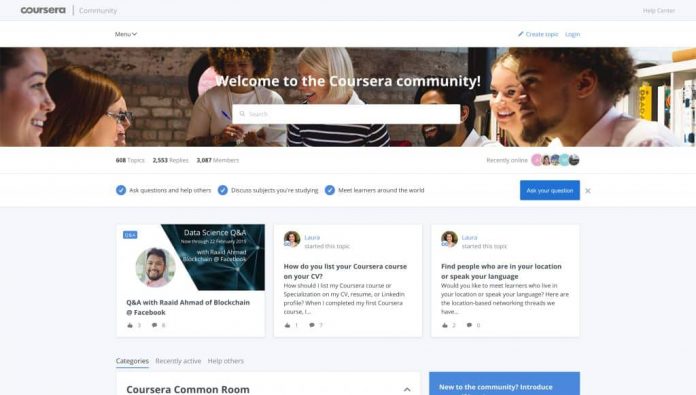
Until now, discussion forums have been limited to within single courses. When the course finished, connections would often be lost. Now, Coursera has come up with a platform-wide discussion board open to everyone with a Coursera account.
The Coursera Community was launched in late 2018 and is growing daily, By mid-February 2019, there were around 3000 users who have contributed more than 2000 posts in over 600 topics.
To find the Coursera Community, go to the Coursera home page and scroll down. Select Learners under the COMMUNITY heading. You may need to select Login to post comments.
Why have a Coursera Community?
According to the Coursera blog, “The new community is geared towards more general discussion about subjects and careers, and anything else you’re passionate about.” You can connect with other learners outside individual courses without losing the connection after the course has finished.
After finishing some courses, I have missed hearing from classmates. Occasionally, groups of learners have contributed to course threads and decided to all take a related upcoming course. Eventually, though, losing touch has been a natural progression as people joined different courses or took a break from online learning. The Coursera Community overcomes this problem. There is even a private messaging facility, where you can connect with particular learners without displaying the details in the public forum. Alternatively, you can block private messaging.
How is it Organized?
The threads have been grouped into four major categories: Coursera Common Room, Subject Discussions, Global Translator Community, and Beta Testing. These are further divided into sub-categories.
Links on the Community Homepage show Recently Active or Help Others lists. The Recently Active list shows all threads with recent additions, in order from Most Recent. The Help Others is a rather depressing list of issues that learners are having problems with. Many of these issues can be addressed by contacting the Coursera Help Center. Sometimes learners need to be patient and keep asking questions if they need to live chat with a real person from the Help Center (rather than a helpbot). If you know the answer to another user’s question in the forum, help out and don’t be shy. We can all learn from each other.
When I started taking online courses, I did not expect to be having conversations with people with similar interests all around the world. I saw myself watching videos and doing quizzes in grand solitude. Very early, though, I had trouble with homework problems and started trawling the discussion boards for hints about how to tackle the questions. I discovered a rich community with people from diverse backgrounds discussing all kinds of subjects. And that was only in one course! I was hooked.
I can see the Coursera Community growing and blossoming in the future.
AD
University of Naples Federico II – Italy | May 20 – 22, 2019. Call for papers now open


 Yoga is based upon the ancient Indian language of Sanskrit, so Antonetta decided to learn the language for herself, to become more immersed in her yoga practice. Through Open Universities Australia (OUA), Antonetta was able to study Sanskrit online as a single subject, provided by Australian National University (ANU).