If someone were to visit the place where you live for the first time, what do you think would stand out to the person? Would it be a food that’s popular in your region? Might it be your accent or a unique turn of phrase? Would it be the climate? Maybe it would be some social custom, like the way people greet one another or say goodbye?
In other words, what are some of the things that make the place where you live unique?
In “Explaining the South on Instagram, One Custom at a Time,” Rick Rojas writes about Landon Bryant, an influencer who found an audience by sharing the quirks, characters and customs that make his small town in Mississippi distinct:
If you had a certain kind of upbringing in the South, you likely know the strict hierarchy that dictates who brings the potato salad and cornbread to a covered-dish supper and who is responsible for the paper plates.
There is a good chance you know the difference between moseying and meandering. Just as you understand that a prayer request can be a genuine call for divine assistance on someone’s behalf — and a loophole for relaying gossip without, technically speaking, engaging in it.
But not everyone can have that sort of home training, bless their hearts. That’s where Landon Bryant comes in.
He has covered all of this and plenty more in his daily videos posted on social media on the customs and mannerisms he learned growing up in small-town Mississippi.
“The Lord laid it on my heart and we all need to lift her up because — insert information here,” Mr. Bryant explained in the video detailing how one might go about gossiping by way of a prayer request.
“The prayer list,” he added, “is sort of a news feed.”
With his sweep of silky shoulder-length hair and soft drawl that cloaks a devilishly sly sense of humor, Mr. Bryant, 35, has become a fixture on Instagram, TikTok and YouTube with his explanation and exploration of what it means to be Southern.
A lot of it is food: Grits, fried green tomatoes, sweet potato pie, divinity, corn nuggets, hot tamales and crawfish are just some of the delicacies he has discussed. He has done soliloquies on social protocol (a phone call should never end with a quick goodbye), language (defining “might could” and “fixing to”) and Mississippi’s climate (the humidity can feel like wearing “a sweater full of Vaseline”).
Since February, his “Landon Talks” posts have amassed hundreds of thousands of followers, many from around the world — a testament to the odd fascination that has always surrounded the quirks, characters and complicated history of the South.
Students, read the entire article and then tell us:
What is something new you learned about the South from this article? Does Mr. Bryant’s perspective make you see the region in a different way? You can watch some of his videos, too. Which do you find most interesting, and why?
Mr. Bryant shares with his followers what is singular about the South. What is unique about your town, state or region of the country? What features — such as customs, traditions, food, superstitions, words, phrases and climate — make it different from other places?
Choose one of the things you listed above and explain it as you would in a TikTok or Instagram post. What do you think this custom says about the place where you live and the people who live there?
Mr. Bryant realized that his videos could help younger generations “figure out which Southern traditions were worth preserving, and which were best left behind.” Which traditions from where you live are worth preserving? Which are best left behind? Why?
Students 13 and older in the United States and Britain, and 16 and older elsewhere, are invited to comment. All comments are moderated by the Learning Network staff, but please keep in mind that once your comment is accepted, it will be made public and may appear in print.
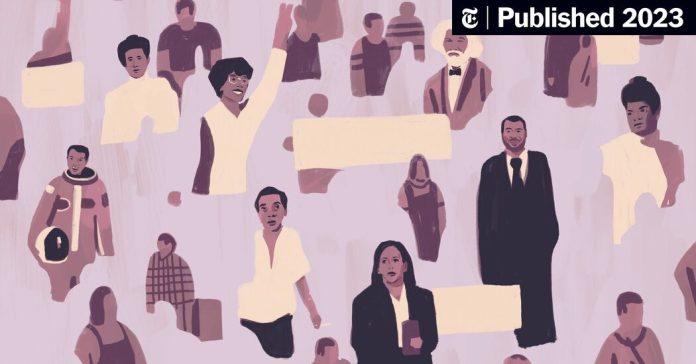
What do you think this image is saying? How does it relate to or comment on society or current events? Can you relate to it personally? What is your opinion of its message?
Students 13 and older in the United States and Britain, and 16 and older elsewhere, are invited to comment. All comments are moderated by the Learning Network staff, but please keep in mind that once your comment is accepted, it will be made public and may appear in print.
But even as Ms. Glück continued to weave her verse with an autobiographical thread, there is nothing solipsistic in her later, more mature work, even as she explored intimate themes of trauma and heartbreak.
… With sometimes remorseless wit and razor-sharp language, she seamlessly tied the personal to the social, the particular to the universal, looping together meditations on her own struggles with themes of family, mortality and loss.
Daily Word Challenge
Can you correctly use the word solipsistic in a sentence?
Based on the definition and example provided, write a sentence using today’s Word of the Day and share it as a comment on this article. It is most important that your sentence makes sense and demonstrates that you understand the word’s definition, but we also encourage you to be creative and have fun.
If you want a better idea of how solipsistic can be used in a sentence, read these usage examples on Vocabulary.com. You can also visit this guide to learn how to use IPA symbols to show how different words are pronounced.
Students ages 13 and older in the United States and the United Kingdom, and 16 and older elsewhere, can comment. All comments are moderated by the Learning Network staff.
Riphah International University, located in Pakistan, is a private educational institution with over 25,000 students spread across multiple campuses. In the wake of the global COVID-19 pandemic, higher education institutions such as Riphah were faced with unprecedented challenges. The disruptions caused by the pandemic highlighted how crucial it was for universities to swiftly enhance their digital capabilities to ensure uninterrupted learning for their students.
Much like its counterparts worldwide, Riphah recognized the urgency of embracing digital transformation to mitigate the impact of the pandemic on its academic operations. The university took proactive measures to rapidly scale up its digital infrastructure.
Leading Riphah’s digital transformation efforts in this regard is Muhammad Saud Khan, Director of the university’s Coursera Project Directorate. Under Khan’s leadership, Riphah has seen tremendous impact from its Coursera partnership, including 1.72 million learning hours logged, and over 200 courses blended with Coursera with over 53,600 certificates earned to date.
As Riphah’s Coursera champion, Khan has partnered extensively with leaders across the university to embed online learning into the very fabric of their academic programs. In this interview, Khan provides valuable insight on Riphah’s Coursera adoption journey – from early successes and challenges to results achieved and their plans for the future.
Q1: Hello Muhammad, we’re thrilled to hear your thoughts and perspectives. Could you please elaborate on Riphah International University’s digital transformation vision and how Coursera for Campus aligns with and supports that vision?
At the heart of Riphah International University’s digital transformation strategy is a vision that goes beyond the conventional. In 2021, we strategically partnered with Coursera to accelerate the development of our digital capacity. Our focus wasn’t just on embracing online learning but on weaving it intricately into the fabric of our academic programs across 15 diverse degree disciplines, including computing, management, English, and more.
The essence of our strategy extended beyond providing mere access to online resources. Our goal was to cultivate a dynamic learning environment by strategically integrating Coursera’s rich content directly into our on-campus courses. This deliberate blending of traditional and digital models was envisioned to create a symbiosis that enhances the overall learning experience for our students.
Recognizing that a successful transformation requires more than just technology, we prioritized gaining buy-in from stakeholders across Riphah. From the beginning, we provided Coursera licenses to every student and faculty member within participating departments, integrating digital content into physical classrooms while also exposing users to the benefits of using digital platforms.
Our approach to Coursera for Campus isn’t just about adopting a platform; it’s about strategically aligning technology with our broader vision for an innovative and enriched learning experience at Riphah International University
Q2: What approach did Riphah use to ensure a successful implementation of Coursera for Campus?
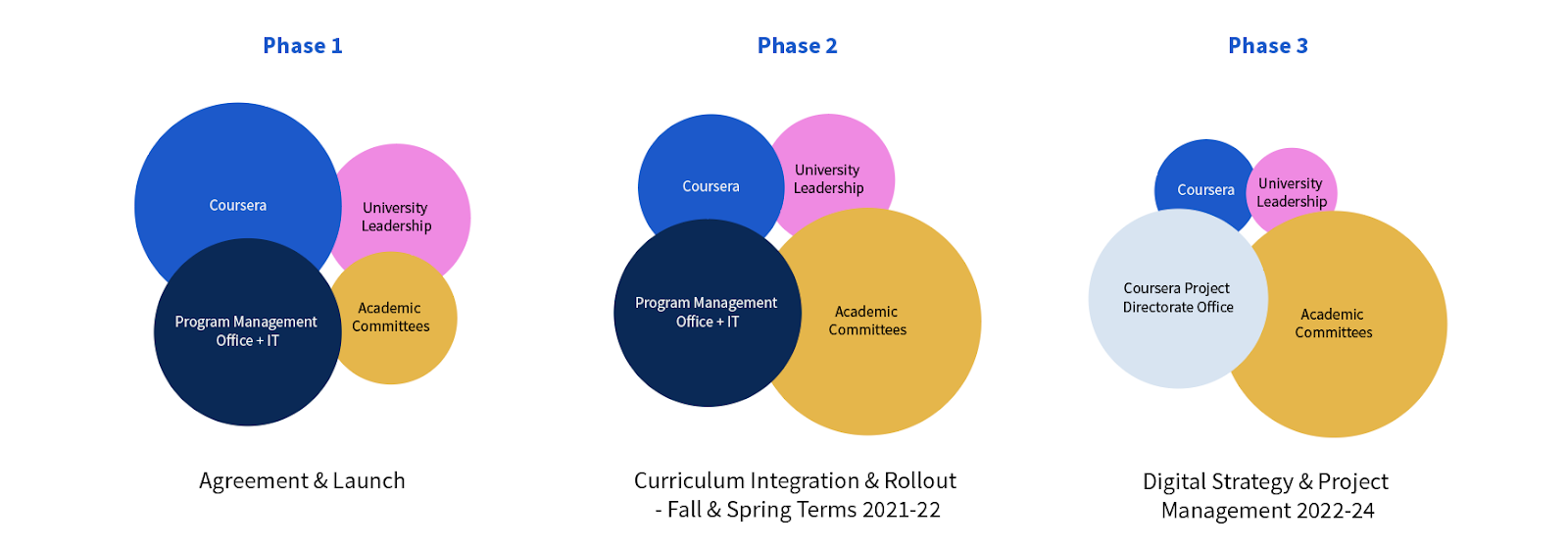
Riphah took a phased approach to rolling out Coursera for Campus to drive adoption:
Phase 1 Launch (June 2021 – October 2021): The first five months focused on initial planning, stakeholder onboarding, and launching Coursera sites for students and faculty.
Phase 2 Awareness and Engagement (October 2021 – October 2022): The first year of utilizing Coursera focused on actively driving student and faculty usage of the platform through campaigns and integrating Coursera content into on-campus courses.
Phase 3 Institutionalization (October 2022 – October 2024): The following two years focused on maximizing impact by fully incorporating Coursera into curricula, awarding course exemptions/credits for completions, and private authoring.
Diagram representing the evolving role of key stakeholder groups in different phases of the roll-out.
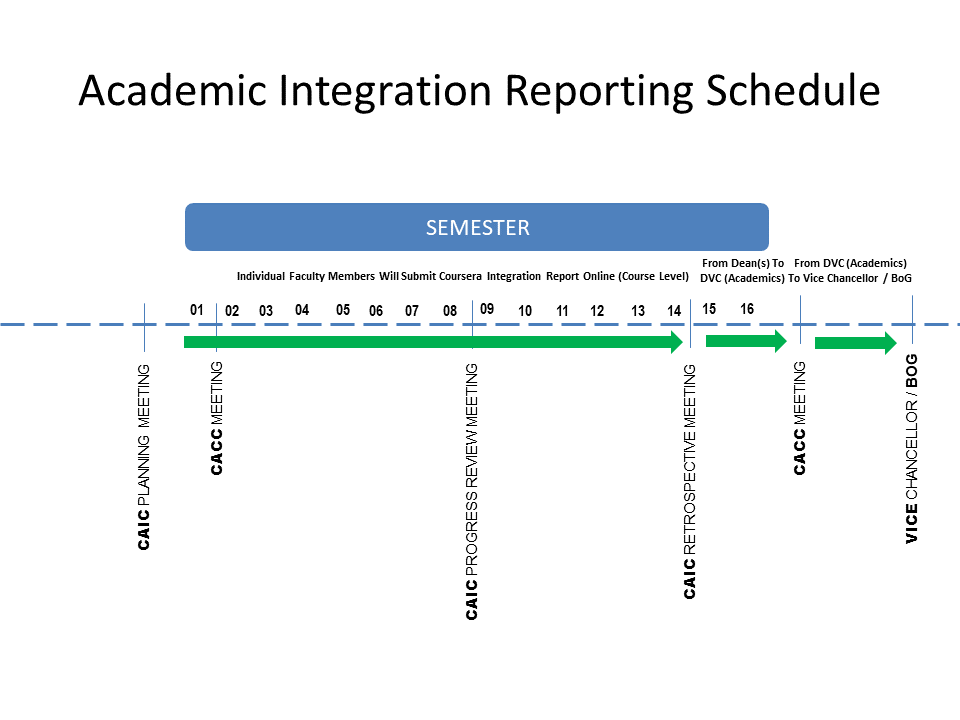
We established governance committees like the Coursera Academic Coordination Committee (CACC) to support and monitor progress across different schools. We also set up Coursera Academic Integration Committees for each participating degree program to monitor day-to-day integration and license utilization.
By implementing robust systems to govern, track, and support usage, we were able to scale rapidly. Within the first two years, we did more than 1000 digital content integrations in our classroom courses.
Q3: How did Riphah International University implement Coursera across the different degree programs? What challenges did you face and what strategies did you use to overcome them?
As a large university, Riphah offers over 150 degree programs to students across multiple cities and campuses. It was critical that our Coursera integration mirrored this diversity.
We onboarded six different schools onto Coursera, spanning very different domains:
● Faculty of Management Sciences
● Faculty of Computing
● Faculty of Rehabilitation & Allied Health Sciences
● Faculty of Social Sciences & Humanities (FSSH): Psychology Department
● Faculty of Social Sciences & Humanities (FSSH): Public Policy Department
● Faculty of Social Sciences & Humanities (FSSH): English Department
To manage this complexity, we took two strategic approaches:
1. Launching separate Coursera admin sites for each school: This allowed us to easily track adoption and curate content specifically for each student population.
2. Establishing centralized governance committees with local integration committees: The centralized CACC monitored progress across schools and set policies. While each school also had its own integration committee to handle day-to-day blending based on its unique needs.
Meetings and reviews were scheduled throughout all the semesters, helping to align all stakeholders with developments.
We also faced some adoption challenges as Coursera usage accelerated:
1. Student time management: As learning on Coursera became mandatory in some courses, some students struggled with self-regulation and deadlines. We addressed this through better orientation — for example, instructors have reported more interactive sessions with students when they integrated Coursera content in flip-classroom mode.
2. Content misalignment: In certain courses, the integrated Coursera content didn’t fully align with the on-campus curriculum. We fixed this by improving our content review and integration planning.
3. Limitations of IT infrastructure: Large class sizes, limited devices, and internet bandwidth constraints posed challenges for some students. We’re actively upgrading our IT infrastructure to enable seamless blended learning.
Overall, our phased approach, along with robust governance structures enabled us to understand these challenges and continuously improve. We’re also leveraging the data collected from over 1,000 course integrations to further refine our policies and processes.
Q4: How is Riphah leveraging Coursera to accelerate the development of digital content?
One of the key motivations for choosing Coursera was to accelerate Riphah’s plans to develop digital content and strengthen our capabilities as content creators.
Coursera’s educator site and comprehensive resources have enabled us to fast-track building our content development capacity. Rather than attempting to build systems and resources from scratch, we can leverage Coursera’s proven authoring platform built over years of working with top universities worldwide.
We have started authoring digital content spanning topics like research methodology, technology, management, liguistics, rehabilitation sciences, public policy, and ethics. Our faculty have published courses taught in both English and Urdu on Coursera’s educator platform and are currently authoring over 50 courses. This student-facing content strengthens the blended learning experience.
The feedback loop enabled by directly publishing content is invaluable. Our long-term roadmap is to offer more courses in niche areas where Riphah has specific expertise. We aim to build a comprehensive repository of digital content authored by our faculty over the next 3 to 5 years.
Beyond just authoring, Coursera has accelerated building our overall capacity:
Identifying content gaps and subject matter experts
Training faculty on digital pedagogy and online course development
Developing policies and processes to support content creation
Upgrading in-house multimedia and instructional design capabilities
In essence, Coursera has enabled Riphah to fast-track its digital content strategy by years within a short period of time.
Q5: How has the learner experience and student feedback been on the Coursera integration?
Students have reacted very positively to having access to Coursera’s vast catalog for self-paced learning. It’s opened up new possibilities for students to explore topics beyond the constraints of their degree curriculum.
Students have especially appreciated features like Guided Projects to quickly learn in-demand skills like data analysis, programming, etc. Computing students leverage Coursera for their final year projects, since they can easily try out new technologies.
Classroom integration has further enriched learning for students:
Interactive sessions have increased due to flipped classrooms
Direct access to content from world-renowned universities
Developing self-learning habits and time management skills
Bridging competency gaps in the curriculum
Students recognize that Coursera is accelerating their future-readiness. As per our learner surveys, 77% of students believe Coursera will improve their employment prospects. They also see value in showcasing Coursera certificates from leading universities to employers.
Q6: What tips do you have for other universities who want to drive Coursera adoption?
Here are my top recommendations for universities to ensure successful Coursera adoption:
● Peer advocacy enhances uptake: Assemble cross-functional teams of students, faculty, and leadership as Coursera champions.
● Don’t attempt a full-scale integration from the beginning: Take a phased approach focused on awareness first, then habit formation.
● Collect and analyze your own tracking data: This enables data-driven decisions and continuous improvement.
● Showcase career benefits: Connect students with alumni who used Coursera to highlight career impact.
● Personalization drives engagement: Curate specific content recommendations for each student population.
● Build up your digital expertise: Leverage Coursera’s educator resources to develop in-house capabilities.
With strategic planning, robust systems, and stakeholder involvement, universities can maximize the value of Coursera for learners, faculty, and the institution. Treating it just as a content library underutilizes its full potential as a digital transformation partner.
Q7: Do you have any final thoughts on Riphah’s journey with Coursera? What does the future hold?
Here are my key reflections on what made Coursera successful at Riphah:
1. Coursera must be woven into the institutional fabric for maximum impact. Integration into policies, processes, and curricula is crucial.
2. Strong governance structures enabled centralized oversight with local flexibility to meet each program’s unique needs.
3. Tracking quantitative metrics is invaluable – but regularly capturing qualitative faculty/learner feedback is equally important.
4. Look beyond just content access. Leverage Coursera’s educator resources to build in-house digital capabilities.
5. Coursera cemented Riphah’s learner-centric approach. Students recognize it’s accelerating their future readiness through relevant skills.
For any university, technology is simply an enabler. The human touchpoints of faculty mentorship, student counseling, and enabling policies bring it all together. Coursera’s global best practices combined with localized implementation is a powerful formula to drive positive change.
In just two years, Coursera has helped Riphah make rapid strides in its digital transformation, with 1.72 million learning hours logged on the platform and over 53,600 certificates earned to date.
Our expectation is that the increase in credit hours delivered online will result in significant cost savings for the university. With our increased institutional capacity, we’re also hoping to launch new programs and micro-credentials, which would bring in extra revenue.
We’re excited to further build on this strong foundation and deepen the impact of high-quality blended learning experiences for students.
February is Black History Month, and this year’s theme centers around celebrating Black artists and their impact. When most of us think about art, our minds usually go to traditional expressive mediums like music, performance, visual art, literature, and film. You can probably think of countless influential Black artists who’ve shaped culture and the world. But there’s a subgenre that combines technology and art that you may not know about: Afrofuturism.
Afrofuturism is a genre that “expresses notions of Black identity, agency, and freedom through art, creative works, and activism that envision liberated futures for Black life,” according to the National Museum of African American History and Culture. From Octavia Butler sci-fi novels to the Black Panther films and Janelle Monae’s music, you can find Afrofuturist themes laced into pop culture past and present. At its core, Afrofuturism is a lens and a tool for highlighting the richness and diversity of Black culture and imagining empowered futures for Black people. Technology is often a key part of Afrofuturism, both in how works are created and the types of themes that they explore.
Learn something new for free
To celebrate Black History Month, we’ve put together exercises that are inspired by the lives and accomplishments of Black technologists, the Afrofuturism genre, and Black artists throughout history. These project ideas are all open-ended prompts, so feel free to riff on the ideas and make them your own.
We’re firm believers that code can be a tool for positive change in our world, whether you’re coding apps that address inequalities in your community or programming a thought-provoking art piece. We hope that learning about the Black technologists who laid the groundwork for future generations inspires you to keep working towards your individual goals.
Celebrations calendar
The inspiration: Black History Month was founded by historian Carter G. Woodson in 1926. We celebrate Black History Month in February because both Abraham Lincoln and Frederick Douglass have birthdays during this month.
The exercise: Create a calendar app that people can use to reference Black History Month events that take place in February. Make sure users can see details about daily events and give your calendar a unique style. You can start with HTML, CSS, and JavaScript to build this app, or use the AngularJS framework (it’s great for single-page web apps).
Science fiction sentiment analysis
The inspiration: Renowned science-fiction author Octavia Butler wrote novels that explored themes of Black injustice through a dystopian or futuristic lens. Many of her books were published back in the ‘70s, but the themes and messages that she writes about feel prescient today.
The exercise: Develop a Python program that performs sentiment analysis on science-fiction books, focusing on themes related to race, gender, and power dynamics. Sentiment analysis is a technique that uses natural language processing, linguistics, and text analysis to categorize the subjective emotional tone of a body of text. Fun fact: You can apply sentiment analysis to everything from song lyrics to posts on X (formerly known as Twitter).
Cartridge creator
The inspiration: Before you could play games on your phone or collect Nintendo cartridges, video games came pre-installed on gaming consoles. That changed in 1976, when Jerry Lawson figured out a way to store games as software on swappable ROM cartridges.
The exercise: Come up with the concept for a story-based video game about Jerry Lawson’s career as a Silicon Valley engineer and pioneer. Decide what type of game you’d make and which platform you’d use, then outline the objectives, mechanics, and controls your players would use. We’ll teach you how to develop and design a video game in the free course Introduction to Game Development.
Math star
The inspiration:Katherine Johnson was a mathematician at NASA who was instrumental in the success of some of the first manned spaceflights. Katherine was on a team that that helped ensure the safe trajectory and return of astronaut John Glenn’s 1962 spaceflight (the hit movie and book Hidden Figures is based on this true story!).
The exercise: Use the primary Python operators to code a calculator program that performs basic arithmetic operations on integers and prints a solution. Curious which coding languages you can use to perform more advanced, large-scale math problems? Read more about the programming languages to learn for math.
GPS groundbreaker
The inspiration: In the 1950s, mathematician Dr. Gladys West became the second African American woman hired to work at the Naval Proving Ground. She used her programming prowess to help develop a program that calculated satellite orbits, which became the basis of the Global Positioning System, aka GPS. Dr. West’s work is why we can look up directions on our phones, monitor satellites in space, and so much more.
The exercise: Create a Python program that simulates the processing and analysis of geolocation data, like coordinates, altitude, speed, and time. Provide clear documentation on how to use the program, explaining the algorithms used for data analysis and visualization. You can get started with Matplotlib in the free course Intro to Data Visualization with Python.
Programming perceptual art
The inspiration:Black Lives Matter is a global activism movement that campaigns against violence and systemic racism toward Black people. Black Lives Matter began as a hashtag in 2013, after George Zimmerman was acquitted in the fatal shooting of 17-year-old Trayvon Martin.
The exercise: For this project, you’ll code a perceptual art piece that honors the Black Lives Matter movement using the VR framework A-Frame. Perceptual art is a form of artistic expression that pushes the boundaries of perception by employing multidimensional techniques to transform flat images into 3D representations. Discover more about the framework in the free course Learn A-Frame (VR).
Language legacy
The inspiration:John Henry Thompson is a computer scientist who studies the relationship between technology and creative expression. In the late ‘80s, he invented a high-level programming language called Lingo that’s used to control multimedia elements on screens.
The exercise: Build a database that contains information about when various programming languages were invented, who the chief developer was, and the languages that preceded it. A relational database would be the best fit for this dataset; you can get started with our free course Intro to SQL. If you want to learn more about the early days of your favorite programming language, check out this blog about how popular programming languages were invented.
Creative coding
The inspiration: Neo-expressionist painter Jean-Michel Basquiat grew up in Brooklyn and became a key figure in the New York City art scene. His work is often held up as an example of the Afrofuturism movement (though scholars didn’t coin the term until the ‘90s, after his death).
What connections can you make between this film and your own life or experience? Why? Does this film remind you of anything else you’ve read or seen? If so, how and why?
3. An additional challenge | Respond to the essential question at the top of this post: Why are some many Americans feeling lonely?
4. Next, join the conversation by clicking on the comment button and posting in the box that opens on the right. (Students 13 and older are invited to comment, although teachers of younger students are welcome to post what their students have to say.)
5. After you have posted, try reading back to see what others have said, then respond to someone else by posting another comment. Use the “Reply” button or the @ symbol to address that student directly.
6. To learn more, read “The Life Span of Loneliness.” Adam Westbrook and Emily Holzknecht, the filmmakers, wrote in December:
The Opinion video above gives voice to the lonely. We are publishing it at the end of a year in which loneliness started getting the kind of attention it has long deserved — an effort led, in large part, by the surgeon general of the United States, Dr. Vivek Murthy. In a guest essay last spring, he revealed that he, too, had struggled with loneliness and said the nation was facing “an epidemic of loneliness and isolation.” Several days later, he issued a surgeon general advisory about the problem, calling it a “public health crisis” and outlining a strategy to confront it.
The New York Times invited readers to share how loneliness was affecting their lives. More than 1,400 people responded — young and old, from every corner of the country, every walk of life. Each response was like a message in a bottle cast into the water from a distant island.
They continue:
Opinion Video followed up with dozens of respondents to learn more about their experiences. The result — the video above — is an intimate portrait of a nation of people struggling, and often failing, to find meaningful connection. We learned that loneliness does not discriminate by age or background. With the holidays upon us and the year coming to a close, we hope this video serves as a reminder that no one is alone in feeling lonely and that sometimes the most meaningful gifts we have to offer are our time and attention. So if there’s someone you’ve been meaning to reach out to, don’t wait.
If you are having thoughts of suicide, call or text 988 to reachthe National Suicide Prevention Lifeline or go to SpeakingOfSuicide.com/resources for a list of additional resources.
Students 13 and older in the United States and Britain, and 16 and older elsewhere, are invited to comment. All comments are moderated by the Learning Network staff, but please keep in mind that once your comment is accepted, it will be made public.
I feel that when it comes to my family, my parents give me lots of freedom in regards to my social life. Although with this freedom, there are a few rules that come with it: if I’m not sleeping over somewhere then I must be back on the property by 12:30AM, and I have to be nice to them and maintain good grades. Being the youngest of three, I feel that my parents have essentially found the perfect balance of rules regarding my social life.
Sleepovers started off as family friends but once I got older it was pretty much anyone. It wasn’t ALWAYS like this. I had to earn my parents’ trust that I could be responsible when going out. The only rules are they have to meet the parents, I have to keep an eye on my phone, and to give them updates throughout the hangout. When I get to being a parent, many years in the future, I will probably have the same views on these things.
I don’t think my parents think they are overprotective, but sometimes they can be. They have always been good and supportive of me going out with friends but as we all reach the age of high school and parties, alcohol, etc. they, understandably, ask many questions. Who? Where? When? Why? How? and more. It can get annoying, I must admit, and I hate to compare them to other parents so I just go along with it. I have nothing to hide. They were once in high school too so I am sure they understand how it goes. Do I wish they would back off a little? Yes. Can I really stop them? No. Whether I like it or not they are just looking out for me and making sure I don’t do anything dumb and I love/hate them for that. Not hate but you know what I mean.
And a few shared what they wish parents better understood about letting their children socialize.
Sleepovers are an amazing way for kids to become better friends and talk with each other about things they probably wouldn’t talk about out in public. Parents who take their kids home early or don’t even let their children go are only hurting their kids in the long run. You might not think that it’s a big deal but sooner or later, these friends that your kid has are going to stop asking them to come over because they already know what his or her parent is going to say. This will result in your child feeling like nobody likes them and that they don’t have any friends, all because their parent wouldn’t let them spend the night at somebody’s house. I know that for some parents, safety is a big concern but there are ways to get around that. For example, before I can go spend the night at someone’s house, my parents have to talk to their parents. I also have to communicate with my parents if we go somewhere or plan to do something. It is all about communication; sit your child down and tell them what the rules are, what you expect, and what you don’t expect. There is no reason for you to ruin your child’s fun because you are always thinking about the negative things that could happen.
My parents did not let me have sleepovers until around the beginning of middle school. When I was a little bit younger than that, there were situations where I was the only kid that was picked up early and it did make me feel left out at times. I think parents should let their kids have these experiences especially in adolescence. Parents should try to create situations where they would feel more comfortable. Some examples are getting to know the other child’s parents, having the sleepover at your house instead, keeping in contact with your child during the sleepover, etc. I usually only have sleepovers with close friends that I trust, and my parents have had conversations with me about safety. I know that it’s okay to leave a situation if I don’t feel comfortable and I can use my parents as an excuse to leave. Overall the most important takeaway is that a parent should be having conversations with their child about safety but letting them have these experiences in a safe environment.
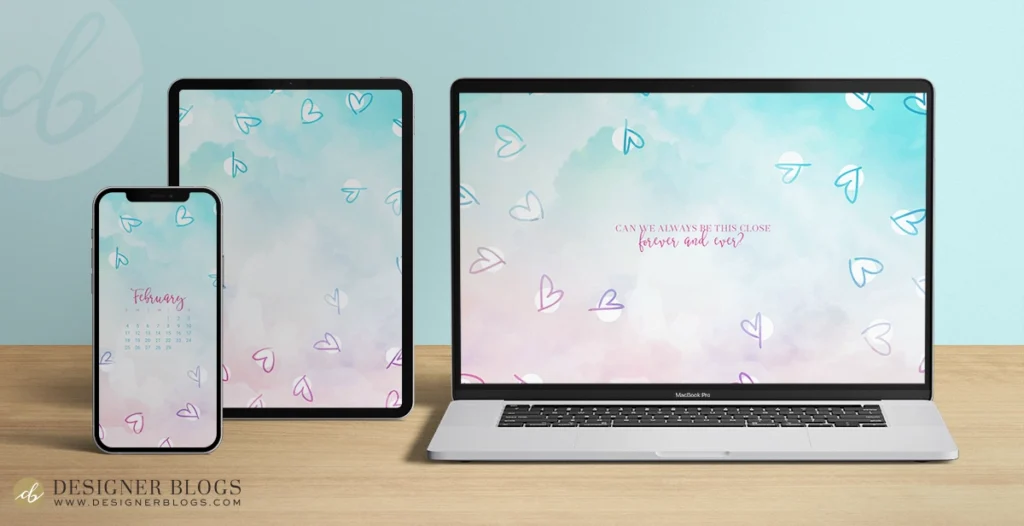
I’m really excited to share with you this new idea I have for our free monthly wallpapers in February. Instead of sticking to the usual seasonal theme, I’ve decided to create a design inspired by one of Taylor Swift’s albums with a lyric quote included. It is based on her album “Lover”, so it’ll still have a seasonal touch. I’d love to hear your thoughts on this. Would you like to see more designs with song lyrics in the future? Let me know in the comments!
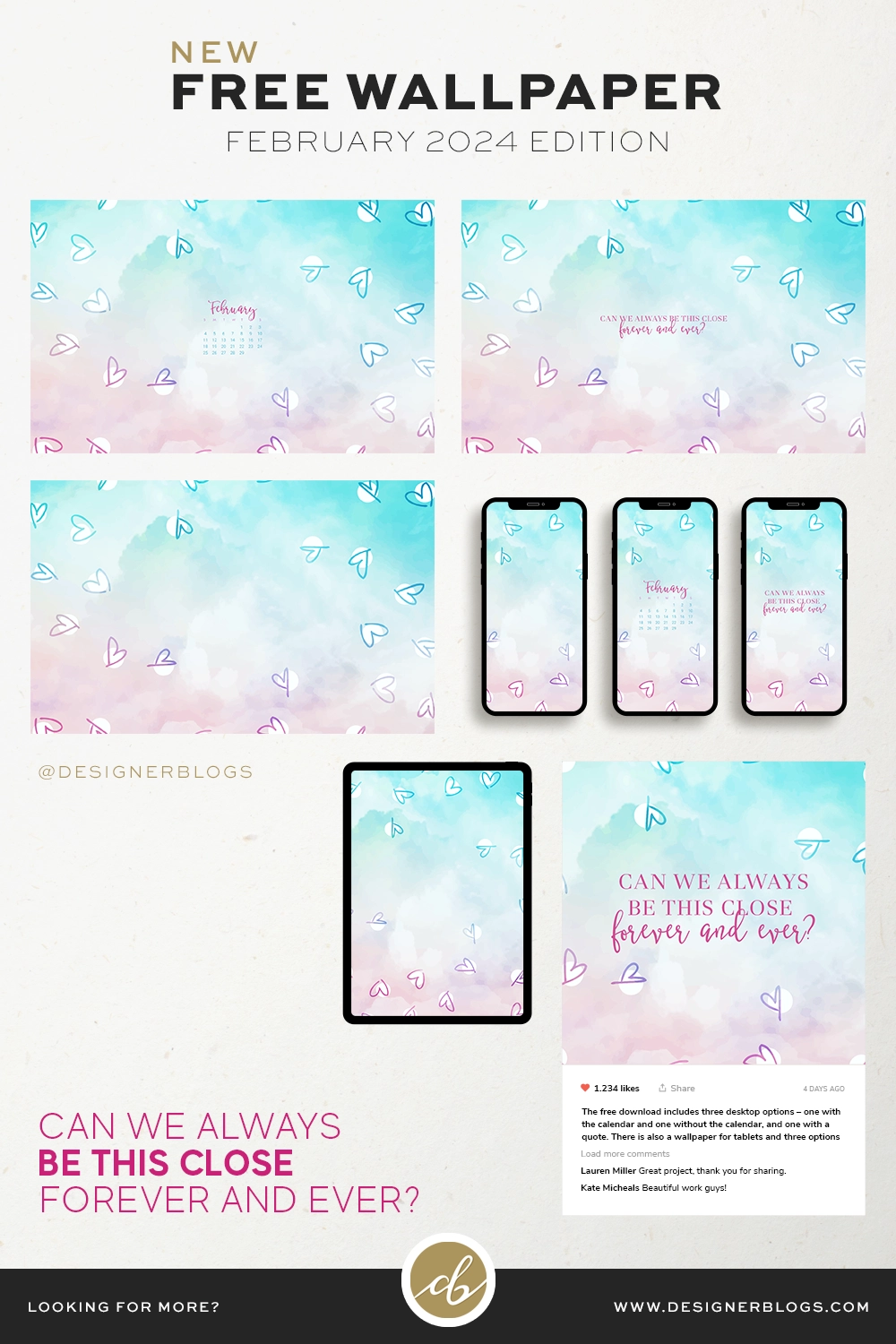
Each wallpaper download from February 2024 includes the following:
Desktop wallpaper x3 (plain, with the calendar, and with a quote)
Phone wallpaper x3 (plain, with the calendar and with a quote)
Tablet wallpaper
Instagram ready quote
Quote for February 2024
So, at the start of this post, I mentioned that instead of an inspirational quote, we have a Taylor Swift lyric on our wallpaper. I went with “Lover” because it just feels so perfect for February, don’t you think? But here’s the thing – I’m not entirely sure if the lyric fragment should be longer. What do you think? I’d love to hear your thoughts on this!
If you like the idea of using song or book fragments on our wallpapers, please let me know in the comments section. You can even list your favorite songs, authors, or quotes. I’m always looking for feedback and would love to hear from you!
Can we always be this close forever and ever?
P.S the square image is also included as a larger file in the download package below! Feel free to post it on your Instagram.
You can get three different desktop options with the free download – one with a calendar, one without the calendar, and another with a quote. Additionally, there’s a wallpaper available for tablets and three phone options too. You’ll also find an Instagram-ready square that features the weekly quote.
FOR PERSONAL USE ONLY.
NOTE: This wallpaper is available as a free download through February 29, 2024 only. After that, a $5 download fee applies.
Looking for more?
Browse all wallpapers from this series.
Start a year with a new design!
Since you just got a new wallpaper, consider updating your blog’s appearance with a fresh and modern look too! There are many different blog templates available that can make your page more enjoyable to read and navigate. Take some time to browse through them and see what catches your eye.
Blogger templates
WordPress Themes
Your voice matters!
If you have your favorite quotes or lyrics and would like them to appear on the next free wallpaper, make sure to post them in the comments below or send us your ideas via email.
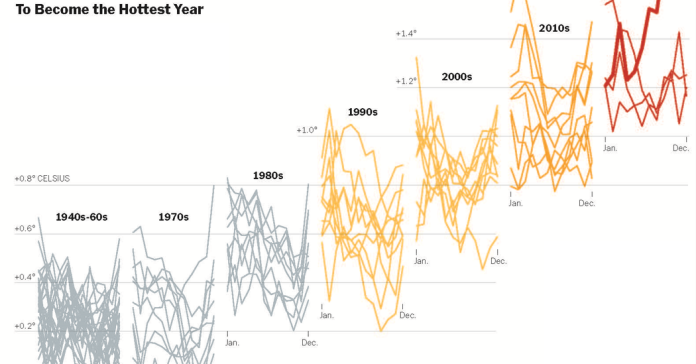
This graph was previously published in The New York Times. The data is from the European Union’s Copernicus Climate Change Service of the European Centre for Medium-Range Weather Forecasts (ECMWF), an independent intergovernmental organization.
1. After looking closely at the graph above (or at this full-size image), answer these four questions:
What do you notice?
What do you wonder?
The questions are intended to build on one another, so try to answer them in order.
2. Next, join the conversation online by clicking on the comment button and posting in the box. (Teachers of students younger than 13 are welcome to post their students’ responses.)
3. Below the response box, there is an option to click on “Email me when my comment is published.” This sends the link to your response which you can share with your teacher.
4. After you have posted, read what others have said, then respond to someone else by posting a comment. Use the “Reply” button to address that student directly.
On Wednesday, Feb. 7, teachers from our collaborator, the American Statistical Association, will facilitate this discussion from 9 a.m. to 2 p.m. Eastern time.
5. By Friday morning, Feb. 9, we will reveal more information about the graph, including a free link to the article that includes this graph, at the bottom of this post. We encourage you to post additional comments based on the article, possibly using statistical terms defined in the Stat Nuggets.
Reveal
We’ll post more information here on Thursday afternoon. Stay tuned!
• Learn more about the notice and wonder teaching strategy from this 5-minute video and how and why other teachers are using this strategy from our on-demand webinar.
• Sign up for our free weekly Learning Network newsletter so you never miss a graph. Graphs are always released by the Friday before the Wednesday live moderation to give teachers time to plan ahead.
• Go to the American Statistical Association K-12 website, which includes teacher statistics resources, Census in the Schools student-generated data, professional development opportunities, and more.
Students 13 and older in the United States and the Britain, and 16 and older elsewhere, are invited to comment. All comments are moderated by the Learning Network staff, but please keep in mind that once your comment is accepted, it will be made public.
“I think a lot of people picture, like, modern rappers who really just, like, pen and paper in the studio, writing down their raps, figuring it out, scratching it out, changing it.” “Yeah, no, we stopped writing a long time ago. Not many people write.” “Back in the day, when people were just using tape, you just had one take. So everybody had to be on point.” “There used to be a time before the 24 track, for instance. If a singer went in, you had to sing that [expletive], top to bottom, baby. You had to have it figured out.” “Most music up until about 20 years ago was always recorded on tape. It’s more of a process. It’s a lot more laborious, a little bit more tedious.” Rapping: “Three strikes and we might just blast —” “I’ve watched Tupac giving a speech — ‘Hey, we have two hours of studio time. Come here prepared.’” “We don’t have time or the luxury to spend all of this time doing one song. We don’t have it.” “Fast forward a little bit. Word starts to spread mid-to-late 90s that Jay doesn’t actually write any of his rhymes down.” “So you literally come in the studio and then formulate sentences in your head?” “Yeah.” “And then spit it to that beat?” “Yeah.” “And you never write down the lyrics?” “Never.” “Which leads to other rappers wanting to do the same thing.” “I found out that Jay wasn’t writing. I didn’t want to ever see a pen or paper, again, in my life.” “He has class, first in the lunch line. My lunch ticket let me eat rappers at lunch time.” “What I know is, when you see your hero can jump seven feet, it makes you want to jump eight.” “If it depends on me, 10 out of 10.” “You’re telling me, you’re falling out of love with me.” “I came up at the trenches.” “The problem is that not all of them are as great or as capable of doing it.” “Yeah, turn me up in my ear.” [rapping] “That’s no pen, no pad. They’re just going in and punching in.” “Punch in.” “Punch method.” “Punch and recording.” “Punching three more bars.” “I ain’t never wrote raps. I just be rapping.” “Do you write, or do you punch in?” “I punch in. I don’t write.” “Today, ProTools is essentially, like, the pen and paper, and that’s where it becomes this different type of art form.” “It’s improvisational versus writing the stand-up piece. You know what I mean?” “It’s like freehand versus tracing.” “Oh OK.” “Keep that part for me, just punch me in.” “The artist might not really have the song written, but they’re not necessarily freestyling in the traditional sense, where they’re just going in and saying the first thing that comes to mind, and they’re doing that for four minutes straight.” “Punching in, like saying one bar at a time.” “I’ve got these racks that can’t fold in the wallet. I’m making deposits. “Definitely one line at a time.” “That bar, and you said the bar out there, and you play it all together. It sounds like a whole sentence. “They’re using punching in as a way to create their rhymes as opposed to a way to correct their rhymes. Yeah, I feel it’s really just a generational thing.” “But you don’t think you could end up with something better if you sometimes wrote some stuff?” “No.” “It’s just not for you?” “No, [expletive] that.” “Rap has grown. Rap has evolved, and there’s always good and bad when it comes to evolution. What we’re seeing is a lot of the same lane being explored over and over again.” “People think, oh, they just rap about this, or they’re just rapping about, like, the easy rhyme scheme or the easy — but to be in a studio and write five songs a day, seven days a week about new topics and make it sound different, it’s very, very impressive.” “It is a sport. It is a sport to it.” “Instead of one song for a week, it’s five songs a night, and you keep it pushing.” “Not that our artistry isn’t appreciated, but it’s more so like, all right, how fast are we getting this done?” “And I’m just saying that the unprofessional rap culture is what I’m a kid of. Guys were like, I’m just a street cat, and I’ll rap.” [rapping] “I jumped off the porch and bought me a gun.” “I just want people to know that, like, you’re not Jay-Z, you’re not a failure.” “It’s about you, whether you’re writing on a phone, a piece of paper, punching in, off the dome. It doesn’t matter.” “Rapping to me, coming from, like, how I feel right then and there. Like me writing down ain’t going to be the same energy of me saying it.” “You can’t really hold your technique over a younger generation’s head, right? Ultimately, it is about just getting the best end result.” [rapping] “I respect it all because it all takes work, and it all takes thought. Whether you’re sitting over a pad or you got to spend four hours figuring it out, piecing it together, punching in, if the end, result moves people emotionally, the art is worth it.”