

“I think a lot of people picture, like, modern rappers who really just, like, pen and paper in the studio, writing down their raps, figuring it out, scratching it out, changing it.” “Yeah, no, we stopped writing a long time ago. Not many people write.” “Back in the day, when people were just using tape, you just had one take. So everybody had to be on point.” “There used to be a time before the 24 track, for instance. If a singer went in, you had to sing that [expletive], top to bottom, baby. You had to have it figured out.” “Most music up until about 20 years ago was always recorded on tape. It’s more of a process. It’s a lot more laborious, a little bit more tedious.” Rapping: “Three strikes and we might just blast —” “I’ve watched Tupac giving a speech — ‘Hey, we have two hours of studio time. Come here prepared.’” “We don’t have time or the luxury to spend all of this time doing one song. We don’t have it.” “Fast forward a little bit. Word starts to spread mid-to-late 90s that Jay doesn’t actually write any of his rhymes down.” “So you literally come in the studio and then formulate sentences in your head?” “Yeah.” “And then spit it to that beat?” “Yeah.” “And you never write down the lyrics?” “Never.” “Which leads to other rappers wanting to do the same thing.” “I found out that Jay wasn’t writing. I didn’t want to ever see a pen or paper, again, in my life.” “He has class, first in the lunch line. My lunch ticket let me eat rappers at lunch time.” “What I know is, when you see your hero can jump seven feet, it makes you want to jump eight.” “If it depends on me, 10 out of 10.” “You’re telling me, you’re falling out of love with me.” “I came up at the trenches.” “The problem is that not all of them are as great or as capable of doing it.” “Yeah, turn me up in my ear.” [rapping] “That’s no pen, no pad. They’re just going in and punching in.” “Punch in.” “Punch method.” “Punch and recording.” “Punching three more bars.” “I ain’t never wrote raps. I just be rapping.” “Do you write, or do you punch in?” “I punch in. I don’t write.” “Today, ProTools is essentially, like, the pen and paper, and that’s where it becomes this different type of art form.” “It’s improvisational versus writing the stand-up piece. You know what I mean?” “It’s like freehand versus tracing.” “Oh OK.” “Keep that part for me, just punch me in.” “The artist might not really have the song written, but they’re not necessarily freestyling in the traditional sense, where they’re just going in and saying the first thing that comes to mind, and they’re doing that for four minutes straight.” “Punching in, like saying one bar at a time.” “I’ve got these racks that can’t fold in the wallet. I’m making deposits. “Definitely one line at a time.” “That bar, and you said the bar out there, and you play it all together. It sounds like a whole sentence. “They’re using punching in as a way to create their rhymes as opposed to a way to correct their rhymes. Yeah, I feel it’s really just a generational thing.” “But you don’t think you could end up with something better if you sometimes wrote some stuff?” “No.” “It’s just not for you?” “No, [expletive] that.” “Rap has grown. Rap has evolved, and there’s always good and bad when it comes to evolution. What we’re seeing is a lot of the same lane being explored over and over again.” “People think, oh, they just rap about this, or they’re just rapping about, like, the easy rhyme scheme or the easy — but to be in a studio and write five songs a day, seven days a week about new topics and make it sound different, it’s very, very impressive.” “It is a sport. It is a sport to it.” “Instead of one song for a week, it’s five songs a night, and you keep it pushing.” “Not that our artistry isn’t appreciated, but it’s more so like, all right, how fast are we getting this done?” “And I’m just saying that the unprofessional rap culture is what I’m a kid of. Guys were like, I’m just a street cat, and I’ll rap.” [rapping] “I jumped off the porch and bought me a gun.” “I just want people to know that, like, you’re not Jay-Z, you’re not a failure.” “It’s about you, whether you’re writing on a phone, a piece of paper, punching in, off the dome. It doesn’t matter.” “Rapping to me, coming from, like, how I feel right then and there. Like me writing down ain’t going to be the same energy of me saying it.” “You can’t really hold your technique over a younger generation’s head, right? Ultimately, it is about just getting the best end result.” [rapping] “I respect it all because it all takes work, and it all takes thought. Whether you’re sitting over a pad or you got to spend four hours figuring it out, piecing it together, punching in, if the end, result moves people emotionally, the art is worth it.”
How Should Schools Respond to Racist Jokes?

Have you ever heard racist jokes or comments at your school? Do you think that hateful speech — in class or online — is a big problem for your school community?
How do your teachers and school administrators deal with these incidents? Do you think their responses are effective?
In “How Do You Respond to a Young Person Upset by Racist Jokes at School?,” Dashka Slater writes:
The sixth-grade boy who raised his hand was wiry and small. “People at my school make racist jokes,” he said, when I called on him. His voice had yet to change. “How do I get them to stop?”
I was sitting on a high school stage in Piedmont, Calif., where I had finished a conversation with two high school seniors about my new book, “Accountable,” which was adapted in The New York Times Magazine last August. Both the article and the book tell the story of the turmoil that befell a California high school and its community after some students created and shared racist material on an Instagram account. Since the article and book came out, I have spoken at schools around the country about the issues the story raises: social media radicalization, racism, humor, boy culture, the impacts of bullying and the vexing question of how to respond effectively.
This particular audience was made up mostly of adults, and they responded with applause, as if the boy’s mere desire to stop racist jokes was triumph enough. Perhaps it was. But this sixth grader wasn’t looking for approval. He wanted an actual answer, not the platitudes that adults fall back on when asked about the toxic social dynamics of middle and high school: “Be kind!” “Speak up!” “Be an upstander!” He wanted to know how to get people at his school to stop making racist jokes without becoming the butt of the jokes himself.
I talked about having a firm but nonconfrontational phrase ready, something like “Dude, that’s messed up.” I talked about how to identify which classmates had the social clout to influence their peers and how to approach those people. I talked about when to get an adult involved and how to choose the right one. But even as I spoke, I was thinking: “You know I’m just a journalist, right? I’m the one who asks the questions. What makes you think I have the answers?”
This is both the joy and the terror of talking to young people about hot-button topics. I usually start by asking students to raise their hands if they’ve seen or heard hate speech online, whether it’s the use of slurs on gaming platforms; racist memes or videos on social media; or ugly remarks in the comment section of an article or video. They all have, of course. We all have.
If I’ve managed to engage their attention — tougher to do just before lunch or during first period, when they’re barely awake — students will respond to my presentation with questions that reveal both how pertinent the topic is to their lives and how eager they are for guidance.
It concludes:
At one school, a girl spoke so softly that I had to lean close to hear her. Haltingly, with her eyes fixed on the ground, she asked how people could make amends for a harm they caused if the person harmed wouldn’t speak to them. She didn’t tell me what she had done, but I could see that it haunted her — both the guilt over the injury she had caused and the fear she would be punished in perpetuity.
I think about this girl often, wishing I had a better answer to give her. At every school I visit, I remind students that they are works in progress, that during their teenage years they will both be harmed and cause harm, and that they have the capacity to survive both. And each time, I walk away struck by how vulnerable they are to forces that they neither created nor control.
Students, read the entire article and then tell us:
Have you ever heard a racist joke or witnessed students sharing hateful speech online at your school? If so, how did you — and your peers or teachers — respond? Reflecting on the incident now, how might you handle it differently?
How prevalent are hateful jokes or speech at your school? Do you think they are a big problem? How do they affect students and the learning environment as a whole?
What kinds of rules or policies does your school have about racist or hateful speech? Are they meaningful or effective? Do you think your school community is doing enough to address the issue?
Ms. Slater begins the article with a simple but poignant question by a sixth-grade boy: “People at my school make racist jokes. How do I get them to stop?” The audience of adults applauded the student’s bravery in posing the question aloud, but Ms. Slater writes that the boy wanted an actual answer, not validation or platitudes. How does the story resonate with your own experiences as a student? Do you wish there were more guidance and answers — and fewer clichés — in responses from adults and teachers?
How would you respond to the sixth-grade boy? What would you recommend he do to get kids at his school to stop making racist jokes without becoming the butt of the jokes himself? Are there any effective strategies you have tried or witnessed?
What would you like adults and educators to know about being a teenager now and experiencing racist and hateful speech in school?
Students 13 and older in the United States and Britain, and 16 and older elsewhere, are invited to comment. All comments are moderated by the Learning Network staff, but please keep in mind that once your comment is accepted, it will be made public and may appear in print.
Find more Student Opinion questions here. Teachers, check out this guide to learn how you can incorporate these prompts into your classroom.
Understanding and Addressing the 3 Motivation Issues in ADHD Children

Written by Liau Alex
Understanding and dealing with the difficulties of raising a child with Attention Deficit Hyperactivity Disorder (ADHD) means grasping the specific motivation challenges they go through. Having trouble focusing, experiencing changes in their mood, and organising tasks may prove difficult for children with ADHD.
This blog post delves into the motivation issues in children with ADHD, exploring the underlying factors that contribute to these challenges. ADHD affects more than just the ability to focus; it also influences how children perceive rewards, setbacks, and their own abilities to succeed. By shedding light on these intricacies, I aim to offer insights and practical strategies to help children with ADHD find motivation and achieve their full potential.
Three Motivation Issues Present in Children with ADHD
- Trouble Focusing
If your child has ADHD, staying focused on important things can be tricky for them. It shows up in school and everyday tasks. In class, they might not finish assignments or have trouble following directions. At home, even easy chores can feel like a big deal.
To help with this, try breaking tasks into smaller parts. Use pictures or set up a special place to work. Talking with teachers about personalized strategies for the classroom can really make a difference in improving focus and finishing tasks.
- Mood Swings
If your child has ADHD, handling emotions can be a bit tricky. They might have unexpected mood swings and strong reactions. Figuring out what sets off these emotional changes is really important. It could be changes in routine, things they see or hear, or feeling frustrated when focusing for a long time.
As a parent, you’re a big help in guiding your child through these emotions. Having a regular schedule, providing lots of emotional support, and teaching calming tricks such as deep breathing or mindfulness exercises can make a big difference in helping them handle their feelings better.
- Sorting Out Tasks
If your child has ADHD, deciding what to do first can be challenging for them. It’s not just in school; things like getting dressed or organizing stuff can feel overwhelming.
But as a parent, you can help! Try using pictures to show what comes first, using colors to make things clear, and reminding them about the order of tasks. Celebrating even small victories helps them feel good about getting things done.
Helping your child with ADHD stay motivated needs a complete plan. Team up with teachers to use special classroom strategies for a supportive environment. Getting advice from healthcare pros and therapists can give you more tips and resources.
At home, it’s important to create a supportive atmosphere. Talk openly, set goals that make sense, and cheer for small wins. Keep in mind: every kid’s journey is different, so being patient, understanding, and giving constant support is the key to their success. If you want to better understand your child’s ADHD motivation, you can learn more from my various courses available for free on Alison, which will empower you to do as such!

Biking

Use your imagination to write the opening of a short story or poem inspired by this picture, or describe a memory from your own life that this image makes you think of.
Tell us in the comments, then listen to related podcast to learn more.
Students 13 and older in the United States and Britain, and 16 and older elsewhere, are invited to comment. All comments are moderated by the Learning Network staff, but please keep in mind that once your comment is accepted, it will be made public and may appear in print.
Word of the Day: unfathomable

The word unfathomable has appeared in 101 articles on NYTimes.com in the past year, including on Dec. 3 in “Michael Stipe Is Writing His Next Act. Slowly” by Jon Mooallem:
Three years later, in 2011, R.E.M. amicably broke up. It all went away: no more touring. No more adrenaline. No calendar. No stress. For nearly 32 years, Stipe had been plugged into a particular socket. Now he was unplugged — it was as simple as that. When Rolling Stone asked if he planned to make a solo album, he answered, “It’s unfathomable to me right now.”
“I just folded my hands and sat for a while,” Stipe told me. Years passed. The journalists who still came sporadically to interview him would mention tallies of elapsed time — X number of years since the breakup; the 10-year anniversary of a particular album — and those numbers would catch him off guard: Had it really been that long?
Daily Word Challenge
Can you correctly use the word unfathomable in a sentence?
Based on the definition and example provided, write a sentence using today’s Word of the Day and share it as a comment on this article. It is most important that your sentence makes sense and demonstrates that you understand the word’s definition, but we also encourage you to be creative and have fun.
If you want a better idea of how unfathomable can be used in a sentence, read these usage examples on Vocabulary.com. You can also visit this guide to learn how to use IPA symbols to show how different words are pronounced.
If you enjoy this daily challenge, try our vocabulary quizzes.
Students ages 13 and older in the United States and the United Kingdom, and 16 and older elsewhere, can comment. All comments are moderated by the Learning Network staff.
The Word of the Day is provided by Vocabulary.com. Learn more and see usage examples across a range of subjects in the Vocabulary.com Dictionary. See every Word of the Day in this column.
30 Climate Change Graphs
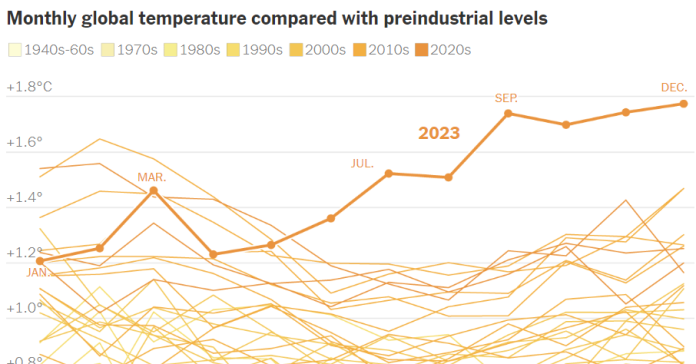
How can we help students really see climate change when it is a planet-wide process gradually unfolding over decades? Any given hurricane, prolonged drought or scorching hot day (or summer) might be more likely to occur because of the changing climate. But there will always be weather anomalies; just like in sports, records will be set.
Images can be very powerful (like a video of a starving polar bear), and they can be an important resource in helping young people to see the effects of a warming planet. But perhaps no visual can tell the story of climate change more succinctly, and more effectively, than graphs. Because a single graph can show change over time.
In this teaching resource, we have gathered 30 graphs previously published in The New York Times that relate to climate change. We organize them by topic: rising air temperature, intensifying storms and changing precipitation, warming oceans, greenhouse gas emissions, and climate solutions. Above each graph you’ll find the link to the original Times article. Scroll down to the bottom of this post to find teaching strategies for using one or more of these graphs in your classroom.
Note: For more climate-related graphs, visit this post from 2019.
Strategies for Teaching With This Collection
1. Notice and wonder.
For more than seven years we have been collaborating with the American Statistical Association to bring New York Times graphs into classrooms via our What’s Going On in This Graph? activity. Each week we post a new graph and then invite students to respond to four open-ended prompts:
What do you notice?
What do you wonder?
Teachers can use this same activity with one or more graphs from this collection. Students can journal individually or share their observations with a partner before moving into a class discussion. Or, you can host the conversations online (similar to our comments section), where students post their ideas in an online classroom forum and the teacher and other students submit replies with the goal of helping one another deepen their analysis.
For more detailed information about how to use this approach, visit our previous climate change graph collection, or watch our three-minute tutorial or 45-minute webinar.
2. Read and react.
Invite students to pick any graph from the collection and click on the article link above it. Then they should read the piece and answer these questions:
How does the article contribute to your understanding of climate change?
What role do the graphs embedded in the article serve? Do they make it better? If you were the article’s editor, would you have made the decision to include the graphs? Why, or why not?
What other questions do you have after reading the article?
3. Investigate.
To create each of the graphs in this collection, the Times graphics team used data from one or more sources. Ask students to find the source of the data, which is labeled on the graph itself or in the article, and then investigate using the following prompts:
Who collected this data? Why did they collect it?
How did they collect it? What was their methodology?
When was this data collected? Is it still current?
Is this data accurate and reliable? How do you know?
What do you think about the way Times editors decided to present the data visually in a graph? Do you think they made the right choices? Why, or why not?
How else could this data be presented?
4. Rank.
There are 30 graphs in this collection. Assign students to work in pairs or small groups, and then have them discuss which graph they think is most effective for teaching the general public about Earth’s changing climate. Or, have students choose a few. Then they should explain why they selected that graph — or those graphs.
Confused? Welcome to the Learning System World of 2024

I just read (1-31-24) that during the Pandemic, students (EdTech, K-12, Higher Education) went down something like 4% in learning. That’s not good. I blame it on two areas – that seem to reverberate that e-learning isn’t as effective (I disagree).
The first? Professors and teachers only do synchronous-based learning (which I believe isn’t as effective unless you add some parameters such as activities, deep thinking, etc.). The second? The Bore Factor – as in professors, teachers, heavily (in some cases, all the time) on the screen using a web conference solution (edtech often refers to it as a digital classroom) and talking. How engaged is that? That is like an audiobook, whereas it teaches you how to fall asleep to someone speaking in a monotone voice. Instead of leveraging what kids use these days, such as Instagram and TikTok, EdTech did the same as they would in a classroom. They changed nothing, but the problem is they failed by doing so. And who takes the whammy for that? Online learning – which EdTech refers to as remote learning (I guess remote viewing was unavailable because the CIA tried it during the Cold War).
Next up? Many “experts, including some analysts,” use learning systems to refer to all learning systems except an LMS. Thus, you will see LMS and Learning Systems. This makes no sense to me.
An LMS can do everything an LXP can do (depending on the vendor), and the combo LMS/LXP angle is a mish-mash of whatever a vendor thinks an LXP is (in reality, there are only a few that are legit combo – Juno Journey is one). A learning platform is second in the type of learning system – the challenge is that the vendors who slide under a learning platform rarely call themselves that. I’ve seen – an employee engagement platform – I’m sure everyone is running to type that into a search engine or say it when considering what system to buy. Employee Development Platform is another. Some weird concoction that a vendor has devised is another. Mentoring platforms are a combo; the core is the mentoring piece, and learning plays a significant role. A coaching platform follows the same angle. Thus, you have a CORE component and a twist within it.
Bouncing back to the LMS for a moment, here is a post I did about the reality of the LMS and breaks away the myths you might hear or will hear and read.
There are still vendors out there who say we are not an LMS or tap into the whole traditional thing (which is inaccurate), and yet they will use “LMS” as a keyword in their AdWords campaign and/or as a word when you search an LMS. If they believe they are not an LMS, why place that as part of your search?
One vendor told me it is a way for people to visit their website (I figured that out on my own). I’ve heard that before, so let me get this straight – you think an LMS is traditional, but you aren’t an LMS. Hey, we add it to our SEO keywords.
The most popular learning system is an LMS. Number one. It always has been. There is a reason: people who investigate the LMS will find that the whole formal focus, compliance angle only, is invalid. You can add content (or have a 3rd party). And you have always been able to since the corporate systems launched in the early days. Heck, I bought content through my LMS vendor in 2000.
If you seek a learning system that targets or pitches for frontline/diskless workers, blue-collar will slide under that (but in some systems that target, they rarely mention them – rather, they use “manufacturing” as a vertical). The most critical piece is the mobile app; it has to have an on/off synch. It has to be designed with the learner in mind – not the person running the department or division (such as the head of L&D, HR, or Training (internal). Ideally, a mobile app should be able to identify the bandwidth speed and change it accordingly. You might think that is impossible, but some vendors did it years ago. Just as they were able to change the playback speed, thus lowering FPS (frames per second) while maintaining quality.
Today? It’s rare to find one. Suppose you have someone working at a retail location (where the net is all over the map, often bad), on the plant floor (ditto), or at some other location on-site (those items noted above, I think it would be relevant).
Every vendor will say yes when people ask if the system is mobile-responsive. They really mean that you can access the system via a mobile web browser – the same spin if you ask if they have mobile learning – yep, via the mobile web browser.
Some vendors angle the “no need” to use an app because folks can access it via a mobile device. Yuck. I have problems at home with top-tier mesh adaptors. Some places in the UK would be excited if they could get 10MB speed. And these folks think a mobile browser via your mobile device will suffice.
The Shell Game of Active Users or MAUs
The pricing approach continues to confuse. The whole “active user” that is counted is seriously propaganda unless that vendor sends an invoice to you each month and charges you for each month. That’s it. If that isn’t happening, the whole “active user” spin is just spin. Ditto on the MAU thing, which is monthly active users. I know vendors who are confused by what they see other vendors do regarding the pricing of “active users.” Think about that for a second. The folks who sell a learning system, can’t understand how the active model really works – because it is a shell game.
Look here. Look there. Pick where the ball is. Sorry, it’s not there. It’s over here.
Some vendors say, “Okay, we will bill quarterly,” and count only the active users—two sides here to this coin. Unless the vendor is counting each month, and it isn’t, we break out your total bill over four quarters – but if it is the same price you would pay annually, then well, it is the latter.
I can tell you that some vendors are jumping into the latter or offering it as an option (plenty do, even before 2024), which will help you financially. Plus, it sounds like a better deal – around the whole active piece.
I want to stress – I repeat stress – if you are paying annually upfront OR the split for each quarter is the actual annual price, just broken up from an invoice standpoint – the vendor is not counting your active user count and bouncing it back to zero to start up again. It is not happening. Do not get into the shell game here. I know there will be a lot of people who will fall for that. Heck, I talked to one vendor who does it, and I kept asking, no, this is the way it is done, and they went all over the place, where for a moment I got confused – but with lots of pushing, finally got them to admit, that yes, you pay upfront annually.
Please do not get all Svengali with the vendor; they are Svengali, and you are his pupil. You pay upfront? They are not counting the active side back to zero. Focus on the proposal total. The bundled model is the most effective pricing model (it’s been around since 2000). ”We will sell you 1,000 seats,” – some now use licenses, but the term behind the scenes is seats. You have 650 active users. What are you paying upfront for? 1,000 seats. If you end up with 720, you still pay for the 1,000. There are no refunds here.
Nowadays, the bundled model is often tied around range pricing (behind the scenes), but it is still bundled.
How many vendors go with this type of pricing approach? My guess is about 90%. Always remember the goal of a learning system vendor, learning tech, whatever system you are purchasing, or tech you are buying, is to make money. Generate Sales. Not to lose money. They won’t last long if they follow that approach, albeit, behind the scenes, there is always at least one vendor privately on the market – either due to financial straits, or they want out, and are seeking the right buyer. Many fall into the former category – which I have found is always due to mismanagement at the top of the food chain. Soylent Green, anyone?
Other pricing news you need to know about in 2024 (as of today’s post, 1-31-2024)
- It is going up more than going down. People are losing their jobs. L&D, Training, and HR departments are the first to get cut. It’s too bad many vendors are ignoring that.
- You pay more for better support or support in general. There is one vendor that offers support packages right out of the gate. Free? Ain’t happening. And each package is expensive. It has nothing to do with your user base. And you pay yearly. The bummer for me? I like the system, but that is bad business.
- The number of hours of free training is dropping. I see one hour with some vendors. One hour? Who retains information over an hour? If the department/division/company head wants to be trained on the system, give it to them for free. If the admin needs more training on XYAX, give it to them. Give it to them if they have a new admin or one that has gone on vacation and needs to be trained. As many hours as needed. Why? Those support calls into your company aren’t free – they cost, and wouldn’t it make more sense to offset and stop that before it happens? Who is running the strategy around the low-hours training? Elmer Fudd?
- One way vendors are trying to lower it is to provide training videos on specific areas. It sometimes works, but there isn’t any way to know what someone needs training on. And unless you are going into every key spot, that won’t work. A vendor should look at the support calls or tech issues and see the top five using trend lines. That should be the indicator here. Not how to log in.
- Tiered pricing is back! You get XYZ at this cost. Then, another tier, and you get more. There is often a “most popular,” which means – this is the one the vendor wants you to buy unless you are an Enterprise. Then you contact them.
The problem? Only the vendor knows what Enterprise means. It may be 500 users or more. It may be 1,000 or 2,500 or 5,000 or 10,000 or how much revenue the client brings in (bad idea, but anyway, have fun with that). I’ve seen vendors who say 1,000 or more – but it is listed as Enterprise. They also show up to 1,000 on a lower tier. Which is it? I’ve seen vendors who go Enterprise, Mid-Market – SMB. Now, SMB means small to mid-market.
Suppose you are already saying mid-market (which many people have yet to learn what that means – which is why vendors do not say it out loud – nor should they), then do not say SMB. What do you say? Small business. If you privately say Large Enterprise, have a number min. for that. I’ve seen it all over the map. A vendor will always have a sweet spot. And in my experience, it is different from the 20,000 or more. As a prospect, you will not know – that’s ok. It is not relevant to a buyer.
Appropriate to an analyst – I always ask. A vendor should know it. No surprise, I talk to vendors – and I mean high-level, who have no idea. And they are often running sales.
Gen-AI Potential Fiasco
Okay, you will see AI. You are already seeing it everywhere. When you see the term AI, what the company, even vendors in our market, really mean is generative AI (there is machine learning, too, but nowadays, the vendor, entity, and even the folks selling LLMs, it is generative AI).
There are two types – Text (the most common one today) – which you will see in quite a few systems that already have it, or it is coming, OR multi-modal, which means it will generate text, video, audio, images, and so on. For example, synthetic audio is used when you see AI audio. A vendor may say it is in their product you can generate synthetic materials such as audio, images, etc.
Or they may not, but it is synthetic.
I continue to be surprised at the number of vendors needing to figure out what they are doing. Sure, they went with ABC, and they know some stuff, maybe a lot about AI in general, but they do not know how to leverage or tap into within their learning system, learning tech, heck, even 3rd party content platform.
I see it all the time, and it drives me up the wall – because here is the kicker – they tell you they know it and do this and that. Yet, when I dive in, I see them writing stuff down, which clearly says, I didn’t realize that, OR I should be doing this. Even when I write stuff, I hear from vendors who have AI now and are surprised that it can’t do this OR that its hallucinations piece will still exist when the client is adding only their stuff, whatever it might be, into the LLM (think foundation for gen AI).
Inquire what the text input and output are. Deer in the headlights look.
Inquire whether it is multi-modal or not. Silence, then they ask you what that means exactly. They tell you the token fees are low and are not impacting them. Then you notice that only the admin side can use the AI – no wonder it is low.
Wait until your learners type in text and seek it tying content or skills and content – recommending it based on what they want, and since they do not know what they should do – to get a clear response and more aligned – the fees will go up. Have 10,000 people hit that? I hope you calculated that cost into your pricing strategy. I see plenty who don’t because they have yet to learn many of the nuances of AI.
AI bias? It occurs. The snake eats it’s own tail? It’s called Model Collapse – and yeah, it is a genuine concern in the AI space. It involves training of the LLM, which is achieved by scraping text, etc., off the internet. Let’s say it is scraping stuff already written by AI on websites. Researchers have already found it in ChatGPT and Bard (which uses Gemini Pro).
What do you think will happen?
Recently, a researcher used Midjourney to create an image of the “Joker.” It did. The problem? It was the same as the copyright version.
Let’s say your employee asked that question, saw what they viewed, and had no idea it was copyrighted. Then they place that into some document (uh, not the Joker, but something else). How will that play?
Training with vendors providing AI must be extensive.
Content Providers must create content around AI – and how to leverage it for better results (to reduce token fees). All learning tech, learning systems, providers, and e-learning entities – will need to know the ins and outs – far more so than the general public. Today, I’m not seeing it.
Other issues showing up in AI? Data Poisoning or what is referred to as “sleeper agents.” Wait. What about the Poision Pill angle, when it comes to images, photographs, etc. that an LLM is trained on. By using those images and photos that have this code in it which poisons the image or photograph. Making it as researchers note, unsuitable for AI training. When do you find out? When you try to create an image or photo with the code in it.
L&D and Training Responsibilites – Because the vendors won’t always know
L&D and Training departments have to stay up to date, know about context windows (basically the number of input text that someone could enter at one time in a context window – i.e. known as a prompt window), and create online content on an ongoing basis so that their employee doesn’t damage the company. If the employee doesn’t know – and let’s say they looked at what was produced – under the improved productivity aspect – and then they push that up to their boss – and their boss doesn’t know – how will that work? Who is the expert here? Trust me, it is unlikely to be the vendor. It has to be you, and therein is the biggest issue.
Are vendors aware of small LLMs? I only know two – and that is because the folks who oversee AI at their companies stay current and knowledgeable – about gen AI. Everyone else in our industry? Not likely. Model as a Service? Across the board? Good luck.
Is Bard better than Bing? And what’s the difference – pluses and minuses of Bard – Bing – Claude. I note the last one because Bard is now built on Gemini Pro (a work in progress), Bing (ChatGPT), and Claude is Claude, a legitimate competitor to all three. Who knows about Gemini Ultra? Well, is it available in Windows Copilot. The thing that costs you $20 extra with particular business 365 packages. Oh, some vendors state “copilot” in their marketing copy.
Do they have it? When I look at it, no in nearly every case, and maybe in one, but it is a stretch.
And those in L&D and Training – do you know what it is and how it works? It isn’t just Microsoft’s exclusive term, nor the only one doing it. Because you better – the vendor that has it? Trust me, they won’t know the ins and outs.
Why?
They are not training their employees – if you are lucky once. I know of one 3rd party content provider that regularly has clinics for their employees – training on the latest with AI – that vendor? OpenSesame.
Bottom Line
Genesis once sang about this being the “Land of Confusion.”
I call that a prophecy.
That has come
True.
E-Learning 24/7
Is High School a Good Time to Train for a Career?

What career or careers interest you? Do you know what path will take you to your dream job? Will it require training, experience, a college degree or perhaps additional degrees, internships and so on?
If you had the opportunity to start training for that career while you’re still in high school — earning college credits or even starting work as soon as you graduate — would you take it? Why or why not?
In “Hospitals Are Desperate for Workers. They Might Find Them in High Schools,” Jenna Russell writes about a project that will help prepare students for careers in a variety of medical fields, resulting in college credits or a job they can start after high school. The article begins:
Public school students in Boston will have a direct route to guaranteed jobs with the city’s largest employer, the Mass General Brigham health system, via a new initiative that will pair high schools eager to expand career training with hospitals desperate for workers.
A $38 million investment by Bloomberg Philanthropies — the largest gift in the history of the city’s public schools — will transform a small existing high school into an 800-student feeder for the sprawling Mass General system, which is currently plagued by some 2,000 job vacancies.
Boston is one of 10 cities or regions where Bloomberg has pledged to spend a total of $250 million over five years pairing hospitals with high schools. Students will earn college credits as they train for careers in nursing, emergency medicine, lab science, medical imaging and surgery.
But in a nod to evolving views on higher education, and to surging demand for vocational training, the program will prepare thousands of students to start full-time jobs upon graduation instead of college if they choose.
“There’s a growing sense that the value of college has diminished, relative to cost,” Howard Wolfson, education program lead at Bloomberg Philanthropies, said in an interview on Tuesday. “This should not be construed as anti-college — every kid who wants to go should have the opportunity. But at the same time, we have to acknowledge the reality that, for a lot of kids, college is not an option, or they want to get on with their careers.”
The foundation started by Michael R. Bloomberg, the former mayor of New York who grew up in a Boston suburb, will establish similar partnerships between schools and hospitals in New York, Philadelphia, Nashville, Houston, Dallas, Charlotte and Durham, as well as in rural areas in Tennessee and Alabama.
In Boston, the money will allow the Edward M. Kennedy Academy for Health Careers to gradually double its enrollment to 800 students from 400 and offer five health care career tracks instead of the current two. The new curriculum will be developed by Mass General Brigham.
Students will choose a specialty by the end of 10th grade, then spend time as juniors and seniors training in hospital labs, emergency departments and other such settings, the school said.
Students, read the entire article and then tell us:
Do you think programs like the one described in the article will appeal to high school students? Do they appeal to you? If you lived in Boston, would you want to attend the Edward M. Kennedy Academy for Health Careers?
Were you aware of the staffing crisis facing the health care industry? Do you think the programs being funded by Bloomberg Philanthropies can help alleviate the problem?
Do you attend a vocational school or know anyone who does or has graduated from one? What about programs that allow high school students to earn college credits? If so, what has the experience been like? If not, is this something you’re interested in?
What are the advantages and disadvantages of learning about and perhaps even preparing for an eventual career while in high school? Is it good to get a jump on a career as early as possible? Or do you think high school students should focus only on high school?
How does it feel to contemplate life after high school? Have you talked about it with anyone yet? Is a postgraduation plan coming together in your mind? What is one thing you can do today or this week to learn more about a career, an industry, a college major, a training program, military opportunities, the job market in the place you live or another place you might want to live when you’re an adult?
Students 13 and older in the United States and Britain, and 16 and older elsewhere, are invited to comment. All comments are moderated by the Learning Network staff, but please keep in mind that once your comment is accepted, it will be made public and may appear in print.
Find more Student Opinion questions here. Teachers, check out this guide to learn how you can incorporate these prompts into your classroom.
Your Energy Playlist

At the beginning of this month, the Well section asked Ahmir K. Thompson, also known as Questlove, to curate a playlist for their Six-Day Energy Challenge.
Mr. Thompson, who owns over 200,000 records, is known for his inventive playlists, and has made them for many world leaders, including the Obamas.
Before you listen to the tracks he chose, tell us: What songs would you choose for a list that would give you energy and inspire you to move? Why?
When you’re done, read the related article to see what Mr. Thompson picked.
Students 13 and older in the United States and Britain, and 16 and older elsewhere, are invited to comment. All comments are moderated by the Learning Network staff, but please keep in mind that once your comment is accepted, it will be made public and may appear in print.
Word of the Day: auteur

The word auteur has appeared in 71 articles on NYTimes.com in the past year, including on Dec. 2 in “Beyoncé the Auteur Takes Center Stage in ‘Renaissance’” by Salamishah Tillet:
“I’m excited for people to see the show,” Beyoncé says early in “Renaissance: A Film by Beyoncé,” based on her recent world tour and seventh studio album. “But I’m really excited for everyone to see the process.”
… But what makes “Renaissance” unique among other great concert films is that she did not just star in it the way the Talking Heads did in Jonathan Demme’s classic “Stop Making Sense” or Madonna in Alek Keshishian’s provocative “Truth or Dare.” Beyoncé also wrote, directed and produced the film. In fact, she has created some of the past decade’s most memorable cinematic musical experiences and should be considered an auteur — in terms of both this film and her career.
Daily Word Challenge
Can you correctly use the word auteur in a sentence?
Based on the definition and example provided, write a sentence using today’s Word of the Day and share it as a comment on this article. It is most important that your sentence makes sense and demonstrates that you understand the word’s definition, but we also encourage you to be creative and have fun.
If you want a better idea of how auteur can be used in a sentence, read these usage examples on Vocabulary.com. You can also visit this guide to learn how to use IPA symbols to show how different words are pronounced.
If you enjoy this daily challenge, try our vocabulary quizzes.
Students ages 13 and older in the United States and the United Kingdom, and 16 and older elsewhere, can comment. All comments are moderated by the Learning Network staff.
The Word of the Day is provided by Vocabulary.com. Learn more and see usage examples across a range of subjects in the Vocabulary.com Dictionary. See every Word of the Day in this column.
