fbpx
Home Blog Page 947

How Are You Doing Your Part for the Environment?

0
How Are You Doing Your Part for the Environment?

April 22 is Earth Day, a day set aside for appreciating the environment and encouraging protections of it. The tradition dates back to the first Earth Day in 1970, when some 20 million people across the United States, from thousands of schools, colleges, universities and communities, took part in demonstrations, marches and environmental cleanups. It led to the passage of landmark environmental legislation in the country and helped create the modern environmental movement.

Today, Earth Day is celebrated in 192 countries. Its mission includes curbing plastic pollution, supporting regenerative agriculture and combating climate change.

Do you celebrate Earth Day? What role does the environment or nature play in your life? What do you appreciate most about it? Do you do anything to help protect the planet?

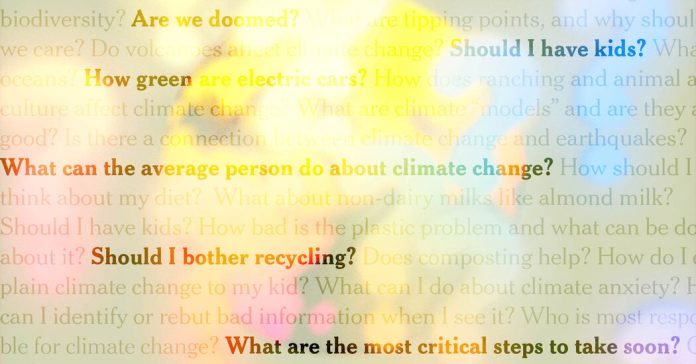
In the face of a warming world and increasing climate catastrophes, you might be asking yourself: Can one person help save the planet? In “Have Climate Questions? Get Answers Here,” The New York Times Climate Desk responds to that query and others. Somini Sengupta, a climate reporter, writes:

What can the average person do about climate change?

This is one of the most common and vexing questions: Can one person’s actions really make a difference? The problem is so big that the fix has to come from powerful nations and policymakers, right?

First of all, it’s impossible to separate the two things: Personal actions and international cooperation are inextricably linked. The answer also depends on whose actions we’re talking about.

The actions of a middle-class American matter a lot more than the actions of, say, a farmer in Bangladesh. Why? Because people in wealthy countries consume much more than people in poor countries, and so their choices matter more to global emissions.

What can individuals do? Here’s a detailed guide. A few examples:

∙ Transit: What car a person buys — or whether a person even owns a car — matters tremendously, because transportation is the single biggest source of emissions in most American cities.

∙ Air travel: Long-haul and first-class trips in particular increase a person’s carbon footprint.

∙ Food: If people were to simply waste less food, it would make a significant difference in emissions.

∙ Stuff: Avoid the disposable. Purchase things that last.

In our homes, one of the most effective (but sometimes complicated) things that can help is to replace gas heaters with electric heat pumps. Gas stoves, too, contribute to warming, although to a lesser degree, but also have other negative health effects.

Changing what you do can also influence others. Research shows, for instance, that people tend to conserve more electricity when their utility bills show how their power use compares with their neighbors’.

And it’s worth noting that individual action is a prerequisite for collective action. Without individual activists getting together, there would be no Sunrise Movement camping out in the halls of Congress. And, of course, voting is an individual action that can be an important force for change.

On the whole, though, humans tend to be bad at altering their behavior today to address risks tomorrow. This “present bias,” as cognitive scientists call it, makes it hard for us, as individuals, to carry out lifestyle changes now to prevent a catastrophe down the road.

Because the world has deferred climate action for so long, it must now cut greenhouse gas emissions drastically and swiftly. It can be hard to imagine how those cuts can be made without ambitious government policies.

Still, it’s not too late to make a difference. While it’s true that we have already dangerously warmed the planet by burning fossil fuels for generations, the future isn’t set in stone. Many futures remain possible. It’s up to us to decide which one plays out.

Students, spend some time exploring the rest of the guide. You can type your own climate-related question into the search bar or browse through the curated list of reader questions. Then tell us:

Band Practice

0
Band Practice

Use your imagination to write the opening of a short story or poem inspired by this illustration or, tell us about a memory from your own life that this image makes you think of.

Tell us in the comments, then read the related essay to learn more.


Students 13 and older in the United States and Britain, and 16 and older elsewhere, are invited to comment. All comments are moderated by the Learning Network staff, but please keep in mind that once your comment is accepted, it will be made public and may appear in print.

Find more Picture Prompts here.

Word of the Day: defunct

0

The word defunct has appeared in 180 articles on NYTimes.com in the past year, including on April 5 in “In Ohio, Electric Cars Are Starting to Reshape Jobs and Companies” by Jack Ewing:

Warren, in eastern Ohio, knows what happens when a carmaker leaves town. The city has lost one-third of its population, about 20,000 people, since the 1970s, a process that accelerated after G.M. closed the factory in nearby Lordstown, which produced Chevrolet Cruze sedans, in 2019. Sales of that car had been fading as more Americans chose sport utility vehicles.

Even before that shutdown, auto production jobs had been declining. U.S. automakers and their parts suppliers employed about one million people at the end of 2018, down from more than 1.3 million in 2000. In the years before G.M. closed the Lordstown plant, it had reduced shifts and pared its work force.

… Today, things are looking somewhat better. Ultium Cells, a joint venture of G.M. and LG Energy Solution, is ramping up production of batteries near the defunct factory.

Can you correctly use the word defunct in a sentence?

Based on the definition and example provided, write a sentence using today’s Word of the Day and share it as a comment on this article. It is most important that your sentence makes sense and demonstrates that you understand the word’s definition, but we also encourage you to be creative and have fun.

Then, read some of the other sentences students have submitted and use the “Recommend” button to vote for two original sentences that stand out to you.

If you want a better idea of how defunct can be used in a sentence, read these usage examples on Vocabulary.com.


Students ages 13 and older in the United States and the United Kingdom, and 16 and older elsewhere, can comment. All comments are moderated by the Learning Network staff.

The Word of the Day is provided by Vocabulary.com. Learn more and see usage examples across a range of subjects in the Vocabulary.com Dictionary. See every Word of the Day in this column.

Teen Writing on Spring, Mindfulness and Childhood Hobbies

0

I dislike spring for its assault on my nose. Every year, from March 15th to June 15th, I struggle through every day with a tissue box attached to my hip. I look like a rare Rudolph among the rest of my reindeer acquaintances, my nose bright red enough to act as a lighthouse to guide ships through the darkness of night. Of course, spring has the pretty flowers, the nice weather, and even I myself am a spring baby. However, my one greatest adversary, my sworn enemy, the dreaded pollen arrives with spring. For this reason, I can never bring myself to love the season.

— Gwen-Zoe, San Jose, CA

For many people, spring signifies hope and renewal. Buds begin to open, trees begin showing new leaves. Spring is perhaps the most poetic season of them all. Besides the poetic quality of Spring it has many more practical pleasing qualities. Spring is the perfect temperature, not too hot and not too cold, and it is the peak time to experience the natural world. Spring may not be host to the same ridiculous amount of holidays as winter but Easter, and the gifts and break from school that comes with it, is always appreciated.

— Emma, Julia R. Masterman

I keep having to tell myself that winter will be over before I know it, forgetting that I live in Minnesota, where we have winter for the majority of the year … After a while, it eventually gets old, and I am faced with my reality: I must get out of bed and live through another gloomy and cold day. Day after day, the cycle repeats itself, and despite the feelings of joy from childhood nostalgia, I hope for the arrival of spring. I know that as spring slowly arrives, the hushed, frigid, and snowy winter mornings in Minnesota will transform into times of joy, filled with the fluttering of butterflies, the smell of flowers, and the chirping of early morning birds.

— Mirella, East Ridge High School, Woodbury, MN

The equinox turns from darkness to light, gloom to the sun. Spring is underestimated, no one sees the joy it brings, not even when the cherry blossoms bloom or the squirrels come out from hibernation. We take spring for granted, it’s when nature returns from rest. Yes, it is annual but it only lasts a short while. I love when the weather is perfect, the air is moist, and life comes back. Spring is when I was born, it’s when nature was born, and nature will not always last. I can’t bear to see the huge maple tree from my window barren, just a long stick of brown. Now, the tree has invited red sparrows to my window, owls at night, and bright vines trailing up its trunk. Spring brings rain, I love rain. I love the comforting sound of drippings, and I love the sweet smell spreading through the atmosphere.

— Arianna, Julia R. Masterman School, PA

What’s Going On in This Graph? | April 24, 2023

0

3. Below the response box, there is an option to click on “Email me when my comment is published.” This sends the link to your response which you can share with your teacher.

4. After you have posted, read what others have said, then respond to someone else by posting a comment. Use the “Reply” button to address that student directly.

On Wednesday, April 26, teachers from our collaborator, the American Statistical Association, will facilitate this discussion from 9 a.m. to 2 p.m. Eastern time.

5. By Friday morning, April 28, we will reveal more information about the graph, including a free link to the article that includes this graph, at the bottom of this post. We encourage you to post additional comments based on the article, possibly using statistical terms defined in the Stat Nuggets.

We’ll post more information here on Thursday afternoon. Stay tuned!


More?

• See all graphs in this series or collections of 60 of our favorite graphs, 28 graphs that teach about inequality and 24 graphs about climate change.

• View our archives that link to all past releases, organized by topic, graph type and Stat Nugget.

• Learn more about the notice and wonder teaching strategy from this 5-minute video and how and why other teachers are using this strategy from our on-demand webinar.

• Sign up for our free weekly Learning Network newsletter so you never miss a graph. Graphs are always released by the Friday before the Wednesday live moderation to give teachers time to plan ahead.

• Go to the American Statistical Association K-12 website, which includes teacher statistics resources, Census in the Schools student-generated data, professional development opportunities, and more.

Students 13 and older in the United States and the Britain, and 16 and older elsewhere, are invited to comment. All comments are moderated by the Learning Network staff, but please keep in mind that once your comment is accepted, it will be made public.

Retrieval Strategies in Children with Developmental Language Disorder

0
Retrieval Strategies in Children with Developmental Language Disorder

Sometimes their recall was tested, and they were asked to produce the word. For example, “Tell me about the truck. The truck is very___” or “Tell me about the table. The table is very___” and they needed to finish the sentence. Sometimes they were tested with multiple-choice; they were shown four pictures and were asked to point to which one was one the adjective (e.g., show me the one that is zogi).

The Results:

Overall, the results showed that retrieval practice was better for learning the novel adjectives than studying, for both groups of children. Retrieval practice also led to better generalization; the children were better at recognizing new objects that illustrated the adjective when they learned the word with retrieval practice rather than studying. These effects held across time, too.

The sample size in this experiment was small, but these effects have been generally replicated by this research group across a few experiments (2-4). Thus retrieval practice seems to be an effective strategy that could be implemented with teachers, parents, or those who work with children during language intervention. While more research on retrieval practice with more diverse samples is welcomed, overall, looking at the vast research base we do have, it seems like retrieval practice is a powerful strategy for many types of individuals.

If you liked this post, you may be interested in this one: Retrieval Practice Improves Learning, but Will it Help ALL of my Students?

References:

 (1) Leonard, L. B., Deevy, P., Karpicke, J. D., Christ, S., Weber, C., Kueser, J. B., & Haebig, E. (2019). Adjective learning in young typically developing children and children with developmental language disorder: A retrieval-based approach. Journal of Speech, Language, and Hearing Research, 62(12), 4433-4449. https://doi.org/10.1044/2019_JSLHR-L-19-0221

(2) Leonard, L. B., Karpicke, J. D., Deevy, P., Weber, C., Christ, S., & Haebig, E., Souto, S., Kueser, J. B., & Krok, W. (2019). Retrieval-based word learning in young typically developing children and children with developmental language disorder I: The benefits of repeated retrieval. Journal of Speech, Language, and Hearing Research, 62(4), 932-943. https://doi.org/10.1044/2018_JSLHR-L-18-0070

(3) Leonard, L. B., Deevy, P., Karpicke, J. D., Christ, S. L., & Kueser, J. B. (2020). After initial retrieval practice, more retrieval produces better retention than more study in the word learning of children with developmental language disorder. Journal of Speech, Language, and Hearing Research, 63(8), 2763-2776. https://doi.org/10.1044/2020_JSLHR-20-00105 

(4) Leonard, L. B., Christ, S. L., Deevy, P., Karpicke, J. D., Weber, C., Haebig, E., & Kueser, J. B., Souto, S., & Krok, W. (2021). A multi-study examination of the role of repeated spaced retrieval in the word learning of children with developmental language disorder. Journal of Neurodevelopmental Disorders, 13, 20: 1-16. https://doi.org/10.1186/s11689-021-09368-z

Learn how Kenia balances being a full-time working mother of two while preparing for a new career

0
Learn how Kenia balances being a full-time working mother of two while preparing for a new career

Meet Kenia! A photographer from Toole, Utah whose passion for the camera sparked an interest in learning new computer skills. Read more below about Kenia’s journey and how, through the Google IT Support Professional Certificate program, she’s on her way to a new career in tech.

I’m a bilingual photographer, mother, and now a certified Google IT Professional thanks to Coursera! I’ve held an array of jobs in different fields, and photography has always been a particular passion of mine. With photography, I was reintroduced to computers and technology through a camera lens. After 6 years, I decided it was time to add to my well of knowledge to better myself and my family. Specifically, I wanted to learn more about how I could better serve my customers through customer service and computer troubleshooting.

My biggest concern about starting this program was scheduling. With young children, it would be nearly impossible for me to physically go to school or an internship. After doing some brainstorming and research, I stumbled upon Coursera. A completely remote, learn-at-your-own-pace program? Sign me up! 

I decided to enroll in the Google IT Support Professional Certificate program. Through this program, I’ve gained skills in IT like troubleshooting, system administration, and networking. I’ve also been able to implement my troubleshooting skills on my own personal computer. To deepen my knowledge of other user operating systems, I also enrolled in Operating Systems and You: Becoming a Power User program from Google. Currently, I am still in the process of researching and learning more about the IT field. While photography will always be my passion, I’m also now interested in working in the IT field as a new career. I am thrilled to explore the world of tech further. I would love to connect with other individuals in the IT sphere and learn from their experiences.

Being a mother–especially a working mother–is not for the faint-hearted! I am constantly trying to juggle my schedule, my kids’ schedules, and work. I am very grateful for the flexible and remote learning program Coursera has to offer. 

To other learners out there, I’d just like to say: You are capable, you got this!

Vocabulary in Context: ‘Top Chef’

0
Vocabulary in Context: ‘Top Chef’

Scores of its roughly 300 contestants have leveraged the show to open restaurants and grow empires in cities like Chicago, New York, Honolulu, Houston and Miami, and to draw attention and tourists to smaller markets like Boulder, Colo., Athens, Ga., and Paducah, Ky.

Through its 17 years on television, “Top Chef” has reflected the evolution of America’s culinary world, from the foam-crazed molecular gastronomy of the mid-2000s to the tattooed rejection of fine dining’s to the reckonings around #MeToo and workplace equity.

What Should Free Speech Look Like on Campus?

0
What Should Free Speech Look Like on Campus?

An incident at Stanford Law School drew national attention to the debate over free speech at colleges and universities. When, if ever, should free speech be limited?

Sunshine and Rain

0

What do you think this image is communicating?