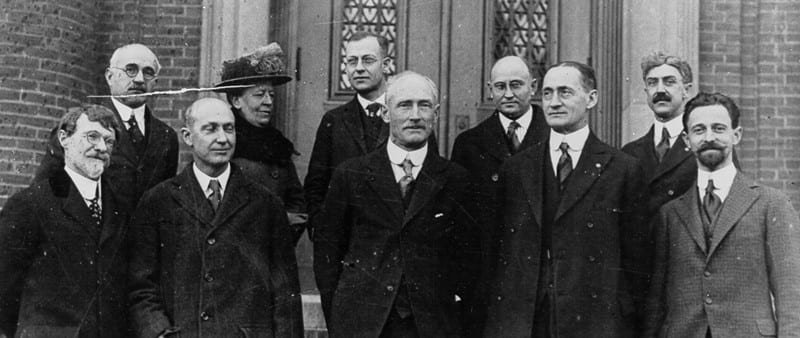
by Althea Need Kaminske
In the past month I’ve been thinking a lot about history. I was tasked with writing a brief overview of cognitive psychology for a book I’m writing with Megan, and someone wrote into the Learning Scientists interested in the history of learning and asking for some places to start. I was not prepared for either of these requests. I never had the chance to take a class on the history of psychology, so the only history I knew was more or less what was presented in the textbooks I used for class. These all tend to paint a similar, unidimensional picture of the history of cognitive psychology which I would summarize as: Important men (mostly white and European) had important ideas. Then the computer came along! This changed some of these ideas. And then the men (mostly white and American, but now with some women) continued to have important ideas that you’ll learn more about in this book. These histories are often related as a series of dates with little mention of the lives and circumstances of the players involved; flattening otherwise dynamic, charismatic, and flawed (i.e. human) people into figureheads and symbols for schools of thought*. This paints a rather flat and unsatisfying picture.
After some initial digging, I can report back that the history of learning is much broader than just the history of cognitive psychology. Even the history of cognitive psychology is broader than cognitive psychology – encompassing the various disciplines that make up Cognitive Science (philosophy, neuroscience, computer science, linguistics, anthropology, and psychology), and at a pivotal point in its development spanning two world wars†. As the Ebbinghaus quote says, “Psychology has a long past, but a short history” (1).
All of this is to say that even if you have a degree in Psychology the only thing you probably know about Mary Whiton Calkins is that she was the first female president of the American Psychological Association. She was also, separately, the first female president of the American Philosophical Association. I was also delighted to find out that her early work focused on memory. Her ideas and theories about paired associate learning and the effects of primacy and recency predated modern memory research by about 70 years. She also was never awarded her PhD.
Mary Whiton Calkins was born in Hartford, Connecticut in 1863. She was the oldest of five children. She spent her childhood in Buffalo, New York, then moved with her family to Newton, Massachusetts in 1881. Calkins went to Smith College to study philosophy and the classics – during a time when it was uncommon for women to pursue higher education. After completing her undergraduate degree, and traveling Europe for a year with her family, Calkins was offered a job at Wellesley College teaching Greek (2).
Her skill in teaching and interest in philosophy prompted her department to recommend that Calkins be appointed to the newly created position in experimental psychology. The college agreed on the stipulation that she take some time off to study the subject further. This required special arrangements since the nearby universities offering courses in psychology did not take women. So Calkins was independently tutored by Edmund Sanford of Clark University and attended seminars from William James of Harvard University.
“I have been attacking the President again on the subject you know of. He tells me that the overseers are so sensitive on the subject that he dares take no liberties. … They are at present in hot water about it at the medical school he himself being for the admission of women.” William James, 1890 (3)
A brief aside for those who are unfamiliar with William James. He is credited with being the “Father of American Psychology”. He was also a philosopher and credited with establishing pragmatism in philosophy‡. His brother was Henry James, celebrated American novelist, and his sister was Alice James, noted diarist. Unlike many early figures in psychology he disliked conducting research and instead focused on teaching and writing. By my count he published over 300 works in his lifetime (I counted the number of items in the 47 pages of bibliography in the back of The Writings of William James (4). There may be some duplicates in this count, but not many. It’s a truly impressive amount of writing.). In psychology his most famous work is two volumes entitled Principles of Psychology which are remarkable in their descriptions of various psychological phenomena and are eminently quotable even now, some 130 years later.
“I began the serious study of psychology with William James. Most unhappily for them and most fortunately for me the other members of his seminary in psychology dropped away in the early weeks of the fall of 1890; and James and I were left … quite literally at either side of a library fire. The Principles of Psychology was warm from the press; and my absorbed study of those brilliant, erudite, and provocative volumes, as interpreted by their writer, was my introduction to psychology.” Mary Whiton Calkins, 1930 (5, p. 31)
When Calkins returned to Wellesley in 1891 she established a psychological laboratory and introduced experimental psychology into the curriculum. At the time there were only a dozen or so other psychological laboratories in North America. In the first year students dissected sheep’s brains and conducted experiments on sensation, association, space, perception, memory, and reaction time (2). She was invited by G. Stanley Hall❡ to publish an article describing her experimental psychology course in the American Journal of Psychology. Calkins published a series of reports on findings from her and her students in the lab over the next 10 years (2).
After establishing her laboratory, Calkins returned to Harvard to work in the laboratory of Hugo Münsterberg§ . Here, Calkins pioneered the use of paired-associate learning, a methodology that is heavily used in memory research today. Her method involved showing a series of colors paired with numbers, then testing the memory of the numbers when shown the colors. She demonstrated that while numbers were remembered better when paired with bright colors, it was the frequency of the exposure that mattered for memory (7, 8, 9).
“She was one of the first in this new field, and she created an experimental technique that is now called the method of paired-associates, which has survived to the present time.” Hernstein & Boring, 1966 (10)
Calkins made several notable observations that are of interest to modern memory researchers (11), but before I go on to describe some of her observations it will be useful for you to know about the Serial Position Curve. If I were to read you a list of items – say I’m cooking a new dish and ask you to get a list of ingredients at the store – you would likely repeat those items back to me in a predictable pattern. People tend to remember the first items on the list really well, remember less and less as the list goes on, and then remember the last item or two on the list really well again. We call this the serial-position effect, or serial position curve.