By Megan Sumeracki
When creating content and materials for the Learning Scientists website, we try to include many different types of forms (NOT because of Learning Styles, but because of preferences, and diversity in the type of media an individual can consume!). To that end, I’ve created blog versions of some bite-size research podcast episodes in the past, to switch the format, create some healthy repetition, and cater to different preferences.
Today’s blog post revisits a paper that Althea and I covered a few years ago in a podcast episode (Episode 49 Learning Styles and Dual Coding). It is a repeat, and specifically, we tend to repeat ourselves a lot when it comes to learning styles and dual coding. However, repetition, especially after time has passed, helps with learning (though this is much longer than we would normally recommend!). And, learning styles is a pervasive theory. As long as companies are out there trying to sell learning styles assessments and students show up in our classes claiming to have been labeled as kinesthetic, auditory, visual, or verbal learners, we’ll keep writing about it!
We really like this paper because the authors, Josh Cuevas and Bryan Dawson, compare learning styles and dual coding directly. On the surface the two are really similar. But, if you’ve been following our work for a while and/or engage with the literature, you know that the two are not the same and do not have the same learning outcomes.
Learning styles is the idea that people have preferences, and specifically that matching instruction to those preferences is essential to maximizing learning. For example, let’s say that Isla is an auditory learner, and they like to learn by listening. Then, according to the learning styles hypothesis, Isla is going to learn best when the content they need to learn is presented to them in an auditory fashion. This could include having a teacher explain the content to them verbally, or perhaps even listening to a podcast or a recorded lecture. As another example, let’s say that Juaquin is a visual learner, and likes to learn by seeing visuals, like pictures or diagrams. Then, according to the learning styles hypothesis, Juaquin will learn best when the content they need to learn is presented to them in a visual fashion. Specifically, we would need to see this pattern that researchers describe as a cross-over interaction. If we had Isla and Juaquin in an experiment, then Isla would learn more than Juaquin when the information was presented in an auditory format, but Juaquin would learn more than Isla when the information was presented in a visual format. To maximize learning for both, we would need to cater to each individual’s style.
Dual coding, on the other hand, is the idea that when we combine modalities, specifically visual and verbal modalities, we maximize learning. This does not involve diagnosing individuals as one type of learner or another. Certainly, people still have preferences, but the idea is that we all tend to learn best when we are able to consume multiple representations of the information.
The Experiment:
The experiment pits learning styles and dual coding against one another.
University students read statements. Importantly, they were randomly assigned to either (auditory learning condition) process the statements by thinking about the way the words sounded or (visual learning condition) process the statements by thinking about how easy it was to create a visual image of the statement.
The students also completed a learning styles assessment, the VARK, to determine their learning style. The researchers cannot randomly assign students to learning styles; this is a “come as you are” variable. However, they can separate the data to look at how the auditory students perform when randomly assigned to each of the two learning conditions, and how the visual students perform when randomly assigned to each of the two learning conditions.
The researchers measured how many of the statements the students could remember immediately after learning.
Hypotheses:
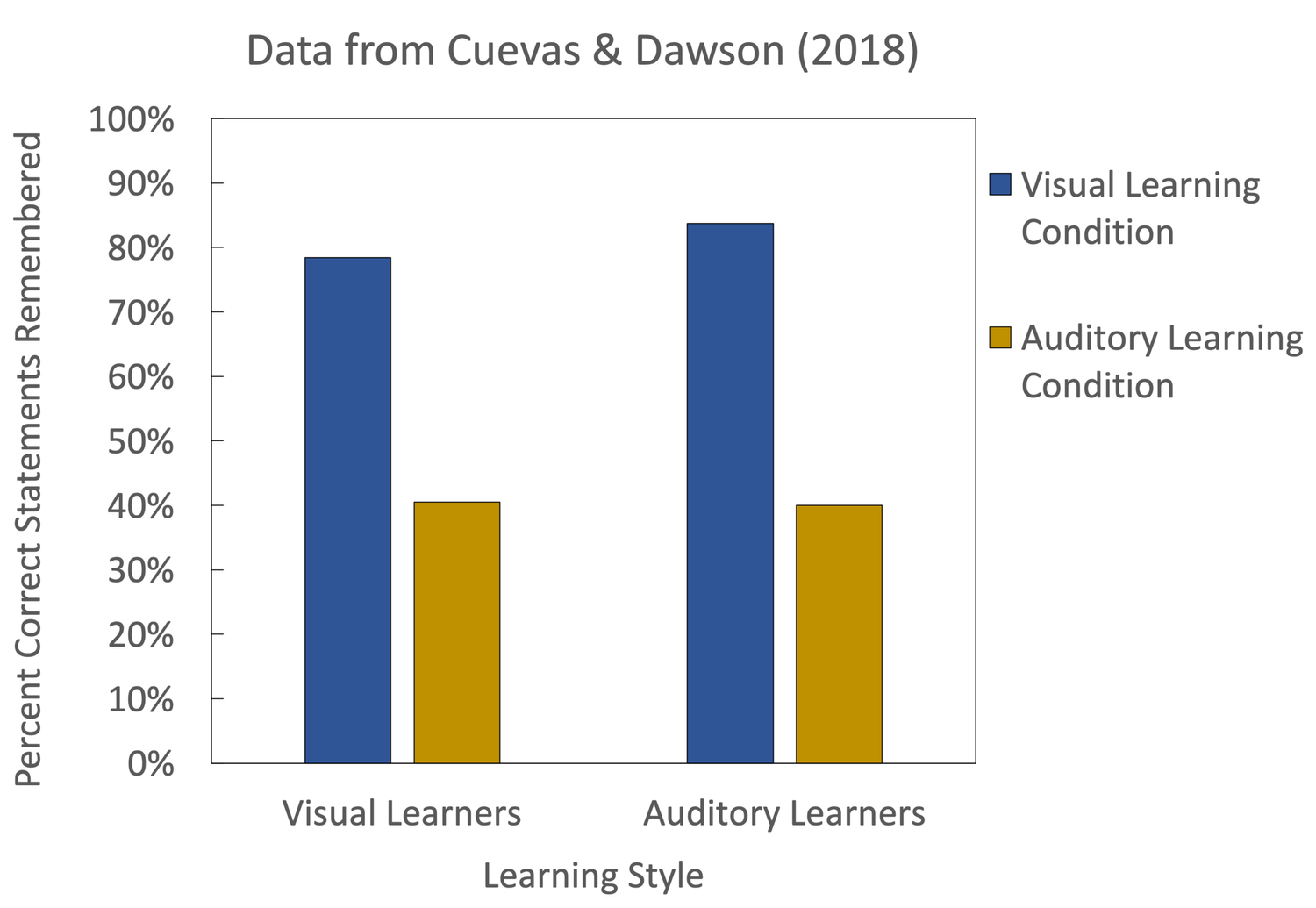
If dual coding is true, then students should remember the statements from the experiment best in the visual learning condition. The reason is that the statements are already presented in a verbal way because the students are reading them, and so if we add visual processing, then we’ve added another representation that should facilitate learning. Importantly, this pattern of results should hold for students labeled as both visual learners and auditory learners.
If learning styles is true, then the condition that is best depends on students’ individual learning styles. If we group the auditory learners together and the visual learners together, then we should see opposite patterns of results. Those who are labeled as auditory learners should remember more statements if they were in the auditory learning condition than the visual learning condition, and those labeled as visual learners should remember more statements if they were in the visual learning condition than the auditory condition. In other words, we should see a crossover interaction.
The Results:
The results show strong support for dual coding. The graph below was created based on the data in the paper, and we can clearly see that students remember more of the statements when they are in the visual learning condition (compared to the auditory learning condition) regardless of learning style.