4. Read the introduction of chapter two, “Relationships,” that begins with, “During this journey….” Then, as you read the rest of the section, choose one image and one quote that you think best illustrates the main idea from the introduction. Explain why you chose the image: What about it was particularly moving or evocative to you?
5. This section explores the themes of love, loss, struggle, home and legacy. Choose one of those themes that you connected to personally: How would you capture it in a photograph or drawing? If you want, you can take a picture or sketch a drawing, or you can describe it using vivid language and details.
6. Now visit chapter three, “Space,” by Elliott Jerome Brown Jr., which explores the restorative properties of physical space. In what ways is the Shady Grove Camp Ground an example of this kind of space, both presently and historically?
7. Acorn Center for Restoration and Freedom and the New Orleans for Lincoln Beach both appreciate the relationship between rest and work while also centering the histories and healing practices of Black people. What is one image or quote that stood out to you about the work that these two groups are engaging in?
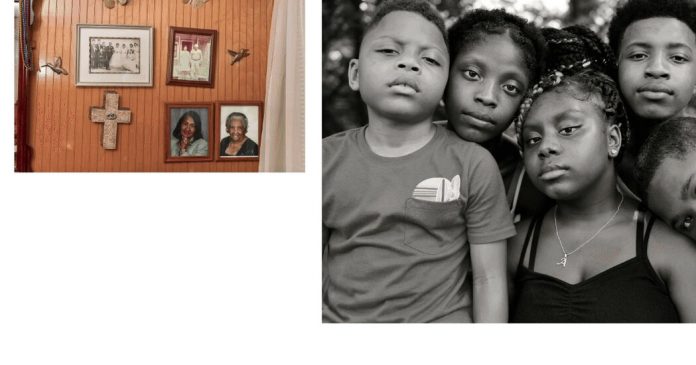
8. In chapter four, “Care,” Mr. Brown begins by writing, “I often photograph negative space….” How do you understand “negative space” based on his description and the photographs from this section? Choose one image and describe how the use of negative space photography affected your experience and understanding of the image.
9. Mr. Brown integrates his personal family story, and photographs, into part of this section. After reading his work and seeing his other photographs, how did his vulnerability and self-reflection change or deepen your understanding of his writing and art?
Going Further
Option 1: Create a one-pager
The article started with this prompt: “After a year of disproportionate loss from the pandemic and the continuous threat of police violence, on top of centuries of discrimination and disenfranchisement, what does healing look like for Black Americans?”
How often do you encounter racist, sexist or otherwise discriminatory language online in posts or comments? Do you think abusive language is a serious problem that social media companies, like Twitter and Facebook, should do a better job of addressing? What consequences should there be for users who post these kinds of comments?
If you were in charge of a social media company, what actions, if any, would you take to stop such abuse?
In “English Soccer Will Boycott Social Media to Protest Online Abuse,” Jesus Jiménez and Andrew Das write about English soccer officials’ announcement that they would conduct a social media blackout to pressure platforms like Twitter, Instagram and Facebook to do more to combat abuse among their users:
Cases of harassment have been well documented online. In February, Arsenal striker Eddie Nketiah posted a picture on Twitter with the caption “Working with a smile!”
The tweet was met with racist abuse from a Twitter user who told Nketiah, who is Black, to leave the club. Twitter responded by permanently suspending the user’s account, Sky Sports reported.
Such harassment has been instigated not only by fans, but also by club social media accounts. In December, the commentator and former soccer player Karen Carney deleted her Twitter account after she received a wave of online abuse.
After a 5-0 win by Leeds United over West Brom, Carney on Amazon Prime Video Sport wondered whether Leeds would “blow up at the end of the season.” A clip of her commentary was shared by the Leeds team Twitter account, which invited a slew of hateful messages toward Carney.
Many on Twitter defended her and criticized the team’s social media folks, including the former Leeds captain Rio Ferdinand, who called for the tweet to be deleted.
Bethany England, a forward for Chelsea, called out Leeds’ social media team for “atrocious behaviour.”
“Cyber bullying a female pundit and opening her up to mass online abuse for DOING HER JOB AND HAVING HER OPINION!” England said.
In February, the top executives of the Football Association — English soccer’s governing body — the Premier League, and other organizations wrote an open letter to Jack Dorsey, Twitter’s chief executive, and Mark Zuckerberg, the C.E.O. of Facebook, calling for the leaders to put an end to “the levels of vicious, offensive abuse” coming from users on their platforms.
“The reality is your platforms remain havens for abuse,” the soccer executives wrote. “Your inaction has created the belief in the minds of the anonymous perpetrators that they are beyond reach.”
In the past, Instagram, Facebook, and Twitter have taken steps, such as banning users temporarily or permanently, but the issues of online abuse have persisted.
In a news release announcing the social media boycott, which will take place from Friday afternoon through Monday, English soccer called on the United Kingdom to “bring in strong legislation to make social media companies more accountable for what happens on their platforms.”
In the statement, Richard Masters, the Premier League’s chief executive, said the league would continue to push social media companies to make changes to prevent online abuse.
“Racist behaviour of any form is unacceptable and the appalling abuse we are seeing players receive on social media platforms cannot be allowed to continue,” Masters said. “Football is a diverse sport, which brings together communities and cultures from all backgrounds and this diversity makes the competition stronger.”
The article concludes:
The social-media blackout will take place while an entire slate of games in multiple leagues will be played, including one between Manchester United and Liverpool, the Premier League’s defending champion.
Edleen John, director of international relations for the Football Association, said English soccer will not stop pressing for change after next weekend.
“It’s simply unacceptable that people across English football and society more broadly continue to be subjected to discriminatory abuse online on a daily basis, with no real-world consequences for perpetrators,” John said. “Social media companies need to be held accountable if they continue to fall short of their moral and social responsibilities to address this endemic problem.”
Students, read the entire article, then tell us:
Do you think English soccer’s blackout will bring about change in social media companies’ policies regarding discriminatory abuse on their platforms? Why or why not?
What about users themselves? To what degree do you think the blackout will make them reconsider their behavior online? Why do you say that?
How and where do you draw the line between comments that are acceptable, though perhaps inappropriate, and those that should lead to repercussions like having one’s account deleted?
Have you ever reported another social media user for abusive language online? If so, what happened?
Do you think that public figures like professional athletes and pundits, along with celebrities and influencers, endure more abuse online than people who aren’t famous? Is it just “part of the job”? Should it be?
The article points out that Leeds United’s team Twitter account shared a clip including speculation by the soccer commentator Karen Carney that the team might not do well at the end of the season, which in turn “invited a slew of hateful messages toward Carney” from Leeds fans. What are your thoughts about this incident? Did members of Leeds United’s social media team act irresponsibly, were they just trying to engage fans or is there some other reason they posted the video? Explain.
Students 13 and older in the United States and the United Kingdom, and 16 and older elsewhere, are invited to comment. All comments are moderated by the Learning Network staff, but please keep in mind that once your comment is accepted, it will be made public.
As Chairman and Co-founder of Coursera, I was thrilled to present Coursera’s 2021 Outstanding Achievement Awards at our 9th annual Coursera Conference on April 19th and recognize the partners, course teams, and customers demonstrating a deep commitment to partnering with us to build a world where anyone, anywhere can transform their life through learning.
Coursera has come a long way since we launched our first courses in 2012, and none of the progress would have been possible without our partners. By examining data on the Coursera platform, we are able to identify content that launched in the last year with the highest enrollments, top learner ratings, and greatest career transformation. Now, we are excited to recognize the course teams, partners and customers that make these learning experiences a reality.
Let’s announce our 2021 award winners:
Innovation Award
The Innovation Award goes to the partner and course that best exemplifies innovation in the service of learning and demonstrates how the agility, adaptivity, and flexibility of online learning can be harnessed to create content that meets the world’s most pressing needs. We are pleased to present the 2021 Innovation Award to Johns Hopkins University for their timely and incredibly impactful COVID-19 Contact Tracing course. This course had launched on May 10, as the whole world was still in the early phases of stay at home orders and figuring out how to deal with the pandemic. I’d enrolled in this too. Created with support from Bloomberg Philanthropies, it helped people learn about how contact tracing is done, including how to build rapport with covid patients, identify their contacts, and support both patients and their contacts to stop transmission in their communities. It received more than half a million enrollments in the first 6 months and has earned a satisfaction of 4.9 out of 5 stars with 80,000+ ratings.
From Dr. Emily Gurley, professor at the Johns Hopkins Bloomberg School of Public Health: “The real innovators have been students of the course… who took the course and then took action in their own communities.”
Congratulations John Hopkins University!
Campus Transformation Award
The Campus Transformation Award goes to the educational institution doing the most to extend access to world-class education through digital transformation.
This year’s Campus Transformation Award goes to Manipal Global Education Services. Manipal is a leading, private university with over 42,000 students and campuses in India, Dubai, Malaysia, Nepal, and Antigua that provides degrees in a range of disciplines including Engineering, Management, and Healthcare.
Manipal partnered with Coursera in 2017 to inculcate a culture of multidisciplinary and lifelong learning among its students. In 2019, Manipal’s engineering and management schools mapped Coursera courses to their curriculum and offered credit for completion. This led to an increase in course enrollments from 71,000 in 2018 to nearly 265,000 in 2020. 12,000 of these enrollments were in courses that were integrated into academic programs and had an average completion rate of 80%. Ravi Panchanadan, Chief Executive Officer of Manipal Global Education Services, reminded us all of how online courses can help “to augment skills and human capital” around the world.
Congratulations Manipal Global Education Services!
Talent Transformation Award
The Talent Transformation Award recognizes a company that has helped its employees achieve extraordinary success through online learning. I was delighted to present this to Novartis. Novartis is a global healthcare company headquartered in Switzerland with 110,000 employees across 140 countries.
Novartis wanted to nurture employee curiosity to retain talent in a highly competitive pharma talent industry and continue to develop creative solutions to the world’s biggest healthcare challenges. They chose Coursera as a partner in 2018 to help establish a culture of learning that delivers critical data science, digital, business, and soft skills. In 2019, they expanded their partnership and added free tuition reimbursement for online Degrees as well as MasterTracks in data science. In 2020, due to positive learner feedback and increasing demand for online learning, Novartis’ expanded its program yet again to provide employee-wide access as well as a new “Friends and Family” program.
Today, over 23,000 Novartis employees have logged 80,000+ enrollments in 3,600+ distinct courses and guided projects, developing skills across data, technology, business, human skills, and health domains. From Simon Brown, Chief Learning Officer at Novartis: “we’ve doubled the amount of time our employees spend learning.”
Congratulations Novartis!
Learners First Award
The Learners First Awardgoes to the course that maintains the highest learner rating on the platform launched in the last calendar year. This year’s winner is Facebook Social Media Marketing Professional Certificate by Facebook and Aptly. This is the first social media marketing certificate on the Coursera platform. It ranked in the top 5 for new content enrollments across all of 2020 and achieved an exceptional average learner rating of4.9 out of 5 across ALL 6 courses in the certificate.
“Facebook is committed to providing tools and skills to support job seekers who need it the most. To help us achieve the latter at scale – and as we strive to improve economic equity — we are thrilled to offer the Facebook Social Media Marketing Certificate to job seekers looking to enter the digital marketing space while providing a pathway to employment.” – Judy Toland, VP, Head of Scaled Solutions, Global Business Marketing
Congratulations Facebook and Aptly!
Career Transformation Award
The Career Transformation Award recognizes the instructor, course team, or partner whose career-focused learners are experiencing the highest rates of success for achieving their goals. This year’s recipient is UniAndes for Introducción a la programación orientada a objetos en Java.
Early signals are demonstrating the value of this course to learners: 50% of course completers who completed our learner outcome survey this year have received a promotion or pay increase and one-third have started a new career after completing this course. This open content is a leveling MOOC for Universidad de Los Andes’ Maestría en Ingeniería de Software (Masters in Software Engineering), Coursera’s first Spanish-language degree. This degree launched in 2020 as the first non-English degree on the Coursera platform and has been truly transformational for Coursera learners in Latin America!
As UniAndes continues to make more content, the online learning team reports: “we are excited to keep changing the world through the power of education.”
Congratulations UniAndes!
Thank you to all of the partners and customers who continue to serve the world through learning and a special congratulations to our award winners. I am honored, proud and humbled to be working with you on the education mission.
Andrew Ng
Chairman and Co-Founder
Andrew Ng is the Chairman and Co-Founder of Coursera and an Adjunct Professor at Stanford University. As a pioneer both in machine learning and online education, Dr. Ng has changed countless lives through his work in AI, authoring or co-authoring over 100 research papers in machine learning, robotics and related fields. Dr. Ng now focuses his time primarily on his entrepreneurial ventures, looking for the best ways to accelerate responsible AI adoption in the larger global economy.
It’s not a secret that more and more people browse the internet on their mobile devices every year. Looking at today’s statistic form our site, 37% visits from last 30 days comes from phone and tablets. Those are some pretty crazy stats! With this increase in mobile device use, it becomes more important to have a mobile responsive site.
What is mobile responsive coding?
It is usually part of your design that makes your site look good on all popular screen sizes. This way, you can browse your website on the phone or tablet, and all the content is clearly visible and easy to read.
Having a mobile responsive site creates a better user experience for mobile users and has been shown to increase traffic, decrease bounce rate (that means your readers are sticking around longer), and has been shown to increase page views.
How can I check if my site is responsive?
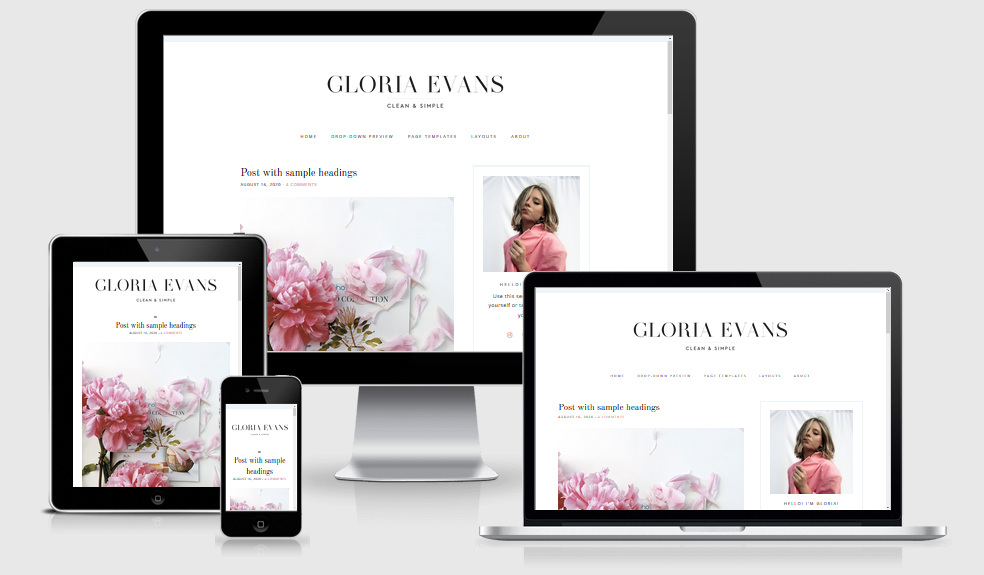
The easiest way will be to visit it via one of your mobile devices. However, you can also use sites like Am I Responsive to see how your site looks on various mobile devices. As an example, check the screen below of one of our designs (Gloria).
Indeed, all Blogger designs (whether or not you have a design from us) come with Blogger’s default mobile coding; however that coding does not allow many of your design elements to show. Rather than showing your beautiful header design, it may show only default text. Our mobile coding codes the site to allow all design elements to display beautifully on mobile devices.
Here is a comparison of our design vs. default blogger one for our Burke Blogger template.
How to turn off default Blogger mobile template
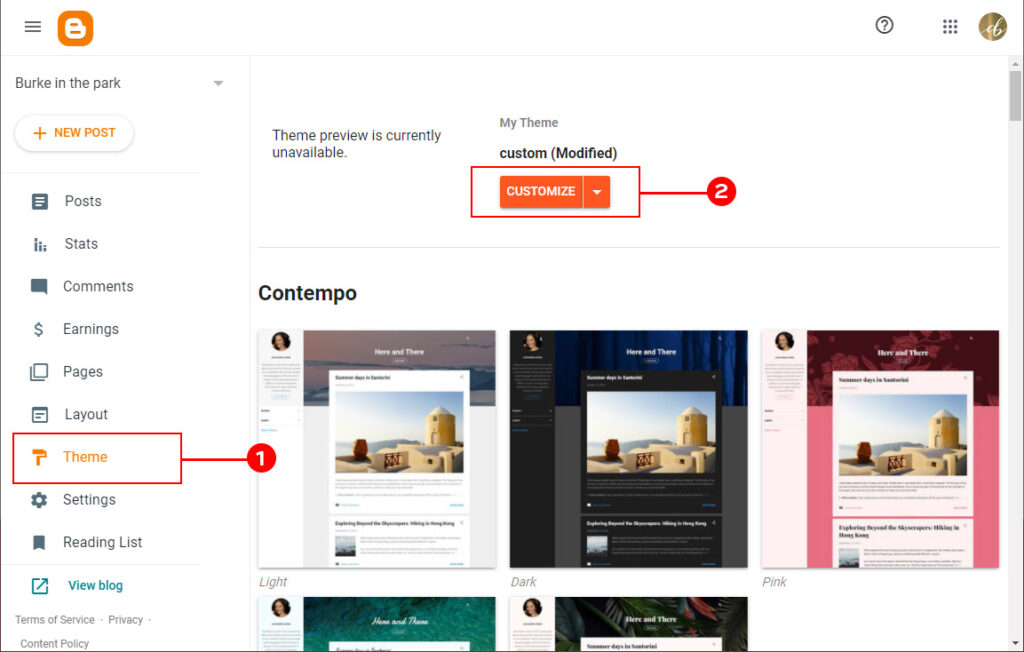
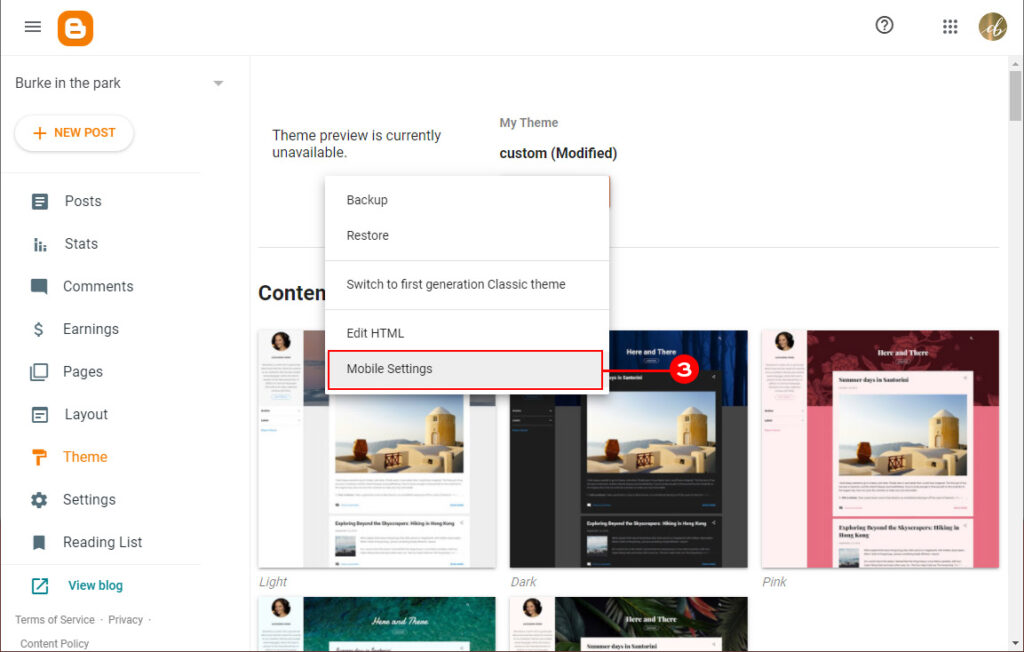
Default Blogger view is always turned on for all blogs, so if you know that your design comes with custom mobile responsive coding, you need to go to your Dashboard and visit the Theme tab.
Once there, click on the orange Customize and pick Mobile Settings from the drop-down menu.
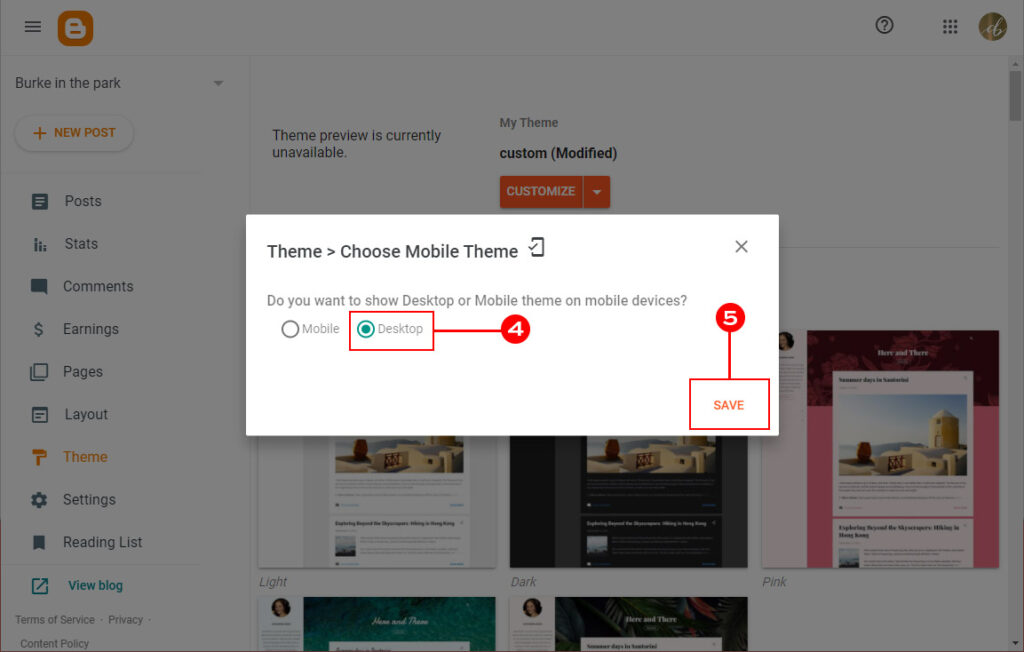
A new window will pop up. Check the Desktop option and remember to save changes.
That’s all! Your Blogger is now ignoring the default mobile template provided by Blogger.
WordPress & mobile coding
WordPress does not have default mobile coding built-in. To make your site mobile responsive, you need to either get yourself a design that includes such a feature or install a plugin that will add mobile coding to your site.
Without mobile responsive coding on WordPress designs, you see the entire design as you would see it on a computer screen, and then you have to zoom in and out to view and access the content. Mobile responsive coding neatly organizes all of the content nicely within the width of the mobile screen so all links and content can be accessed and viewed easily.
Register for the live webinar on May 6 at 4 p.m. Eastern.
Providing students “voice and choice” is at the core of our annual Summer Reading Contest, in which we invite teenagers to let their interests guide their exploration of The New York Times.
Participating is easy: Every week, we invite students to choose an article, photo, video, podcast, or graphic in The Times that has sparked their interest and to tell us why. At the end of the week, judges from the newsroom pick their favorite responses, and we publish them.
In this webinar, Learning Network staff, educators and past winners of the contest will introduce the contest and discuss ways to keep teenagers reading, writing, thinking and learning on their own all summer long.
CTLE credit is available for New York educators. All participants will receive a certificate of completion.
Register to join our live webinar or to receive a link to view the on-demand recording.
Despite those findings, the young women I interviewed all had high aspirations — they wanted to become a novelist, an animal scientist and a basketball player. One, Ana Shepherd, 18, had decided to pursue politics as a direct result of what she saw the last four years. She was born in Mexico and felt she could help give immigrants a voice in policy.
Their thoughts had been molded by the racial justice protests, by Trump administration policies, by Hillary Clinton’s loss and those of other women in the 2020 Democratic primaries. They spoke eloquently about the importance of representation in government and giving voice to people who had been marginalized. In high school, they had named role models like Beyoncé, the Kardashians and their school principal. Now they mentioned Representative Alexandria Ocasio-Cortez and Vice President Kamala Harris.
Jordan Barrett, 19, was a supporter of Donald Trump in 2016 and the sole student from Moro who agreed to talk. The last four years, she said, have made her learn about perspectives other than those she grew up with, and think about issues like refugee policy and access to health care. She voted for Joe Biden.
I partnered with Ruth Fremson, a Times photographer, on this project, and she shot portraits of the girls in 2016 and this year. The photographs reflected the changes in their awareness, ambitions and sense of identity that I observed in my interviews. In the more recent set of photos, the young women are more mature and composed but still bright-eyed.
Returning to the group also brought up new topics I hadn’t expected to explore in my reporting, most notably about race. Every one of them mentioned race in their discussions about leadership and sexism — they saw these issues as interlinked.
The young women, even the more conservative ones, had progressive views about diversity — something that young people of both parties share, surveys show. They demand that leadership reflects the people leaders represent. Whether it’s in politics, their jobs or their daily lives, they are going to bring these values to the forefront.
Maybe I’ll try to catch up with them again in 2024.
Not so very long ago, before our scientific era, it was a common experience to encounter, in the sky above us, troubling things that could not be explained, and to build myths and taboos and religions around them. Mark Twain, who was born when a certain comet passed by Earth, predicted that he would die when it returned. He wrote a whole book on the premise that a modern time-traveler who could forecast an eclipse would have been seen, in the past, as a terrifying magician. The Romantics distinguished between the merely beautiful and the truly sublime; the second was overwhelming, in part, because humans feared and could not understand what Edmund Burke called “the terrible uncertainty of the thing.”
Daily Word Challenge
Can you correctly use the word sublime in a sentence?
Based on the definition and example provided, write a sentence using today’s Word of the Day and share it as a comment on this article. It is most important that your sentence makes sense and demonstrates that you understand the word’s definition, but we also encourage you to be creative and have fun.
Then, read some of the other sentences students have submitted and use the “Recommend” button to vote for two original sentences that stand out to you.
If you want a better idea of how sublime can be used in a sentence, read these usage examples on Vocabulary.com.
Students ages 13 and older in the United States and the United Kingdom, and 16 and older elsewhere, can comment. All comments are moderated by the Learning Network staff.
1. After looking closely at the image above (or at the full-size image), think about these three questions:
2. Next, join the conversation by clicking on the comment button and posting in the box that opens on the right. (Students 13 and older are invited to comment, although teachers of younger students are welcome to post what their students have to say.)
3. After you have posted, try reading back to see what others have said, then respond to someone else by posting another comment. Use the “Reply” button or the @ symbol to address that student directly.
Each Monday, our collaborator, Visual Thinking Strategies, will facilitate a discussion from 9 a.m. to 2 p.m. Eastern time by paraphrasing comments and linking to responses to help students’ understanding go deeper. You might use their responses as models for your own.
4. On Thursday afternoons, we will reveal at the bottom of this post more information about the photo. How does reading the caption and learning its back story help you see the image differently?
Readers have been writing letters to The New York Times since the newspaper was founded in 1851. When Adolph S. Ochs purchased the paper in 1896, one of his aims, he wrote, was to “make the columns of The New York Times a forum for the consideration of all questions of public importance, and to that end to invite intelligent discussion from all shades of opinion.”
Today, The Times receives up to 1,000 letters a day from readers from all over the world, a handful of which are selected to be published in the Letters to the Editor column. These letters, written by ordinary people and experts alike, comment on a broad array of stories in The Times — from vaccines and gun violence to religion, social media, education and family.
What do you have to say about what’s in the news? In this lesson, we invite you to respond to a Times article of your choice. You’ll read previous letters to see how the writers expressed strong, clear opinions in just 150 to 200 words; and did so with a certain stylishness, wit and charm. Then, you’ll write your own letter to the editor and submit it for publication.
Ideas for Teachers
Warm-Up
The Letters to the Editor column invites readers to respond to an article in The Times that has appeared within the last seven days.
What recent news stories have caught your eye? What have you read that has outraged you? Inspired you? Moved you? Delighted you? What articles have made you feel “seen” or brought up a memory from long ago?
Spend a few minutes scrolling through The New York Times to see which headlines speak to you. If you can’t find anything that interests you there, choose a section (found at the top of the home page), such as Politics, Sports, Science, Style, Smarter Living, World or Opinion, and skim the recent articles.
Choose at least three different articles about which you think you might have something to say, whether it’s a critique, praise or a personal connection. Just make sure that whatever you choose was published within the past week.
You’ll return to these in the Going Further section.
As you read your chosen letters, annotate and take notes about what you notice. Here are some questions to consider:
1. Identify some basic parts of the structure of letters to the editor: How do they all begin? How do they all end? Which article is each letter responding to? How do you know?
2. What is the letter writer’s opinion or point of view on the article they are responding to? Underline or highlight at least one sentence that captures the letter’s main idea or argument.
3. The Letters editors encourage writers to make their arguments “forcefully and clearly.” Do the letters you read do that? What words, phrases or lines convey the writers’ opinions or attitudes toward the subject in a clear, concise and strong way?
4. The Letters editors say that readers should be able to judge the “credibility and motivation” of letter writers. What credibility, expertise or personal connections do the letter writers have to the subjects they are writing about? Can you tell what motivated them to write in?
5. Analyze the writers’ use of language and style. What makes this letter interesting to read? What words, phrases and grammatical structures do they use that are particularly affecting? How do they use wit or humor, if at all? In what lines can you hear the writer’s voice coming through the page?
6. Among the hundreds of letters that are sent to The Times, what do you think made these letters stand out to the editors? What unique angle or perspective did the writers offer on the articles they commented on? What else did they do well?
7. Which “writer’s moves” from any of the letters you read would you like to try in your own letter to the editor?
Going Further
Now, it’s your turn: Write a letter to the editor about any Times article of your choosing.
Step 1: Read advice from the Letters editors and writers.
This step is optional, but before you choose your article and write your letter, you might want to find out what exactly the Letters editors are looking for.
In “To the Reader,” Thomas Feyer, the Letters editor since 1999, explains what qualifies as a publishable letter to the editor. As you read, highlight or underline Mr. Feyer’s suggestions.
You can find even more advice in these articles:
Step 2: Choose an article to respond to.
Return to the articles you chose in the warm-up activity. Read them thoroughly and then choose one that you want to respond to in your letter to the editor.
You can write about any issue, big or small, but keep in mind that timeliness is key, so make sure that whatever piece you choose was published no more than seven days before you submit your letter. Mr. Feyer writes, “We’re in an age of fast-moving news and virtually instant reaction; letters about an especially timely topic often appear within a day or two (and almost always within a week).”
Step 3: Write your letter to the editor.
Here are the requirements:
Letters should be about 150 to 200 words.
They should include the headline and a link to the Times article they are responding to.
They should refer to an article that has appeared within the last seven days.
Beyond that, your letter can agree or disagree with the ideas expressed in the essay or article. And feel free to be creative with your language and writing style. Use the letters you read earlier as examples of what makes a great letter to the editor.
Step 4: Submit it for publication.
If you are in high school, you can submit your letter to The Times’s annual student letter writing competition until May 3. Please be sure to read all the rules carefully before submitting.
You can also submit a letter to the editor any time by following the instructions here.
About Lesson of the Day
• Find all our Lessons of the Day in this column. • Teachers, watch our on-demand webinar to learn how to use this feature in your classroom.