With so much business carried out online these days, businesses are finding themselves in possession of huge amounts of information and data. The management and protection of this information is critically important for businesses. Information security is not merely a concern for sectors such as banking or healthcare, it’s vitally important in every industry.
Information security management means making sure that information is correct, easily and readily accessible and confidentially stored. An Information Security Management System (ISMS) is a management system which works on the Plan-Do-Check-Act cycle of a Quality Management System. An ISMS includes operation controls, planning and risk assessment.
In October 2019, the International Organisation for Standardisation (ISO) issued its latest Information Security Management System Standard – ISO 27001:2013. This standard outlines how to implement a robust Information Security Management System as well as how to continually improve management.
Did you know that most of Genesis Themes come with additional built-in Genesis layout options? They allow you to modify your design without touching its code. This tutorial will show you how to access the Genesis layout options and remove or add a sidebar to your post and pages.
Genesis Layout Options
There are two ways of disabling (or turning on) sidebar on your site. You can set it up for all posts and pages on your site at once or you can remove/add a sidebar just for one specific post or page. No matter which option you choose, you can always return to those settings later and revert them. Because of that, you do not need to worry about messing something up.
Sidebar settings for all posts and pages
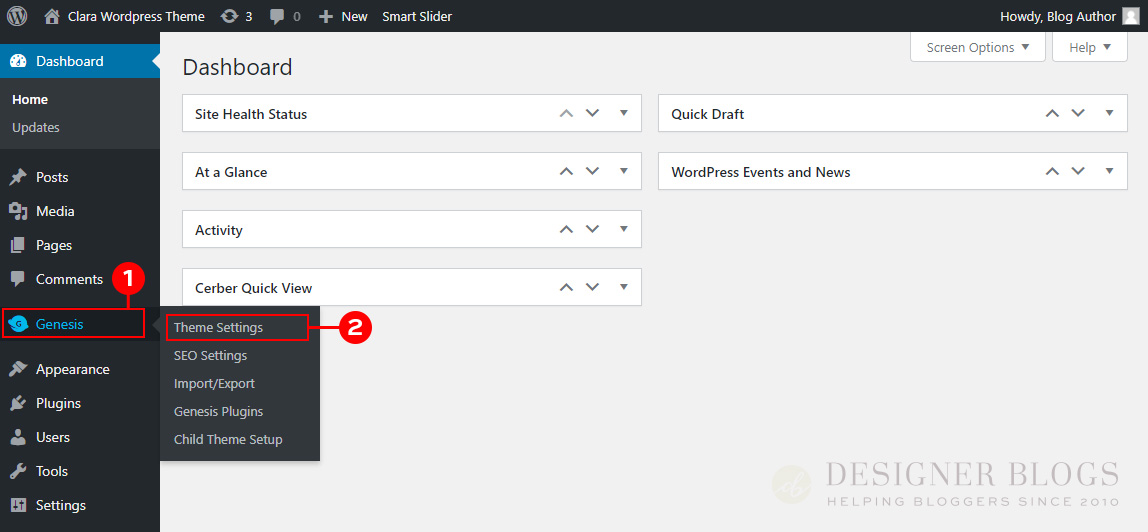
Firstly, to change the sidebar settings across your entire site, go to your WordPress Dashboard. From there, navigate to the left tabs, pick Genesis, and the Theme Options.
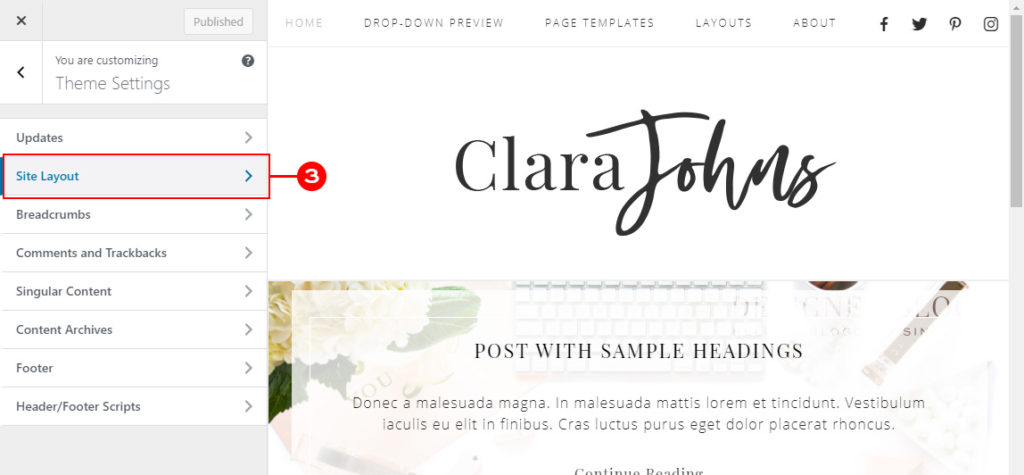
You should now see the WordPress Customization section in the new window. With a preview of your theme on the right and Genesis Layout Options on the left.
For the sidebar settings, go to the Site Layout tab.
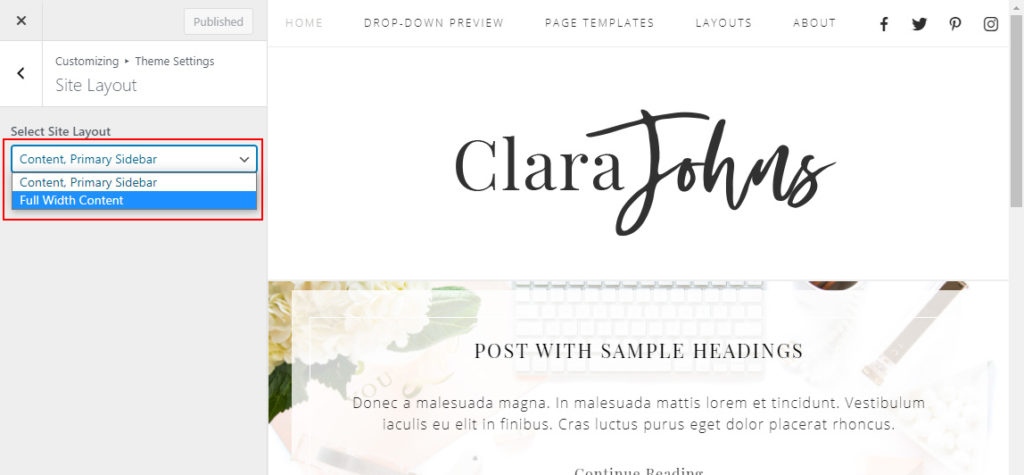
Once clicked, it will give you access to a drop-down menu with all the layout options your theme has. Our WordPress premade themes come with a full-width layout and the one with the right sidebar. You can see it on the screens from Clara theme in this post.
Pick the layout you like and hit the Publish button at the top. Now all the posts and pages will be using the format of your choice.
Sidebar setting for one post or page
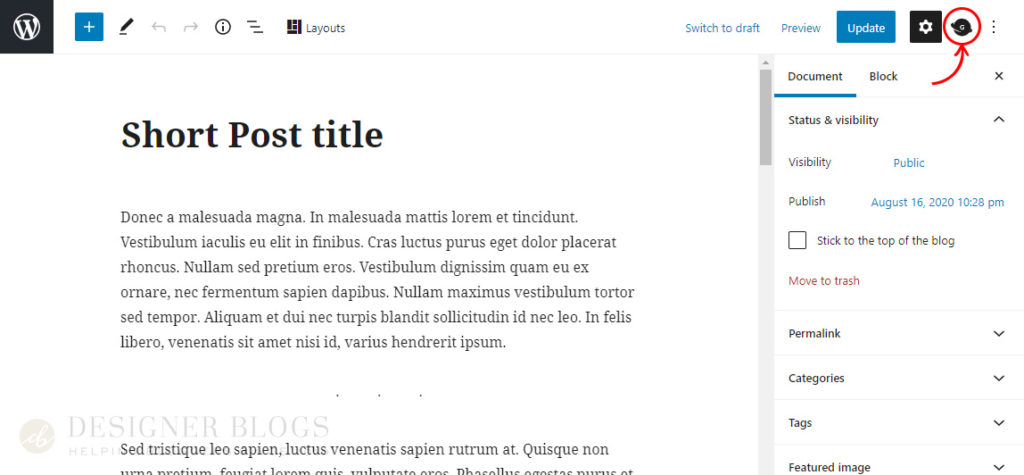
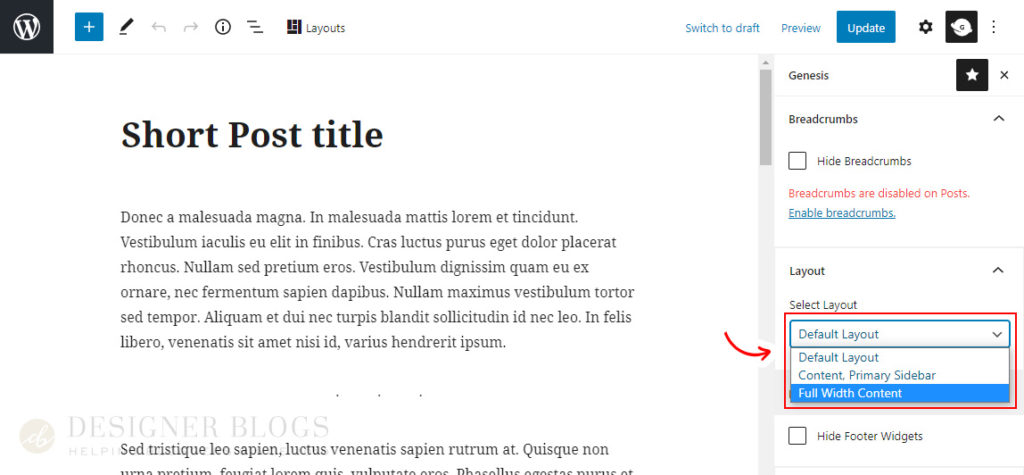
Sometimes, you need to turn off the sidebar for just one of your posts or pages. It is relatively easy to do with Genesis. With the new Gutenberg post and page editor, Genesis options can be found in the top right corner of your post or page edition screen.
After clicking, it will change the right panel to Genesis layout options. To switch it back to the Document or Block view, you will need to click the cogwheel next to the Genesis icon.
Genesis panel on your post or page edition screen will have the same drop-down menu with the layout settings. The layout you will choose here will work only for this specific post or page so you can use it whenever you need a different view for your content.
I hope this tutorial was helpful! If you have any questions, feel free to leave them in the comments below.
At the onset of the coronavirus pandemic, with travel restrictions in place worldwide, we launched a new series — The World Through a Lens — in which photojournalists help transport you, virtually, to some of our planet’s most beautiful and intriguing places. This week, Trishna Mohanty shares a collection of images from Imphal, the capital city of Manipur.
Barely five feet tall and hunched over, Anjana Devi, who is in her 80s, bellows instructions at two men as they unload crates of fruits from a mini truck. All around her, hundreds of women — most of whom are over 60 — mirror her actions. Farm-fresh produce surrounds them. The air is full of heady aromas: incense and fermented fish, jasmine buds and pungent spices.
Every shopkeeper in sight is a woman. Collectively, around 5,000 of them here in the Indian state of Manipur constitute one of the largest markets run solely by women in all of Asia.
Tucked away in a corner of northeast India, Manipur was once a sovereign state called the Kangleipak Kingdom. The valley was inhabited by various ethnic groups, and while patriarchy underlined their traditional norms and social structures, women were not confined to traditional roles.
The kingdom was often at war with its hostile neighbors, and, to keep them at bay, able-bodied men served the monarchy. In their absence, women took care of both households and trade. Around 1580, the monarch established an exclusive trading center for women called Nupi Keithel, or Women’s Market, in Imphal, what is now the capital of Manipur.
Under royal patronage, the traders grew in numbers and the market flourished. It became a conduit for social and political discourse, and women, emboldened by their new roles as drivers of the economy, began asserting themselves in new ways.
One such instance occurred in 1904, when traders from Nupi Keithel protested the colonial administration’s use of forced labor. Other Manipuri women joined the movement and stirred public outrage with several demonstrations. Eventually, the forced-labor policies were revoked.
This was the first Nupi Lan, or women’s war, a crucial milestone marking the political awakening of the people of Manipur led by women traders of Nupi Keithel. In 1939, the market spearheaded a second Nupi Lanagainst the King of Manipur. In the wake of both movements, the market emerged as the dominant voice of resistance against oppression and injustice — and the women emerged as the sentinels of a more equitable Manipuri society.
Born and raised in India, I learned at an early age that deep-seated patriarchal and misogynistic values can work to silence women’s voices. The act of speaking up demanded courage, and I saw an extraordinary example of it firsthand in 2004, when a dozen middle-aged women staged a protest over the death of Thangjam Manorama, a young woman who was taken into custody by soldiers and later found murdered, her mutilated body showing signs of sexual assault and torture.
The Manipuri protesters stood naked, holding banners that said, “Indian Army Rape Us” and “Indian Army Take Our Flesh.” They took aim at the Armed Forces Special Powers Act, which had granted extraordinary powers to the Indian Armed Forces to maintain law and order, and which had led to incidents of extrajudicial executions and brutality against women. While the women’s demand to repeal the act was denied, paramilitary forces vacated their headquarters at the Kangla Palace in Imphal, where the protest had taken place.
And so, at the age of 16, I found my heroes in a group of disenfranchised women using their voices and bodies as an instrument of change in a conservative society. Ever since, I have been trying to understand how women living in far-flung corners of this country, with little to no privilege, are asserting themselves in a culture that oppresses and subjugates them.
“Beti! Beti!”
Several women traders of Nupi Keithel are vying for my attention. On a hot summer afternoon in March, I am their only customer. They call me beti, or daughter.
Thevendors here are spread across three buildings and a massive open market. The shops are separated from each other by various goods. There is only enough space to display a small fraction of wares; the rest are bundled away in trunks and bedsheets that flank each seller as she sits cross-legged in her shop. Among the towers of surplus goods, I spot perfectly camouflaged placards with slogans like “We won’t stay silent” and “We demand justice.”
“We don’t speak the language of silence here,” says Laishram Mema Devi, who has sold handmade jewelry at the market for more than three decades. “It doesn’t matter who we are up against; if what they are doing is not in Manipur’s best interest, they will hear from us.”
Ema Mema makes about 12,000 Indian rupees per month, or about $160. (“Ema,” or mother, is a term used by the people of Manipur to address elderly women; in fact, there are so many elderly women in the market that locals refer to it as Ema Keithel, or Mother’s Market.) “It may sound like a small amount,” she tells me, “but it helped me raise three daughters.”
Walking around Nupi Keithel, I meet H.I.V. patients and other social outcasts who have found refuge here in the market. With the support of the community, they have been able to start their own businesses.
Camaraderie and collective strength thrive in the winding lanes of Nupi Keithel. But the market’s legacy has long since extended beyond its threshold. Manipur’s past bears the distinct imprint of it, and so, too, will its future.
How are you feeling? What are you doing to take care of your mental and emotional needs? Do you ever feel like you need more support than you have?
Several weeks ago, the psychologist Lisa Damour wrote a Well column about how adults could help teenagers attend to their emotional needs as school resumed for a school year that seemed likely to be a challenging one. Some teenagers who read the column responded by asking Ms. Damour to write another column, this time addressed to them rather than to their parents.
Teenagers experience feelings more intensely than adults do, both negative and positive ones. While this amplifies the psychological discomfort you’re certainly experiencing right now, it also means that you get more out of pleasures and delights. These days the only bright spots many of us are finding are small ones, and for a lot of adults, these don’t feel very satisfying. But for you, small comforts and joys are more comforting and joyful than they are for adults. So, when your mood needs a lift, make the most of this emotional superpower.
What makes this power work for you will be highly personal. You might enjoy video games, pumpkin spice treats, cuddling your pet, being in nature, listening to music, going for a run or doing something else altogether. The adults in your life might not quite grasp how happy it makes you to watch your favorite movie for the umpteenth time. That’s OK. Just know what gives you a boost right now and enjoy it fully.
Trust Your Feelings
When you are worried, sad, stressed, frustrated or anything else, trust that you are almost certainly having the “right” feeling. I say this because you have been raised in a culture that is unnecessarily fearful of unpleasant emotions and which may have given you the impression that emotional distress invariably signals fragile mental health. This is not true. In upsetting times, feeling upset proves, if anything, that your emotions are working exactly as they should. You are in touch with reality — a painful one though it is — and attuned to your circumstances.
When your mood is good, trust that too. With the world off its axis, you might wonder if it’s all right to let yourself feel at ease. It is. Should you notice that calm emotional waters follow stormy waves of distress, don’t assume that you have somehow lost touch. In all likelihood, you have processed and moved past a painful mood, largely by allowing yourself to have it.
Count on Your Psychological Circuit Breakers
Sometimes we helpfully make room for unpleasant feelings. Other times psychological defenses kick in on their own like circuit breakers to protect us from emotional overload. Though psychological defenses can be problematic, such as when people use denial to ignore a painful truth, they are often healthy and can help us regulate how much of an upsetting situation we take on all at once.
For instance, you might notice that the anger you feel about your disrupted school days gives way to an appreciation for your growing self-sufficiency. Shifting from exasperation to rationalization maintains your connection to what’s happening while reducing the emotional charge. Using humor — say, when you are inspired to find inventive ways to crack up your classmates to manage the sheer frustration of sitting through online classes — works the same way. Here’s the point: Your mind is built to help you through this hard time. Put stock in its ability to keep your emotional current at manageable levels.
Have a Basic Plan for Mental Health Maintenance
Plenty of sleep and physical activity will improve your mood, reduce your stress, and increase how much you like yourself and other people. Enjoy the company of people who soothe and energize you. Steer clear of those who leave you feeling stirred up or spent.
Distribute your mental energy with care. So much will go sideways this year, and you have every right to resent the challenges and frustrations of Covid-19. Allow yourself time to be upset. Then try to direct the bulk of your energy toward that which you can control. What kind of friend do you want to be this year? What do you want to learn and get better at? What can you do to support others? Focus on what remains within your power, because exercising that power will help you feel better.
Understand When to Worry
If distress is to be expected, when is it time to worry? A first reason would be if your unwanted emotions start to feel like bad roommates: constantly around and taking the fun out of everything. It’s one thing if sadness, anxiety, irritation, outrage or grief stop by for a visit. But it’s another if they move in or linger for more than a day or two.
A second reason for concern would be if you find yourself routinely using unhealthy strategies to numb or contain painful feelings. Avoiding everyone, being cranky all the time, misusing substances, or sacrificing sleep to binge on social media may bring relief in the short term but create bigger problems down the line.
Finally, you should be worried if you feel you might harm yourself or do not feel safe in some other way. Should you be concerned about your own well-being, or that of a friend, reach out to a trusted adult. Tell a parent, a counselor at your school, or any other grown-up you can count on to take the situation seriously and mobilize the proper supports.
Students, read the entire article, then tell us:
What advice in the column do you think is most helpful for teenagers? Why?
What are the small comforts and joys in your life? How have these helped you get through the challenges of this year?
Ms. Damour writes that “teenagers should not underestimate the value of their own special strengths.” What do you think are your special strengths? Give examples.
Who — or what — has helped you the most in taking care of your emotional well-being this year? In what ways?
Ms. Damour recommends that teenagers have a basic plan for mental health maintenance. To help teens come up with their plan, she asks these three questions: “What kind of friend do you want to be this year? What do you want to learn and get better at? What can you do to support others?” Choose one or more of these questions to answer.
The column offers five pieces of advice for teenagers. If you were to add one more piece of advice, based on your own experience and insights, what would it be? Why?
Students 13 and older in the United States and the United Kingdom, and 16 and older elsewhere, are invited to comment. All comments are moderated by the Learning Network staff, but please keep in mind that once your comment is accepted, it will be made public.
Don’t expect to put your arm around Teddy Roosevelt for a selfie. Or poke a finger in a moon crater, or scrape the mighty jaw of a T. rex.
When the American Museum of Natural History reopens on Sept. 9, it will — like all cultural institutions that have been retrofitted for the Covid era — look and feel a little different.
… Touch screens are off, and so are the films at the Hayden Planetarium. The hall of meteorites will stay unexplored, and the small theater tucked underneath the long, long tail of the Titanosaur will remain empty. Under the behemoth’s outstretched neck last week, a museum staff member was testing an about-to-be deployed army of automatic hand sanitizer machines. Their robotic blurp is now part of the soundtrack to many exhibition halls.
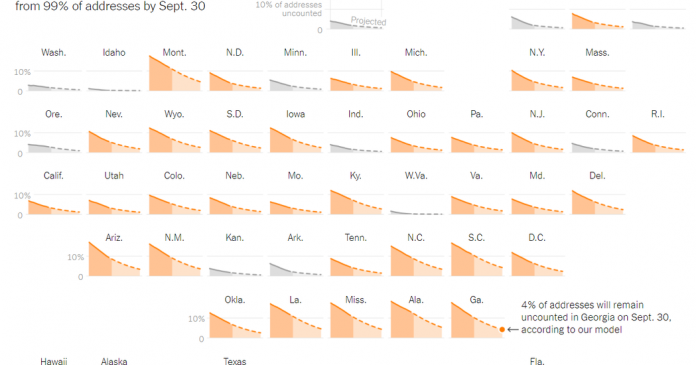
These graphs, showing the projected share of uncounted addresses for the 2020 United States census as of Sept. 30, appeared elsewhere on NYTimes.com.
By Friday morning, Oct. 9, we will provide the “Reveal” — the graph’s free online link, additional background and questions, shout outs for student headlines, and Stat Nuggets.
After looking closely at the graph above (or at this full-size image), answer these four questions:
What do you notice?
What do you wonder?
The questions are intended to build on one another, so try to answer them in order.
2. Next, join the conversation online by clicking on the comment button and posting in the box. (Teachers of students younger than 13 are welcome to post their students’ responses.)
3. Below the response box, there is an option for students to click on “Email me when my comment is published.” This sends the link to their response which they can share with their teacher.
4. After you have posted, read what others have said, then respond to someone else by posting a comment. Use the “Reply” button to address that student directly.
On Wednesday, Oct. 7, teachers from our collaborator, the American Statistical Association, will facilitate this discussion from 9 a.m. to 2 p.m. Eastern time.
5. By Friday morning, Oct. 9, we will reveal more information about the graph, including a free link to the article that included this graph, at the bottom of this post. We encourage you to post additional comments based on the article, possibly using statistical terms defined in the Stat Nuggets.
• Learn more about the “Notice and Wonder” teaching strategy and how and why other teachers are using this feature from our on-demand webinar.
• Sign up for our free weekly Learning Network newsletter so you never miss a graph. Graphs are always released by the Friday before the Wednesday live-moderation to give teachers time to plan ahead.
Students 13 and older in the United States and the United Kingdom, and 16 and older elsewhere, are invited to comment. All comments are moderated by the Learning Network staff, but please keep in mind that once your comment is accepted, it will be made public.
Do you find it difficult to keep up with your friendships in a time of social distancing? Do you find it hard to make new friends in the era of remote schooling, and when people are spending so much time more at home? Has the pandemic brought you closer together, or moved you farther apart, from friends?
What does friendship look like for teenagers in 2020?
Friendships need four elements to grow, according to Kat Vellos, an author and connection coach: close physical proximity, regular interactions, a compatible outlook on life and a shared commitment to being there for each other. In her book, “We Should Get Together: The Secret to Cultivating Better Friendships,” she calls these factors “seeds of connection,” because when they are all present, a healthy friendship can bloom. However, if any of these components are lacking “due to circumstance or not being actively nurtured, the greater your likelihood of failure,” she wrote.
If you’re feeling disconnected because you haven’t been able to spend time with your friends, it’s understandable. When we don’t engage in regular communication and do activities together, even the closest bonds of friendship decay, according to a 2015 study that appeared in the journal Human Nature.
Unlike family relationships, friendships are completely voluntary. Therefore, “they’re the relationships we put the least amount of effort into usually,” said Sabeen Shaiq, a licensed clinical social worker.
Another reason you might be feeling isolated from a friend is because you recently realized your ethical beliefs aren’t as similar as you’d assumed. Clashing viewpoints on social issues may reveal incompatibilities too distressing to ignore. Recent social movements are “really showing more about who people are, what they value, and what’s important to them,” said Ivy Kwong, a licensed marriage and family therapist. “And that’s changing a lot of friendship dynamics.”
Ms. Goldfarb provides some recommendations on what to do if your friendship has been rocky the past few months or if you have been experiencing emotional or physical distance. Here are three of her tips:
Express gratitude.
Write a handwritten letter telling your friend how much they mean to you. Voicing your deep appreciation could help strengthen your bond. “It is scary to do though, because they could not reciprocate,” Ms. Shaiq said. “But sometimes we just have to be authentic to ourselves.”
Try not to take a “no” personally.
If someone says they can’t talk to you right now, don’t spiral into negative questions and assumptions. “Whenever anyone says no, it’s basically them taking care of themselves,” Ms. Kwong said. Respect their decision and let them know your door is always open to them.
Consider this moment as a break, not a permanent chill.
Some relationships can’t thrive in this moment, but you may not want to give up on them entirely. “Allow yourself space to come back to them whenever things are more normal,” Ms. Denworth said. “Sometimes there are people who circle back into your life at different times.” She likens it to discovering a forgotten sweater in your closet that suddenly fits you perfectly. “That could happen with friendships again down the road,” she said. They don’t have to be “all things, to all people, all the time,” Ms. Denworth said, “including during pandemics.”
Students, read the entire article, and then tell us:
Are you having a tough time maintaining friendships these days? If so, tell us the challenges you are experiencing. How have they affected your mental health and your emotional well-being?
What does friendship look like in 2020? What kinds of things are you no longer able to do together with your friends? Has the quality or quantity of your friendships changed? How much time are you able to spend in person? How much is virtual? How does that compare with previous years? Have you experienced any tension or conflicts with friends over expectations around social distancing, mask wearing or hand sanitizer?
What have you been doing to sustain your friendships during the pandemic? Do you have a bubble or pod with friends? What are some creative ways you are staying connected?
Do you agree with Ms. Goldfarb that “some relationships can’t thrive in this moment, but you may not want to give up on them entirely”? Which of her recommendations do you think you might try?
What tips and advice would you give to others struggling to make new friendships or maintain old ones?
Ivy Kwong, a licensed marriage and family therapist, says that current social issues are “changing a lot of friendship dynamics.” Does that resonate with you? Have you experienced “clashing viewpoints” about politics, the Black Lives Matter movement or anything else? If yes, how have you addressed these differences?
The author says that you “might emerge from 2020 with fewer friendships, and that’s OK.” Do you agree? What have you learned about the nature of friendship during the pandemic? Has it made you appreciate friends and friendships more?
Students 13 and older in the United States and the United Kingdom, and 16 and older elsewhere, are invited to comment. All comments are moderated by the Learning Network staff, but please keep in mind that once your comment is accepted, it will be made public.
How do these three questions prompt you to do something similar to some of the suggestions made in the article you just read? Can you apply them to some of the pieces you found in your art collection?
If you’d like to practice your visual observation skills, join us Mondays from 9 a.m. to 2 p.m. Eastern when facilitators from our partner organization, Visual Thinking Strategies, come to our site to live-moderate student responses. Or click through the slide show above and choose an image and apply the questions on your own or with others.
Use Art as a Source of Strength
This spring, as museums in New York closed in response to the coronavirus pandemic, the Museum of Modern Art asked its staff members about art they have found themselves thinking of for solace, support and inspiration. “Is there a work in MoMA’s collection that has become particularly meaningful?” they asked. “Perhaps something unexpected or surprising?” Click through the slide show that resulted, called Art Is a Source of Strength. Do any of the works give you comfort? Why? Can you find a comforting work in your own collection?
Consider How Art Can Train Doctors and Police Officers
Art educators aren’t the only ones who think that looking closely and noticing detail in images can be good for your brain. In one 2016 article, “Off the Beat and Into a Museum: Art Helps Police Officers Learn to Look,” The Times explained how taking police officers to the Metropolitan Museum of Art helped train them to be more observant. In another from the same year, “What Doctors Can Learn From Looking at Art,” The Times explained how the same skills of observation could help train medical students. What other professions might learn something from going to art museums and closely studying the work? Why?
Go back to the collection you worked with as you read the main article. Can you find a piece there that would be useful to use to train police officers? Doctors? Why?
Take an “Awe Walk” in Nature
According to a study reported in the Times Health section, “Consciously watching for small wonders in the world around you during an otherwise ordinary walk could amplify the mental health benefits of the stroll.” Read the article and you’ll see that these walks draw on the same observation skills you have developed in this lesson, but this time you don’t need art to practice them. All you have to do is take a walk and pay attention. Here is how the researchers explain it:
“Basically, we told them to try to go and walk somewhere new, to the extent possible, since novelty helps to cultivate awe,” says Virginia Sturm, an associate professor of neurology at U.C.S.F., who led the new study. The researchers also suggested that the walkers pay attention to details along their walks, Dr. Sturm says, “looking at everything with fresh, childlike eyes.”
They emphasized that the awesome can be anywhere and everywhere, she says, from a sweeping panorama of cliffs and sea to sunlight dappling a leaf. “Awe is partly about focusing on the world outside of your head,” she says, and rediscovering that it is filled with marvelous things that are not you.
Explore Seven Elements of Art
A few years ago, The Learning Network ran a series called “Seven Elements of Art,” in which we paired videos from KQED Art School with New York Times articles on the visual arts to help students make connections between formal art instruction and our daily visual culture. Here are our lessons on space, shape, form, line, color, value and texture.
Choose one element, watch the video and skim the lesson on it, then use what you learn as you return one final time to your collection of art and find that element there.
About Lesson of the Day
• Find all our Lessons of the Day in this column. • Teachers, watch our on-demand webinar to learn how to use this feature in your classroom.
The goal of this resource is to help you take control of your job search timeline and provide you with strategies for advancing your job search process. It will be most useful for people who need to find a job within a certain timeframe and who want to be as effective as possible at every stage of the process.
This plan will help you design your timeline, set your expectations, monitor your progress, and make adjustments, as necessary, to improve your outcomes. To make the most of these recommendations, plan to put them into action once you have your resume completed and are ready to start actively applying for opportunities.
The first step in planning your job search timeline is understanding the main factors that influence how it plays out. These factors are:
1) the time it will take you to apply to the right job (the company that ultimately hires you)
2) the time between the application and the offer.
For example, if you estimate that it will take you four weeks to apply for the right job and another three weeks between the application and the offer, you should plan to receive a job offer in seven weeks.
We’ll begin by discussing how to develop estimates for your job search so you can plan your own timeline accordingly.
The time it will take to apply to the right job
How long it takes you to apply to the company that you eventually work for depends on how many total roles you need to apply for, and the frequency of your applications. For example, if you determine that you’ll need to apply to 50 roles, you can do this in ten weeks at a rate of five applications per week, or in two weeks at a rate of 25 applications per week.
It is important to estimate how many total roles you will need to apply for, as this will help you determine how many applications you’ll need to submit every week to reach your goals. To make this estimate, try to determine what you expect the following numbers to be, then bring these numbers together for a total number of applications you should plan to submit:
Application-to-first interview success ratio
First interview to second interview success ratio
Success rate of any additional interview rounds (as applicable)
Last interview-to-offer ratio
Here is an example:
If you presume a 20% chance of getting a first interview, a 25% chance of passing the first and second interview rounds, and a 25% chance of getting a job offer after the second interview, then you need to plan on submitting 80 applications to get a job offer.
These are metrics that you can influence. The quality of your application materials will impact how frequently you are invited to a first interview, and your interviewing skills will help you get from one round to the next.
The time between the application and the offer
In almost all cases, you will need to apply for the job and complete a series of interviews before receiving an offer. The amount of time that passes between the application and the job offer will depend on how many rounds of interviews there are, and how much time passes between each step. It is important to understand that this timeline is mostly in the control of the employer. Once you submit an application, they will invite you to interview based on their scheduling. For most roles, this process can take between two and four weeks. This can vary by industry, company, and role.
At this point in developing your plan, you should have a clear idea of how long you expect your job search to take. As you progress in your search, we recommend that you record and monitor the accuracy of your initial assumptions about your timeline. This will help you determine whether you are on track to receive your job offer under the timeline you first established, and where in the process you might be able to optimize your performance. Assumptions to track should include:
Application-to-interview success ratio
Success rate of each round of interviews (e.g., how many first interviews led to second interviews)
Number of interview rounds for each company
Tip: It is always a good idea to track details of your job search activities. You’ll gain insight into your success metrics and stay on top of important job search information that might otherwise get lost as your activities progress. You can use a tracker like this one to track your networking activities, application materials, action items, and notes from conversations.
Next, we’ll discuss how you can improve the efficiency of your job search activities at different points in the process.
There are a number of steps you can take to increase the number of interview opportunities you receive.
Apply to more jobs
Most people will be invited to interviews somewhere between 5% and 50% of the time. This means that you will need to submit between four and twenty applications to be invited to a single first-round interview. The more applications you submit, the more interview invitations you’ll receive.
Use the recommendations below to ensure that you are earning as many opportunities as possible:
Make sure you are monitoring major job aggregators (engines pulling jobs from multiple sites) such as Indeed and ZipRecruiter. You can set up alerts to receive new postings by email.
Separately track postings on LinkedIn jobs, as they might not be captured by aggregators.
Identify companies that you’d be interested in working for based on their geographic location or other parameters. Check their career pages directly once or twice a week for new opportunities that might not appear on aggregators.
Make sure you include remote jobs in your search and consider adding other locations if relocation is an option for you.
Monitor local job referral and networking groups on Facebook and other online communities where recruiters and hiring managers share opportunities not posted elsewhere.
Send an email to people in your network, letting them know about your job search and asking them to share relevant opportunities with you. Make it easy for them to help you by explaining what type of role you are looking for and including your resume.
Optimize your applications
In addition to increasing the number of applications you submit, you can improve the efficacy of each application by optimizing your resume and getting referrals.
First off, make sure your resume follows all the best practices outlined in the Coursera Resume Guide.
Next, get feedback on your resume from other people. Recommendations from professionals in your target field are best, but others with experience in hiring can also help. Keep in mind that people might have different preferences, so don’t feel that you need to incorporate every word of feedback you receive. Instead, collect input from multiple people and look for advice that is consistent and makes sense to you. Your goal is to create a resume that is captivating to as many employers as possible!
Finally, ask for referrals. Referrals are generally the best way to turn more of your applications into interviews. Most companies review employee referrals ahead of other applicants, so, at the very least, a referral increases the chances of your application being properly considered. In addition, employees referring you might be able to provide additional information on the role or the status of your application.
Before applying for a role, check LinkedIn to see if you, or someone you know, might have a connection at the company. Ask for a referral or an introduction.
Create a list of companies where you know people. Go through each company’s careers page to see if there are relevant open roles for which you can request a referral.
Make sure that everyone you know is aware of your job search, so they can send opportunities your way. Reach out to people directly, post on social media, and mention it in conversations. Remember that opportunities can come from unexpected places such as your barber, book club, church, and more.
Tip: Some companies offer referral bonuses to their employees, so even a stranger might be open to referring you if you are a qualified candidate. Be creative when seeking out referrals, and don’t hesitate to ask.
The next milestone is getting from one interview round to the next. Companies generally interview multiple candidates at every stage, so it’s to be expected that you won’t always advance to the next round. The good news is that you can increase your interview success rate by using the strategies outlined below.
First, to increase your chances of getting to the next round, make sure that your resume accurately describes you. Generally, the first round of interviews is a conversation with the recruiter or the hiring manager, with the purpose of confirming that their impression of you from your resume is accurate, and that you meet all the basic requirements for the role. Be careful about over-optimizing your resume—you may be disqualified as a candidate if the impression you make during your interview clashes with expectations set by your resume. If you’re unsure about the effect of your resume, ask for feedback from people you have recently worked with, since they know you best.
Finally, after you’ve done all the preparation you can on your own, you should get external feedback on your interviewing skills. You can do that by scheduling a mock interview—an emulation of a job interview used for training purposes. Your local job center or networking organizations might offer mock interview sessions. Alternatively, you can ask someone you know to conduct a mock interview with you. Ideally, it should be someone familiar with the role you are pursuing, or someone with experience in interviewing.
Here are a few tips for an effective mock interview:
Bring your resume and a job description that your interviewer can reference.
Prepare at least 5-10 questions that you would like to practice answering. Encourage your interviewer to ask additional questions that you didn’t prepare for.
Stay in character when answering questions, and try to reply exactly how you would reply to a real interviewer.
Ask for feedback. Come to this exercise with a growth mindset and help your partner by asking specific questions.
If you’ve followed the strategies laid out in this guide, you should know how to develop a timeline for your job search, monitor your progress, and troubleshoot your applications and interviews to improve your outcomes.
We encourage you to take the time to record your job search activities—starting with your first application—even if you are not actively trying to establish and maintain a particular timeline. Every application and interview experience is a learning opportunity. Plus, your goals might change over time, and information about your previous applications and interviews will help you analyze your past performance, set realistic expectations for future searches.
Knowing what to expect, and having visibility into what’s actually happening in your job search, is key to being in control of your employment, and landing the job!