fbpx
Home Blog Page 1468

Should National Service Be Required for All Young Americans?

0
Should National Service Be Required for All Young Americans?

David Brooks writes about this topic in the Op-Ed “We Need National Service. Now.”:

There is now a vast army of young people ready and yearning to serve their country. There are college graduates emerging into a workplace that has few jobs for them. There are more high school graduates who suddenly can’t afford college. There are college students who don’t want to return to a college experience. This is a passionate, idealistic generation that sees the emergency, wants to serve those around them and groans to live up to this moment.

Suddenly there is a wealth of work for them to do: contact tracing, sanitizing public places, bringing food to the hungry, supporting the elderly, taking temperatures at public gathering spots, supporting local government agencies, tutoring elementary school students so they can make up for lost time.

The Op-Ed discusses a bill put forward in the Senate by Chris Coons, a Democrat from Delaware:

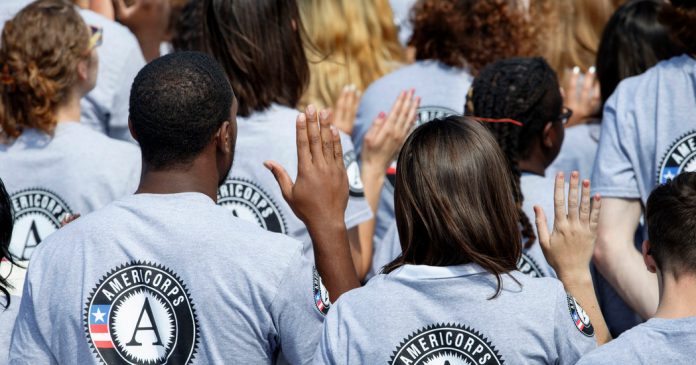
As a young man, Coons launched one of the first AmeriCorps programs, leading 150 members in 15 cities who tutored students in inner-city schools. Later, he created another AmeriCorps program with a local volunteer fire department in Delaware. “It was the most inspiring thing I’ve ever been a part of,” Coons told me.

His bill would double the current number of AmeriCorps volunteers in its first year, from 75,000 to 150,000. Then for years two and three it would double the number again, to 300,000. It would also increase AmeriCorps stipends, which are now as low as $15,000 a year, so the volunteers can have a living wage.

The Coons bill is an excellent start. But it needs to be bigger and bipartisan. Under AmeriCorps, the federal government provides money for the volunteers, matched by private funding. State commissions supervise most programs, and the volunteers work through nonprofits and local agencies. The downside is that the big, well-established nonprofits have a significant advantage when it comes to receiving AmeriCorps volunteers.

There are a lot of great smaller organizations that just don’t have the organizational infrastructure to take part. There are many parts of the country, especially in rural America, where volunteers are relatively thin on the ground. National service has never had confident bipartisan support because Republicans don’t have constant contact with volunteers in their own districts.

The Op-Ed continues:

And as we all know, the benefits of the program accrue not only to those being served but also to those doing the serving. What would it mean to the future social cohesion of this country if a large part of the rising generation had a common experience of shared sacrifice? What would it mean to our future politics if young people from Berkeley spent a year working side by side with young people from Boise, Birmingham and Baton Rouge?

On the other hand, has any nation prospered that did not encourage in each new generation the habits of work, the taste for adventure, a sense of duty and a call to be of use to neighbors and the world?

We Americans suck at regimentation and blindly following orders from the top down. But we’re pretty good at local initiative, youthful dynamism and decentralized civic action. We need a Covid response that fits the kind of people we are. National service is an essential piece of that response.

Students, read the entire Op-Ed, then tell us:

  • Do you agree with David Brooks, the writer of the Op-Ed, that the United States should greatly expand national service programs for young adults? Why?

  • Should a national service program be mandatory? For example, should high school or college graduates be required to serve one year of national service in the military or in a civic organization? Do you believe that mandatory national service would create a sense of patriotism or national unity? Or, would it be undemocratic? What might be other advantages and disadvantages of requiring national service?

  • Have you done any volunteer or community service work? Was the community service required by your school? What was your experience like?

  • In the comments section of Mr. Brooks’s Op-Ed, many Times readers did not think that young people should have to make substantially less money doing national service. How do you think people participating in a national service program should be paid?

  • Mr. Brooks argues that the current coronavirus pandemic is an example of when national service could be useful. How do you think young adults could serve the country right now?


Students 13 and older are invited to comment. All comments are moderated by the Learning Network staff, but please keep in mind that once your comment is accepted, it will be made public.

What connects deforestation and COVID-19?

0
What connects deforestation and COVID-19?

There have been many widely publicised factors behind the spread of the COVID-19 pandemic: the use of live animal markets, government policy to contain the spread once the virus arrived, global air travel, to name a few.

However, one key factor that may also have contributed to the emergence of the virus has been somewhat overlooked – deforestation and the destruction of natural ecosystems. 


 What is deforestation?

It might seem strange to link the destruction of natural habitats with the spread of natural life forms, but there is an increasing body of evidence to suggest that deforestation – the destruction of forest for logging or agriculture – can lead to viruses spreading in humans.

The loss of forest is an issue that predominantly affects tropical areas, regions with the highest biodiversity on Earth. 

In 2018 alone, 30 million acres of tropical rainforest were destroyed, with more than a third of the Earth’s land now being used for agriculture, a process that involves the clearing of woodland to create pasture.

Where is deforestation happening?

Much of this loss has been focussed around the Amazon, a rate of destruction that has only increased in recent years with policy shifts in Brazilian government – 3,769 square miles of Amazonian forest cover was lost between 2018 and 2019.

However, it is Southeast Asia that has seen the greatest rate of forest loss of anywhere in the world, losing 30% of its forest surface in the last 40 years.

Coupled with huge population growth – with the region’s population forecast to rise by almost 250 million by 2030 – human settlements are increasingly coming into contact with animals that had previously been naturally contained in woodland habitats.

What are the effects of deforestation?

This isn’t just a case of creatures being forced to ‘flee’ destruction. The ‘borders’ that demarcate human settlements with newly-destroyed forest are actually attractive to animal life. 

For example, the mosquitos that carry malaria (Anopheles darlingi) thrive in the puddles and pools in by the roads that are cut into woodland during deforestation. 

The malaria infection rate in Brazil has been shown to be linked to logging in the Amazon; control efforts brought annual malaria numbers down from 6 million in the 1940s to just 50,000 by the 1960s, with the numbers rising ever since. Bats, meanwhile, like to live near human habitation because electric lights attract the insects they feed on.

Destruction encourages disease

The increase of disease linked to deforestation and increased contact between humans and tropical animals speaks to the risks involved when ancient natural ecosystems are disrupted. 

HIV – which has killed 40 million people worldwide – was started by humans eating bush meat (likely chimpanzee) after encroaching on the Cameroonian jungle. Ebola virus jumped into humans from fruit bats attracted to human fruit fields, while the Zika virus spread across the world after finding a host mosquito that thrived in urban areas.

Moreover, in these ‘disturbed’ new environments created by deforestation – where normal ecological rules have broken down – animals can come into contact with each other that have never previously met.

Viruses can spread from one creature to another, finding an intermediate host that lets them mutate, before jumping to humans. This was the case with Middle Eastern Respiratory Syndrome (MERS) – which lept from bats, to camels, and then humans.

How did coronavirus start?

There are scientific theories that propose that SARS‑CoV‑2 spread from bats to pangolins – the world’s most trafficked mammal – before settling on humans; although it isn’t currently clear what the intermediary animal was – or if there was one at all. 

Prof Stanley Perlman, an immunologist at the University of Iowa, told the Guardian that pangolins are “are not proven to be the key intermediary”, although he does believe there was one.

Although we are too early into the coronavirus pandemic to say exactly how the virus started, we do know it very likely originated in bats and spread to humans somewhere in China. 

Bats are ‘reservoirs’ of viruses, possessing strong immune systems that let them harbour multiple coronaviruses without displaying symptoms. Some estimates suggest that bats may carry as many as 3,000 coronaviruses.

The need to protect ecosystems

This mixture of circumstances – deforestation of natural habitats, human population growth, and inter-species animal contact – is a grave health risk for human society. 

Even before COVID-19 wreaked havoc with the global economy and national health systems, scientists were warning of the risks posed by deforestation. A group of European scientists cautioned in 2018 that, “the probability of occurrence of the risk [of pandemic] is increasing owing to environmental change and higher environmental pressure.”

There are many lessons that can be learnt from the spread of COVID-19. However, if this is to be the last virus to jump from animals to humans, ensuring the protection of natural ecosystems is key to possibly preventing the pandemics of tomorrow.


If you’d like to learn more about the importance of ecosystems, join Deakin University’s new short course ‘IUCN Red List of Ecosystems: The Global Standard for Assessing Risks to Ecosystems’, or explore our wide range of ecology courses.


How to stay healthy during lockdown

0
How to stay healthy during lockdown

As the COVID-19 lockdown continues to keep many of us at home, it can be easy to fall into bad habits. The detrimental psychological and physical effects of lockdown are well documented.

During these difficult times, your mental and physical health need a bit of support. So, we’ve gathered together some ideas on how to stay healthy during lockdown. Hopefully, they can give you some inspiration as the lockdown continues.

How to look after your mental health

With all the change and uncertainty in life at the moment, taking care of your mental health has never been more important. There are several benefits associated with positive mental wellbeing, including things like:

  •       reduced stress and anxiety
  •       improved moods and clearer thinking
  •       a greater sense of calm and increased self-esteem
  •       improved relationships.

Understand your own mental health needs

For some people, talking about mental health issues can be difficult. They may not know exactly what their feelings are and how to express them. Although this can seem challenging at first, getting to understand your own needs is an important first step towards managing mental health and stress.

There are several elements worth considering as you try to understand your mental health needs. A good place to start is to find some quiet time in which you can reflect on how you’re feeling. Some questions to ask yourself might be:

  • Have you been more irritable with situations or people around you? 
  • Have you been less interested in activities you usually like?
  • Have you found it difficult to concentrate? 
  • Have you been sleeping more or less than usual?
  • Have your changed routines had an impact on your sleep? 
  • Have you been eating more or less than usual? 
  • Have you felt overwhelmed and like there is too much to do?
  • Have you felt concerned about the future? What aspect specifically? 
  • Have you been able to get enough time to yourself to relax? 
  • What sort of activities usually help you ‘reset’ when you’re not feeling yourself – have you been able to do them? 

It’s a difficult and strange time for everybody, so changes to routine and anxiety are a normal response to the circumstances. But recognising which parts are particularly difficult, or understanding exactly how you feel about them, is an important step in trying to improve your mental health. 

As this BBC video explores, feeling in control can go a long way to helping you feel better. So, think about how you’re feeling, what your worries are, and what things are stressing you out. Try writing these points down to give you some clarity, and decide what you have control over and can take proactive steps with.

There are also several tried and tested methods that are proven to help people in various situations deal with trying times such as the COVID-19 pandemic.

If you’re concerned about your own mental health needs, the NHS has a mood self-assessment tool that can help you understand how you’ve been feeling. For young people who are struggling during the lockdown, we also have a course on helping young people manage low mood and depression.

Practice mindfulness exercises 

Mindfulness is a practice that is beneficial no matter what’s going on in the world. If things seem a little stressful at the moment, and you’re finding it hard to focus, it could be the ideal remedy. But what is mindfulness?

Put simply, being mindful is the act of being fully present and aware of where you are and what you’re doing. It’s something that all people can do, although few of us take the time to actually spend doing it. However, it can be a great first step when discovering how to stay healthy during lockdown.

Practising mindfulness can help to reduce stress and anxiety, improve your memory, and help with concentration. And maintaining a mindful life can benefit your emotional health, relationships and communication skills now and in the future.

A great place to start with mindfulness is with some basic breathing exercises. Take one minute out of your day to sit and focus on your breath. Notice the air going in and out of your nostrils as your chest rises and falls. If your mind wanders, gently bring it back to focus on your breathing. 

If you want to learn more about mindfulness techniques for various purposes, check out our course on mindfulness for wellbeing and peak performance.

Stay in touch with friends and family 

In these difficult times, it’s important to focus on some of the positives in our lives. One such positive is our access to technology, and how it can be such a powerful tool for bringing us together. With our smartphones, internet access, webcams, and other methods of communication, it’s never been easier to stay in touch.

Although many of us can’t see friends and loved ones face-to-face at the moment, we can still keep in touch. Speaking with the people you care about can give you (and them) a mental boost.

There are plenty of ways you can keep in touch:

  • Call your friends and family. Try and arrange to speak with different people throughout the week. It can give you something to look forward to and keep you feeling social.
  • Arrange an online activity. There are plenty of apps and services that let multiple people voice and video chat together. Play games, tell stories, and catch up remotely. You can even do things like have a murder mystery party or set up a pub quiz. 
  • Send messages. Try reaching out to some people you’ve not spoken with in a while, even if it’s just a message to say hi.
  • Write letters. If you’re feeling old school and you have the means, now might be a good time to write to someone you care about.

Try to keep busy

Although it can (understandably) be hard to feel motivated and productive at the moment, keeping your mind active can be beneficial for positive mental health.

If you’re looking for some inspiration, we’ve already compiled a list of 50 free things to do during lockdown.

Now is the perfect time to explore your hobbies – or find some new ones. Challenge yourself to read that book you’ve been putting off, start that journal you’ve always wanted to keep or kick off your exercise regime.

Get enough sleep

Sleep plays a fundamental role in mental health. However, when daily life gets disrupted, it’s easy to fall into bad sleep cycles. As this post from SleepFoundation.org outlines, there are many challenges people are facing with their sleep at the moment, with added stress, a disrupted schedule, and excess screen time all causing issues.

By identifying a potential issue, you can work on understanding the habits, solutions and strategies for dealing with sleep deprivation.

Try and focus on maintaining a regular bedtime and avoid the temptation of lying in bed for ages in the morning or during the day. Take some time to wind down at the end of the day and avoid having caffeine or alcohol late at night.

Stay physically active

As well as taking care of your mental health during lockdown, it’s equally important to stay on top of your physical wellbeing. With gyms closed and the daily commute cancelled for most of us, it can seem more difficult to stay active. However, there are plenty of ways you can keep your body moving.

Get moving

The hardest part about being active during lockdown is starting in the first place. The sofa looks extra inviting at these times, and the bed extra comfortable. But try and resist the temptation to spend all of your time there. In the UK, people can still get out and exercise during lockdown, so make sure to take advantage of that.

In our post on how to find a new hobby in lockdown, we looked at a variety of new hobbies you can take on to keep you fit. Whether it’s running, dancing, cycling or weight lifting, there are plenty of activities you can pick up inside and outside the home. Choose one and get active!

Find a routine

Now you’ve started being active, the key thing is to stick with it. The NHS recommends that adults aged 19 to 64 need to do at least 150 minutes of moderate-intensity activity a week. This includes being active every day and doing strengthening activities at least twice a week.

So, what does ‘moderate-intensity activity’ look like? Well, things like brisk walking, riding a bike, dancing, and rollerblading all count. You can try and beat your daily steps target, follow a daily exercise YouTube channel, or try a couch to 5k program.

Try yoga

Yoga is good for the body and mind, and it’s something that just about anyone can do. As well as burning calories and toning muscles, it gives you strength, flexibility, and an awareness of your mind and body.

We mentioned the benefits of mindfulness earlier in this post, and yoga can help with that too. It encourages you to relax and focus on your breathing, stimulating your nervous system. What’s more, you’re sure to be able to find a workout that’s suitable for your fitness and ability level.

The YouTube channel Yoga With Adriene gives a wide range of exercises and workouts that can help set you on your way.

Set yourself a challenge

When it comes to fitness, gradual progress can lead to some pretty significant results. If you’re thinking about how to stay healthy during lockdown, taking a fitness challenge could be exactly what you’re looking for.

There are some great ways you can challenge yourself from home, without the need for any extra equipment. Will you try and complete 100 press-ups in one go? Or is your aim to hold a plank for three minutes?

These types of challenges are a great way of giving yourself regular, progressive exercise. You can see gradual progress, and have an end goal in sight. You can also challenge your friends and family to take up the challenge with you from their homes, keeping you connected and competitive.

Maintain a healthy, balanced diet

If you’ve been working from home or furloughed recently, you’ll no doubt have noticed the benefits of having your own kitchen nearby at all times. You may find yourself eating more of all the wrong things, which, although comforting at the time, can be problematic.

There are so many benefits associated with having a healthy and balanced diet. It’s good for your heart, your bones, your immune system, and your mental health. So, maintaining a healthy diet during lockdown is something we should all think about. 

Learn about healthy eating

The term ‘healthy and balanced diet’ can sometimes seem like a difficult one to understand. We’re often bombarded by messages and advertisements about food that seem to conflict each other, so how do we know what’s healthy?

Well, we can start by understanding the basics of nutrition. Learning about how what we eat impacts our bodies and minds is a good place to start.

The NHS Eatwell Guide is also an excellent resource for understanding what a balanced diet looks like. It provides information about the types of foods we should include in our daily intake, and why they’re important.

If you want to dig a little deeper, you can take a course on topics such as the relationship between nutrition and wellbeing, and how to improve mental health through diet and nutrition.

Keep hydrated

One aspect of healthy eating that’s sometimes overlooked is choosing healthy drinks for your daily routine. Keeping hydrated is essential for staying healthy, and it brings many other benefits besides.

If you’re exercising a lot, you’ll want to make sure you’re drinking plenty. Many activities can feel physically and mentally much more difficult without proper hydration. Similarly, without enough fluids, you’re more likely to have a hard time concentrating and feeling alert.

So, staying hydrated can prevent you from feeling physically and emotionally drained. But how much should you drink? According to the Eatwell Guide, you should aim for six to eight glasses of fluid a day. This includes things like water, tea, and coffee. 

Try a new recipe

Cooking can be a great way to relax and try something new. If you’re looking to put your newly found nutritional knowledge to the test, trying a new recipe is a great excuse.

The BBC Good Food website has a wide selection of healthy recipes. You can even get creative with whatever ingredients you’ve got in the fridge. Experiment with new flavours, try a dish you’ve always wanted to, or cook up your restaurant favourites.

Various studies have shown links between home cooking skills and healthy diets. So, once you’re in the habit, you can maintain your healthy diet during lockdown and beyond.

Reduce your alcohol intake

A recent UK study found that around 21% of the alcohol drinkers they surveyed were drinking more during lockdown.

Although it can seem like a way to escape the stress, in reality, alcohol causes more problems than it solves. For starters, it can interrupt your sleep patterns. So, although it may make you doze off quicker, it can prevent you from getting a restful night’s sleep.

There is also evidence that stress drinking can result in greater feelings of depression, anxiety, and low mood. So, it can be a good idea to limit how much you’re drinking during lockdown.

Government advice is that you shouldn’t exceed more than 14 units per week, which equals around six or seven drinks. However, they also suggest you should have a few drink-free days each week.

Staying healthy is a habit 

Evidently, it’s vital that we all take care of our physical and emotional health during this difficult time. In doing so, we’re better placed to look after ourselves and others.

With some simple changes to your daily routine, such as getting enough sleep, eating well, exercising, and keeping in touch with people, you can boost your mood and stay healthy.

11 New Skills You Can Learn From Home

0
11 New Skills You Can Learn From Home

Yesterday we went live with Learn From Home Day — a full day of learning news skills with our friends from Food52, Y Combinator, Fatherly, Splice, Twitch, Brunchwork, Skillshare, Duolingo, Headspace, and Casper, along with celebrated executive coach Jerry Colonna. We learned soooo much and we hope you did too!

If you weren’t able to join us, we’ve got you. We recorded the live event so you can watch it on your own time (and then watch it again… and again… and again).

Check out the full replay below, followed by a full list of all the skills we learned about. We’ll also share some links to extra resources in case you want to continue to learn and explore.

Before diving into all the new skills, we recommend watching the event opening and keynote! Codecademy CEO and Co-Founder Zach Sims opened the day by answering some questions from Community Manager Alyssa Vigil about online learning. Then, at the 15:00 minute mark, venture capitalist and professional coach Jerry Colonna gave an inspiring keynote on what we can learn from life right now.

At Codecademy, we’ve always been passionate about learning from home. Today, online learning is more important than ever. Being stuck at home can be monotonous, and picking up a new skill can help create a sense of empowerment. Our hope is that, through our Learn From Home Day sessions, you’ll learn at least one new skill to make your days a little bit brighter.

Check out the full list of skills below, and feel free to leave us a comment letting us know about your favorite thing you learned!

Skill #1: Learn about starting your own company with Y Combinator

Starting at 44:15, we were joined by Eric Migicovsky, Y Combinator partner and founder of Pebble for a fireside chat on startups. Eric talked about what a startup is and shared some amazing tips and tricks for anyone that’s thinking about starting their own company.

In order to build a successful startup, Eric Migicovsky recommended the following four things:

1. Build something people want.
2. Build something that’s not easily copied.
3. Be a force of nature.
4. Be on a mission that matters to a lot of people.

But that’s just the icing on the cake. To learn even more, watch the full session.

Want to keep learning? Check out Startup School. One of the resources that Eric mentioned during his session, Startup School is a free 8-week online course designed to help anyone start a company.

Skill #2: Learn how to cook pasta with Food52

At 1:14:37, right around lunchtime on Learn From Home Day, we were joined by Ella Quittner, a writer and recipe developer at Food52. Ella will show you how to make an easy recipe for Pasta with Brocoli-Cheddar Sauce, with just a few ingredients that can be substituted for things you have in your pantry.

Want to keep learning? Check out these recipes and resources that Ella shared during her session:

Skill #3: Learn about parenting during a pandemic with Fatherly

Tyghe Trimble and Patrick Coleman of Fatherly joined us 1:45:00 to answer four of the most frequently asked questions about parenting during the pandemic. Tyghe and Patrick share tips for getting kids comfortable with wearing masks, for dealing with anxiety and mental health as parents, and more.

You’ll get something out of this session whether or not you have children. If you don’t, it’ll shed some light into what your friends and family members that are parents may be dealing with, and how you can support them during this challenging time.

Want to keep learning? You can can find even more tips and advice at Fatherly.com, where you can also sign up for a newsletter full of tips and tricks related to parenting during a pandemic.

Skill #4: Learn how to make music with Splice

Have you ever played an instrument or made music of your own? At 2:16:20, Nick Chen from Splice joined Learn From Home Day to show us how to create a track using a collection of instruments requested by the audience.

Want to keep learning? Check out the Splice Beat Maker that Nick mentioned during the session to start building your own beats for free.

Skill #5: Learn how to live stream with Twitch

At 2:46:20 you can jump to a fun session with Mary Kish, Head of Community Marketing at Twitch. If there’s anyone to learn streaming best practices from, it’s Mary! She covers all the basics of live streaming for beginners, whether you want to go live on Twitch, Instagram, Facebook, or the platform of your choice.

Learn about everything from camera setups and lighting tips to how to interact with viewers who are commenting on your livestream.

Want to keep learning? Check out this resource from Twitch, which dives into the basics of building your brand and engaging your community.

Skill #6: Learn to meditate with Headspace

Midway through our day, we took some time to relax with Eve Lewis, Content Director and the female voice of Headspace. You can check out Eve’s session starting at 3:46:01. Take some time to pause, reset, and find a sense of calm in your day, whether or not you’ve ever done any kind of meditation before.

Want to keep learning? Head over to the Headspace website for a wealth of resources and information on the topics of meditation, mindfulness, and relaxation.

Skill #7: Learn how to network with brunchwork

Whether you’re currently looking for a job, plan to look for a job in the future, or simply want to start building out your professional network, Paulina Karpis of brunchwork has you covered with some wonderful tips, starting at 4:14:46.

Paulina shares a presentation on the secrets to building a world-class network that lands you a dream job faster. She covers everything from why networking is so important to how to build up your own community, the art of the approach, and more.

Want to keep learning? You can find out more about career advancement through community by signing up for the brunchwork newsletter or exploring the bunchwork website, which Paulina mentioned during her session.

Skill #8: Learn how to draw for inner calm with Skillshare

Creativity can help you through these challenging times, whether you consider yourself an artist or not. Which is why we recommend checking out Skillshare teacher Amber Vittoria for a session on how to draw your feelings, starting at 4:44:52. Grab a piece of paper or sketchbook and the writing utensil of your choice and draw what moves you while listening to Amber answer questions about art and creativity during quarantine.

Want to keep learning? If you enjoyed drawing with Amber, learn more from her on Skillshare.

Skill #9: Learn a language with Duolingo

Dr. Cindy Blanco is a language scientist at Duolingo. She joined us at 5:14:51 for a session on learning a new language from home. Whether you want to learn a language to put to use on an upcoming trip abroad, or just to make progress towards a goal while you’re at home, you’ll pick up some tips for learning a new language, including these:

  1. Set meaningful goals
  2. Vary how you study
  3. Make it personal

Want to keep learning? Head over to Duolingo.com to browse all the languages they have available and start learning.

Skill #10: Learn to code with Codecademy

Alex Kuntz and Zoe Bachman, Codecademy curriculum developers, joined Learn From Home Day for a session on learning to code, starting at 5:44:46. In the session, Alex and Zoe walk through the Codecademy course, Learn How To Code.

In the session, they dive into some basic programming concepts and then put them into action. They also answer questions from the audience about learning to code.

Want to keep learning? Learn How To Code is a free course — feel free to dive in and go through the course on your own! If you’ve already got the basics down, check out our full catalog.

Skill #11: Learn to sleep well with Casper and Dr. Frank Lipman

At the end of the day, it’s time to rest. Which is why we closed out Learn From Home Day with a question and answer session with Casper Sleep Advisory Board Member Dr. Frank Lipman.

Starting at 6:44:47, Dr. Lipman discusses the importance of sleeping well — especially now. He answers some of the most popular questions that Casper gets about sleep, including how much sleep you should get each night, how important sleep is in recovery from an illness, and how different foods impact our sleep. He also fields questions from the audience on sleeping well during the pandemic.

Want to keep learning? Check out the Casper blog for more advice and articles about how to improve your sleep.

We hope you learned as much as we did at Learn From Home Day! Please share your favorite sessions and learnings in the comments below. We look forward to seeing you at our next event! To stay in the loop, check out the Codecademy Events page and follow us on social media — you can find us on Twitter, Instagram, Facebook, and LinkedIn.

Word + Quiz: paucity

0
Word + Quiz: paucity

: an insufficient quantity or number

_________

The word paucity has appeared in 54 articles on NYTimes.com in the past year, including on Feb. 12 in “A Simple Way to Equalize the Ivies? Give Others the Legacy SAT Bonus” by Dana Goldstein and Anemona Hartocollis:

A new paper from a team of prominent economists says that a simple strategy — an SAT “bonus” of 64 to 160 points, like that effectively seen in legacy admissions — would go a long way toward decreasing economic segregation in American higher education, and give a boost to social mobility through the generations.

… The 6.2 million people included in the study are approaching 40 years old, but Professor Friedman said the findings remain relevant, given the continued paucity of low-income students at highly selective colleges. At Ivy Plus institutions, there have been more students from families in the top 1 percent of earners than students from the entire bottom half of the income distribution.

_________

What’s the Craziest Thing You Did as a Kid?

0
What’s the Craziest Thing You Did as a Kid?

What you were thinking, or not thinking, at the time? Were there any consequences of your actions?

The driver of the SUV swerved on the freeway at about 32 miles per hour when a trooper for the Utah Highway Patrol spotted and pulled him over.

The trooper could not see a head above the seat’s headrest, and thought the driver might have been impaired.

But when he approached the driver’s side window on Monday, the trooper was surprised by what he saw: a young boy wearing a gray Utah Royals soccer hoodie.

“You’re 5 years old. Wow!” the trooper, Rick Morgan, said in the dash camera video of the traffic stop. He then asked him, “OK, where did you learn how to drive a car?”

The boy, who was not identified, had managed to drive about two to three miles from his home before he was pulled over in the southbound lane of Interstate 15 in Ogden, a city about 38 miles north of Salt Lake City, according to the authorities.

The Highway Patrol shared video and details of the episode on social media, where it quickly gained attention. Like the trooper, people wondered: How did the boy manage to get so far without injury or damage to the vehicle? Where was he trying to go? And where did he learn to drive?

During a news conference Monday, Trooper Morgan said that “when the window came down, I wasn’t quite sure what to think.”

“It absolutely was not what I was expecting when I saw the driver,” he added.

He said the boy was sitting on the front edge of the seat “so that he could reach the brake pedal.” It was not clear how well he could see through the windshield. The trooper helped the child to put the car into park position and to shut it down.

At first, he thought the boy appeared to be 8 or 9 years old.

“But he insisted he was 5, and his family confirmed he’s 5 years old and he will be 6 next month,” Trooper Morgan said.

The boy, who gave short or one-word answers, was on the verge of tears during the stop, the trooper said. The boy explained that he left home after an argument with his mother, according to the Highway Patrol.

“She told him she would not buy him a Lamborghini,” the Highway Patrol said in a tweet. “He decided to take the car and go to California to buy one himself.”

Trooper Morgan said that the boy probably realized something was wrong with the situation, though he might not have understood it completely. “I do think he’s probably had a life lesson,” he said. “I don’t think we’ll see him in the situation again soon.”

Teenage Drivers

0
Teenage Drivers

Last month, Georgia waived its road-test requirement for most drivers in an effort to help fight the spread of the coronavirus. In early May, the state said it had issued driver’s licenses to thousands of teenagers without one. Wisconsin is doing something similar.

Though in Georgia the teens all held permits and had completed the state’s mandatory driver education requirements, many worry that the results could be “catastrophic.”

What do you think? Do you have your license? Was passing the road test an important part of your process in learning how to drive competently? Why or why not?

Weekly News Quiz for Students: Unemployment Rate, Dropped Criminal Case, ESPN

0
Weekly News Quiz for Students: Unemployment Rate, Dropped Criminal Case, ESPN

Above is an image related to one of the news stories we followed over the past week. Do you know what it shows? At the bottom of this quiz, you’ll find the answer.

Have you been paying attention to the news recently? See how many of these 10 questions you can get right.

Lesson of the Day: ‘What We Know About the Shooting Death of Ahmaud Arbery’

0
Lesson of the Day: ‘What We Know About the Shooting Death of Ahmaud Arbery’

After video footage of Mr. Arbery’s killing was leaked this month, two men were arrested and charged with murder. Widespread protests and 2.23 mile solidarity runs ensued, posted on social media with the hashtag #IRunWithMaud.

In this lesson, you’ll investigate the facts of this case. You’ll make connections between this case and a larger narrative about life in America and, if you choose, find creative ways to honor Mr. Arbery’s memory.

What do you already know — or think you know — about the shooting death of Ahmaud Arbery that has recently gained public attention? How did you learn about it? What questions do you have about what happened?

Use a K/W/L chart to record what you know and what you want to know. As you read the article, add what you learn to the last column.

Read the article, then answer the following questions:

1. Mr. Arbery was killed on Feb. 23. Why is his case only getting public attention now?

2. What new information did you learn about Mr. Arbery and how he was killed? Add these key facts to the last column of the K/W/L chart you began in the warm-up activity.

3. Why did George E. Barnhill, the district attorney in Waycross, Ga., argue that there was not sufficient probable cause to arrest Gregory and Travis McMichael? What do Mr. Arbery’s defenders say? On which details do the prosecution and defense differ specifically?

4. What role has the video played both in this case and in the court of public opinion? Why?

5. Mr. Fausset writes that this case “is resonating in troubling and familiar ways.” Why do you think the nation has reacted so strongly? What connections can you make to your own life, current events or history?

6. What is your reaction to what you have learned about the shooting death of Mr. Arbery? What do you think should be done?

In a Letter to the Editor, Cody Lyon from Brooklyn writes:

That it took months before the men were arrested is further proof the country’s justice and law enforcement apparatus is racially biased. There clearly was no sense of urgency among officials in the case.

If not for the video footage and subsequent media reports that stirred the country’s collective outrage, the chances of justice for Mr. Arbery would have probably remained distant. That in itself is a chilling commentary on life in America today.

What do you think this event says about life in America today? Write your own letter to the editor using evidence from the article, other sources or your own experiences to support your opinion.

Get more tips for writing rich reader responses here. And you can submit your final letter here.

Do something creative to honor Mr. Arbery’s life and memory. Try one of these ideas or come up with one of your own:

What to learn during lockdown

0
What to learn during lockdown

As the COVID-19 lockdown continues, many of us find ourselves with more free time than usual. We’ve already outlined some ideas for how to find a new hobby in lockdown, but for those who’d specifically like to study, we’ve put together some further suggestions to help you get started.


 What do you want to achieve with your learning?

Before we delve into the details of what to learn during lockdown, let’s first take a look at what your aims might be. There’s never a bad time to learn something new, but having a goal in mind before you start can help you on your journey. Here are some popular learning outcomes to help you choose a goal. 

Although the world of work seems a little chaotic for many of us right now, things won’t always be so up in the air. When you’re considering what to learn during lockdown, you may want to improve your professional skills, ready for when the world reopens. 

With new technologies and processes being created at a fast pace, closing the skills gap can give you a significant advantage in your career. Whether you’re learning a totally new skill or improving on an existing one, it’s the kind of thing that can make you stand out from the crowd.

You don’t have to delve deep when you first start on your learning adventure. By taking an introductory course or studying the basics of a new subject, you can get a feel of whether it’s the right fit.

There are all kinds of hard and soft skills that you can start learning about. Even a small amount of study can support your existing knowledge and broaden your horizons. From there, you can think about the types of areas that will be most beneficial or interesting to you.

  • Improve your understanding of world issues

Many of us have been gripped by the coverage of current affairs related to COVID-19, with the feed of information almost constant. However, it can sometimes be difficult to focus on global issues aside from the headlines.

There are plenty of topics worth exploring that can give you a more detailed understanding of the world we live in. Studying the environment, human rights, ethics, religion, and other ideas and concepts can all help to give context to current affairs. 

  • Build better relationships

If you’re not quite sure what to learn during lockdown, it’s worth giving some thought to improving your relationships. Emotional intelligence is an invaluable skill that can positively impact all areas of your life. Similarly, improving your communication skills can help in your personal and professional relationships.

Taking the time to work on your own wellbeing can bring significant improvements to your everyday interactions with the important people in your life. At this time of uncertainty, it could be just the thing you need.

Of course, you may just want to study something purely for the joy of learning. There’s a lot to be said for picking a topic you don’t know much about and getting to know some of the basics. Lifelong learning is something that can bring benefits to all areas of your life, and you never know where it may take you.

To borrow from Dr Seuss, ‘The more that you read, the more things you will know. The more that you learn, the more places you’ll go.’


So, you hopefully now have a goal or two in mind for your lockdown learning. The next thing to do is to actually choose a subject to begin studying, but where to start?

We’ve put together a list of some ideas – each with a free online course you can take – that align with all of the main goals we’ve outlined.

Learning to boost your employability

The most in-demand hard skills: 

Let’s start with professional development. Whether you’re working from home, furloughed, or waiting for the job market to start moving again, now is a good time to boost your CV. There are both hard skills and soft skills you can work on, both of which can bring benefits to your career.

As we take a look at some of the learning opportunities available, remember that many of the courses we’ve outlined provide certification upon completion. Such an acknowledgement of your studies can strengthen your CV and show your dedication to continued learning.

A recent LinkedIn study looked at the most in-demand hard and soft skills. This is a great place to start.

Blockchain

You’ve no doubt heard of terms like cryptocurrency and Bitcoin. The latter had a meteoric rise and fall during late 2017 and early 2018 and continues to be an interesting prospect to this day. Blockchain technology is what powers the Bitcoin digital currency. It’s one of the cutting-edge financial technologies of the moment, and knowledge in this field is highly sought-after.

Cloud computing

Cloud computing is one of the technologies that will be the future of many businesses. Already, it’s a popular way of delivering data storage, software, analytics, and more. Essentially, it’s the use of the internet to offer fast and innovative computing services.  

Analytical reasoning

Data is now the most valuable commodity for businesses, and companies across the globe are finding new and unique ways to make sense of it. Emerging fields such as web analytics and big data are growing at a rapid pace. As such, those people who can analyse data and give insights to its meaning will find they’re in high demand.

Artificial intelligence

Artificial Intelligence (AI) was once a science-fiction dream. Now, it’s very rapidly becoming a reality. Robots and AI can supplement and augment the way we work and live our lives. Those with an understanding of machine learning, big data, and other associated topics will find plenty of opportunities in the future.

UX design

User experience design is a field that focuses on how users interact with a product or service. Whether focused on apps, websites, or machines, UX design relates to the ease of use for the user. It takes into account aspects of design, market research, psychology, technology and business.

Business analysis

As companies generate more and more data, there is a need for people who can identify the business needs that arise from such data. Business analysts are the problem-solvers of modern organisations.  If you’re wondering what to learn during lockdown, taking a course in a field such as big data analytics could be seriously beneficial.

Affiliate marketing

Social media and influencers are starting to replace traditional advertising. Whether it’s social selling, leveraging industry experts, or promoting other companies’ products, affiliate marketing is one of the hot new skills businesses are on the lookout for.

Sales

Companies always have and likely always will need good salespeople. Whether you want to learn about customer insight or customer engagement, you can find a course that’s going to boost your knowledge of the sales process. 

Scientific computing

Continuing in the theme of technological advancements, scientific computing relates to a wide variety of professions. For newcomers to the field, a course on how computers work might be a good starting point. For the more experienced, we have an array of computer science courses on offer.

Video production

Video is becoming an increasingly popular medium for all things related to business. Customers love watching videos, so being able to produce high-quality content is a valuable skill. You can learn some of the fundamentals in our explore filmmaking course.

The most in-demand soft skills:

Some skills are hard to teach, quantify and measure, yet remain essential in the workplace. These soft skills are often known as interpersonal or people skills. Many businesses look for candidates with strong hard and soft skills, so it’s worth spending the time to develop both.

Creativity

Being able to connect ideas, come up with unique solutions, and generate original concepts is valuable in all areas of life and business. A course in creative problem solving could be just the thing to help you flex your creative muscles during lockdown. If you’d like to look at a few more options, we have a collection full of courses designed to help you get creative. 

Persuasion

Whether you’re negotiating, leading a team, dealing with suppliers, or any other business task, persuasion is a sought-after skill. Communication skills are useful in general, and none more so than being able to persuade. Check out our course on successful negotiation if you’re looking for inspiration.

Collaboration

The ability to combine ideas and collaborate on finding solutions is something that makes humans unique. When applied to the workplace, being able to work with others is almost universally required. Why not try our course on collaboration, communication and remote working to brush up on your skills? 

Adaptability

The fast-paced and often unpredictable nature of modern life means that adaptability is essential to thriving in the workspace. The ability to change direction on the fly and still deliver results is a soft skill that employers frequently look for.

Emotional intelligence

It’s always useful to be in tune with your own and others’ emotions. It helps to build relationships and create a sense of togetherness. This emotional intelligence can help you understand others, resolve conflict, and make more informed decisions. 

Learning to expand your horizons  

If you’d rather spend your free time developing skills away from the world of work, there are plenty of options you can choose from. These skills to expand your horizons come in all sorts of shapes and sizes, meaning you can work on all kinds of areas of knowledge.

Languages

Learning a new language brings many benefits. It can help you connect with new people, give you a leg up in your career, improve your cognitive skills, and allow you to travel. By taking a language course now, you can put your new skills to the test once lockdown is over. How’s that for motivation?

Cultures

Studying other cultures can be an interesting way of expanding your horizons during lockdown. Our course on cultures and identities in Europe, for example, gives you the chance to develop a greater understanding of Europe and its people. Alternatively, you could choose to study culture in the digital age to see how technology has impacted our lives.

Coding

Coding and programming are tools that are becoming increasingly relevant and important. Studying in this field can give you a greater understanding of how technology works. It also gives you the chance to work on all kinds of projects, whether for personal or professional advancement.

Nature & environment

The natural world around us is ever-changing and fascinating. Studying in the nature and environment sector gives you the chance to explore topics such as sustainability, extinctions, upcycling and the value of the ecosystem.

Study skills

If you’re not quite sure what to learn during lockdown, why not study the art of studying? By brushing up on your study skills, you can make sure you’re performing at your best when you next choose a course to study. These are skills that can be useful both professionally and when you’re in a formal, academic study environment.

Learning to understand world issues

During the coronavirus pandemic, many of us have watched the global story unfold through the news and media. Although the virus has dominated headlines, there is still plenty to understand about the world.  Choosing to learn about some of the key issues facing us today can be highly rewarding.

Climate change

As one of the most pressing issues of modern times, climate change is something that we’re going to have to face and overcome together. Learning about the causes of climate change as well as some of the solutions can help you stay informed about the latest developments in this area.

Crime and criminology

The true-crime fascination of the last few years continues to influence our TV, podcasts, books, and other media. Whether it’s a subject you’re already interested in or you’re a total newcomer, crime and criminology is a fascinating and relevant area to learn about. 

Social issues

Our societies are rich, diverse and complex. If COVID-19 has taught us anything, societies can also be radically changed in a short space of time. Learning about some of the social issues that impact our lives can give you a greater understanding and appreciation of our cultures and values. 

Politics

Like it or love it, politics are something that has a huge influence over our lives. By learning about how the government and politics work, you can make sure you understand how certain key issues impact society. It’s a varied field too, with topics as diverse as international development and gender identity. 

Healthcare

The attention of the world is on our various healthcare systems and how they’re holding up during the pandemic. Now is the perfect time to learn about healthcare, especially with courses such as nursing in times of crisis and pooling healthcare data around the world. 

Learning to build better relationships

During the lockdown, we can all appreciate how important relationships are in our life. Although it can be difficult not seeing the people you care about, working on your relationship skills can yield many benefits.

Communication

The ability to effectively communicate with our friends, relatives, co-workers, and other people in our lives is often underappreciated. Yet it’s what brings us together and lets us understand each other. With courses available such as this one on intercultural communication, you can learn why communication is so valuable, and how you can improve your own skills.

Wellbeing

Taking care of your physical and emotional wellbeing is always a positive move. In terms of your relationships with others, it can help you maintain a healthy work-life balance, understand others’ thoughts and feelings, and boost your mental health.

Mindfulness

This is a topic that’s closely linked to wellbeing. Mindfulness is the act of being present in the moment and connecting with your feelings. Activities such as practising mindfulness can help you feel calmer and more appreciative about the important people in your life.

Management and leadership

The people we work with are often some of those we spend the most time with. It’s therefore worth the time investing in building relationships with them. Not only can learning about management and leadership help with that process, but it can also improve your career prospects overall.

Psychology

Psychology is a broad and interesting field. Learning about the inner-workings of the mind can help us appreciate the way we and others think. This understanding can help you build your relationships with others.  

Learning for pleasure 

Of course, many of us enjoy learning for the sheer enjoyment it brings. There are a whole host of topics we could include here, as well as all the ones we’ve already covered. However, we’ve tried to pick out some of the popular subjects that people are interested in right now.

History

It’s always fun to learn about history. The world that was has shaped the world that is, so it’s fascinating to look back and piece the puzzle together. We have a fantastic range of history courses on offer, covering British and Irish history, archaeology, military history and many more areas.

Creative arts

Whether you’re a film buff, culture vulture, budding photographer, or journalist in the making, the creative arts have plenty to offer. If you considering what to learn during lockdown and you’re feeling a bit creative, this is the perfect field to delve into.  

Literature

If you’ve always wanted to learn more about literature past and present, you’ll find a wealth of courses and resources available to you. You can learn about the importance of words and the power they hold to help shape the world.

Music

Whether you’re learning a new instrument or studying musical theory, there are few better ways to get your creativity flowing during lockdown than with studying a music course. Find out how to write your first song or gain a better understanding of how musical scores work.

Game development

Playing video games is a pastime that many of us have indulged in during lockdown. With that in mind, now might be a good time to turn that hobby into a more creative one. A game development course could be just the thing to take on for your lockdown learning project. 


If you still haven’t found a topic that you’re interested in, perhaps you can find the right course by browsing our short courses and seeing what piques your interest.

Category Current Issues, Learning