On This Day spotlights a historic New York Times front-page article. For teaching ideas, visit this resource.
1982
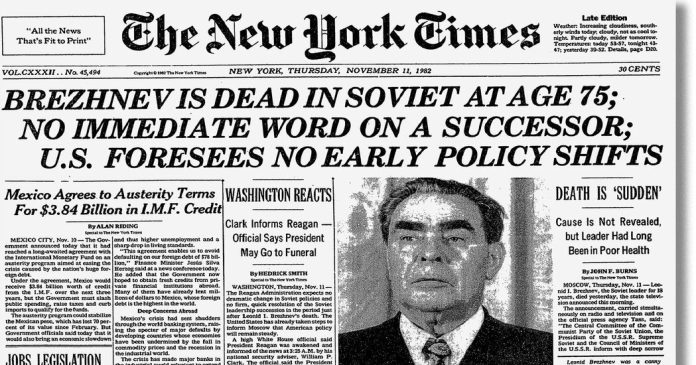
TRIBUTE TO VIETNAM DEAD: WORDS, A WALL
By Francis X. Clines
Washington, Nov. 10 — President Reagan stopped by the National Cathedral to listen for a while to the reading of the names of the Vietnam war dead this evening.
His motorcade sounded fast and far-off heading northwest to the cathedral in the dusk as Tom Toohey, unheeding in another part of town, stepped up to the glossy dark wall of the war’s freshly completed memorial with its long listing of its dead, touching it for the name, he emphasized, of “one good lieutenant.”
“There,” said Mr. Toohey, his fingers brushing the name of Richard H. Housh. “A real good lieutenant. I saw him jump up with his pump shotgun one time and blow away four guys coming at us. He was somebody else, one good lieutenant.”
Ceremony by Candlelight
While the President journeyed to one part of the capital’s weeklong commemoration of the Vietnam dead, the continuous reading of their names in a candlelighted chapel at National Cathedral, Mr. Toohey and hundreds of other Americans continued to arrive at the wall even after darkness fell tonight, the eve of Veterans Day. They bore the slow grief of the Vietnam time and indulged the simplest sort of human memorial, the act of touching stone, feeling the cold, stony texture of the engraved names of the dead that showed up by flashlight and in the wavering glow of matches struck in the dark.
This event occurred on Nov. 10, but appeared in the Nov. 11 issue of The New York Times. Read the entire article or explore this issue in full in TimesMachine.
What’s your reaction to the Nov. 10 “On This Day”?
Read the article excerpt and then make a connection: How does this news event relate to what’s happening today in the world, in your community or in your own life? Post a comment.
If time allows, use the following prompts to dive deeper into today’s featured front page:
Read the entire featured article. What did you learn? What questions do you have about the event, the reporting, the language used at the time, or anything else?
What is it like to be a teenager right now? What are the unique challenges your generation faces? What special opportunities does the world of 2026 offer young people?
Every year since 2020, The Learning Network has extended an open-ended invitation to teenagers to show us what it’s like to grow up now. In 2020, 2021 and 2022, this “coming of age” contest focused chiefly on the Covid-19 pandemic and its myriad effects on young people. In 2023, to celebrate our 25th anniversary as a site, we challenged our audience to give us an inside look at high school today. In 2024, a year of pivotal elections around the world, we asked young people to reflect on their developing political and civic identities. And in 2025, we invited both teachers and students to tell us what it’s like to grow up at a time when artificial intelligence is transforming the world.
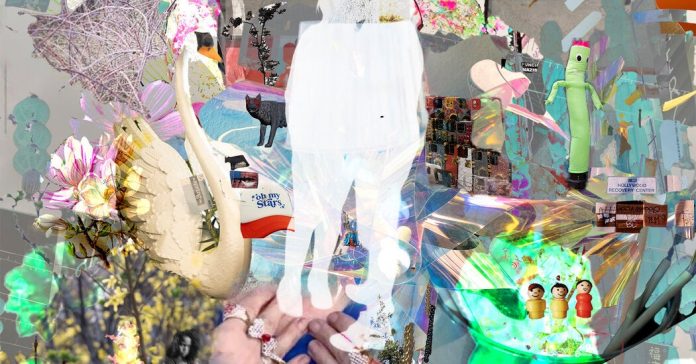
This year we’re again inviting teenagers to document, reflect and express themselves on the challenges and opportunities of growing up in today’s world — but this time we’re asking you to do it by sending us visual pieces only. That means any photo, cartoon, graph, chart, video, painting, drawing, illustration, or work of design that addresses any or all of the three questions in italics above.
Please note, however: This is not a traditional art contest. If you’re reading this and you’re worried you’re “not an artist” and have nothing to contribute, please know that you do. Just as in past years, we’re much more interested in what your piece says about the teenage experience than we are in its technical merit. Plus, you can work alone or with others to make your piece.
Our goal is always to tell as nuanced a story about teen life as possible, and we’re looking for artifacts you already have as well as new work you create. For example, you probably have images on your camera roll right now that would provide interesting answers to the questions at the top of this post. (To see the wide range of work we’ve honored in the past, check out our collection, 40 Works of Visual Art That Show What It’s Like to Be a Teenager Today.)
So think creatively, and don’t forget that every submission must be accompanied by an artist’s statement that explains your process and tells how your work addresses our theme.
Our F.A.Q. and Resources sections below offer much more detail, along with a range of examples.
Questions? Post a comment here or write to us directly at LNFeedback@nytimes.com. You might also consider hanging this PDF one-page announcement on your class bulletin board.
What to Submit
Your submission will include two parts: a visual piece that documents teenage life in 2026, and an artist’s statement that details your process and explains how it relates to that theme.
Your entry must respond to at least one of these focus questions:
What is it like to be a teenager right now?
What are the unique challenges your generation faces?
What special opportunities does the world of 2026 offer young people?
Your submission can be funny or sad, raw or polished, focused on a tiny moment in April or reacting to an entire global movement. It can be deeply personal, or it can reflect the experiences of others.
It’s up to you what to express, as long as you address one or more of the questions above. Our related guide will take you through 40 winning works of teen art created for past iterations of this contest that we hope will inspire you.
1. The visual piece can be an artifact you already have, or something new you create for this contest. It could be a …
Photograph
Video (no longer than 2 minutes)
Cartoon or comic
Collage or work of mixed media (assuming all the elements were created by you)
Graph, chart, map or other data visualization
Drawing or illustration
Painting or work of printmaking
Sculpture
Work of fashion, architecture or graphic design
Anything else that you can capture in an image and upload digitally that shows us something unique, interesting or important about teenage life in 2026.
Use your imagination, and if you’re not sure something “counts,” please email us at LNFeedback@nytimes.com.
2. The artist’s statement gives you up to 400 words to tell us in detail about your process — when, where, how and why you created or acquired the piece — and asks you to tell us how it relates to one or more of our focus questions, above.It also gives you the option of further documenting your process via photos or videos.
As our rubric shows, this statement is an important part of the submission, so we hope you will craft it carefully.
The Rules
Please review the full official rules before submitting an entry. You can find more details in the Frequently Asked Questions section below.
Your submission must include a visual piece. The visual piece can be any image or video that you can upload to our system digitally.
Your entry must also include an artist’s statement of up to 400 words that tells us when, where, how and why you created the piece, and how it relates to our theme of what it’s like being a teenager in 2026. You also have the option of including photos or videos that document your process.
All submissions should include only your own work. For example, if you create a collage, none of the images can come from the work of others.
Videos can be no longer than two minutes and should beuploaded to YouTube. You’ll need to provide the URL and make sure you have not set your upload to “private.”
Update, Nov. 9:Be sure to use non-copyrighted sound effects or music. Please be sure to use only sound effects or music that you have permission to use for your podcast and that do not violate the intellectual property rights of any person. Here are some ways to do that: 1. Don’t include any sound effects or music. 2. Create your own sound effects or music using instruments or audio editing software. 3. Look for copyright-free sound effects and music, or sound effects and music that are in the public domain, such as some of the files on Freesound and SoundBible.
Nothing you submit can contain content that was generated, modified or enhanced by generative A.I. tools (tools that create new text, images or video based on user prompts). These tools include, but are not limited to, chatbots like Gemini, Claude, ChatGPT and Perplexity and image generators like Adobe Firefly, DALL·E and MidJourney. While you can use video and illustration programs including, but not limited to, CapCut, iMovie, Adobe Premiere Pro, Canva, Procreate, Ibis Paint X and Adobe Photoshop, you cannot use A.I. features that automatically add, generate or fill in parts of your image or video (such as auto-generating backgrounds, inserting A.I. objects or applying A.I.-style filters). Standard adjustments like cropping, color correction or brightness are completely fine.
We want to know as much as possible about how you created your work, and sothe submission form includes an optional field where you can upload photos or video documenting your process. For example, you can submit photos of your half-finished painting or illustration; a screenshot of your video editing timeline; a built-in time-lapse video from your drawing app; or screenshots showing your art software’s digital layers. In addition, please save all raw files related to the creation of your work, including the original photo files, raw footage, or layered digital files, in case our judges ask that you share them with us.
You cannot submit anything you have already published elsewhere, including in a school newspaper. You can, however, send in work you have posted on social media, if the work is your own. (Please do not send a link to the social media post itself, however. Just send the work.)
Please also keep in mind that The New York Times has a global audience, including many families, so your submission should be appropriate for a broad audience. (For instance, please avoid cursing.)
You can work alone or with others. However, your name can be on only one submission.
Students ages 13 to 19 in middle school or high school are eligible to participate, and all students must have parent or guardian permission to enter. Please see the F.A.Q. section for additional eligibility details.
Students from anywhere in the world who meet these age requirements may participate. However, submissions must be created for an English-speaking audience. Entries cannot be processed through automated translation tools, including Google Translate and other generative A.I. tools.
All entries must be submitted by 11:59 p.m. Pacific time on Dec. 9, 2026, using the submission form below.
Resources for Teachers and Students
Frequently Asked Questions
Below are answers to your questions about submissions, judging, the rules of the contest and teaching with this contest. Please read these thoroughly and, if you still can’t find what you’re looking for, post your query in the comments or write to us at LNFeedback@nytimes.com.
Questions About Submissions
This year you’re only allowing images and video, while in the past you also allowed writing and audio. Why?
The Learning Network has been running contests for nearly two decades now, and a vast majority of them have focused on writing. We also have an annual podcast contest. This year we wanted to focus at least one contest solely on visual expression.
Another inspiration? The daily New York Times. Increasingly, the paper uses short videos, photo essays, charts and graphs, comics and illustrations to report on what’s happening in the world. One of our jobs on The Learning Network is to help students see how the skills they learn in school translate to “real life,” and we hope this contest will encourage them to understand a broad range of ways to communicate information and to experiment with some themselves.
But I’m not a visual artist. Do I have anything to contribute?
Yes! As we say above, artistic merit is not the main focus of this contest. Instead, we’re much more interested in telling a rich story about the teenage experience right now. And no matter who you are, you have something to add to that story that no one else can.
You can also take a look at this additional guide that spotlights pieces from more of the 2020 finalists, many of which became part of a book of teen work we published. There you can see artifacts students found that include a to-do list, a recipe, a diary entry and a “toilet paper projection chart.” You can also see new work including a collage of selfies, a “food log” in photos, and a political cartoon.
Those pieces were honored because they made us think, or made us laugh, or showed us in a fresh way what was on the minds of teenagers that year. You can also make or find things like them.
So look around you and think about how to capture your experience, or your friends’ or classmates’, in a way that gives you creative satisfaction.
OK, so can I take a photo of my writing? Would that count?
You could, and in some cases that might work well. For instance, an image of a diary entry, letter or recipe, assuming the writing is legible, could be a valuable artifact. But simply sending us a picture of a poem or essay you’ve typed up isn’t in the spirit of this challenge.
Is digital art allowed?
Yes, but the digital creation must be done by you. (We do not allow A.I.-generated images. Please see our rules above.)
Can we make work that is about the same subjects as students in previous versions of this contest?
Of course! We know that big topics like technology, relationships, and the stresses of high school concern every teenager. Just do your best to make a piece that shows a unique angle on the topic that is grounded in the specifics of your life and point of view. What have you experienced about this theme that others may not have? What’s meaningful to say about that?
Why are the artist’s statements so important? What should I write? What will you do with them?
We will read your artist’s statement alongside your work to understand how you made your piece and how it relates to our theme. If your work is selected as a winner, we will also publish an edited version of your statement as a kind of caption for your piece.
We have found over the years that the context each statement adds makes the winning collection as a whole more powerful for our audience. The statements also help show how students came at the same theme in different ways and highlight the nuances of each work. We hope that you’ll write it in your natural, informal voice, and explain as well as you can how and why you made your piece, and what it shows about being a teenager today.
Keep in mind that we have heard from many teachers that writing these statements is immensely helpful to students. Often, doing the metacognitive work of stepping back from a piece and trying to put into words why and how you made artistic choices, what you wanted to express, and how the work connects to a larger theme can help you see your piece anew and figure out how to make it stronger.
We hope you’ll compose your statement as carefully as you do your main piece because, as you can see from our rubric, it is an important part of the submission overall.
_________
Questions About Judging
How will my work be judged?
Your work will be considered by New York Times journalists as well as Learning Network staff members and other educators. We will use this rubric to judge entries. Judging for our contests is blind, meaning we see only the entries themselves when we make our decisions, not the names of specific students or schools.
What’s the prize?
Having your work published on The Learning Network and being eligible to be chosen to have your work published in a print edition of The New York Times.
When will the winners be announced?
It takes about two to three months to judge this contest. We hope to announce winners by early April 2027.
My piece wasn’t selected as a winner. Can you tell me why?
We typically receive thousands of entries for our contests, so unfortunately, our team does not have the capacity to provide individual feedback on each student’s essay.
_________
Questions About the Rules
What is your A.I. policy?
To ensure that our contests remain rich learning opportunities, as well as honest and fair, we have the same rule for everyone, across all our challenges: Nothing you submit can contain content that was generated, modified or enhanced by generative A.I. tools (tools that create new text, images or video based on user prompts). These tools include, but are not limited to, chatbots like Gemini, Claude, ChatGPT and Perplexity and image generators like Adobe Firefly, DALL·E and MidJourney.
To clarify, if you are participating in our contests you are NOT allowed to:
Use an A.I. tool to generate a draft or image that you later revise.
Use an A.I. tool to revise or polish a draft or image you have created yourself.
Use any phrases, sentences, paragraphs, sounds, images or video clips generated or suggested by an A.I. tool.
Use an A.I. tool to translate a work from one language into another.
This policy is guided by the New York Times-wide A.I. policy: Times journalists and freelancers are not permitted to use A.I. to write articles.
Having your work published in The New York Times is a privilege. Just like our journalists, you are responsible for what you submit. Work that we determine has violated our A.I. policy will be removed from consideration.
Who is eligible to participate in this contest?
This contest is open to students ages 13 to 19 who are in middle school or high school around the world. College students cannot submit an entry. However, high school students (including high school postgraduate students) who are taking one or more college classes can participate. Students attending their first year of a two-year CEGEP in Quebec Province can also participate. In addition, students ages 19 or under who are not enrolled in college, either because they are taking a gap year or because they are no longer attending school for any reason, can participate.
The children and stepchildren of New York Times employees are not eligible to enter this contest. Nor are students who live in the same household as those employees.
My piece was published in my school newspaper. Can I submit it to this contest?
No. We ask that your creation be original for this contest. Please don’t submit anything that was already published —in a school newspaper, in another contest or anywhere else — at the time of submission.
You can, however, send in work you have posted on social media, if the work is your own.
Whom can I contact if I have questions about this contest or problems submitting my entry?
Please post any questions in the comments section or write to us at LNFeedback@nytimes.com.
_________
Questions About TEACHING WITH THIS CONTEST
I’m not an art teacher. Can I still use this contest in my classroom?
Yes! During the six years we have run this contest, we have heard from schools all over about how they used the related curriculum in their classrooms to help students reflect individually and build community together. Here is one great example of how two schools used the project that way.
But you can also use it to build subject-specific skills. For instance, if you are a STEM teacher, you might have students create data visualizations of some aspect of their lives, especially if, perhaps, you are a fan of our What’s Going On in This Graph? series and want your students to try making their own charts, graphs or maps.
For social studies teachers, this contest might be a creative way to help students reflect on how world, national and local news affects them. Finalists have sent us work that responded to events like the 2020 presidential election, the Capitol riot on Jan. 6, 2021, and state book bans; to laws and policies on climate, artificial intelligence, race, gender, and sexuality; and to a culture of news — and misinformation — overload.
For English teachers, this contest offers a range of ways for students to think about how meaning-making works in different mediums, and to experiment with composing in those mediums themselves. The related writing prompts and exercises can encourage your students to do the kind of reflection and documentation that can lead to further narrative, persuasive or informative pieces focused on the issues that matter to them. The prompts can also serve a practical purpose, like writing a college essay. And, of course, if you are teaching a “coming of age” unit, your students might use this assignment to reflect on their own experiences of growing up.
We hope you’ll have fun with the possibilities!
Do my students need a New York Times subscription to access these resources?
No.
Students can get free access to Times pieces through The Learning Network. All the activities for students on our site, including mentor texts and writing prompts, plus the Times articles they link to, are free. Students can search for articles using the search tool on our home page.
However, if you are interested in learning more about school subscriptions, visit this page.
How do my students prove to me that they entered this contest?
After they press “Submit” on the form below, they will see a “Thank you for your submission.” line appear. They can take a screenshot of this message. Students should also receive a confirmation email within an hour of submitting, though some school email systems block emails from an external address.
Submission Form
Please read the following carefully before you submit:
Students who are 13 and older in the United States or the United Kingdom, or 16 and older elsewhere in the world, can submit their own entries. Those who are 13 to 15 and live outside the United States or the United Kingdom must have an adult submit the entry (push the “Submit” button) on their behalf. We have this rule because in some countries children under the age of 16 cannot legally agree to the terms at the bottom of the submission form.
The holidays are coming, and if you’ll be gathering with family and friends, you might have an opportunity to sit down and talk with someone you admire, whether an elder in your family, a mentor or a person who has played an important role in your life.
In an article about how interviewing loved ones brings you closer and offers a window into the past, Dana G. Smith writes:
For the person being interviewed, the experience can help with “a sense of life completion and a sense of being heard and understood and being able to tell their story,” said Dr. Ira Byock, an emeritus professor at the Dartmouth Geisel School of Medicine specializing in palliative care.
To get started, choose a quiet time and place where neither of you will be distracted (in other words, not around the Thanksgiving table). Keeping the setting casual can help the person to open up, and using your cellphone to record the audio can feel less intrusive than video.
The article then goes on to suggest five types of questions to ask. Before you see The Times’s recommendations, brainstorm — alone or with others — a series of questions for each of the categories below:
— Lighthearted questions: Use these as a way to ease into the interview. What fun questions could you start with?
— Sensory memories from childhood: Questions that invite people to describe long-ago moments through what they saw, felt, smelled, tasted, touched or heard can help people unearth vivid memories. What kinds of questions might help people remember these kinds of moments?
— Ask about favorites: What questions can you come up to help your interviewee reminisce about high points in their lives? (Keep in mind, however, that questions about the “best” or favorite can feel daunting to answer. Instead, ask about “one of the best” or “one of your favorites.”)
— Dig deeper: Once you’ve broken the ice and are talking comfortably, what questions could you ask that might encourage this person to reflect more fully on their life and its key moments?
— Often-told stories: Don’t forget to invite this person to retell stories they might have told many times before — whether about themselves, their parents or even about you. Which ones do you remember hearing?
When you’re finished with your own brainstorm, take a look at the five questions The Times recommends, and the advice that goes with each. Feel free to add any of these questions to your list!
Finally, make plans to interview your relative, friend or mentor. When and where could this conversation take place? Would you and your interviewee like to record it? If so, what might you do with it when you’re done? For some ideas, see the StoryCorps initiative below, which offers helpful tips whether you participate in their Great Thanksgiving Listen or not.
Every job across every industry is being reshaped by AI, but many professionals struggle to identify the right AI skills they need and where to start. Today, we’re introducing AI Series on Coursera, 12 expert-curated learning plans that help professionals build and apply AI skills in their fields.
From business, leadership, and finance to software development and engineering, each AI series brings together world-class courses, Specializations, and hands-on projects from leading universities, companies, and subject-matter experts. These curated plans are guided by custom skills maps that use industry research, professional standards, and labor-market data to identify the capabilities professionals need. For example, both engineering series are built on the AI Engineering Skills Map, created by one of the world’s foremost AI experts, Andrew Ng, and informed by more than 10,000 job postings and interviews with practitioners.
“AI capabilities are changing what we can build; AI coding agents are further changing how we build. As a result, the world needs more people skilled in AI engineering; but the nature of development work is changing. A skills map gives learners a systematic way to identify and focus on what are the most valuable skills even as the tasks in our jobs are being transformed by AI,” said Andrew Ng, one of the world’s foremost AI experts and creator of the course AI for Everyone.
Our initial launch includes courses across many domains:
Business and leadership
AI for Business Leadership Series: Develop adoption strategies, oversee governance, and lead teams through change. Includes content from Saïd Business School, University of Oxford, SAS, and the University of Michigan.
AI for Project Management Series: Improve project planning, delivery, stakeholder communication, and risk management. Includes content from Hult International Business School, Scrum Alliance, and Vanderbilt University.
AI for Finance and Accounting Series: Streamline forecasting, financial analysis, accounting workflows, and reporting, with appropriate review and controls. Includes content from Google Cloud, IBM, and Rutgers University.
AI for Product Management Series: Accelerate product research, shape strategy, and build working prototypes. Includes content from Duke University, Google, and Replit.
AI for Digital Marketing Series: Develop campaigns, create content, and analyze marketing performance. Includes content from Adobe, Meta, and Unilever.
AI for Healthcare Management and Operations Series: Improve healthcare workflows, coordinate care, and strengthen operational decision-making and governance. Includes content from Microsoft, Stanford Online, and the University of Glasgow.
Data, technology, and engineering
AI for Data Analytics Series: Accelerate data preparation, analysis, visualization, and forecasting. Includes content from Google Cloud, Microsoft, and Vanderbilt University.
AI for Cybersecurity Series: Secure intelligent systems and strengthen threat detection, response, and governance. Includes content from IBM, Johns Hopkins University, and Macquarie University.
AI for Information Technology Series: Deploy cloud workloads, automate operations, and strengthen infrastructure security and governance. Includes content from AWS, DeepLearning.AI, and Microsoft.
AI for Software Development Series: Learn to direct coding tools, review and test outputs, and deploy software. Includes content from DeepLearning.AI, Google, and Microsoft.
AI Engineering: Using Coding Agents Series: Learn to direct coding agents through planning, execution, and monitoring. Includes content from Anthropic, UiPath, and Vanderbilt University.
“Imagine handing someone a book and saying, ‘Here—figure out how to read and write.’ We’d never do that. We teach people the patterns of language: how words fit together, how sentences carry meaning, and how to organize ideas clearly. Yet with AI, we often hand people the technology and say, ‘Go figure it out.’ AI has patterns to learn, too: writing effective prompts, decomposing problems, sequencing prompts, and building agents and tools. Just as people need expert instruction to become effective readers and writers, professionals need structured, expert-led learning to master the patterns of solving problems with AI,” said Dr. Jules White, Senior Advisor to the Chancellor on Generative AI, Vanderbilt University. Creator of the course Chat with Your Data: Generative AI Powered SQL Data Analysis
In Coursera’s 2025 Learner Outcomes Report, 94% of surveyed full-time professionals who completed GenAI content reported a positive impact at work, while 42% of surveyed GenAI course completers reported a salary increase since enrolling. AI Series helps professionals identify the skills that matter, build those capabilities, and apply them to move their career forward.
Join Coursera Plus
to explore AI Series and take the next step toward your career goals.
Coding has always served two purposes: the intrinsic drive to build something, and the practical path to a lucrative career. Even the most passionate code aficionados don’t dream of variables or syntax — they want to make a website, a tool, a game. For years, the career upside was impossible to ignore. You could land a stable SWE job, bootstrap your own app, or join a buzzy startup as a first hire.
Generative AI flipped the script. AI now handles the repetitive tasks that used to define entry-level developer roles. At the same time, the barrier to entry for coding and building is lower than ever — you can spin up a working prototype with just an idea and a natural language prompt.
This shift hasn’t eliminated the desire to code, but it’s changed what and who coding is for. If you’re not learning to land a junior dev role, you’re learning to build the thing you’ve been imagining, to add a technical skill to your existing career, or to understand the tools you’re already using at work. And here’s the catch: those goals all require understanding your code, not just having code that works.
At Codecademy, all of these changes excite us about the future of learning to code. We’re introducing the AI Builder, a new project-based learning tool that flips the script by teaching you how to work with AI-generated code from the start. Our approach brings together the immediacy of modern AI tools and the rigor of real instructional design.
Why we created the AI Builder
AI’s speed and efficiency often come with a tradeoff; you can get working code immediately, but you don’t really know what it’s giving you or why it’s built a certain way. Developers use the term “vibe coding” to describe this phenomenon — it’s fast, fun, but shallow; great for demos, less great for long-term skill-building.
If your goal is to understand what you’re building, generic AI output alone won’t get you there. And the more you push these tools into real-world complexity, “the harder it is for them to give you exactly what you want,” says Zoe Bachman, Head of Learning at Codecademy.
Switch to Learn for behind-the-scenes insights and your personalized roadmap.
With the AI Builder you get an education along with the AI output. In the workspace, you can toggle between two tabs: Build, where you work directly with a project and can modify and change code in real time; and Learn, where you get a personalized learning roadmap that’s based on your project.
“We pair the experience of having a working app with a learning path that allows you to reverse engineer how it’s built, so you can deeply understand it and modify it confidently,” Zoe says. We’re calling our hybrid approach to learning-driven development “vibe learning” — it’s powered by AI guidance but rooted in learning science.
Build first; learn continuously
With AI Builder, you start with what you want to do: build the thing in your head. Whether that’s a habit tracker, a portfolio site, or the seed of a bigger idea, you don’t need to have prior coding knowledge to learn and build with the AI Builder. In other words, there are no pre-requisites for creation.
You create a prototype by typing what you’d like to create in natural language. The AI chatbot will ask a few clarifying questions about your needs and overall goal before generating the project. Once the project is created, you can use the chat function to continue describing what you want. (You’re also welcome to go right into the code and start making changes if you already know your way around!)
“It was fun to build something so quickly and be able to see the code and a learning plan for it,” says Grace Krishna, a Code Crew member who beta tested the AI Builder.
When you need clarity on what’s going on behind the scenes in your code, or you hit a wall with AI, that’s a great time to flip over to the Learn tab.
We’re calling our hybrid approach to learning-driven development ‘vibe learning’ — it’s powered by AI guidance but rooted in learning science.
Your project becomes the curriculum
Rather than teaching concepts in the abstract and hoping learners translate them later, AI Builder removes that translation tax entirely. “We’re showing you specifically your code from your project and helping you understand it,” Zoe says.
Rework your prototype in real time with the help of AI.
To build that personalized curriculum, the AI Builder breaks your project’s code into clear milestones and tasks. For each task, it generates an interactive learning loop, which is an activity designed to help you form a mental model of what your specific code is doing.
These loops help you understand the logic behind each part of your project, so you can confidently apply the same thinking to other sections, or even future projects. This approach also ensures everything you learn is directly relevant to what you’re making — so you don’t have to guess when you’ll ever use this.
Why this is vibe learning (not vibe coding)
A key misconception about AI‑assisted development is that it makes learning superficial. AI Builder challenges that by grounding the entire experience in learning science rather than simple code generation. Our entire system is intentionally designed for you to retain knowledge. So, while it might not feel like you’re taking a course, you’re absorbing key concepts just by interacting with AI-generated code.
A Socratic AI, not an answer-spitting chatbot
Our educational AI chatbot is designed to guide you toward an answer through an in-depth questioning approach that’s based on the Socratic method of teaching. Instead of spitting out shortcuts or answers like AI typically does, you get strategic nudges, hints, and questions that build durable mental models.
Research on AI in education shows that just providing an answer makes it harder for learners to retain the information on their own. Zoe compares the Socratic AI to “a personalized tutor, facilitating you acquiring more knowledge, so you’re not totally left on your own.” Our method encourages you to think critically so you really grasp the concepts and can continue to use them in the real world.
Learning loops with real instructional design
Behind the scenes, every learning loop in the Learn tab is built on proven frameworks like inductive learning and the 5E model, a popular STEM teaching framework that’s shorthand for engage, explore, explain, elaborate, and evaluate.
You’ll notice that the questions and exercises in the Learn tab feel different than the rest of our courses and paths, and that’s intentional. “The learning loops are designed very well — they get you there inductively,” Zoe says. They’re exploratory without being overwhelming, and evaluative without feeling like tests.
Negar Vahid, a beta tester for the AI Builder appreciated the AI’s interactive question format. “The question-based learning feels engaging, and the starter project it builds is simple but useful,” she says.
This structure ensures you don’t develop the wrong mental models — a known risk in fully constructivist or student-centered environments — while still giving you the freedom to explore.
Why learn when AI can build?
There are some projects that are well-suited for simply vibe coding, like making a personal HTML website or a single-use script to automate a one-time task. Tools like Lovable and v0 are suited exactly for these types of projects.
The longer your code needs to live, and the more complex your project becomes, the more you need to actually understand what you’re building. Joe Holmes, Codecademy Curriculum Developer in the AI and machine learning domain, uses the term “ignorance debt” to describe what happens when you don’t:
“It’s like tech debt squared. It’s much, much worse,” Joe says. “You don’t know what kind of code is coming out. You just are only looking at: Does this kind of generally appear to be what I asked for? You don’t know if there are security flaws. You don’t know if there are performance flaws. You don’t know if you’re leaking sensitive information. You don’t know how to fix anything.”
The tipping point comes down to two factors: complexity and time. If you’re developing software professionally, you’re legally responsible for the code you output. If you’re building something that will serve actual users, you need to be accountable for security, performance, and maintainability. And if your project will need updates or fixes over time (which most do) understanding your codebase becomes essential, not optional.
The good news? Learning doesn’t have to feel like eating your vegetables. “Kids hate veggies and broccoli because we don’t cook it well enough to make it tasty when we first introduce it to them,” says Nhi Pham, Codecademy Curriculum Developer. The same is true for teaching AI: “If you do it well, you’re inspiring people to have these very hygienic practices when working with AI,” she says.
That’s exactly what AI Builder is designed to do — make learning feel as immediate and rewarding as building, so you develop good habits from the start rather than building a lifelong aversion to understanding your own code.
Get started with the AI Builder
AI isn’t a replacement for learning, it’s a tool — and a powerful one when it comes to education. Our new AI Builder allows for “just‑in‑time learning that’s highly personalized,” Zoe says. Even the best teachers or bootcamps can’t deliver that for every learner, on every project, instantly. Perhaps the most exciting vision is how AI changes what a learning environment can be.
Zoe described it beautifully: “I imagine the AI Builder as a workspace… like having all your resources around you and an AI tutor in the background.”
That’s the shift: from learning before you build to learning while you build. We can’t wait to see what you create.
Historically, federal standards required that a manufactured home have a permanent steel chassis for safer portability. That requirement makes little sense today: Few manufactured homes are moved after installation, and adding a steel chassis increases building costs and generally precludes the addition of basements, second stories and other variations in manufactured homes that consumers want.
The new law removes the chassis requirement, setting up HUD to adjust related regulations to expand the range of affordable entry-level homes coming off the assembly line. Perhaps more important, it would begin to blur the line between manufactured housing and modular housing — homes with sections made in factories and then assembled on a housing site.
Daily Word Challenge
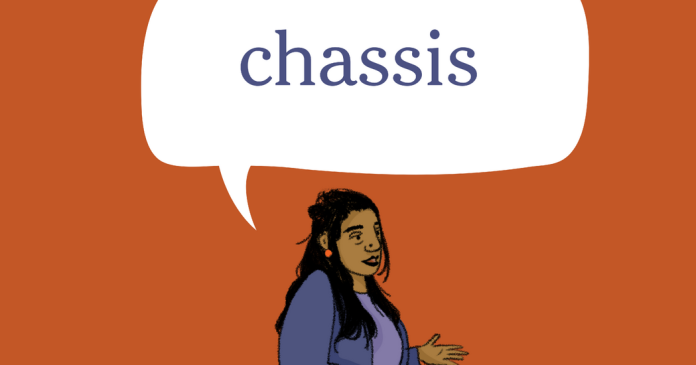
Can you correctly use the word chassis in a sentence?
Based on the definition and example provided, write a sentence using today’s Word of the Day and share it as a comment on this article. It is most important that your sentence makes sense and demonstrates that you understand the word’s definition, but we also encourage you to be creative and have fun.
If you want a better idea of how chassis can be used in a sentence, read these usage examples on Vocabulary.com. You can also visit this guide to learn how to use IPA symbols to show how different words are pronounced.
Students ages 13 and older in the United States and the United Kingdom, and 16 and older elsewhere, can comment. All comments are moderated by the Learning Network staff.
Today, only about 57 percent of teenagers obtain a driver’s license by the end of high school. In the 1980s and ’90s, that number was more than 80 percent. Does that statistic surprise you?
If you’re old enough to have a license, did you complete this rite of passage as soon as you were able? If you’re not yet old enough, do you have a plan to get your license when you are? Or, is being able to drive not that much of a priority to you?
While the decline in teen licensure has attracted headlines for more than a decade, some of the most common theories about its causes are also the flimsiest, said Jean M. Twenge, a professor at San Diego State University and the author of the book “Generations.”
For one, the decline in teenagers’ getting their driver’s licenses began well before ride-sharing apps existed. (Uber did not allow teens to ride alone until 2023; Lyft didn’t until this year.) And while teenagers with lower household incomes are more likely to delay getting their licenses, the overall trend has not fluctuated with economic upturns or downturns, she added.
Rather, she credits the shift to a broader pattern of American teenagers postponing the milestones associated with adulthood.
As improvements in medicine and technology have extended American life expectancies, parents have been having fewer children, who grow up with less independence — a phenomenon that Twenge calls a “slow-life strategy.” Today’s teenagers are also less likely to date, work, drink alcohol and have sex than those in previous generations. (Would the famous “Clueless” stinger — “You’re a virgin who can’t drive” — even be an insult anymore?)
“They have gotten more attention from their parents, their parents are more likely to not encourage independence, maybe not even allow independence,” she said. For a person who never walked to school alone as a child, “the prospect of getting a driver’s license on your own is scary, because you haven’t done these intermediate steps.”
She added: “If you think about the emotions that were associated with getting a driver’s license back then, it was just, like, longing and impatience. And now it’s fear and anxiety.”
The article continues:
Since the 1990s, the internet has also enabled more socialization and entertainment to take place inside the home. Teenagers no longer need to drive to the theater to see a movie (they have Netflix) or the mall to buy a new pair of jeans. (Online shopping, anyone?)
Ky Rogers, a 17-year-old in Lakeville, Minn., said that most of her friends had not been rushing to get their licenses. She plans to get hers sometime next year, but for now she calls herself a “passenger princess” who is content to coordinate rides with her parents and friends.
“I genuinely think it’s because we do everything online now,” she said. “We see each other online, hang out online, call, text, everything.”
Ky’s mother, Tanya Rogers, 56, said she was shocked by her daughter’s reluctance to start driving. As a teenager in the 1980s, she rushed to take her road test so she could drive to her job at a movie theater, and more generally so she could skirt parental supervision.
She is not pushing Ky to drive, especially because she knows that insurance gets less expensive as a teenage driver gets older. Mostly, Tanya said, “I was pleasantly relieved that she didn’t need to escape from my husband and I.”
How much does what you read in the article reflect your observations about teens and driving? How important is it to you and your peers to be able to drive? Why do you think fewer young people are rushing to get their license?
When you think about driving, how do you feel? Do you associate being behind the wheel with freedom and maturity or, as Professor Twenge suggests, fear and anxiety? What else comes up for you?
If you drive, what was the experience of learning like? Who taught you? How did you prepare for any tests you had to take? How did the tests go? How did you feel afterward?
The article raises points about teens and independence: that some aren’t given much freedom by their parents, while others don’t particularly seek out experiences independent of the family, like driving, getting a job or starting to date. Do you think your generation is in more or less of a hurry to grow up than generations past? Why do you think that is?
The article suggests that teen life now is different in many ways from teen life in decades past. What are the most significant changes, in your opinion, based on what you’ve learned from your parents about what their childhoods were like? What might they not understand about what it’s like to be a teenager today?
Students 13 and older in the United States and Britain, and 16 and older elsewhere, are invited to comment. All comments are moderated by the Learning Network staff, but please keep in mind that once your comment is accepted, it will be made public and may appear in print.
The midterm elections this month didn’t just deliver a decisive swing in political power in the U.S. House and Senate. They might also represent a fundamental shift in how elections are thought about and analyzed.
Prediction markets like Polymarket and Kalshi, where people bet on elections just as they might bet on a basketball game, use math to turn betting data into predictions of real-world outcomes.
For example, on Nov. 1, Polymarket used its data to predict that Democrats had a higher than 70 percent chance of taking control of the U.S. Senate. Now, according to the article “How Accurate Were Prediction Markets at Picking Midterm Winners?,” whether prediction markets can accurately anticipate election results has become a key question:
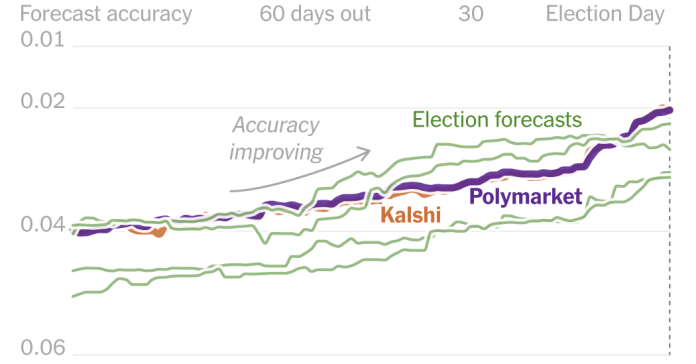
An analysis by The New York Times, using statistical methods, found that for most of the midterm race, prediction markets performed no better than election forecasts, which produce odds using polling and other indicators instead of betting activity. But as Election Day neared, prediction markets performed better as forecasts and polling became stale.
The nature of prediction and the role of prediction markets
Ask your students these questions:
First, take a look at the graphs at the top of the article about the predictive accuracy of Kalshi and Polymarket in the midterms, clicking through the four categories (House & Senate, Senate, House, Governor). Note: The green lines represent four different election forecasts, which produce odds using polling and other indicators instead of betting activity. What do the graphs show? What conclusions can you draw?
According to the article, Polymarket assigned Senator Darline Graham a 70 percent chance winning her election in South Carolina. What does it mean to say that someone has a 70 percent chance to win an election? How is this kind of statement different from a statement like “When a fair six-sided die is rolled, there is a roughly a 33 percent chance that a 5 or a 6 will appear”?
In fact, Ms. Graham lost her election to the Democratic challenger Annie Andrews by around 90,000 votes. Given the outcome, how do we think about the prediction that she had a 70 percent chance to win? Does it mean that the prediction was incorrect? What exactly constitutes evidence for, or against, a claim like this?
The prediction markets publicly celebrated their successful predictions. But Nate Silver, who himself found fame in 2008 for accurately projecting the election of Barack Obama, was less impressed:
Mr. Silver, the forecaster behind Silver Bulletin, said the accuracy of prediction markets was a direct result of work by pollsters and forecasters, who create the information that bettors have mostly relied on.
“In a world where these models didn’t exist, or if the models kept their forecast private, I don’t think the prediction markets would be as accurate,” he said in an emailed statement.
What does Mr. Silver mean by this?
If you’d like to go further:
Online prediction sites allow you to wager money on the existence of aliens, the return of Jesus and even the chances of nuclear Armageddon. We asked students this spring: Has betting gotten out of hand? To address some of the ethical questions around this topic, invite your students to read the piece and post their thoughts to our forum.
How do more traditional methods of election analysis compare to relying on betting markets? Students can see how pollsters and pundits did with their midterm predictions in July and September, and check them against the November results. Did they fare better or worse than the prediction markets? And were late polls suggesting big Democrat gains reliable, or were they overstating leads?
And when it comes to polling, students can learn more about margin-of-error calculations in this Upshot piece. They can also read about everything from data sources to how a winner is declared to concerns about how news reporting on polls might affect the polls themselves in this Times Insider response to reader questions about election coverage.
To learn even more about prediction markets, check out this article about a Polymarket “sharp” who bet over a million dollars on the midterms; this piece, “How Everything Became Gambling,” to delve into cultural issues; this one about the ethical and legal issues accompanying the expansion of sports gambling; and, finally, this piece about the possibility of corruption in prediction markets.
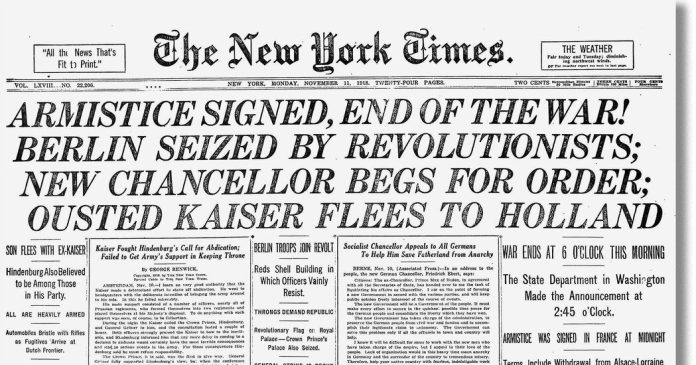
On This Day spotlights a historic New York Times front-page article. For teaching ideas, visit this resource.
Washington, Monday, Nov. 11, 2:48 A.M.—The armistice between Germany, on the one hand, and the allied Governments and the United States, on the other, has been signed.
The State Department announced at 2:45 o’clock this morning that Germany had signed.
The department’s announcement simply said: “The armistice has been signed.”
The world war will end this morning at 6 o’clock, Washington time, 11 o’clock Paris time.
The armistice was signed by the German representatives at midnight.
This announcement was made by the State Department at 2:50 o’clock this morning.
The announcement was made verbally by an official of the State Department in this form:
“The armistice has been signed. It was signed at 5 o’clock A.M., Paris time, [midnight, New York time,] and hostilities will cease at 11 o’clock this morning, Paris time, [6 o’clock, New York time.]
The terms of the armistice, it was announced, will not be made public until later. Military men here, however, regard it as certain that they include:
Immediate retirement of the German military forces from France, Belgium, and Alsace- Lorraine.
Disarming and demobilization of the German armies.
Occupation by the allied and American forces of such strategic points in Germany as will make impossible a renewal of hostilities.
Delivery of part of the German High Seas Fleet and a certain number of submarines to the allied and American naval forces.
Disarmament of all other German warships under supervision of the allied and American Navies, which will guard them.
Occupation of the principal German naval bases by sea forces of the victorious nations.
Release of allied and American soldiers, sailors, and civilians held prisoners in Germany without such reciprocal action by the associated Governments.
Read the article excerpt and then make a connection: How does this news event relate to what’s happening today in the world, in your community or in your own life? Post a comment.
If time allows, use the following prompts to dive deeper into today’s featured front page:
I think there will be the first girl president by then. It’s going to take a couple of years for everybody to start voting for girls. And I feel like the girl will be nice and kind. And probably arrest all the bad people.
Liam Kwon, Queens, N.Y.
What will technology be like in 2050?
We’ll still have laptops, but with chips that can read your mind. Maybe there could be a sensor in your brain, and whatever you’re thinking can just go into the app.
Will people go to space?
In the old days, they paid Americans to go to the West. They might pay people to go to space, because the population is so big that there might not be enough room.
Amani Green, Denver
What’s life going to be like in 2050?
Companies will start using A.I. instead of human workers. That’s probably going to cause a pretty big job shortage.
What will happen to people who lose jobs to A.I.?
Lots of anger. Probably protests. Just lots of outrage.
What will other technology be like?
Higher-class citizens will start owning robot butlers. But I feel like with the rise of robot butlers, humans will start to lose competence and basic everyday skills.
Sarah Fink, Denver
Where will you live?
I want to live in the ocean, honestly. I want to be an architect, designing homes underwater — coral-friendly hotels and apartments and homes. They’ll have underwater taxis, too. Or you could swim. That would be like walking.
Henry Zotti, Western Springs, Ill.
Will the world be in a better spot than it is today?
Way better. I just think it’ll be kinder, and a better environment. I think people are kinder each day.
Students, read the entire article and then tell us:
What do you think life will be like in 2050? Will we still draw, paint, read and write? Will we finally have jetpacks or hovercrafts? Will there be a female president? Will we still have nations and presidents? Will we be living on other planets? Let us know your predictions — big or small, realistic or fanciful.
How old will you be in 2050? What do you want your life to be like then?
What’s your reaction to the article? Which predictions by the 10-year-olds profiled in it do you think are most likely to come true? Which, if any, do you hope will become reality?
A lot of the children expressed worry about the future: skyrocketing prices, a loss of human interaction, war. But others, like, Henry Zotti, imagine a more hopeful, “kinder” world. Are you optimistic about the future? Do you think the world will be better or worse than it is now?
What do you think adults should be doing now to make sure that we have a better world in 2050? What could you do?
Students 13 and older in the United States and Britain, and 16 and older elsewhere, are invited to comment. All comments are moderated by the Learning Network staff, but please keep in mind that once your comment is accepted, it will be made public and may appear in print.