



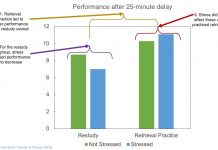
Retrieval Practice and Stress
School can be stressful, and 2020 has been a particularly stressful year for many of us. So, for this week’s blog, I thought I would write about retrieval practice and stress. Fortunately, I get to share some good news! Prior research has shown that acute stress can hinder our ability to retrieve information. Acute stress is…

Racism in the Classroom: Why Does This Keep Happening and What Can We Do?
If your institution has trouble hiring and retaining black academics there is no time like the present to ask yourself why. What are the barriers in your field or institution for black academics? As every publication in higher education keeps reminding us, we currently have more Ph.D.s than jobs for Ph.D.s in academia (though there…

Student Ability, Self-Regulated Spaced Practice, and Performance In Online Learning
Recording authentic student study behavior A recently published study by Carvalho, Sana, and Yan (1) contributes to the evidence base supporting spaced practice by approaching the question about the benefits of spaced practice differently: They recorded the authentic study behavior of students enrolled in an online course. The online course consisted of 12 units and…

A Statistics Primer for the Overwhelmed Educator
Factorial ANOVAs are a bit more complicated. A factorial ANOVA means there is more than one factor being examined. Maybe we’re interested in both multiple choice vs. short answer questions as well as whether the questions are factual or applied. There are two factors that require a factorial ANOVA. There can be more factors and…

Six Strategies for Effective Distance Learning: A Summary for Teachers
By Megan SumerackiCurrently, in 2020, most of us are engaging in some sort of distance learning, and planning to do so in the near future. So, in the most recent podcast, Episode 47, I talked about emergency distance instruction and a few ways that the six strategies could be implemented in distance courses. For today’s…
Time Management: What is it, who has it, and can you improve it?
Time management can refer to a wide range of behaviors and can look very different from person to person. There are lots of different systems and approaches to time management. Making a to-do list, keeping a planner, setting event reminders in your phone, setting goals, prioritizing tasks, and marking events on a calendar can all…
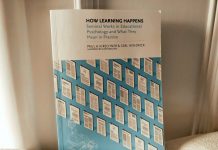
Book Review: How Learning Happens (Kirschner & Hendrick)
By Carolina Kuepper-TetzelA few weeks ago, Paul Kirschner contacted us and said that he co-wrote a new book with Carl Hendrick and wondered whether we would be interested in reviewing it in form of a blog post. So, here I am now, sitting in my living room: laptop on my lap, book by my side,…

Elaboration as Self-explanation
Self-explanation has been shown to be related to better understanding of concepts (2). In a correlational study, where the researchers identified which students used self-explanation naturally and compared this to performance on a concept test, Chi and colleagues showed that those who self-explained performed better. Chi and his research team wanted to know whether engaging…

Learning “Useless” Things in School is (Usually) NOT Useless
The challenge facing teachers is to prepare a diverse set of students for later situations that are not only varied, but likely different from ones we can even imagine in our current time. As technology rapidly changes our world, our instructors are set with the task of attempting to make students ready for whatever that…
Teaching Effectiveness vs. Teaching Evaluations
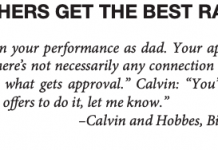
Header note, this quote appears at the top of the cited article by Kornell and Hausman (1)By Megan SumerackiFor most of us who teach in higher education, the end of the semester means administering teaching evaluations and can be a bit stressful for some. However, the beginning of each semester means reading those evaluations. In…
