
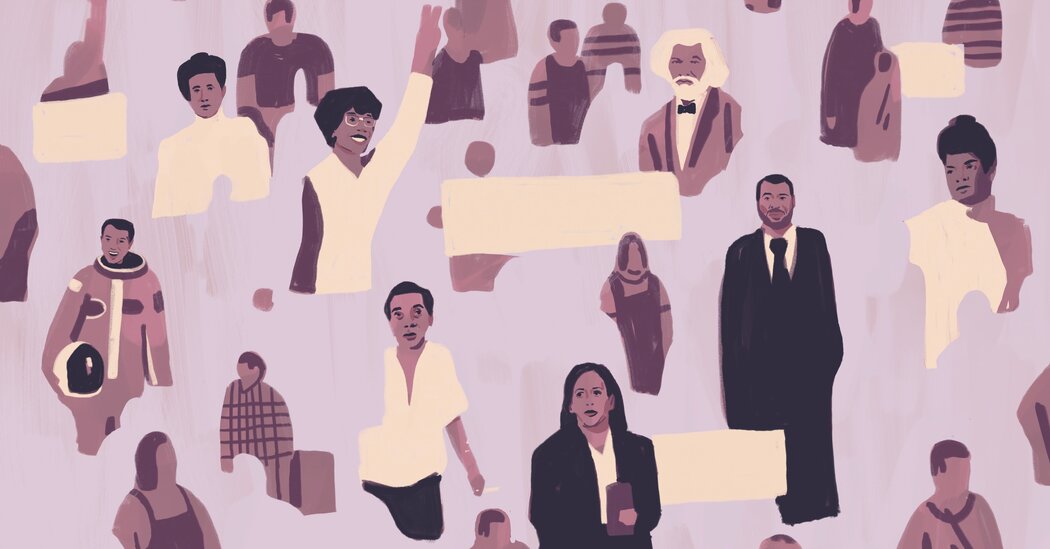
In “How Negro History Week Became Black History Month and Why It Matters Now,” Veronica Chambers and Jamiel Law tell the story about how Black History Month came to be:
Black History Month has been celebrated in the United States for close to 100 years. But what is it, exactly, and how did it begin?
In the years after Reconstruction, campaigning for the importance of Black history and doing the scholarly work of creating the canon was a cornerstone of civil rights work for leaders like Carter G. Woodson. Martha Jones, a professor of history at Johns Hopkins University and the Society of Black Alumni presidential professor, explained: “These are men [like Woodson] who were trained formally and credentialed in the ways that all intellectuals and thought leaders of the early 20th century were trained at Harvard and places like that. But in order to make the argument, in order to make the claim about Black genius, about Black excellence, you have to build the space in which to do that. There is no room.” This is how they built the room.
The article explains how Carter G. Woodson, the son of formerly enslaved people who went on to earn his Ph.D. at Harvard, is now known as the “father of Black History.” He created the first Negro History Week in February 1926.
Dr. Woodson believed deeply that a celebration of Black history would have lasting impact on future generations of leaders. As he reportedly told an audience of Hampton University students, “We are going back to that beautiful history and it is going to inspire us to greater achievements.” Determined to lead the charge to study that history, Dr. Woodson announced the first Negro History Week in February 1926.
He chose February because it was the month in which both Lincoln and Douglass were born. After Lincoln’s assassination, his birthday, on Feb. 12, had been celebrated by Black Americans and Republicans. Douglass Day, which was observed on Feb. 14, had grown in popularity since Mary Church Terrell had started it in Washington in 1897. Dr. Woodson saw Negro History Week as a way to expand the celebration of these two men and encourage Americans to study the little-known history of an entire people.
The article concludes by discussing the continued relevance of Black History Month today:
Why does Black History Month in particular, and the study of Black history overall, still matter so much? “There’s no question that history is and continues to be a battleground. The origin stories that we tell matter a great deal for where we set the bar and how we set the bar going forward,” noted Professor Jones of Johns Hopkins. “So when you talk about people like Carter G. Woodson, these are men who knew that if you don’t rewrite the history of Africans and people of African descent, if you don’t rewrite the history of the United States through the lens of Black history, if you don’t make that record and if you don’t make that case, there are [false] stories that will expand and go toward rationalizing and perpetuating racism, exclusion, marginalization and more.”
Students, read the entire article, then tell us:
What have you been taught about Black history in school? Do you feel that it is a subject that has been accurately and thoroughly taught? To what extent do you feel that the neglect and distortion of Black history, which was so common in schools in the past, still lingers today?
How have you learned about Black history outside of school, from your family or community or through your own exploration and curiosity?
Black History Month is not just about ensuring the study of Black history; it is also intended to be a celebration of the achievements and accomplishments of Black Americans. Do you feel that the month has helped accomplish that goal?
What did you learn about the origins and meaning of Black History Month from the article? What was most surprising and memorable?
An argument that some people make about history months in general, whether celebrating Black people, women or Native Americans, is that they confine the history of a historically marginalized group to a single month, when instead these histories should be fully integrated into education all year. What do you think? Do history months succeed in promoting complex and important histories that are otherwise neglected? Are they ever counterproductive? Why?
How Black history is taught in schools is still argued today. For example, a new Texas law forbids teaching that “slavery and racism are anything other than deviations from, betrayals of, or failures to live up to, the authentic founding principles of the United States.” A recent Florida rule bans the teaching of the 1619 Project in public schools. Published in 2019 by The New York Times Magazine, the 1619 Project “aims to reframe the country’s history by placing the consequences of slavery and the contributions of Black Americans at the very center of our national narrative.” And to date, more than 20 states — including New Hampshire, Michigan and Arkansas — have introduced regulations that restrict teaching about race and racism. What do you think of these efforts to restrict how schools teach about Black history, race and racism?
What topics related to Black history would you like to explore in more depth, either in school or on your own? Why?

