fbpx
Home Blog Page 1500

How to choose a career

0
How to choose a career

Whether you’re young and at school, you’ve recently graduated, or you’ve been in the same job for some time, there’s the chance you haven’t quite yet got to where you want to be in terms of having your dream job. 

The issue for many is either how to get to their final destination, or perhaps even not knowing what their ideal career looks like.

This article lays out some of the questions you need to answer and the hurdles you need to cross before choosing your perfect career.


What would you love to do if money wasn’t a barrier?

Although this isn’t going to be the question that puts the entire issue to bed, working out what your dream job is, regardless of money, is a great step to finding out what exactly you want to do. 

Even if not the perfect guide to the job you’re likely to take, this is a quick and easy method of eliminating some types of work that you would entirely avoid if given the opportunity. Whilst a “money is no object” thought experiment won’t resolve the problem, it narrows it down to a smaller list of solutions that you can use to identify your next career move.

How can you make money and do something you love?

Once you have a shortlist of things you’d like to do from the above question, you can further narrow down your career options by seeing which of them could realistically provide you with a living in the near-term future. 

There might be some roles that require you to work voluntarily rather than as a paid position, and, whilst you might enjoy the role, they won’t help you pay the bills. 

By taking into account the monetary factor, you can work out what career gives you the chance to do what you love and live comfortably without having to worry about your cost of living.

What sort of environment are you comfortable working in?

If you’re really ill-suited to working in an office environment or wouldn’t enjoy working from home, you’ll need to factor this into your decision. Although it can be difficult to find a job that also allows you to work where you want, working in the wrong environment can have detrimental effects, including work-related stress. 

Working in the wrong environment, even in what you consider to be a dream job, could be harmful to your mental health, and even make you dislike your passion.

What’s stopping you from changing career now?

When you’re moving from one career to another, there are always going to be some bumps in the road. 

For some, this comes in the form of a sparse CV. In other cases, there’s a skills gap that needs to be filled in order to do the job right in the case that you do change careers. 

In both cases, or any others you might come across, if you don’t make sure that these roadblocks are out of the way, then moving to your dream job could prove to be impossible. Training in cutting-edge areas, boosting your CV and your skillset in the process, could be a big jump along the path to job satisfaction.

What is my first step to a new career?

To start moving towards your new career, you’ll need to make sure you have the skills to do the job. FutureLearn can provide you with the courses and training you need to get up to speed.

We use a variety of online learning modules, including free short courses, to improve your skills level and prepare individuals for the role of their dreams. All our courses are 100% online, which means you can retrain in your own time, at your own pace, with a global community of learners.

If you still don’t know what your dream career looks like, explore FutureLearn’s Career Mapper. This uses a series of detailed questions to help you narrow down what exactly you want your career to look like – starting today.


COVID-19: The cultural impact of coronavirus

0
COVID-19: The cultural impact of coronavirus

To learn more about coronavirus, join our free online course COVID-19: Tackling the Novel Coronavirus, created by leading health experts at the London School of Hygiene & Tropical Medicine.


The effects of coronavirus are having a devastating impact on health services around the world. Beyond the immediate threat to life, COVID-19 is also laying waste to the cultural schedule, forcing cancellations and suspensions of some of society’s biggest cultural events.

Musical delays and cancellations

Major concerts and festivals such as Glastonbury have been cancelled. In South Korea, K-pop concerts have been suspended, while Country to Country, which is normally held in three separate locations (London, Glasgow and Dublin) has been postponed.

In the sporting world, Euro 2020 has been put on hold for a year, and all footballing fixtures put on hold until further notice. The Japanese government still insist the Tokyo Olympics will go ahead, although it looks more in doubt with every new announcement of travel bans and closed borders.

Green Day are among the musical artists who’ve moved to postpone tour dates. They were set to perform in Singapore, Thailand, the Philippines, Hong Kong, South Korea and Japan. Instead, they will begin their tour in California on 25th April, but of course, that too is subject to change if the virus continues to spread.

Most recently, Eurovision has announced its intention to suspend – for the first time – the 2020 edition of the beloved pop competition until next year.

James Bond delayed

The movie industry has also been scrambling to respond. The Chinese premiere of the new Bond film ‘No Time to Die’ was cancelled, along with the planned accompanying red-carpet tour. Sonic the Hedgehog, Little Women and 1917 are also among those whose Chinese premieres have been delayed, with no indication of when they will go ahead. The uncertainty of how long it will take to contain the virus has been a huge knockback to the film industry.

It’s true that these are big-budget films, have the backing of film studios and access to large amounts of money, but when the investment in a film isn’t recouped in tickets sales, this can quickly affect the budget for further productions. Future ticket sales could even be increased to recover losses, but as people may be reluctant to pay more, the losses could have a negative impact on the future of the film industry.

The television industry has been similarly affected. Netflix have announced the suspension of all productions, while the BBC has put its dramas on hold, including suspending Eastenders for the first time in the soap’s history.

Large scale gatherings

Large scale gatherings of over 500 people have been banned in New York, while gatherings of over 250 have been prohibited in Seattle. Many people in other areas, both in the US and worldwide have chosen to self-isolate, or to avoid large scale gatherings. This has led to many events being cancelled or postponed.

Many people working in the arts rely on these events for a large proportion of their income or to supplement their freelance earnings. How governments respond now to the closing of venues and media productions could determine their future prospects once the virus is under control.

Writing at risk

It’s well-known that literary festivals are a vital source of income for authors across the globe. Yet book festivals and fairs have followed the trend and announced suspensions across the board. 

This year’s Oxford Literary Festival has been cancelled, along with the London Book Fair. Meanwhile, the Strand Bookstore in New York has also been shut down.

Art galleries

Some art galleries rely on both funding and paintings being sold, in order to remain open. With people self-isolated because of Coronavirus, this causes a reduction in the numbers of any ticket sales, art sales or people attending associated events which might have bought in much-needed cash.

We’ve seen high-profile art galleries and museums shutter their doors in recent days, including the Wellcome Trust, the V&A, and the Tate Galleries. In New York, all museums – including the legendary MOMA art gallery – have closed indefinitely.

These are just a few of the ways Coronavirus is impacting movies, arts and other cultural events. Although containing the virus should be the number one priority, the effects on the cultural industries will felt long after the threat to our health is over.


If you want to know more about the coronavirus, we have partnered with leading health experts at the London School of Hygiene & Tropical Medicine on the free online course, COVID-19: Tackling the Novel Coronavirus. 

We also have a variety of online courses exploring different aspects of the arts; from An Introduction to Screenwriting to Innovation: the Fashion Industry, and everything in-between. Explore our creative arts and media selection and find the course to get you through coronavirus shutdown.

Category Coronavirus, Current Issues

COVID-19: How to boost your immune system

0
COVID-19: How to boost your immune system

To learn more about coronavirus, join our free online course COVID-19: Tackling the Novel Coronavirus, created by leading health experts at the London School of Hygiene & Tropical Medicine.


The emerging coronavirus pandemic has swept from China across the world, resulting in a blaze of headlines warning of an increasing number of cases, shutdowns and the oft-repeated mantra to wash your hands.

First-hand hygiene

Soap and water can be hugely helpful in stopping transmission of the infection. The virus has a lipid (or fatty) layer on the outside, so simple hand washing breaks it down and stops it spreading. 

We’ve also learned that a person’s underlying level of health is relevant to how well the body copes with infection (as with any virus). Lifestyle changes can do nothing to stop you from becoming unwell – that mostly comes down to hand hygiene or social distancing techniques – but they can help to strengthen your body and mind as the pandemic rolls on.

The strength of the immune system varies not only from person to person but also from day to day – its ability to fight off infection fluctuates depending on many factors. 

Here are five things you can do to keep your immune system in check during the COVID-19 outbreak.

Reduce stress

The headlines we’re bombarded with every day about the virus could easily have an impact on the nation’s mental health. Already we’ve seen waves of panic in the supermarkets as people stockpile everyday goods. In this time of stress, it’s useful to remember the impact stress hormones have on weakening the immune system.

In short supply, the stress hormone cortisol can boost immunity by limiting inflammation. But, once it crosses a certain threshold, too much cortisol in the blood opens the door for more inflammation. 

Stress can also negatively impact the production of lymphocytes — the white blood cells that are the body’s first line of defence against infection — putting you at potential risk of viral disease. Consider limiting your daily screen time and take breaks when you feel burned out. Relaxation techniques like meditation and gentle exercise might also help.

The importance of exercise

Regular exercise promotes cardiovascular health, lowers blood pressure, helps control body weight, and offers protection against diseases. 

Exercise also improves blood circulation, allowing immune system cells to move through the body more freely and do their job more effectively.

Eat a balanced diet

The immune system is the body’s natural defence system, and (like any army) its soldiers need sustenance. Make sure you eat a balanced diet with fruits and vegetables in order to receive the right proportion of micronutrients.

Nutrition, and the advice of nutritionists, is useful in understanding the best way to respond to patterns of illness. If you want to learn how to help others by becoming a nutritionist, you can explore our selection of online courses for that profession.

In addition to learning how to eat a balanced, healthy diet you can learn how to adopt a diet specifically designed to prevent disease.

Monash University’s Food as Medicine course, designed especially for healthcare professionals, gives an introduction to current evidence surrounding the impact of nutrition on the development and treatment of chronic low-grade inflammation, and potential subsequent disease development.

Don’t smoke

Smoking tobacco has several negative effects on immune system health, such as:

  • Greater susceptibility to infections such as pneumonia and influenza.
  • More severe and longer-lasting illnesses.
  • Lower levels of protective antioxidants (such as vitamin C), in the blood.

Try to sleep

Studies show that people who don’t get enough sleep or good quality sleep are more likely to get sick after being exposed to a virus.

When we sleep, the body releases proteins called cytokines, while sleep deprivation decreases their production. Cytokines are paramount during times of infection or inflammation. 


If you want to know more about the COVID-19 outbreak, we’ve partnered with the London School of Hygiene & Tropical Medicine to create a free course exploring the pandemic – from its origins to how we should react to it in the present.

Category Coronavirus, Current Issues

Social Distancing

0
Social Distancing

What story does this image inspire for you?

Tell us about something from your own life, past or present, that this illustration makes you think of — or use your imagination to write the opening of a short story or poem from the perspective of one of the people pictured.

Post it in the comments, then read the related article to find out what it’s all about.


Find many more ways to use our Picture Prompt feature in this lesson plan. You can find all our Picture Prompts in this column.

Word + Quiz: sortie

0
Word + Quiz: sortie

1. a military action in which besieged troops burst forth from their position

2. (military) an operational flight by a single aircraft (as in a military operation)

_________

The word sortie has appeared in five articles on NYTimes.com in the past year, including on May 8 in “These Jewish World War II Veterans Would Be Legends, if People Knew Their Stories” by Aron Heller:

… Unlike their American counterparts, the Canadians and the Royal Air Force flew their missions at night. Their aircraft had no belly gunners and were at the mercy of Luftwaffe fighters that attacked from below. Whenever they lifted off on a mission, they departed with the knowledge that this sortie could easily be their last.

“The Germans used to come up from the bottom, and boom, that was it,” my grandfather told me in a rare revelation. In addition to flying in daytime, American crews flew en masse, and “they had five or six gunners in each plane, and lots of firepower, so the Germans couldn’t get close to them,” he said. The Royal Air Force and Canadian forces, by contrast, “had a terrible time.”

_________

What Role Does Poetry Play in Your Life?

0
What Role Does Poetry Play in Your Life?

Find all our Student Opinion questions here.

How do you feel when you read a poem? Does it make a difference if you have to read a poem for school rather than for pleasure? Do you ever seek out poems on your own or share poems on social media?

In “How Poetry Shakes Up the National Desk’s Morning Meetings,” Marc Lacey writes about a new tradition to read a poem at the beginning of meetings:

When the National desk gets together to discuss stories, it can be a grim half-hour. We dissect natural disasters. We reconstruct mass shootings. We delve into political scandals and all manner of domestic tumult. Recently, though, we added a new feature to our morning meetings aimed at inspiring us and boosting our creativity before we embark on another long day of editing the news.

We read a poem.

I got the idea from an unlikely source: my son’s high school English teacher, Anne Baney. During parent-teacher night, she explained how she reads a poem at the beginning of every class from “Poetry 180,” an anthology of contemporary poems compiled by Billy Collins, the former poet laureate of the United States. The room turns quiet when she reads, she told us. If she ever forgets to start off the day with a poem, her students remind her. They like it.

And, it turns out, so do we.

While there was some initial eye rolling when I first suggested the idea, Morrigan McCarthy, a photo editor and former poetry major, got it. She started us off with a poem called “The Book of Hand Shadows,” by Marianne Boruch. It began like this:

An eagle and a squirrel. A bull and a sage.
All take two hands, even the sheep
whose mouth is a lever for nothing, neither
grass nor complaint. The black swan’s
mostly one long arm, bent
at the elbow but there’s always feathers
to fool with.

“The magic of poetry,” Morrigan remarked, “is that it jolts your mind into thinking about a subject or theme in an unexpected way. That’s exactly what we want to be doing on the National desk: looking every day for smart and interesting ways to tackle the most important stories in this country.”

The article continues:

Each new day brings a fresh jolt. Lauretta Charlton, the editor of Race/Related, our team covering race and identity, chose Wordsworth’s “The World Is Too Much With Us”:

The world is too much with us; late and soon,
Getting and spending, we lay waste our powers;—
Little we see in Nature that is ours;
We have given our hearts away, a sordid boon!

Just the other day, I took the editors to Harlem through Langston Hughes’s poem by that name:

What happens to a dream deferred?

Does it dry up
like a raisin in the sun?
Or fester like a sore —
And then run?
Does it stink like rotten meat?
Or crust and sugar over —
like a syrupy sweet?

To leaven the mood on a Friday, Julie Bloom, a deputy National editor, read a poem about a runaway bagel (“The Bagel,” by David Ignatow):

Faster and faster it rolled,
with me running after it
bent low, gritting my teeth,
and I found myself doubled over
and rolling down the street
head over heels, one complete somersault
after another like a bagel
and strangely happy with myself.

The playwright Sarah Ruhl wrote an Opinion piece reflecting on Broadway theaters closing because of the coronavirus outbreak, “Broadway Is Closed. Write Poems Instead.” She writes:

During the 1590s plague, when the theaters were shut, William Shakespeare apparently chose to write poems instead. From his “Venus and Adonis,” penned while the playhouses were closed and writers were essentially quarantined, came this somewhat strange compliment: “The plague is banished by thy breath.” Should we theater people — writers, players and audiences alike — be staying home now and writing and reading poetry as a curative for the next month? Books, unlike group events, carry no germs.

My own children’s school has closed indefinitely, and I’ve been encouraging them to learn a new poetic form every day they are at home. So far, only my son has written a sonnet, an ode to candy. The final couplet: “Now I must eat you with a splendid grace/Remember how I put you in my solemn face.” But they all just looked at me with raised eyebrows when I mentioned a villanelle.

Students, read the entire article, then tell us:

  • How do you know if you like a poem? Does it make you feel certain emotions? Does it make you think about things differently in your life or in the world? Or, do you prefer silly or ironic poems that make you laugh?

  • What is one of your favorite poems? How did you discover this poem? Did someone share it with you? What emotions, images or thoughts does this poem bring up for you? If you choose to share the poem in the comments, be sure to include the poet’s name and why the poem is meaningful to you.

  • In the past several years, there are more poets who have become popular on social media, such as Rupi Kaur, who posts poems to Instagram. Do you think that poems published on the internet are more accessible or interesting for readers? How do you think online poetry has changed the art form of poetry?

  • How do you think poems can inspire us or change the way we view the world? When you experience hardship or pain, do you ever turn to poetry? Are there other art forms or creative expression that you seek out or create in difficult moments?

  • Do you ever write poems? If so, what kinds of things do you enjoy writing about? What inspires you?


Students 13 and older are invited to comment. All comments are moderated by the Learning Network staff, but please keep in mind that once your comment is accepted, it will be made public.

Lesson of the Day: ‘Procrastinate Much? Manage Your Emotions, Not Your Time.’

0
Lesson of the Day: ‘Procrastinate Much? Manage Your Emotions, Not Your Time.’

Find all our Lessons of the Day here.

Featured Article: “Procrastinate Much? Manage Your Emotions, Not Your Time.” by Adam Grant

Procrastination is something most of us have dealt with at one time or another, whether it’s waiting until the last minute to turn in an assignment or finding ways to get out of doing chores around the house. But contrary to popular belief, procrastination “isn’t about avoiding work; it’s about avoiding negative emotions,” Adam Grant writes.

In this lesson, you’ll learn the real reasons we put off work, as well as strategies for overcoming them. Then you’ll consider how to apply this advice to your life and share it with other teenagers.

Take a minute to study the illustration at the top of this lesson. What thoughts, feelings or memories come to mind when you look at it? What do you think its message is? Can you relate to it personally in any way? How do you think it relates to procrastination?

Now, consider this selection from today’s featured article:

The psychologists Timothy Pychyl and Fuschia Sirois have discovered that procrastination isn’t about avoiding work; it’s about avoiding negative emotions. We procrastinate when a task stirs up feelings like anxiety, confusion or boredom. And although it makes us feel better today, we end up feeling worse — and falling behind — tomorrow.

How does this statement add to your understanding of the illustration? Are you a procrastinator? Write about a time when this image and statement have applied to your life.

Read the article, then answer the following questions:

1. How does Mr. Grant draw you into the article with the anecdote about Douglas Adams?

2. What role do emotions play in procrastination according to the psychologists Timothy Pychyl and Fuschia Sirois?

3. What are three ways people can manage their emotions to procrastinate less?

4. Think about your own procrastination habits. Which of these three suggestions would be most helpful for you? Why?

5. “Procrastination is not a disease that can be permanently cured — it’s a challenge we all have to manage,” Mr. Grant writes. What does he mean by that?

6. Mr. Grant ends by returning to Mr. Adams’s story. What can we learn about procrastination from this anecdote?

Imagine you wanted to share some tips on managing procrastination with other teenagers. Design a poster that you could hang in your classroom or a series of posts you could share on social media with advice from the article.

Remember to consider your audience in your designs: What do teenagers specifically procrastinate about? What do they need to help them overcome it? What kind of language, images and graphics will grab their attention? What kind of tone will they respond to? Humor, irony, sincerity, surprise? Incorporate all this in your design.

If you have more time …

Use Canva or another design program to produce your designs. Use open-source images or create graphics that help get your point across. Be sure to cite all the sources you use. Then share what you made via social media or with peers at your school.

Add Watermark to Photos with Canva

0
Add Watermark to Photos with Canva

How to add watermark to photos using canva

Watermarks are those half-transparent images or texts which you can place over the photo to make sure that none will steal them. If you have a blog or if you post content online it is something you should learn. In this tutorial, I will show you that adding watermark to photos is easy and will take you only a few seconds.


What program should I use?

You can pick any graphic software to add your watermark; however, in this tutorial, I will be using Canva as it is one of the most popular free online tools.

With Canva, you will add watermark to your photos for free. With the convenient phone app included, you can post them to your social media directly from the Canva editor.


Adding Watermark to Photo

Before you start, make sure to prepare a photo you would like to use and a watermark.

Need watermark? Check our accessories shop.

For this tutorial, I will be using the following materials:

Sample photo which will be used for watermark tutorial
Designer Blogs Watermark

Feel free to save them and use them for training purposes. Once you have your photo and watermark ready, you can go to the Canva site.


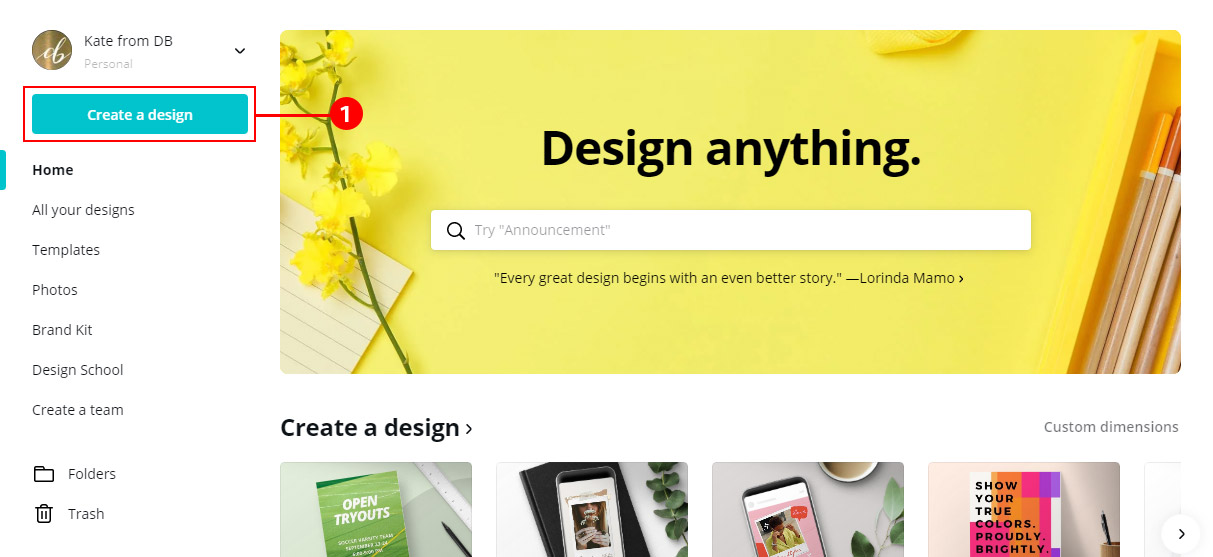
#1 Create a new design

Log in to your Canva account and click on ‘create a design’ on the left.

Create a design in Canva to add a watermark to your photo

Alternatively, you can use the search field in the center of the screen. Both options will show you available project types.

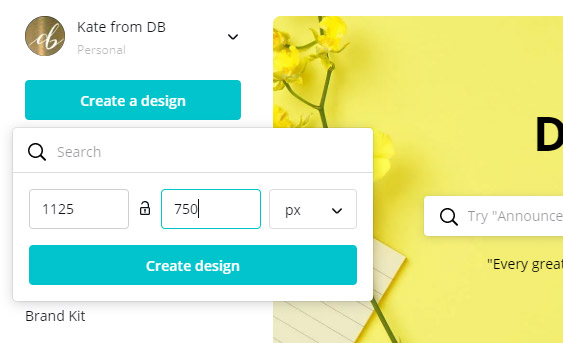
Feel free to pick any size you like. If you just want to add watermark to photo for a blog post, select a custom size image and set it to your photo width and height

Choose your design size in Canva

Remember that with the free version of Canva, you can’t resize an already created project. If you need it to have a different size, you will need to create a new design.


#2 Upload your files

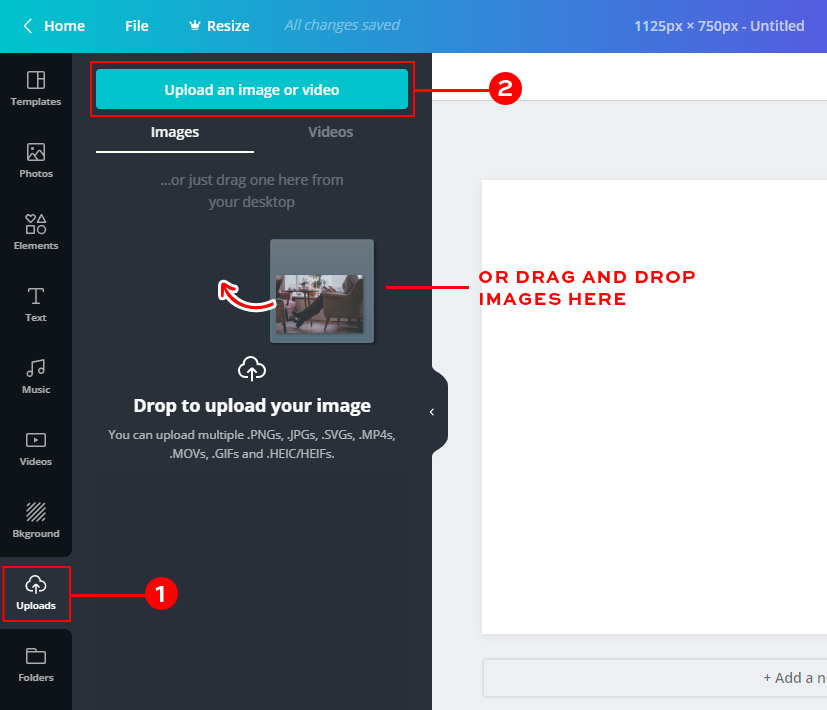
In the new window, go to the ‘Uploads’ tab on the left and add your photos by choosing ‘upload an image or video’ button on the top or by dragging images from your computer directly to the dark area under the button.

Upload a photo to which you want to add a watermark

All uploaded files will be accessible from this place until you remove them. It means that you need to upload your watermark just once, and you can then use it for all your projects.


#3 Add a watermark to your photo

Drag and drop photos from the uploaded files section to the working area on the right.

If you want it to cover the whole area, make sure to drag it to the top before dropping it.

Now add your watermark. You can either click on in on the left upload files area or drag and drop it over your photo. Once added, move it to the desired place


#4 Change opacity

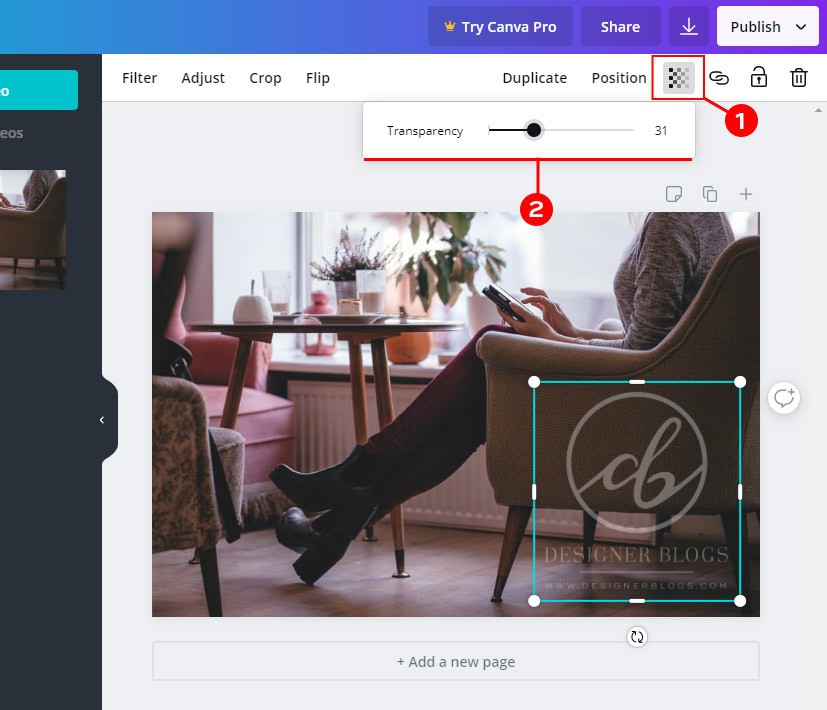
Watermarks are usually half transparent. When we create them for our customers, we save them that way to make the process faster for those who will be using them. If you created your watermark and it isn’t half-transparent, you can play with transparency settings in your Canva panel.

Make sure that your watermark layer is selected and navigate to the transparency button above your editing area.

Change the transparency level

Use the scroll to set the transparency level. On the example above, I have set it to 31, and I think it works perfectly with the photo.


#5 Save your work

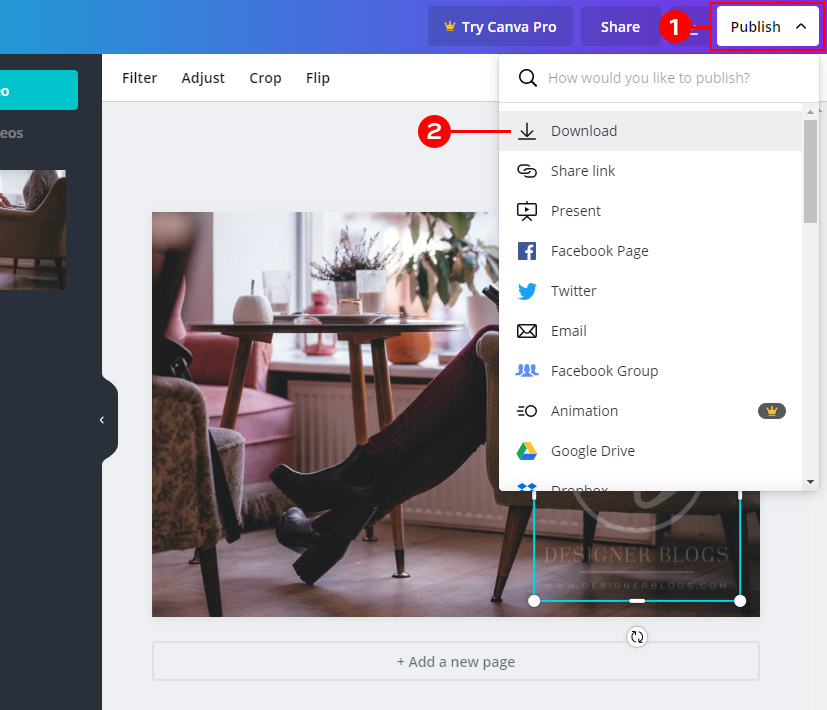
When a watermark is added to the photo, click on the ‘Publish’ button in the top right corner and go for the ‘Download’ option if you do not plan to publish your photo immediately.

Save options avaiable in Canva

Canva will ask you for a few more details, to make sure the file is saved correctly. You can choose between various file formats. If you are working on a photo for your post, use JPG unless you do not care about the file size and want the images to be as good as possible. In that case, go for PNG.

I use JPG for all post photos and PNG for social media.


Here is how the final photo looks like. I have saved it as JPG with default Canva settings:

Finished photo with watermark added in canva

I hope the tutorial was helpful and you learned how to add watermark to photos! If you have any questions, make sure to let me know in the comments below.

How to Create a New Post in Blogger

0
How to Create a New Post in Blogger

Learn how to create a new post in blogger with our super-easy tutorial

The first thing every blogger needs to learn is how to create a post. It is the essential element of your site and will allow you to share content with your readers. In this tutorial, I will show you how to create a post in the blogger.


Adding a post to Blogger blog

Start by logging to your Blogger Dashboard. If you do not have a Blogger blog yet, you can follow this guide to get one.

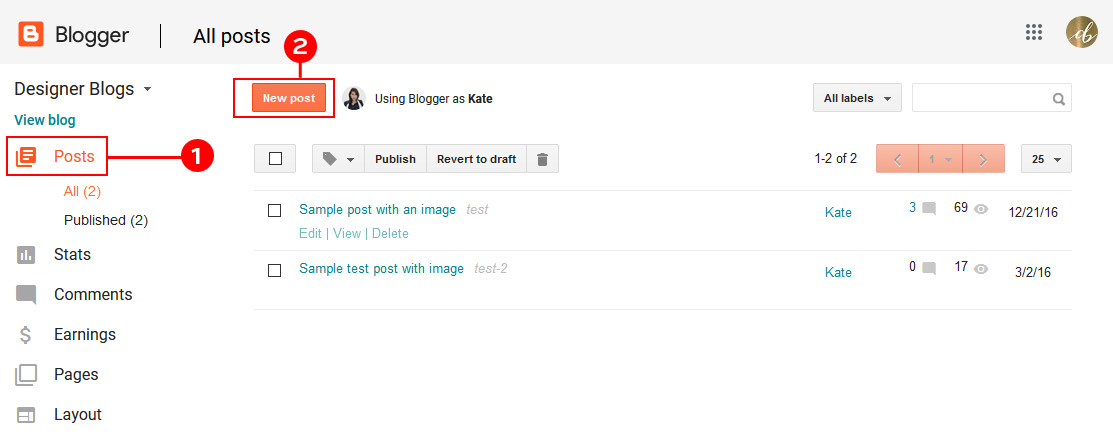
Once in, pick the ‘Posts’ (#1) tab in the left menu and click on the orange ‘New Post’ (#2) button.

Create a post in blogger by using your blogger dashboard

Your post is almost ready!

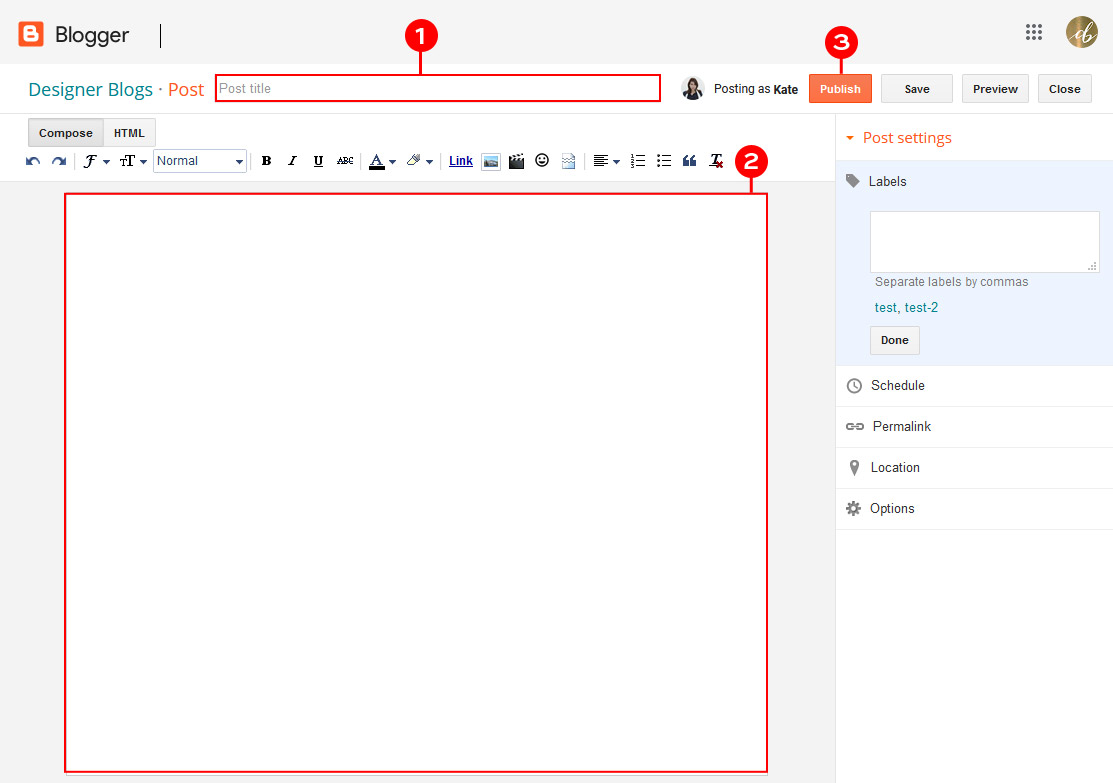
In the new window add a post title (#1), post content (#2) and hit the orange ‘Publish’ button.

Add title and content to your new blogger post

Congratulation! You have now created your first post!


Accessing post options

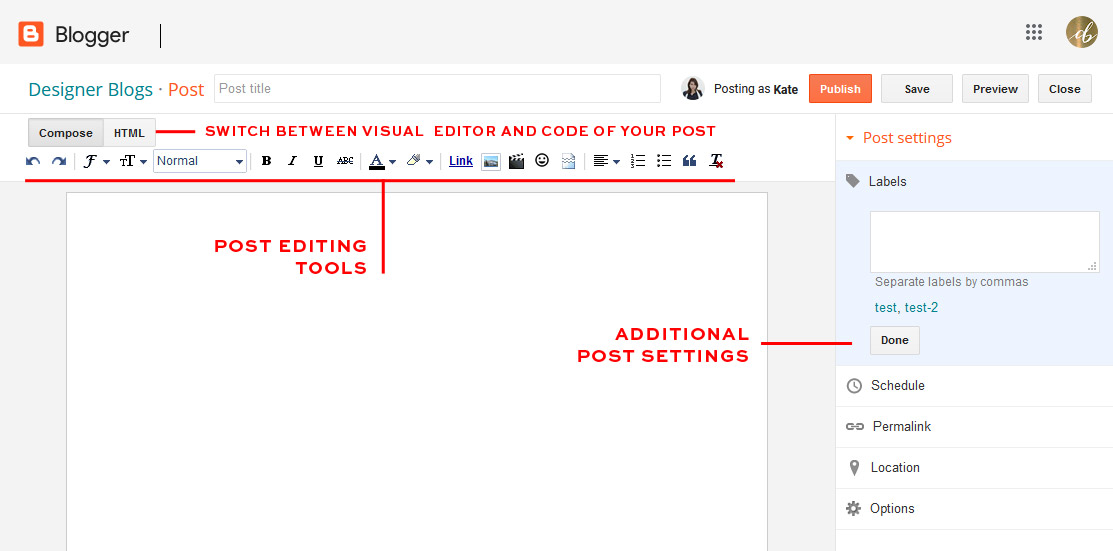
Posts do not need to be simple. You can add images, links, make your text bold, large or in different colors. All those options can be accessed from the menu between post title and content.

Post editing tools in blogger dashboard

Most of these tools are straightforward so I will not list them all here. The only one I would like to highlight is ‘Insert Jump Break’ (6 from the right on the screen above). It will allow you to display post snippets on your blog homepage.

Click here to learn more about creating post excerpts on blogger.

Additional post settings can be located on the right of the post content area.


Compose vs HTML

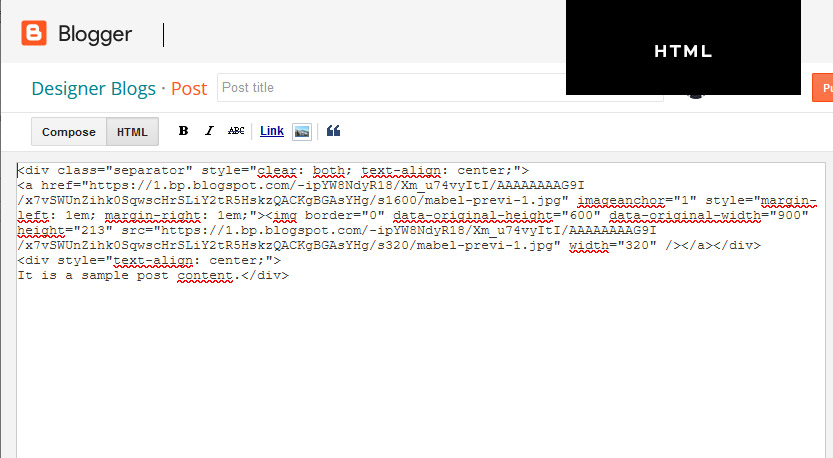
Above the post-editing tools, you may find a switcher between visual and code version of your post. Below you can see the same post visible in those two views: Compose and HTML.

Compose view of blogger post
HTML view of blogger post

As you will notice, post-editing tools are different in both modes.


Create a sticky post in blogger

Posts can be used to create a simple Welcome blurb on your blog homepage. To learn how to set up one visit our tutorial about sticky blogger posts.


I hope that this tutorial was helpful! If you have any questions, make sure to let me know in the comments below.

St Patrick’s Day

0
St Patrick’s Day

Today is St. Patrick’s Day. Although parades around the world have been canceled to help contain the coronavirus outbreak, the holiday can still be enjoyed in a number of other ways.

Do you celebrate St. Patrick’s Day, whether you’re Irish or not? Do you dress in green garb, perform Celtic step dancing or play traditional music with loved ones? Does your family prepare a special feast? What foods do you eat?

What are some of your favorite memories of the holiday?

Tell us in the comments, then read the related article, which features a plethora of Irish recipes.


Find many more ways to use our Picture Prompt feature in this lesson plan. You can find all our Picture Prompts in this column.