The word vacuous has appeared in 22 articles on NYTimes.com in the past year, including on April 5 in “Hudson Yards: A City Within a City” by C. J. Hughes:
Plans for Battery Park City went through multiple iterations. It started with a 1966 “towers in the park” plan for apartment buildings to house World Trade Center employees that Ada Louise Huxtable, the architecture critic for The New York Times, called “sterile high-rise towers in vacuous open space.” The plan estimated about 90,000 residents, a far cry from the 16,000 there today.
The art of paper folding goes back thousands of years in Japan.
In today’s lesson, you will learn more about the history of origami and how it has grown and is flourishing today. In a Going Further activity, you will create your own origami as a holiday gift.
Teachers: Students will need paper and scissors for today’s lesson — as well as access to a computer to follow a short online tutorial. Ideally, students will use 6-by-6-inch square origami paper. However, any kind of notebook or printer paper will do. The tutorial video in the warm-up activity will show students how to fold and cut paper into a square. (You can find more details on using and making origami paper here.)
Warm Up
Have you ever done origami? Have you ever wanted to?
Before reading, take out a piece of paper and take a few minutes to do your best to fold it into an interesting shape or an object — say a box or a cube? Or an animal? Or maybe a star?
How was that? Any luck? Were you able to make something? If you are in a classroom setting, hold up your creation for others to see. What strategies or techniques did you use? Which were most successful?
(Don’t fret if you were not so successful. We are about to provide a little more guidance and support.)
For this second attempt, we recommend using 6-by-6-inch square origami paper. If you don’t have square paper, don’t worry; the video will explain how to use scissors to cut your paper into a square.
Afterward, if doing this activity as a whole class, share your creations and reflect on the process together:
What was hard about making your origami fish?
What was fun?
What strategies and techniques might help you be more successful if you were to make the fish (or another origami creation) again?
Finally, quickly scroll through the images of origami objects featured in the article:
Are you impressed? Do you think you could ever make any of these dazzling paper folding creations?
Questions for Writing and Discussion
Read the article, then answer the following questions:
1. What are the origins of origami? What are some of the essential techniques in origami? Which ones did you use in the warm-up? Which would you like to try next? Which is the most intimidating?
2. How have paper-folding techniques been applied outside the world of origami? Which of thepractical uses described in the article do you find most intriguing or surprising, and why?
3. What are the keys to creative and successful origami making, according to the article? What does the author mean by this statement: “The goal is to arrive at the most efficient and elegant means of achieving a particular effect”?
4. What does Koshiro Hatori, a master folder, mean by the statement: “I feel my works are collaborations between paper and me”? Why is selecting the right paper so important to origami?
5. Why does Toshiko Kobayashi, an art therapist, believe that origami has the ability to heal? Do you think making origami would have a calming or healing presence for you?
6. Look more closely at the photos and select your favorite: Explain why you chose it and what aspects you admire. After reading the article, do you think origami should be more widely appreciated as an art form?
Going Further
The article features many dazzling origami creations. Now it’s your turn: Create an origami object as a gift for the holidays.
Be sure to choose an origami object that is appropriate for your skill level. And keep in mind that, as in all things, practice makes … if not perfect, then better. So you may have to try several times before you get your origami creation just right.
Feel free to get nice origami paper, but remember the admonition from the article to be wary of the fanciest or prettiest paper — it may not fold and hold its shape well. If you don’t have access to specialty paper, here are some more tips on how to make origami paper as well as additional folding techniques.
Lastly, here are a few more keys to success to guide you as you make your origami object:
Often, teachers will write to us about one or two ways they’ve used The Times in their classrooms. But this idea, submitted by Susan Shatford, a library media specialist at Marblehead High School in Marblehead, Mass., is different.
It’s not just one lesson or unit, but a comprehensive overview of how The New York Times is used in almost every facet of her school. She tells us how she and others have integrated The Times into Marblehead’s curriculum, including in core subjects, elective classes and even the principal’s office.
Marblehead High School has been using The New York Times for the past three years in a variety of disciplines. From science and social studies to English and English language learning, The Times is always a heavily utilized resource for our teachers and students.
As a library media specialist, I am fortunate to be able to collaborate with teachers and select resources that support their students’ learning. While state-funded databases have diminished over the years, Marblehead High School has been extremely grateful to have The New York Times as an educational partner. Our school is one of 4,000 public schools that has received a free subscription thanks to The Times’s Sponsor a Student Subscription program.
Here are some of the many ways teachers and students make use of that subscription across our school.
Science: Exploring Recent Developments in Biology
Each year, Brian Heenan and Tom Ericsson invite students in their freshman biology classes to select a research topic from a list of preapproved ones for their modern biology research project. These include subjects like genetically modified organisms, stem cell research, developments in cancer treatments, artificial organs, renewable energy, CRISPR and aging research, among others.
While the school library has books that provide important background information for their projects, students also need to find literature on the most up-to-date and cutting edge breakthroughs. Because fields like stem cell research and genetic engineering are constantly evolving, finding texts that have been published within the past year or two is vital.
To help students find resources like these, I always review the various databases that are available to them, and I show them how to search for their topic on nytimes.com so they can see the wealth of information that’s available.
“You would think that The New York Times has information on political and cultural articles and events,” Mr. Ericsson said, “but it is also an amazing resource for current developments in science.”
Social Studies: Finding Relevant, Reliable and Current Sources for Research Projects
Current Events Articles
Once a week in Stephen Venezia’s civics class, students are asked to bring in a newspaper article on politics, history or news. They write a half-page reflection on the article and then share it in class.
When his students come to the library to print out an article, I familiarize them with The New York Times and show them how easy it is to get quality articles from a highly reputable source. It has become the first stop for many students for current events content.
Recently, I witnessed a senior, Thomas Wheeler, show another student how he used TheTimes to select an article for class. When I asked why he chose the article “American-Born Woman Who Joined ISIS Is Not a Citizen, Judge Rules,” he said, “I wanted something different than the usual politics and it was interesting.”
A U.S. History Research Paper
The juniors in Brian Crowley and Daniel Ritchie’s United States history classes are no strangers to The Times, either. It’s one of their main resources for their end-of-year research papers in which they write about a topic that they covered during the course of the year — anything from the Civil War to the Vietnam War (plus some exceptions for topics of significance from more recent history, like Sept. 11.)
Students have explored such topics as immigration, the United States’ emergence as a world power, the morality of dropping the atomic bomb, and the role of journalism in the Spanish-American War.
A key component of this project is finding relevant, reliable and current sources to support their research. When asked why he recommends The Times for this, Mr. Crowley said, “We always impress upon the students the value of reputable sources and The New York Times is at the top of the list.”
English: Making Text Connections and Improving Writing With Learning Network Contests
Student Contests and Mentor Texts
Jenn Billings has embraced teaching with The Times by encouraging her students to enter the many contests on The Learning Network. Virtually every one of her students has entered one, and three have been selected as finalists: Grace MacLean was awarded an honorable mention in the 2018 Student Review Contest for her piece “Riverdale: Exquisite Garbage”; Annie Sheridan was a runner-up in the 2019 Connections Contest for her piece comparing “Frankenstein” to an article about mental health care; and, this year, Lucas Koughan’s photo was a runner-up in the “Show Us Your Generation” Photo Contest.
Now, the word is out and students are eager to enter, win and get their work published. (Plus, they know if their piece is selected, Ms. Billings will immediately replace their prior grade with a perfect score.)
“I think it is a good opportunity to connect to the outside world, outside of Marblehead,” Freya Corelle, a junior, said about entering the contests. “It feels rewarding to enter a contest. Knowing millions of people read The Times every day, I want to make sure my writing is authentic in terms of my opinions and my morals.”
And when I asked Grace MacLean, who received an honorable mention for her review of the TV show “Riverdale,” why she wrote her piece, she said, “I liked doing it because it wasn’t something I did for a grade. It was for fun so it came more naturally.”
Ms. Billings’s students aren’t the only ones who have been inspired. Earlier this year, editorials written by her former students for The Learning Network’s Student Editorial Contest were featured in our local paper in a multipart editorial series called “Marblehead High School Students Speak Their Minds.”
“The beauty of the assignment is that the students got to focus on what they were interested in learning more about,” Ms. Billings is quoted saying in the piece.
This year, Ms. Billings is using The Learning Network’s new Mentor Text series to teach writing in preparation for these contests. On a recent visit to her 11th-grade class, she was using two of those texts, “The Iguana in the Bathtub” by Anne Doten and “How Ramen Got Me Through Adolescence” by Veronique Greenwood, to introduce personal narratives to the class. Her students looked through each text to find words and phrases that the authors used well to evoke feelings and develop their characters. This whole class activity was helpful since students were working on writing personal narratives of their own to submit to The Learning Network’s Personal Narrative Essay Contest.
Connecting Novels to the News
Alisha Dolan uses The Times with her 11th-grade classes during their study of “The Crucible.” As they read, Ms. Dolan invites students to relate the novel to current events by having them find articles in The New York Times that explore similar figures, themes and events.
Students have connected the hysteria during the Salem witch trials to President Trump’s reaction to the Mueller report. They’ve also compared how immigrants were treated during the Red Scare to how they are treated in the United States today. They’ve even related the way Senator Joseph McCarthy discredited the media in the 1950s to the way Mr. Trump has tried to do so.
For fun, she’s had her classes enter The Learning Network’s annual Connections Contest, which invites students to link something they’re studying in school with the world today. When I asked why she likes using this contest, Ms. Dolan said it “is exactly what we do as part of English. Making relevant connections to ‘The Crucible’ and the world around us makes something written in the 1950s, now 2019.”
Thomas Higgins uses The Times to help students build background knowledge before they read “Of Mice and Men.” In a “mini-research project” they learn what life was like for different groups of people during the 1930s by researching topics like the plight of migrant workers, the treatment of the developmentally disabled, the Great Depression and the American dream.
Then, because Mr. Higgins wants to show his students how these topics relate to modern society, they read articles from The Times that touch on the issues migrant farm workers and those with developmental disabilities face today. Being able to make these modern connections has been invaluable to his students.
In her classes’ study of the novel, Ashley Skeffington makes a different use of The Times: She has her students read the 2010 Opinion piece “Friendship in an Age of Economics.” Then, students discuss how it relates to George and Lennie’s relationship.
The Freshman Research Paper
The research paper is a key part of the freshman English curriculum. A few years ago, the teacher Anna Buono developed a research project around Mary Shelley’s “Frankenstein.” Once again, The Times is a very important resource for students seeking well-vetted background on the book and information on the evolution of the “monster.”
For example, in the library guide I created for students to use along with this project, I include two Times articles: “Frankenstein at 200,” a 2018 piece by Jennifer Schuessler that provides a comprehensive overview of the seemingly endless stream of adaptations of Shelley’s story, and “The Microbots Are on Their Way,” a 2019 article from the Science section related to bioethics and medicine. It begins:
Like Frankenstein, Marc Miskin’s robots initially lie motionless. Then their limbs jerk to life.
But these robots are the size of a speck of dust. Thousands fit side-by-side on a single silicon wafer similar to those used for computer chips, and, like Frankenstein coming to life, they pull themselves free and start crawling.
Service Learning: Building Action Plans Based on Times Texts
In addition to her English classes, Ms. Billings co-teaches a newly created service learning course with a social studies teacher, Lindsay Bachman. They’ve built their curriculum around several New York Times texts.
One of the focal issues they explore is poverty. Their students read texts like Matthew Desmond’s book “Evicted: Poverty and Profit in the American City” and Stephanie Land’s 2019 New York Times Op-Ed “The Housecleaning Job That Saved My Life.” Students explore the texts in groups to glean a better understanding of the causes and effects of poverty and determine ways to alleviate it.
When I visited their class, students were reading New York Times articles to come up with potential action steps they could take to address poverty on a local level. Ms. Bachman had asked the class to come up with three solutions and an unintended consequence those might have. Each student then had to find two sources that supported their solution and one that went against it.
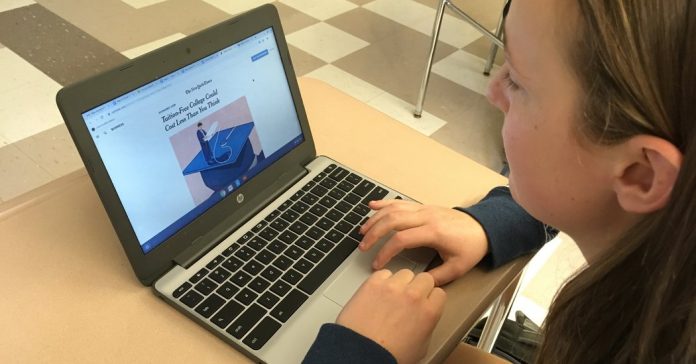
One student, Katherine Simcoe, chose to use the article “Tuition-Free College Could Cost Less Than You Think” by David Deming to support her position. She told me, “By getting a reduced-cost education, college students, especially those from low-income families, can help reduce their debt and decrease those living in the poverty cycle.”
At the end of the unit, Ms. Bachman and Ms. Billings had their students write a letter to a local official advocating for the implementation of an action step they had identified. A few of them even received responses.
English Language Learning: Using Images to Spark Writing and Discussion
Pictures can be great writing starters for English language learners, according to the English language education teacher Catherine Whyte. Inviting students to write about or discuss an image from The Learning Network’s Picture Prompts feature is a common way for Ms. Whyte to begin her classes. She says it’s been a great practice to get students sharing their perspectives, looking at details, and articulating what they want to convey.
She’s also used these images as starting points for narrative essays. This year, she had students respond to images from The Learning Network’s “550 Prompts for Narrative and Personal Writing” to build a collection of stories that they can further develop into personal narratives. The image above, from “Are You a Sneaker Head?,” was one such picture.
The writing prompts also make a great jumping off point for mini-lessons on text organization, nonfiction text features and analytical thinking strategies. Students and teacher read the pieces together to talk about structure and features of reported information and important facts. Ms. Whyte feels The New York Times is a way for her to bring in current events, personal stories, experiences and background knowledge when teaching students how to write personal narratives.
Health and Wellness: Discussing Real-World Problems to Make Healthy Choices
While CarlaCefalo teaches the standard health curriculum — touching on topics like healthy relationships, opioid use, vaping, depression, eating disorders and public health — social and emotional wellness has also become a key component of her class.
Recently, she used the Learning Network writing prompt “Why Do Bystanders Sometimes Fail to Help When They See Someone in Danger?” in relation to talking about relationships, CPR, bullying and vandalism. Students first read an excerpt from an article about a teenager who was killed in a fight while others stood by and recorded his suffering on their phones. Then, they chose three of the prompt’s questions to which to respond.
This elicited an engaging and varied class discussion: One student shared a situation in which she had witnessed domestic abuse; another talked about how video gaming has desensitized students toward violence.
Articles like this one get students talking about real-world examples of social and emotional issues and act as wonderful supplemental materials to Ms. Cefalo’s curriculum. In fact, she plans to turn several other writing prompts from The Learning Network into core talking points for her class, including:
Administration: Spreading Awareness About Issues That Affect Teenagers
Long before Gov. Charlie Baker signed legislation to restrict vaping products in the state of Massachusetts, Marblehead High School’s wellness department, health department, counselors and administration sought out ways to inform students and the high school community of the dangers and signs of vaping.
When I saw the article “The Mysterious Vaping Illness That’s ‘Becoming an Epidemic’” this summer in The Times, I knew it would be a valuable resource for our community. I sent it to Ms. Cefalo, a wellness teacher who addresses this issue in her curriculum, and Gina Hart, a counselor who provides resources to the school community.
Then, at the beginning of the school year, our principal, Dan Bauer, included this article in an email on vaping that he sent out to the Marblehead community. With e-cigarette use escalating and the Food and Drug Administration moving to further regulate them, he wanted to share some educational information with students, parents and staff.
Knowing my principal shared this resource from The New York Times with the Marblehead High School community showed me how valued The Times is not only by teachers and students, but by the administration as well.
As a school library media specialist, it is my job to find well-vetted sources to show students that there are alternatives to just searching Google for an answer. While they may get many hits from a Google search, they will not find the wealth of reputable information on their topic that they could discover with one search on nytimes.com.
I want to personally thank The New York Times for its commitment to education and for partnering our school with its generous sponsorship program.
Whether you’re young, old, or somewhere in-between, aged care is likely to have touched a part of your life. You may have visited a grandparent living in an aged care facility, or perhaps a parent. But have you ever stopped to think about the level of care being given in these facilities? The Royal Commission into Aged Care Quality and Safety has. And their findings are changing the industry.
As the places we entrust with our loved ones’ livelihood, aged care facilities are so much more than quiet rooms where the elderly can rest.
They’re the places that keep the senior members of our society happy, healthy and out of pain where possible.
But sadly, recent findings from the Royal Commission have found that, in many cases, these needs are not being met.
The findings of the Royal Commission
The Royal Commission is an investigation following more than 5,000 complaints from aged care consumers, families, carers, aged care workers, health professionals and providers. These reveal a number of areas which are lacking in the field.
From one man being told by aged care staff that his heart attack pain was “all in his head”, to a woman acquiring a life-threatening pressure wound while in care, aged care facilities are coming under fire in a series of testimonials.
A movement for improved care
While the findings of the Royal Commission are shocking, there is a silver lining. With aged care under greater scrutiny than ever before, there’s a new push for qualified, inspired aged care workers to step into the field.
With this, a new range of courses have been created by leading Asutralian universities – inspiring the next wave of carers to transform aged care.
The best part? Some of these courses are available through Open Universities Australia (OUA), meaning that you can become part of the aged care revolution – studying online, when and where it suits you.
Introducing the Bachelor of Ageing and Dementia Studies
Throughout the course, students come to understand the social and health challenges associated with ageing – so that they can take a more holistic approach to care.
More widely, the degree covers care navigation, policy, research, governance, safety, quality, leadership and innovation – creating graduates who go above and beyond the findings of the Royal Commission, so that we can create safer environments for our elderly loved ones.
Consider yourself someone who could steer aged care in the right direction? Love the thought of impacting the elderly in a positive way? You might just make a nurturing aged care worker.
By Jennifer Wolochow, Senior Product Manager at Coursera
Coursera is committed to helping our 200+ university and industry partners create transformational learning experiences. Authoring and managing courses is a vital aspect to our platform, and the tools to do so are used by thousands of partners on a weekly, if not daily, basis. That’s why we’re excited to announce redesigned course authoring and admin tools.
After extensive research and a beta program with over 60 partners, where nearly all partner participants preferred the new tools to the old ones, we’re introducing a revamped admin and authoring experience for all partners. With the redesigned tools, course creation and management happens seamlessly for even the largest of course staff teams, decreasing turnaround time and leading to even more top-quality content.
Here’s how the redesigned tools work:
After logging in, you’ll notice that the coursera.org/admin page looks the same, displaying a list of your institution’s courses that you have permission to view. Click on a course to edit or view.
From here, you’ll see the redesigned course overview page, which applies to the course as a whole. This is where you can edit the landing page, general course settings, add course staff, view course dashboards, and send course announcements. All instances of your course are clearly listed on the new course overview page, making it simpler to choose which one you’d like to edit. This set-up also makes it easier to manage both public and private instances within a single course shell.
Once you choose an instance-specific course page (for example, “Private: Spring 2019”) to edit, you’ll see all of the course instance-specific Content, Grading, Learner, and Settings pages. We’ve replaced the old dropdown menus with a clear header at the top of each instance page confirming which course version or group you’re currently editing. We’ve also introduced navigation “breadcrumb trails” that act as a convenient signposting tool at the top of each page.
Pro tip: to easily distinguish between the different public versions of your course within the course overview page, we’ve made it easy for you to rename them on this page. Click the “…” menu next to any instance of your course to rename the version or group.
For many like Mr. Miller, it’s the convivial, laid back atmosphere that makes the New Jersey beach experience preferable to that of, say, the East End.
“I feel like in the Hamptons, you’re either at a pool party or you’re sort of secluded, but on the Jersey Shore, you have the boardwalks,” Mr. Miller said. “So everybody comes to the boardwalk at night to go to the restaurants and shops and hear music; everyone’s convening together.”
In this lesson, you will read Maggie Astor’s article, “She’s 16 and Wants to Be President: Meet the Teenagers Planning Their Campaigns,” and get a glimpse into the Young Women Run Columbus conference. Then, you will get to think about your own political beliefs and activism and, if you choose, share your ideas more widely with The Times.
Warm Up
Would you consider yourself to be politically active? Are you involved in student government, debate team or student activism groups? Do you think it is important for young people to be aware of what is happening in politics locally and across the country?
Watch the above video created by Ignite, a group dedicated to getting young women involved in politics. Then respond to these questions:
What is your reaction to watching the video?
Have you ever thought about running for office in your state or nationally?
Do you connect with any of the issues that the women in the video addressed? Are there other issue that you think are important where you live or in the country?
Questions for Writing and Discussion
Read the article, then answer the following questions:
1. Why does Haley Zaker, a high school senior in Lancaster, Ohio, hope she is not the first woman president? What does this tell you about the goals of Ignite and the larger movement of women running for office?
2. The article states, “If women’s representation in American government kept increasing at the rate it has over the past decade, it would take more than 100 years to reach gender parity.” How is Ignite trying to expedite this process?
3. What were some of the sessions held at the Young Women Run Columbus conference? How did participating in the conference affect Kira Jones, a first-year student at Ohio State?
4. What are some possible reasons that Ignite has struggled to recruit more Republican women?
5. How did young people like Ms. Zaker, Abby Cumming-Vukovic and Sydnee Brown become active in politics?
6. Ms. Astor writes that Generation Z “has grown up under multiple existential threats” and that could be a reason they are more politically active than previous generations. Do you agree with this conclusion? Can you think of other reasons young people in Generation Z are politically active?
Going Further
What is your reaction to reading this article? Is there anything that you found inspirational or motivational in what the teenagers shared? Does it make you want to run for office when you are old enough? Or, does it pique your interest in becoming more politically active in other ways? Why or why not?
The article focuses on racial and gender representation in political office. Is this something you see reflected in any of your state and local governments? How important is the diversity of elected officials to you?
You can share your responses in the comments. And, if you’re open to having a wider audience and you were born between Jan. 1, 1997 and Nov. 3, 2002, you can fill out The Times survey below. The Times wants to hear from young people in Generation Z to learn more about your political opinions and involvement.
The weird outsider became a popular girl in 2019. The songs of Billie Eilish, 17, are death-haunted and depressive, by turns arrogant and anxious, mocking and desperate. Yet they became mass singalongs, aided by Eilish’s busily maintained, anti-fashion social media presence. Eilish’s sound understands how adolescence can feel like a horror movie: the constantly looming suspense, the way the ordinary is suddenly pierced by the ghastly or the absurd. Her music often whispers, but it’s hardly soothing. Quiet moments are shattered by creepy sound effects or loud intrusions, while her breathy vocals — hushed enough for A.S.M.R. — often carry bitter thoughts. The show-tune shapeliness of her melodies is often a sardonic frame for grim sentiments, to be faced with a ballooning bass line and a self-conscious smirk.
And here are two of the top picks of the Times critic-at-large Wesley Morris, who wrote “The Best Performances of 2019”:
Officially, what Ohashi did with her perfect-10 floor exercise at a college gymnastics meet in January was a solo routine. But somebody made a video of her slingshot leaps and Velcro-tight landings, and in it, you can see her daggone teammates not just cheering her on, but eventually moving with her in synchronicity to choice bits of songs like “Proud Mary” and “September.” They don’t just have the usual tumblers’ spunk. They’ve got rhythm and timing and great taste for that floor-exercise soundtrack.
It’s true that Jerome is around for the first three parts of this mini-series about the so-called Central Park Five, but the final installment focuses on the incarceration of Korey Wise, and Jerome and his full, searching eyes change the meaning of the dutiful, scrupulously moral thing we’d been watching. He gives the existential terror some rage and physical imagination and, most impossibly, these glimmers of wonder.
Students: Scan some of the sources of inspiration we’ve included above. Then tell us …
— If you were making your own 2019 Top 10 list, what would be on it?
— What were the best things about 2019 for you? What world, national or local events did you enjoy? What breakthroughs in science or technology excited you? What would be your headline for the year?
— What were the worst things about 2019? What happened in the news that would make the list? What annoyed you about pop culture or sports?
— What happened in your own life this year that was wonderful? In what personal ways will you be sad to see 2019 go? What aspects of your personal, family or school life will you be happy to leave behind?
Students 13 and older are invited to comment. All comments are moderated by the Learning Network staff, but please keep in mind that once your comment is accepted, it will be made public.
By Leah Belsky, Chief Enterprise Officer, Coursera
It has been an unstoppable year for Coursera for Business. Technology and globalization are rapidly advancing and companies can no longer afford to let talent fend for itself in a changing economy. 79 percent of CEOs today see skill shortages as a growth threat, meaning skills transformation is and will continue to be imperative.
Increased adoption of our enterprise platform is closely linked to the urgent pace at which companies need to acquire the skills of the future. Last week, we announced a series of new enterprise customers: Large organizations including Mastercard, Southwest Airlines, Adobe, and the NYC Department of Small Business Services initiated or continued partnerships with Coursera for Business this past year.
These relationships led to 100 percent customer growth year-over-year in North America, driving accelerated momentum of our enterprise business. As a result of this demand, we also opened two new offices dedicated to enterprise in New York and Toronto.
We also continued to advance the enterprise learning experience in 2019 with Coursera Labs, offering hands-on experiences using popular workplace tools and almost any native desktop application to ensure that technical skills learned are easily applied on the job.
All must take action to compete in the changing economy and Coursera is best equipped to help companies do so. We deliver the high-quality content and applied learning needed to drive data literacy among employees and in turn, accelerate digital transformation. We are thrilled to have a diverse network 2,000 companies and governments worldwide relying on us to drive skills transformation, and we embrace the opportunity to further their success in 2020.
For more information about the Coursera for Business offering, visit coursera.org/business.
Coursera for Business provides a world-class learning platform for companies that need to upskill, reskill, and deepskill their talent. With topics ranging from digital transformation and data science to software development and leadership, over 2,000 companies trust the Coursera for Business enterprise platform to transform their talent.
When you study through Open Universities Australia (OUA), it’s so much more than an online experience. As shown at the Macquarie University graduation this year, students have the option to attend their graduation. Gown, mortar board and all.
So, what did our proud students have to say on their big day? We attended their graduation to find out.
Having completed her degree online through OUA, Jodi-Maree wanted to make sure she had a “real life” graduation experience.
For her, it was about seeing years of hard work come to life.
“I’m really pleased that I attended. It makes it feel a bit real.”
About Macquarie University
This research-intensive university in north-western Sydney offers a range of undergraduate and postgraduate degrees. With over 30,000 current students, Macquarie has a strong reputation for welcoming international students and embracing flexible and convenient study options, including its partnership with OUA.