




When is Retrieval Practice Most Efficient?
Participants spent less time doing their practice tests when they were multiple choice than when they were short answer, and because performance was about the same, multiple choice self-testing was shown to be the better choice when participant-controlled. But again, participants didn’t score as high when they dropped items after getting them right. On average,…

GUEST POST: A Student’s Lived Experience Account of Neurodiversity in Higher Education
References:(1) Syharat, C. M, Hain, A., Zaghi, A. E., Gabriel, R., & Berdanier, C.G.P. (2023). Experiences of neurodivergent students in graduate STEM programs. Frontiers in Psychology, 14. https://doi.org/10.3389/fpsyg.2023.1149068 (2) Pesonen, H. V., Nieminen, J. H., Vincent, J., Waltz, M., Lahdelma, M., Syurina, E. V., & Fabri, M. (2020). A socio-political approach on autistic students’ sense…

Spaced Practice and Working Memory
If you need another reason to love spaced practice, Ouhao Chen and colleagues (1) provide yet another one. They conducted two experiments to investigate the relationship between spaced practice and working memory depletion. First, I’ll provide a primer on working memory and resource depletion, and then I’ll describe the experiments and results.Working memory is the…

The Potential Harm of Learning Styles
By Carolina Kuepper-TetzelWe have discussed the learning styles myth in different blog posts and you can find all of our posts in this topic here. Briefly, the idea of learning styles is that if you assess the learning styles in students and then match instruction accordingly to their self-reported learning style, their performance will be…

Interleaving Improves Learning for All Learners
References:(1) Taylor, K., & Rohrer, D. (2010). The effect of interleaving practice. Applied Cognitive Psychology, 24, 837-848. https://doi.org/10.1002/acp.1598(2) Rohrer, D., Dedrick, R. F., & Burgess, K. (2014). The benefit of interleaved mathematics practice is not limited to superficially similar kinds of problems. Psychonomic Bulletin & Review, 21, 1323-1330. https://doi.org/10.3758/s13423-014-0588-3(3) Kornell, N., & Bjork, R. A.…

Digest #172: Mnemonic Devices
By Carolina Kuepper-TetzelOur memory capabilities are fascinating and with some tricks we can expand our memory performance quite significantly. These tricks are called mnemonic devices. Mnemonic devices let us organize, elaborate, and visualize information so that we can retrieve that information easier in the future. Mnemonic devices are best applied to learning lists of concepts…

GUEST POST: Leveraging AI in a Research-Driven Way: Augmenting feedback during spaced retrieval practice...
If you use edtech in your classroom, you’ve probably seen at least one of the tools you use recently advertise their brand new “AI feature.” At Podsie, the core of what we’re building has always been research-driven, so as the AI hype rages on, we’ve been asking ourselves, “How can we leverage the recent advances in…

When Restudying Trumps Retrieval
by Cindy Nebel(Cover image from Pixabay by squarefrog.)We have so many blogs about retrieval practice. In fact, it is the most common tag we use on our blog. If you’re new to this conversation, you can find some summary information about the benefits of retrieval practice here and some additional resources here. In short, there…

Digest #171: Resources for Calendars and Scheduling
By Althea Need Kaminske(cover image by MabelAmber on Pixabay)Time management can be a challenge for learners at all levels. Generally, the farther along you are in your educational journey, the less your time is managed for you. You are given more independence and autonomy to set your own priorities and manage your own time -…
Pitting Learning Styles Against Dual Coding
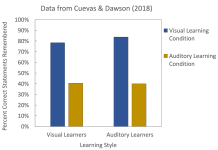
By Megan SumerackiWhen creating content and materials for the Learning Scientists website, we try to include many different types of forms (NOT because of Learning Styles, but because of preferences, and diversity in the type of media an individual can consume!). To that end, I’ve created blog versions of some bite-size research podcast episodes in…
